CBSE Class 7 — Notes, Chapters & Practice Quizzes
Every Class 7 chapter, made friendly — notes with pictures, key words, and a quiz for each chapter.
10 questions · instant score · weak-chapter diagnosis
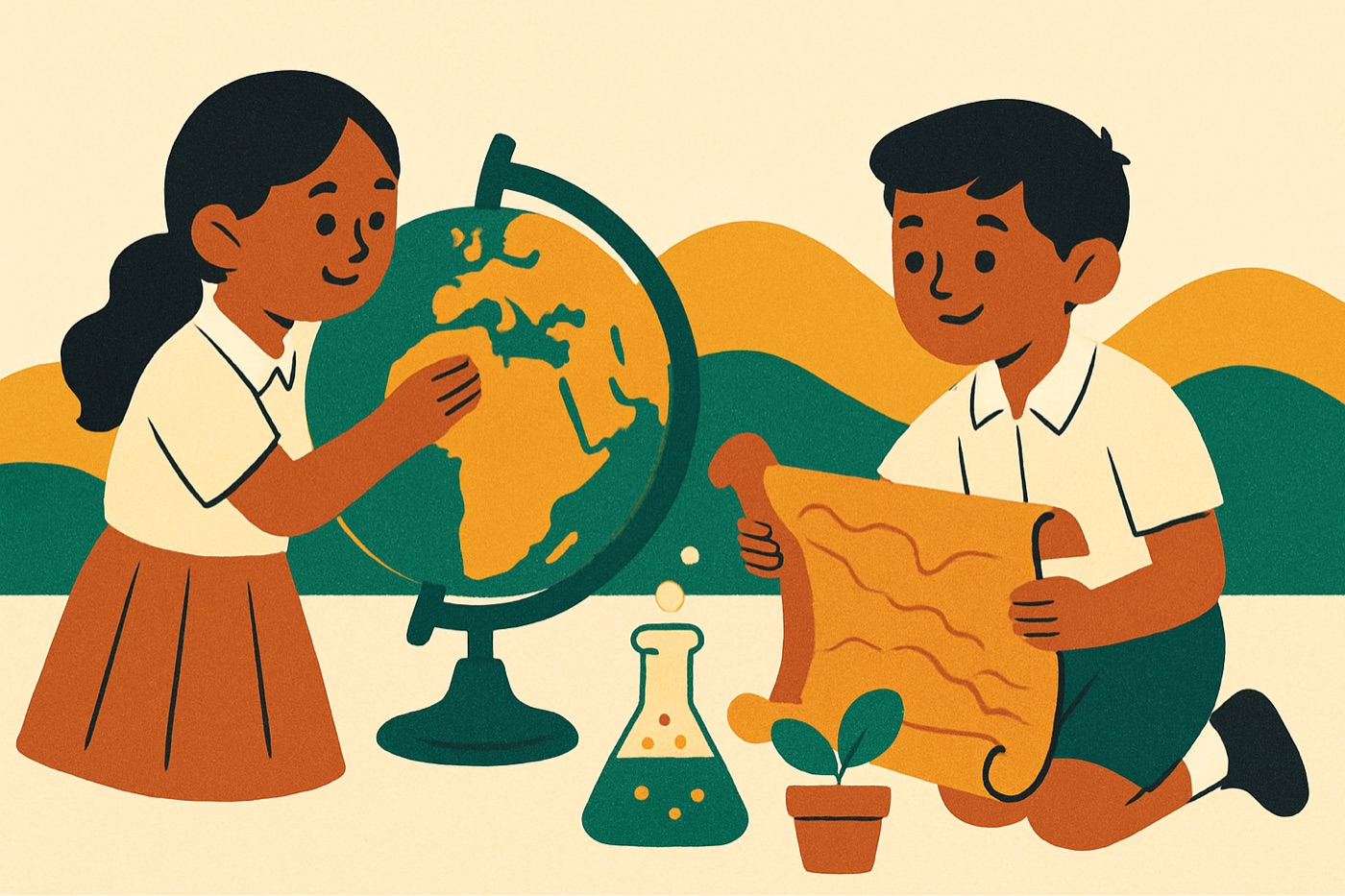
Students preparing for CBSE Class 7 Annual Assessment
View all



Chapter 1: The Ever-Evolving World of ScienceClass 7 Science — summary, notes, extra questions & NCERT solutions
Summary
This opening chapter welcomes Grade 7 learners back to the adventure of science begun in Grade 6, presenting science not as a set of fixed facts but as an ever-evolving process of asking questions, performing experiments, and exploring the world. It reminds students that the world of science spans the very small and the very large, the near and the far — from tiny cells inside a leaf to the movement of the Sun and stars. The playful page numbers, following a butterfly and a paper plane, are used as a metaphor: just as a simple paper plane once inspired real studies of flight, curiosity makes learning take flight. The chapter then previews the year ahead, touching on the properties of materials, why some fruits are sour, electricity and the materials needed to make a lamp glow, metals and non-metals, reversible and irreversible changes, the flow of heat, the water cycle, growth and change during adolescence, life processes in animals and plants, the measurement of time and speed, light and shadows, eclipses, and the motions of the Earth and Moon. A central message is that the different fields of science — physics, chemistry, biology, and earth science — are deeply interconnected, and that discovery comes hand in hand with responsibility for the environment and society. Activity 1.1, "Question the Answer," encourages students to invent imaginative questions for given answers, training them to think like scientists who ask amazing questions, not just answer them.
Key terms
Extra questions & answers
Activity 1.1: Question the Answer
Explore interactively
Keyboard: ← → to move · Space to flip
Practice quiz · The Ever-Evolving World of Science
Score on this chapter, climb the leaderboard, and get an AI diagnosis of your mistakes.
Dual AI-verified questions Real exam pattern 1 free quiz every month, then ₹9 per quiz — or a monthly plan
The Ever-Evolving World of Science
Start hereInstant score, answer review and weak-topic diagnosis