Wave Optics
Class 12 Physics · Physics Part II · Chapter 2
173 members in the CBSE community
View all







CBSE Class 12 · PhysicsTrending
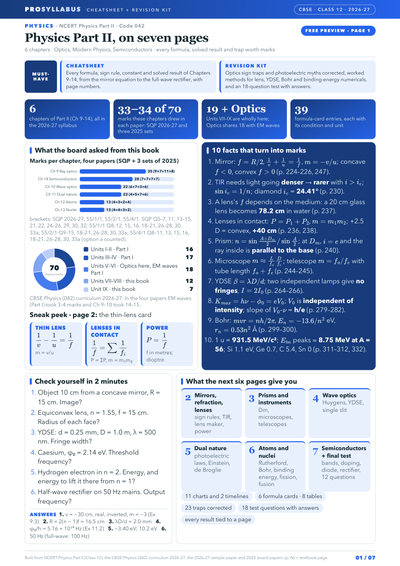
Ray Optics: 35 marks across four papers- Marks booster + cheatsheet: key concepts in 2 lines each, common traps
- 22 marks across four papers: Wave Optics
- 22 marks: Dual Nature, with 4-mark cases
- Common traps that cost marks, listed
- 13 marks each: Atoms and Nuclei
- 7 marks in all four papers: Semiconductors
CBSE Class 12 · Physics
Capacitance: 32 marks in 4 papers, most asked- Marks booster + cheatsheet: key concepts in 2 lines each
- 34 marks in 4 papers: Magnetism, Ch 4–5
- 33 marks in 4 papers: Induction and AC
- 26 marks in 4 papers: Current Electricity
- Every formula with its page number
- What each 2025 board paper asked
Summary
Wave optics explains phenomena that ray optics cannot, by treating light as a wave. Huygens' principle, in which every point on a wavefront is a source of secondary wavelets, derives the laws of reflection and refraction. When two coherent waves overlap they interfere; Young's double-slit experiment produces alternating bright and dark fringes of spacing \(\beta=\dfrac{\lambda D}{d}\), bright where the path difference is an integral multiple of \(\lambda\) and dark where it is an odd multiple of \(\lambda/2\). Coherence—a constant phase relationship—is essential for stable fringes. Diffraction, the bending of light around obstacles and slits, gives a central bright maximum flanked by weaker minima, with the first minimum at \(a\sin\theta=\lambda\); this sets the ultimate resolution limit of optical instruments. Polarisation reveals the transverse nature of light: unpolarised light becomes plane-polarised on passing through a Polaroid, obeying Malus' law \(I=I_0\cos^2\theta\), and on reflection at Brewster's angle \(\tan i_B=n\). Together these effects confirm light's wave character and underpin modern optical technology.