Moving Charges and Magnetism
Class 12 Physics · Physics Part I · Chapter 4
173 members in the CBSE community
View all









CBSE Class 12 · Physics
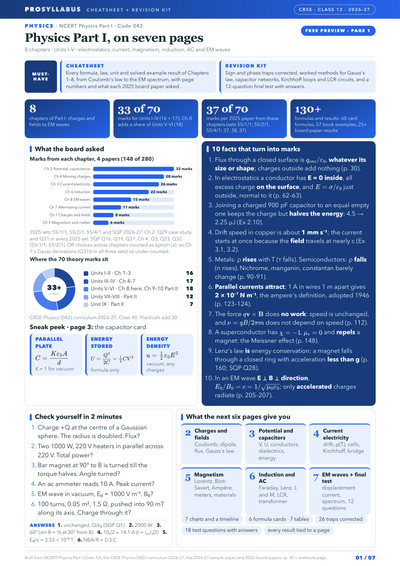
Capacitance: 32 marks in 4 papers, most asked- Marks booster + cheatsheet: key concepts in 2 lines each
- 34 marks in 4 papers: Magnetism, Ch 4–5
- 33 marks in 4 papers: Induction and AC
- 26 marks in 4 papers: Current Electricity
- Every formula with its page number
- What each 2025 board paper asked
CBSE Class 12 · PhysicsTrending
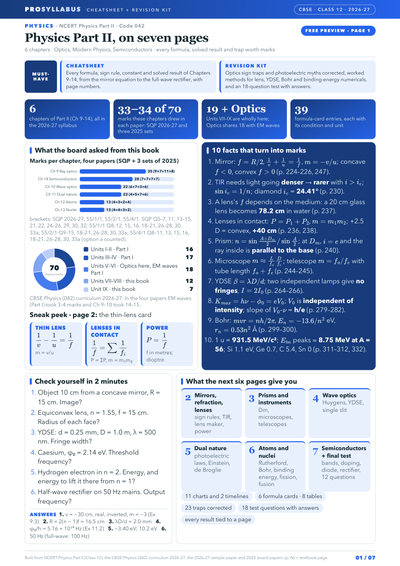
Ray Optics: 35 marks across four papers- Marks booster + cheatsheet: key concepts in 2 lines each, common traps
- 22 marks across four papers: Wave Optics
- 22 marks: Dual Nature, with 4-mark cases
- Common traps that cost marks, listed
- 13 marks each: Atoms and Nuclei
- 7 marks in all four papers: Semiconductors
Summary
A moving charge experiences a magnetic force \(\vec{F}=q\vec{v}\times\vec{B}\), perpendicular to both velocity and field, doing no work and causing circular or helical motion. Combined with the electric force it gives the Lorentz force \(\vec{F}=q(\vec{E}+\vec{v}\times\vec{B})\). The Biot-Savart law gives the field of a current element, \(d\vec{B}=\dfrac{\mu_0}{4\pi}\dfrac{I\,d\vec{l}\times\hat{r}}{r^2}\), from which the field of a circular loop and a straight wire follow. Ampere's circuital law, \(\oint\vec{B}\cdot d\vec{l}=\mu_0 I_{enc}\), elegantly yields the field of a long solenoid \(B=\mu_0 nI\) and a toroid. A current-carrying conductor in a field feels \(\vec{F}=I\vec{l}\times\vec{B}\), and two parallel currents attract or repel, defining the ampere. A current loop behaves as a magnetic dipole with moment \(\vec{m}=I\vec{A}\), experiencing torque \(\vec{\tau}=\vec{m}\times\vec{B}\)—the principle of the moving-coil galvanometer. With suitable shunt or series resistance, a galvanometer is converted into an ammeter or voltmeter.