CAT
CAT

CAT — Syllabus & notes

  • Marks booster + cheatsheet: most-asked concepts in 2 lines each
  • 15 traps CAT has tested
  • Quant formulas, unit by unit, worked examples
  • DILR set types, each with its method
  • VARC question types, each with its method
  • The +3/−1 scoring maths, worked
Page 1 free about 8 min read, Full kit about 55 min read

Syllabus and study notes

Revision & Exam Traps· 15 formulae · 10 traps
Percentages
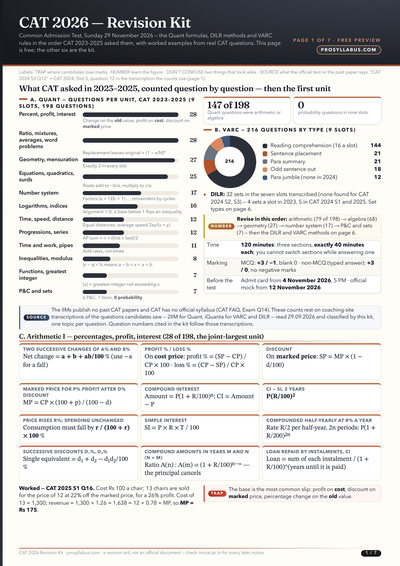
Successive % changes never just add. A +20% then -20% leaves you at 96%, not 100% — apply them one after the other.
Profit & Loss
Profit % is on COST price unless stated otherwise; discount % is on MARKED price. Mixing the bases is the classic loss-of-marks.
Successive discount
Simple Interest
Compound Interest
Time, Speed & Distance
Average speed over equal distances is the harmonic mean 2v1v2/(v1+v2), NOT the simple average (v1+v2)/2.
Average speed
Time & Work
In time-and-work, add the RATES (1/a + 1/b), never the days. Adding times is wrong.
Averages
Permutations
Combinations
Probability
Progressions
Boats & Streams
Alligation
Interest
CI and SI are equal only for the first year. From year 2 onwards CI > SI — never reuse the SI figure.
Speed units
Convert km/h to m/s by multiplying 5/18 (not 18/5). Flipping it inverts your answer.
Counting
nPr counts ordered arrangements; nCr counts unordered selections. "Arrange/order" -> P, "choose/select" -> C.
Discounts
Two successive equal discounts of x% give (2x - x^2/100)% off, not 2x%.
Ratios
In ratio problems, scale by a common multiplier k. The ratio numbers are not the actual quantities.
Data Interpretation
Read DI graph axes and units before computing. A "% of total" question rarely wants the raw value.
CAT Syllabus (2025)
3 subjects · 20 topics

Select a topic from the list to start revising.

Preparing with colleagues?Send this page to your CAT group — the papers and guides are free to read.
Community