Chapter summary
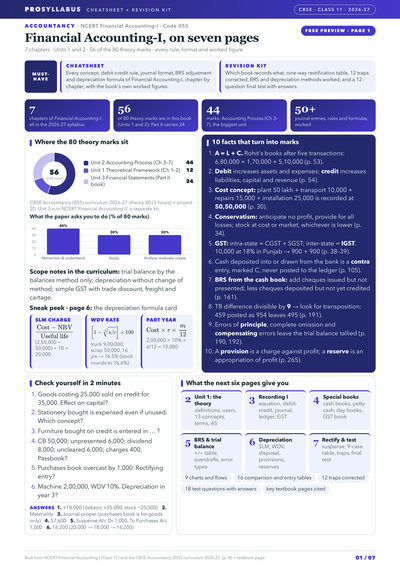
As a business grows, journalising every transaction becomes cumbersome, so the journal is sub-divided into special purpose books (also called subsidiary books or daybooks), each recording transactions of a similar nature. The main special purpose books are the cash book, purchases (journal) book, purchases return (return outwards) book, sales (journal) book, sales return (return inwards) book and the journal proper, which records transactions that fit none of the others. The cash book records all cash receipts and payments and serves as both a journal and a ledger account; it may be a single column cash book, a double (cash and bank) column cash book, or a petty cash book. In a double column cash book a contra entry records the transfer of money between cash and bank, appearing on both sides. The petty cash book records small day-to-day expenses, often maintained on the imprest system where the petty cashier is reimbursed for the amount spent. Purchases and sales books record only credit purchases and credit sales of goods, while the return books record goods returned. Entries from these books are posted to the ledger and the accounts are then balanced. The chapter also shows the recording of GST in subsidiary books and explains the balancing of accounts.
Key ideas & terms
- Special Purpose Books
- Subsidiary books or daybooks into which the journal is sub-divided to record transactions of a similar nature.
- Cash Book
- A book recording all cash receipts and payments that serves as both a journal and a ledger account.
- Contra Entry
- An entry in the double column cash book that records the transfer of money between cash and bank, shown on both sides.
- Petty Cash Book
- A book maintained to record small day-to-day expenses, often under the imprest system.
- Imprest System
- A system in which the petty cashier is given a fixed sum and is reimbursed for the amount actually spent in a period.
- Journal Proper
- The book used to record transactions that cannot be entered in any other special purpose book.
Extra questions & answers
Why are special purpose books maintained?
They allow quick, efficient and accurate recording of repetitive transactions and make division of labour possible in accounting work.
Name the main special purpose books.
Cash book, purchases book, purchases return book, sales book, sales return book and the journal proper.
What is recorded in the cash book?
All cash receipts and payments, and in the bank column, all bank transactions; it also acts as a ledger account.
What is a contra entry?
It is an entry recording the transfer of money between cash and bank in the double column cash book, appearing on both the debit and credit sides.
What is the petty cash book used for?
It records small recurring expenses such as postage, cartage and stationery, keeping the main cash book free of minor entries.
Explain the imprest system of petty cash.
The petty cashier is given a fixed amount at the start of a period and is reimbursed at its end for the amount actually spent, restoring the fixed balance.
What is entered in the purchases (journal) book?
Only credit purchases of goods in which the firm deals; cash purchases and purchases of assets are excluded.
What is entered in the sales (journal) book?
Only credit sales of goods dealt in by the firm; cash sales and sales of assets are excluded.
What is the purpose of the return books?
The purchases return book records goods returned to suppliers and the sales return book records goods returned by customers.
What is recorded in the journal proper?
Transactions that cannot be recorded in any other subsidiary book, such as opening entries, adjustment entries and credit purchase of assets.