ProSyllabusLearn a little. Grow every day.Log in
YOUR STUDY SPACE · CBSE

Financial Statements - II — Class 11 Accountancy

Financial Accounting Part II · Chapter 2

173 members in the CBSE community

View all

CBSE Class 11 · AccountancyTrending

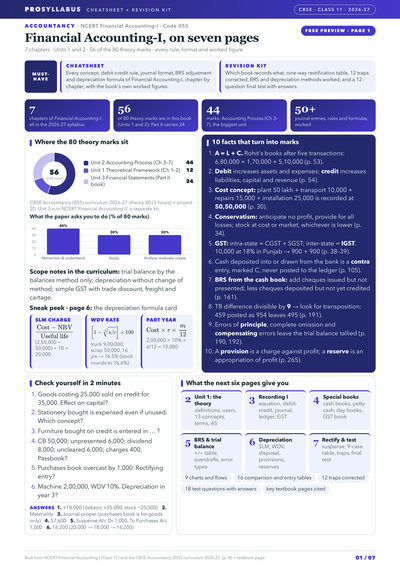
Financial Accounting-I: 56 of 80 theory marks
  • Marks booster + cheatsheet: key concepts in 2 lines each, common traps
  • 44 marks: Unit 2, recording to depreciation
  • Journal formats and special purpose books
  • Traps from all seven chapters
  • Bank reconciliation adjustments
  • Depreciation formulas, book's worked figures
Page 1 free about 8 min read, Full kit about 55 min read
$ 12₹159$ 12€ 11£ 9CHF 10DKK 83SEK 122NOK 130PLN 47CZK 278AED 47SAR 48QAR 47KWD 3.975OMR 4.989BHD 4.881CA$ 17A$ 19NZ$ 21S$ 16HK$ 101RM 55See the full kit
  • Marks booster + cheatsheet: key concepts in 2 lines each
  • 12 exam traps, listed
  • Five calculations the paper keeps asking
  • Each adjustment: one entry, two effects
  • Both formats: trading and P&L, balance sheet
  • Yogita illustration solved line by line
Page 1 free about 8 min read, Full kit about 55 min read
$ 12₹159$ 12€ 11£ 9CHF 10DKK 83SEK 122NOK 130PLN 47CZK 278AED 47SAR 48QAR 47KWD 3.975OMR 4.989BHD 4.881CA$ 17A$ 19NZ$ 21S$ 16HK$ 101RM 55See the full kit
View all amazing Class 11 Marks Booster kits →

Chapter summary

Simple final accounts assume no accounting complexities, but because income and financial position are determined on the accrual basis, several items need adjustment before final accounts give a true and fair view. The accrual concept requires that revenues be taken on an earned basis and expenses on an incurred basis, regardless of when cash is received or paid. The common adjustments discussed are: closing stock, which is valued and shown both in the trading account and the balance sheet; outstanding expenses, which are expenses incurred but not yet paid; prepaid (unexpired) expenses, which are paid in advance; accrued income, which is earned but not yet received; and income received in advance (unearned income), received but not yet earned. Further adjustments include depreciation on fixed assets, bad debts written off, provision for bad and doubtful debts created on debtors, provision for discount on debtors, and manager's commission on profits. Each adjustment generally affects two accounts—one in the trading or profit and loss account and the other in the balance sheet—so that the matching principle is satisfied. By incorporating all such adjustments, the trading and profit and loss account and the balance sheet present a true and fair picture of the profitability and financial position of the business.
Need for adjustments and the accrual conceptClosing stock, outstanding and prepaid expensesAccrued income and income received in advanceDepreciation, bad debts and provisionsPreparation of adjusted final accounts

Key ideas & terms

Adjustment
An entry made while preparing final accounts so that incomes and expenses relate correctly to the accounting period under the accrual concept.
Outstanding Expense
An expense that has been incurred during the period but not yet paid, shown as a liability.
Prepaid Expense
An expense paid in advance whose benefit relates to the next period, shown as an asset.
Accrued Income
Income that has been earned during the period but not yet received, shown as an asset.
Income Received in Advance
Income received during the period that relates to a future period, also called unearned income and shown as a liability.
Provision for Doubtful Debts
An amount set aside out of profit to cover debts that may not be recovered.

Extra questions & answers

Why are adjustments needed while preparing financial statements?

Because under the accrual concept incomes and expenses must relate to the correct period so the final accounts show a true and fair view.

How is closing stock treated in final accounts?

It is credited to the trading account and shown as an asset in the balance sheet.

What is an outstanding expense and how is it treated?

It is an expense incurred but not yet paid; it is added to the relevant expense in the profit and loss account and shown as a liability in the balance sheet.

What is a prepaid expense and how is it treated?

It is an expense paid in advance; it is deducted from the relevant expense and shown as an asset in the balance sheet.

What is accrued income?

It is income earned during the period but not yet received; it is added to the income and shown as an asset.

What is income received in advance?

It is income received during the period but relating to a future period; it is deducted from the income and shown as a liability.

How are bad debts treated in the final accounts?

Bad debts are written off by debiting the profit and loss account and deducting the amount from debtors in the balance sheet.

What is a provision for bad and doubtful debts?

It is an amount set aside out of profit to cover debtors who may default; it is debited to the profit and loss account and deducted from debtors.

How is manager's commission on profit treated?

It is charged to the profit and loss account as an expense and shown as an outstanding liability if unpaid.

Why does each adjustment usually affect two accounts?

Because the adjustment follows the dual aspect and matching principles, with one effect in the trading or profit and loss account and the other in the balance sheet.