Checked 29 September 2026. Pass rates to FY2025 (USPTO page updated 3 Oct 2025); FY2026 figures were not published by 29 Sep 2026. The waiver of 37 CFR 11.7(b)(2) runs "until further notice": when it ends, the 90-day wait and five-attempt limit return.
Since fiscal year 2013, fewer than half of US Patent Bar sittings have ended in a pass in every year the USPTO has published. It reports 46% for fiscal year 2025, on 2,278 exams, and every year since FY2013 has landed between 42.8% and 49%. Across all 21 years from FY2005 the figure is just above half: about 27,600 passes in 53,867 exams, roughly 51% (our arithmetic on the rounded yearly rates). The pass line is 63 of the 90 scored questions, with 10 more unscored beta questions hidden among the 100. This guide sets out the full USPTO series, how the scoring works, what happens after a fail, and the retake rules as written and as applied today. If you are not a US citizen and you live in India, you cannot sit this exam. The USPTO's General Requirements Bulletin says the registration examination "is not administered to aliens who do not reside in the United States". Of non-citizens, only US lawful permanent residents may apply for registration; others living in the US with qualifying work authorisation can get only limited recognition, and the one foreign-reciprocity clause, 37 CFR 11.6(c), covers Canada alone. ProSyllabus is an independent study site, not part of the USPTO, its Office of Enrollment and Discipline (OED) or Prometric. Every rule here is quoted or summarised from the USPTO General Requirements Bulletin, the Code of Federal Regulations and USPTO pages, and OED decides every application.
USPTO Registration exam results and statistics (3 Oct 2025); Registration examination page (29 Sep 2026); USPTO Becoming a patent practitioner page (5 May 2026).
Where other pages get this wrong
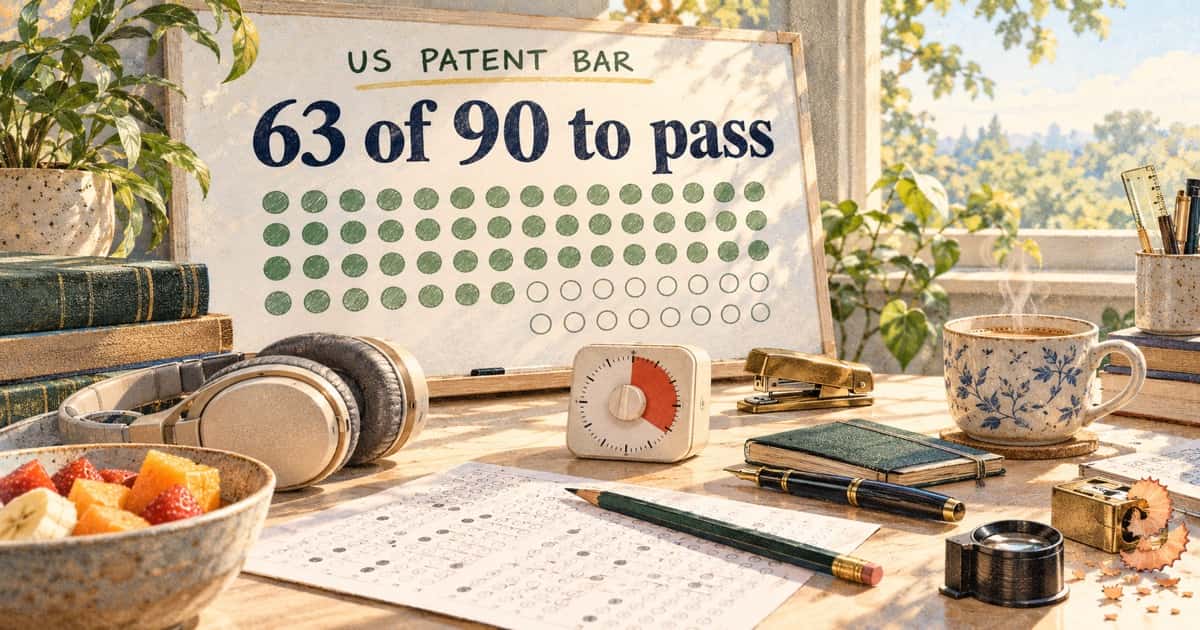
The pass mark is 63 correct out of the 90 scored questions, not 70 of the 100 you answer.
Commonly published instead: A reading of "70 percent" as 70 correct answers out of 100 questions.
The USPTO says the exam "includes 100 multiple-choice questions, of which 90 are scored. To pass the examination, a candidate must correctly answer seventy percent of the scored questions (63 of 90)." The 10 beta questions "will not be identified and will not be scored".
Pass rate by fiscal year, FY2005 to FY2025
FY2021 to FY2025 from the current USPTO statistics page (whole percentages); FY2005 to FY2020 from the same page as archived on 25 Jul 2021 (one decimal).
| Fiscal year | Number of exams | Percent pass | Source |
|---|---|---|---|
| FY2025 | 2,278 | 46% | USPTO statistics page (updated 3 Oct 2025) |
| FY2024 | 2,025 | 49% | USPTO statistics page (updated 3 Oct 2025) |
| FY2023 | 1,957 | 46% | USPTO statistics page (updated 3 Oct 2025) |
| FY2022 | 1,768 | 46% | USPTO statistics page (updated 3 Oct 2025) |
| FY2021 | 2,062 | 45% | USPTO statistics page (updated 3 Oct 2025) |
| FY2020 | 1,616 | 48.9% | Same page, Wayback capture of 25 Jul 2021 |
| FY2019 | 2,119 | 45.3% | Same page, Wayback capture of 25 Jul 2021 |
| FY2018 | 2,232 | 47.2% | Same page, Wayback capture of 25 Jul 2021 |
| FY2017 | 2,346 | 43.9% | Same page, Wayback capture of 25 Jul 2021 |
| FY2016 | 2,424 | 47.7% | Same page, Wayback capture of 25 Jul 2021 |
| FY2015 | 2,495 | 48.4% | Same page, Wayback capture of 25 Jul 2021 |
| FY2014 | 2,799 | 42.8% | Same page, Wayback capture of 25 Jul 2021 |
| FY2013 | 2,766 | 46.8% | Same page, Wayback capture of 25 Jul 2021 |
| FY2012 | 3,365 | 53.8% | Same page, Wayback capture of 25 Jul 2021 |
| FY2011 | 2,716 | 56% | Same page, Wayback capture of 25 Jul 2021 |
| FY2010 | 3,120 | 59.4% | Same page, Wayback capture of 25 Jul 2021 |
| FY2009 | 3,357 | 59.6% | Same page, Wayback capture of 25 Jul 2021 |
| FY2008 | 3,634 | 56.6% | Same page, Wayback capture of 25 Jul 2021 |
| FY2007 | 3,192 | 55.6% | Same page, Wayback capture of 25 Jul 2021 |
| FY2006 | 2,923 | 58.8% | Same page, Wayback capture of 25 Jul 2021 |
| FY2005 | 2,673 | 57.4% | Same page, Wayback capture of 25 Jul 2021 |
USPTO statistics page (updated 3 Oct 2025). FY2026 not yet published.
How to read these numbers. The USPTO column is "Number of Exams", which we read as sittings, not people: someone who sits three times in a year is counted three times. The USPTO publishes no split by first attempt or retake, by degree category, or by citizenship or residence, so there is no "pass rate for Indians" and no first-timer rate. Our arithmetic on FY2025: 2,278 × 46% gives about 1,050 passes, but the 46% is rounded, so treat that as approximate. The rate fell from the high 50s in FY2006 to FY2011 to the low-to-high 40s from FY2013 onward; the USPTO gives no reason for the change and we do not supply one.
How the score works
| Item | Figure | Source |
|---|---|---|
| Questions on the exam | 100 multiple choice, 5 choices each | GRB IX.B; USPTO process page |
| Sessions | 50 questions in a 3-hour morning session, 50 in a 3-hour afternoon session | GRB IX.B |
| Scored questions | 90, each used before on an exam form and psychometrically analysed | Registration examination page |
| Beta questions | 10, spread through the exam, not identified, not scored, not reviewable | Registration examination page |
| Pass mark | 70% of scored questions = 63 of 90 | Registration examination page; OED FAQ |
| Wrong answers you can afford | 27 scored questions (our arithmetic: 90 - 63) | Ours |
| Time per question | 3 minutes 36 seconds on average (our arithmetic: 180 minutes / 50) | Ours |
| Negative marking | None described: the score is the number of scored questions answered correctly | Our reading of the pass rule |
Score explainer: what 63 of 90 means for your count
You never learn which 10 of the 100 questions were the unscored beta items. If you count answers you are sure of out of all 100, the tool shows the range your scored total could fall in and whether you would pass anywhere in that range. If you already know your count out of the 90 scored questions (for example on a practice set built that way), choose the second option.
Our arithmetic on the USPTO rule: 90 scored questions, pass at 70 percent = 63 correct. A pass shows only “passed” on screen; a fail shows your percentage. Official results come by mail.
The useful consequence for exam day: because only correct answers count and nothing in the USPTO's description penalises a wrong answer, there is no scoring advantage to leaving a question blank. A wrong answer carries no deduction, while a correct answer earns credit if the question is scored. And because you cannot tell which items are beta, answer every question.
What you see at the end, and when it becomes official
| Situation | On screen | Official result |
|---|---|---|
| Both sessions on one day, score 70% or more | "passed", with no score | By mail from OED |
| Both sessions on one day, score below 70% | The percentage of correct answers | By mail from OED |
| Exam split over two days (an accommodation) | No unofficial result on either day | By mail from OED |
The USPTO gives two timings for the official notice, which we treat as the same thing: its statistics page says results are mailed "about a week" after the exam, and its process page and FAQ say "generally within 5 business days". Notification of results is final: there is no regrade (37 CFR 11.7(e)).
Retakes: the rule as written, and as applied today
| Rule | As written | As applied on 29 Sep 2026 | Source |
|---|---|---|---|
| 37 CFR 11.7(b)(1)(ii) | Wait thirty days after the date you last took the exam | 30 days | eCFR current; GRB XI.B |
| 37 CFR 11.7(b)(2), added 2023 | 30 days after a 1st or 2nd failure; 90 days after a 3rd or 4th; no more than five attempts without a petition | Waived "until further notice": immediate reapplication, new window starts no sooner than 30 days after the failed attempt, no attempt cap | eCFR current; USPTO page (5 May 2026); OED waiver notice (26 Nov 2024) |
| 37 CFR 11.9(e)(2) | The same 30/90-day and five-attempt text for limited-recognition applicants | The USPTO page describes the waiver for "applicants for the registration examination"; it does not name 11.9(e)(2) separately | eCFR current |
Two official dates for one waiver. The OED notice signed on 26 November 2024 waived 11.7(b)(2) "for the next six months and until further notice". The USPTO page updated on 5 May 2026 says "For the next twelve months and until further notice". Neither prints an end date; the newer page is the live statement, and the waiver was in force on 29 September 2026. The USPTO also says what happens when it ends: the wait periods return, and a sixth or later attempt needs a petition in which you "must demonstrate preparedness to take and pass the examination", with the fee, filed on time. So "no attempt limit" is true only while the waiver lasts.
Every retake is a fresh application: a new form, the $118 and $226 fees, then a new Prometric booking and fee. You do not resend documents OED already has, but you must update any answer that has changed.
The failed-question review
| Point | Prometric review | USPTO review |
|---|---|---|
| Who | Anyone who did not pass | Anyone who did not pass |
| Deadline | Within 60 days of the mailing date of the notice of results | Within 60 days of the mailing date of the notice of results |
| Where | A Prometric test site, by computer | OED, 600 Dulany Street, Alexandria, Virginia |
| Fee | $300, paid to Prometric | $505, paid to the USPTO |
| What you see | Scored questions you answered incorrectly; not correct answers, skipped questions or beta items | The same |
| Length and limits | 2.5 hours, no notes, no copies, one review per exam | One review per exam, no notes, no copies |
Your dates after the exam: retake, review, registration
Enter your exam date and result. The deadlines for a review and for registering run from the mailing date on your official notice of results, so type that date if you have it. Without it, the tool uses our estimate of 7 days after the exam (the USPTO says official results are mailed “about a week” after the exam) and marks every date that depends on it.
Our date arithmetic on 37 CFR 11.7 and 11.8, GRB sections XI and XIV, and the USPTO page on the retake waiver (updated 5 May 2026). Calendar days. The waiver of 11.7(b)(2) runs “until further notice” with no printed end date.
What the numbers do not tell you
- Pass rates by first attempt versus retake, by degree category, or by nationality or residence: not published.
- FY2026 statistics: not published by 29 September 2026 (the page was last updated 3 October 2025).
- Whether the exam form introduced on 23 September 2026 changes difficulty: the USPTO describes no content change, and the source materials are the same.
- How many questions come from any one MPEP chapter or from ethics: not published.
Where we give a figure the USPTO does not print, it is labelled as our arithmetic.
Nothing on this page is legal or immigration advice. For your own case, write to OED (OED@uspto.gov), and on visas speak to a US immigration lawyer. ProSyllabus has no US Patent Bar practice quizzes yet.
What is the pass rate of the US Patent Bar exam?
46% in fiscal year 2025, on 2,278 exams, according to the USPTO. From FY2013 to FY2025 it has ranged between 42.8% and 49%.
How many questions do I need to pass?
63 of the 90 scored questions, which is 70%. The other 10 of the 100 questions are unscored beta items that are not identified.
Is there negative marking?
The USPTO describes the score only as the number of scored questions answered correctly and mentions no penalty for wrong answers, so there is no advantage in leaving a question blank. Answer every question.
Do I get my score if I pass?
No. A passing candidate is told only that they passed. A failing candidate sees the percentage of correct answers.
How long must I wait to retake the patent bar?
As applied today, 30 days after the failed attempt. The 90-day wait after a third or fourth failure in 37 CFR 11.7(b)(2) is temporarily waived until further notice.
Is there a limit on attempts?
The rule allows five attempts without a petition, but that limit is temporarily waived. When the waiver ends, a sixth or later attempt will need a petition showing preparedness.
Can I see the questions I got wrong?
Yes, within 60 days of the mailing date of the notice of results, at a Prometric site ($300) or at the USPTO ($505). Only scored questions you answered incorrectly are shown.
Can I ask for a regrade?
No. Notification of the examination results is final.
Is there a pass rate for Indian candidates?
No. The USPTO publishes only yearly totals, with no split by nationality, residence, degree or attempt.
How long is each session?
Three hours for 50 questions, twice, with an optional timed one-hour lunch break between them.
Sources
- official — USPTO — Registration exam results and statistics (last updated 3 Oct 2025): number of exams and percent pass, FY2021 to FY2025; unofficial and official results
- official — USPTO Registration exam results and statistics as captured by the Wayback Machine on 25 Jul 2021: FY2005 to FY2020
- official — USPTO — Registration examination page (last updated 29 Sep 2026): exam updated 23 Sep 2026; 180-day scheduling window "until further notice"; 100 questions, 90 scored, 63 of 90 to pass; 10 unscored beta questions
- official — USPTO — Becoming a patent practitioner (last updated 5 May 2026): application and registration process, fee table including the Prometric fee of $221, retake waiver "for the next twelve months and until further notice", limited recognition
- official — USPTO — OED Frequently Asked Questions (last updated 19 Feb 2026): Prometric test centres "in the United States and U.S. Territories", transcripts and translations, extensions, review sessions, finding a registered practitioner
- official — USPTO OED — General Requirements Bulletin for Admission to the Examination for Registration to Practice in Patent Cases, "Issued August 2026" (PDF created 11 Aug 2026): section III (Categories A-D, eligibility of aliens), IV-VII (application, fees, review), IX-XI (the examination, test administration, reapplying), XIV (after passing)
- official — eCFR — 37 CFR 11.7, Requirements for registration (current text, including 11.7(b)(2): 30/90-day waits and the five-attempt limit; added 88 FR 45086, 14 Jul 2023, per the eCFR source note)
- official — eCFR — 37 CFR 11.8, Oath and registration fee (current text: two years to register after passing; certificate of good standing no more than six months old)
- official — eCFR — 37 CFR 11.9, Limited recognition in patent matters (current text: 11.9(b) for aliens in the US; 11.9(c) for PCT international applications)
- official — USPTO OED — Notice of Temporary Waiver of 37 CFR 11.7(b)(2), signed 26 Nov 2024 (PDF)
official = a document published by the conducting body. reported = a news or coaching site we could not check against an original. Where sources disagree this page says so rather than picking one.