Checked 1 November 2026. Exam areas, participating countries and dates change every cycle. This page follows the UN Careers YPP page and job opening 285586 for the 2026 cycle (applications 16 Oct to 30 Nov 2026). The UN says the structure may vary slightly from year to year and gives full details only to invited candidates. Read on 1 Nov 2026.
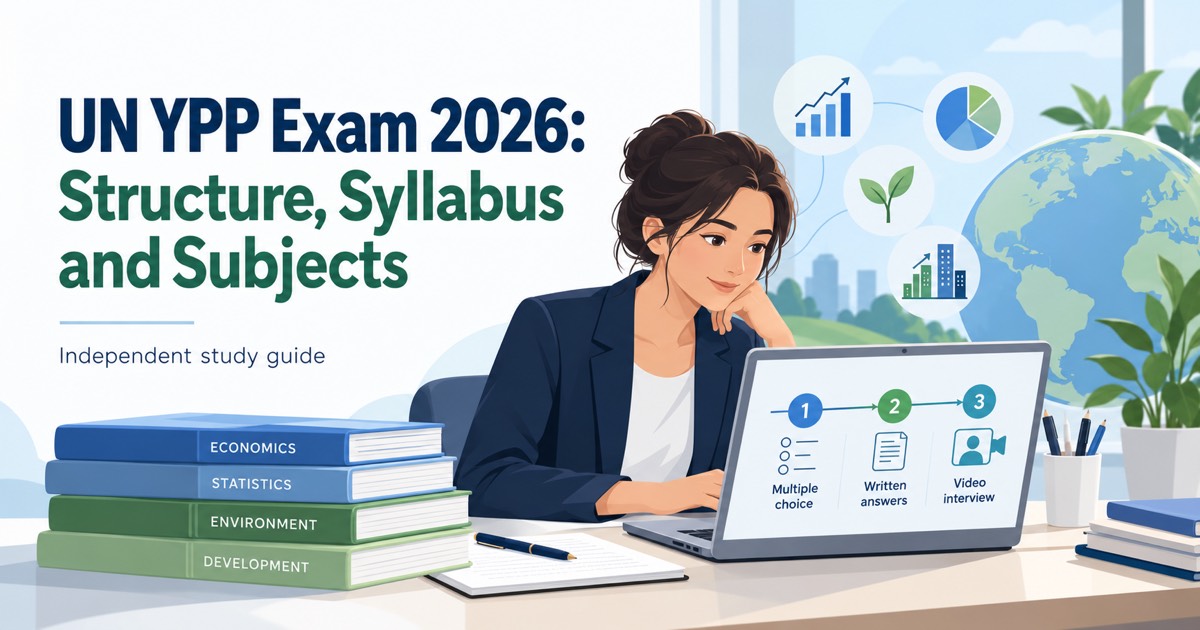
The UN YPP exam has three stages after your application is screened: stage one, about 2 hours of multiple-choice questions (a General Paper plus the first, multiple-choice part of a Specialized Paper); stage two, about 2 to 2.5 hours of open-ended written answers in your exam area, each with a suggested word limit; and a competency-based video interview. The UN publishes no formal syllabus; for the 2026 cycle, the job opening for its one exam area, Development and Sustainability, lists the topics covered, and Part I is anticipated in February 2027.
What the UN does publish is the exam structure, the list of exam areas for each cycle, and, in each job opening, the topics the specialised exam covers and the degrees it accepts. This guide puts all of that in one place, by stage and by exam area, with a reading list of public UN documents, three worked examples and a preparation checklist.
Independent practice. ProSyllabus is not affiliated with, endorsed by or connected to the United Nations. We have no inside information, we do not know the exam questions, and we do not review applications. Everything about the exam on this page comes from the public UN Careers pages linked below, and the UN gives its own preparation materials free of charge to invited candidates.
UN Careers: Young Professionals Programme page and job opening 285586.
FreeTests: UN Charter and organs · Written communication · Teamwork · Economics
UN YPP Exam Practice: free sample
Answer 4 questions against the clock, like the real exam. You then see the right answer, the reason and your time on each. About 5 minutes · free · no sign-in.
4 questions to answer
Start nowabout 5 minThis one is free · no sign-in needed
Your result shows how long each question took you.
Key facts: the UN YPP exam in the 2026 cycle
| Item | Detail |
|---|---|
| What it is | The entrance examination of the UN Young Professionals Programme, which recruits entry-level professionals (P-1/P-2) for the UN Secretariat |
| Exam area for 2026 | Development and Sustainability (job opening 285586 for external applicants) |
| Application window | 16 October to 30 November 2026, through Inspira or the UN Careers portal |
| Stages | Screening of applications, written examination online (two parts), oral examination (video interview) |
| Part I | General Paper plus the first part of the Specialized Paper (multiple choice); about 2 hours; anticipated February 2027 |
| Part II | Second part of the Specialized Paper (constructed response, open-ended); about 2 to 2.5 hours; tentatively 1 to 2 months after Part I; only for those successful in Part I |
| Oral examination | Competency-based interview by video conference; anticipated mid-2027 |
| Exam languages | Questions in English or French; some Part II answers must be in English or French, others can be in any of the six UN official languages |
| Who is convoked | Up to 90 applicants per country per exam area to stage one; at most 60 per country per exam area go on to stage two |
| Where you sit it | Online, at a place you choose with a reliable computer and internet connection; stage two may be proctored remotely by webcam |
| Fee | None. The UN charges no fee at any stage |
| Official pages | careers.un.org/ypp and the job opening for your exam area |
The structure, stage by stage
The UN Careers page calls its overview "an example of the examination process structure" and says more details go to invited candidates, because the structure may vary slightly from year to year. The 2026 job opening confirms the same shape for this cycle.
| Stage | Format | What it tests |
|---|---|---|
| 0. Application screening | Inspira checks nationality, age, education and language; if more than 90 eligible applicants come from one country for one exam area, they are ranked on highest education, UN languages and relevant work experience | Eligibility, not knowledge |
| 1. Online exam, stage one (Part I) | Multiple-choice questions, about 2 hours, in English or French | General Paper: competencies for an international organisation (e.g. written communication, reasoning, UN core values and competencies). Specialized Paper part 1: knowledge of the exam area |
| 2. Online exam, stage two (Part II) | Constructed-response (open-ended) questions, about 2 to 2.5 hours, each with a suggested word limit; may be remotely proctored | Specialized Paper part 2: knowledge and attributes for the exam area, in writing |
| 3. Oral examination | Competency-based interview by video conference | The key competencies in the job opening; your Specialized Paper answers and your profile may also be verified |
| Result | Successful candidates go on a roster for three years | A roster place does not guarantee a job offer |
Two details from the YPP FAQ matter for planning. First, you get a broad testing window to suit time zones: the FAQ's example is a two-hour exam with a window of up to 14 hours in which to complete it. Second, invited candidates get access to the UN Online Examinations & Tests System, where they can learn the platform and review preparation materials for their exam, which may include a suggested reading list, sample or previous questions and other tips.
The General Paper: what it covers
The UN describes the General Paper as assessing "a variety of competencies/abilities critical to working in an international organization", and gives three examples: written communication skills, reasoning skills, and UN core values and competencies. The 2026 job opening words it as competencies and abilities "critical to success in working in an international affairs context". It sits in stage one with the first part of the Specialized Paper, and its questions are multiple choice.
The UN does not list the question types, the number of questions or how the General Paper is marked. As preparation, we suggest three things that follow from the UN's own description: practise reading a dense passage and choosing the best-supported conclusion; know how the UN system is organised (the Charter, the principal organs, the Secretariat's role); and read the competencies listed in the job opening, because the UN names its values and competencies as part of what this paper assesses.
FreeTests: UN Charter and organs · Written communication · Teamwork · Economics
UN YPP Exam Practice: free sample
Answer 4 questions against the clock, like the real exam. You then see the right answer, the reason and your time on each. About 5 minutes · free · no sign-in.
4 questions to answer
Start nowabout 5 minThis one is free · no sign-in needed
Your result shows how long each question took you.
The Specialized Paper: subjects by job family and exam area
YPP exam areas follow the UN's projected needs. The FAQ says most exam subjects are offered every second year, though the schedule can change, and each cycle's areas are announced on the YPP page. These are the cycles shown on the UN Careers YPP page on 1 November 2026.
| Cycle | Exam area(s) | Where successful candidates mainly work (UN wording) |
|---|---|---|
| 2026 | Development and Sustainability | Department of Economic and Social Affairs (DESA), UNCTAD and the Regional Commissions |
| 2024 | Human Resources & Administration; Political Affairs & Human Rights; Finance & Budget; Information System & Technology | Not stated on the current YPP page; each area had its own job opening |
For 2026, job opening 285586 says the Development and Sustainability exam "covers a broad range of topics". This is the nearest thing to a published syllabus, so here it is broken into topics, with the kind of work the opening links to each.
| Topic in the 2026 job opening | Work it links to (job opening) |
|---|---|
| Economics | Research and analysis on economic issues; national, regional and global trends and policies |
| Statistics (and data science) | Collecting, validating, analysing and visualising statistical data; statistical methods and programming languages |
| Social affairs (and population) | Social and demographic analysis; population affairs |
| Environmental issues | Environmental protection and related areas of sustainable development |
| Sustainable development | Progress on internationally agreed goals and frameworks such as the Sustainable Development Goals |
| Technology and digital transformation | Data platforms, information systems, emerging technologies and data science approaches |
| Programme management support | Technical cooperation and capacity development projects; monitoring progress and results |
The opening adds that the exam "also encompasses other areas within the Development and Sustainability field" addressed by UN entities, so treat the list as the core, not the limit. Written outputs feature heavily in the work described (briefing notes, background papers, reports for intergovernmental meetings), which is a good hint for how to practise the open-ended part.
Who the 2026 Development and Sustainability exam is for
You need at least a first-level university degree (a Bachelor's or an equivalent of at least three years) relevant to economics, statistics, data science, social affairs, environment and sustainable development, chosen in Inspira from one of these "Main Course of Study" options:
| Main Course of Study options accepted (2026) |
|---|
| Agriculture, Forestry & Fishery |
| Business & Administration |
| Computing |
| Environmental Protection |
| Humanities |
| Law |
| Mathematics & Statistics |
| Social & Behavioural Science |
The other basic rules: be 32 or younger by the end of 2026 (born on or after 1 January 1994), be fluent in English or French (UN Level II or above in reading, writing, listening and speaking), and hold the nationality of one of the participating Member States listed in the job opening. Selecting "Other" for main course of study or field of study disqualifies you automatically. The full list of countries, and what to do if yours is not on it, is in our UN YPP participating countries guide.
Try free practice questions
These questions play in our test player. They are our own practice questions on topics from the 2026 job opening, written for practice; they are not UN questions and are not taken from the UN's preparation materials. Press Start, answer them, and the result page shows each answer with its reason and a public UN source.
FreeTests: UN Charter and organs · Written communication · Teamwork · Economics
UN YPP Exam Practice: free sample
Answer 4 questions against the clock, like the real exam. You then see the right answer, the reason and your time on each. About 5 minutes · free · no sign-in.
4 questions to answer
Start nowabout 5 minThis one is free · no sign-in needed
Your result shows how long each question took you.
A reading list of public UN documents for Development and Sustainability
Invited candidates may receive a suggested reading list from the UN through the online testing system. Until then, these public UN documents cover the topics in the 2026 job opening. This list is our suggestion, not the UN's reading list.
| Document | Why read it |
|---|---|
| <a href="https://www.un.org/en/about-us/un-charter/full-text" style="color:#255a45;font-weight:600" rel="nofollow">Charter of the United Nations</a> | Purposes, principal organs and the Secretariat (Chapter XV); useful for the General Paper too |
| <a href="https://sdgs.un.org/2030agenda" style="color:#255a45;font-weight:600" rel="nofollow">2030 Agenda for Sustainable Development</a> | The 17 SDGs and the framework the job opening names |
| <a href="https://unstats.un.org/sdgs/report/2026/" style="color:#255a45;font-weight:600" rel="nofollow">The Sustainable Development Goals Report 2026</a> | Progress on the SDGs with data: economics, social affairs and statistics in one place |
| <a href="https://desapublications.un.org/publications/world-economic-situation-and-prospects-2026" style="color:#255a45;font-weight:600" rel="nofollow">World Economic Situation and Prospects 2026</a> | DESA's flagship economic outlook: growth, inflation, debt, trade |
| <a href="https://population.un.org/wpp/" style="color:#255a45;font-weight:600" rel="nofollow">World Population Prospects</a> | Population affairs and demographic data from DESA's Population Division |
| <a href="https://unctad.org/topic/investment/world-investment-report" style="color:#255a45;font-weight:600" rel="nofollow">World Investment Report</a> | UNCTAD's report on foreign direct investment and development |
| <a href="https://unfccc.int/process-and-meetings/the-paris-agreement" style="color:#255a45;font-weight:600" rel="nofollow">The Paris Agreement</a> | The climate framework behind much environmental work in the UN system |
| <a href="https://www.un.org/en/summit-of-the-future/pact-for-the-future" style="color:#255a45;font-weight:600" rel="nofollow">Pact for the Future</a> | The 2024 Summit of the Future outcome, including sustainable development and digital cooperation |
Read for structure and argument, not for numbers to memorise. We suggest practising clear, evidence-supported written answers, and the reports above model that style.
Three worked examples
Example 1: checking eligibility before you start studying
- A candidate born on 15 March 1994 with a three-year Bachelor's degree in economics is within the age rule for 2026 (born on or after 1 January 1994), and economics is one of the subject areas the job opening names. They pick the closest of the accepted Main Course of Study options in Inspira.
- A candidate born on 31 December 1993 is not eligible for the 2026 exam. The FAQ says there is no exception, even for one day.
- A candidate whose degree title is not in the dropdown chooses the closest field and types the exact title, in the original language and in English or French, in the comment box. Choosing "Other" means automatic disqualification.
Rules from job opening 285586 and the YPP FAQ.
Example 2: turning the job opening into a study plan
- Take the seven topics in the job opening (economics, statistics, social affairs, environmental issues, sustainable development, technology and digital transformation, programme management support).
- Rate yourself on each from 1 to 3 against your degree. A statistics graduate might rate statistics 3, economics 2 and environmental issues 1.
- Give most of your weekly study time to the 1s, using the matching document in the reading list above, and keep one session a week on the General Paper. This is our suggested method; the UN does not publish topic weights.
Topics from job opening 285586; the planning method is ours.
Example 3: practising an open-ended answer to a word limit
- Stage two gives each question a suggested word limit. Practise with a limit of your own, say 400 words, on a prompt such as: "Brief a senior officer on why progress on one SDG of your choice has stalled, and suggest two actions."
- Plan for a few minutes: one sentence of position, two or three points with evidence, one recommendation. Write, then cut anything that does not support the position.
- Time yourself. With about 2 to 2.5 hours for the whole stage and several questions, practising to a fixed time per answer is more useful than writing one perfect essay. The limit and prompt here are our illustration, not UN figures.
Stage two description from the UN Careers YPP page; the prompt and limit are illustrative.
The interview: competencies named in the 2026 job opening
Candidates successful in the written examination are invited to a competency-based video interview. The UN says the oral examination assesses the key competencies for the job family as described in the job opening. For Development and Sustainability those are:
| Competency | Examples from the job opening |
|---|---|
| Professionalism | Mastery of subject matter; meeting commitments and deadlines; persistence; staying calm under stress; gender perspectives |
| Planning & Organizing | Clear goals; setting and adjusting priorities; allocating time; foreseeing risks; monitoring plans |
| Teamwork | Collaborating; valuing others' ideas; putting the team agenda first; supporting group decisions; sharing credit and responsibility |
UN Careers advises preparing a wide range of brief real-life stories about your accomplishments, structured as Situation, Action, Result, that show these competencies, including challenges and what you learned. UN Careers also warns that invitations to interviews held by email are fraudulent: the UN does not conduct interviews by email.
Your preparation checklist
UN YPP exam preparation checklist
Tick each step as you do it. It combines the UN's published guidance with our own suggestions.
0 of 12 done
Ticks are saved only in this browser on this device.
Common mistakes
- Studying for a cycle's exam area from an old list. Areas change by cycle: 2026 has only Development and Sustainability.
- Paying for "insider" preparation. The UN says it partners with no company selling YPP services, and its own preparation materials are free.
- Trusting a breakdown of question counts or a pass mark from an unofficial site. The UN publishes neither.
- Choosing "Other" for Main Course of Study or Field of Study, which disqualifies you automatically.
- Reading only for facts. Stage two asks for written answers and the interview for spoken examples, so we suggest practising both, not just memorising.
- Leaving the application to the last day. Substantive application details cannot be edited after submission, although contact information can be updated and required documents can still be uploaded.
After the exam: results, roster and pay
The FAQ says marking of the written examination is usually completed within 3 to 4 months, and interviews normally follow 1 to 2 months later. Everyone is told their result. Successful candidates go on a roster valid for three years and may be offered a two-year fixed-term contract at P-1 (Bachelor's, no experience) or P-2 (Bachelor's and two years' experience, or a Master's). For what P-2 pays, see our UN YPP salary guide. For more free practice, see our UN YPP sample questions.
Practise both parts of the written exam before February 2027
The free questions above are the start of our UN YPP Exam Practice: general-paper multiple-choice sets on the UN system, international affairs and reasoning, plus specialised sets on the Development and Sustainability topics the 2026 job opening lists. Every answer is explained and sourced to a public UN document, so you learn the material and not just the answer.
See UN YPP Exam Practice (independent). Written by us; not made, endorsed or reviewed by the United Nations.
FreeTests: UN Charter and organs · Written communication · Teamwork · Economics
UN YPP Exam Practice: free sample
Answer 4 questions against the clock, like the real exam. You then see the right answer, the reason and your time on each. About 5 minutes · free · no sign-in.
4 questions to answer
Start nowabout 5 minThis one is free · no sign-in needed
Your result shows how long each question took you.
Frequently asked questions
What is the UN YPP exam syllabus?
The UN does not publish a formal syllabus. It publishes the structure (a General Paper and a Specialized Paper in two online stages, then a competency-based interview) and, in each job opening, the topics of the exam area. For 2026, Development and Sustainability covers economics, statistics, social affairs, environmental issues, sustainable development, technology and digital transformation, and programme management support.
What is the structure of the UN YPP exam?
Stage one is about 2 hours of multiple-choice questions, general and specialized. Stage two is about 2 to 2.5 hours of specialized open-ended questions, each with a suggested word limit, and may be proctored by webcam. Those who pass both are invited to a competency-based video interview.
What are the YPP exam subjects for 2026?
One exam area: Development and Sustainability. Successful candidates mainly work in DESA, UNCTAD and the UN Regional Commissions.
Which YPP exam areas were offered in 2024?
Human Resources & Administration; Political Affairs & Human Rights; Finance & Budget; and Information System & Technology, according to the YPP Exam Cycles section of the UN Careers page.
What does the YPP General Paper test?
The UN says it assesses competencies and abilities critical to working in an international organisation, for example written communication skills, reasoning skills, and UN core values and competencies.
Is there negative marking or a pass mark in the YPP exam?
The UN does not publish its marking scheme, negative marking rules or a pass mark. Up to 90 applicants per country per exam area are invited to stage one, and at most 60 per country per exam area go on to stage two, based on exam performance.
Can I take the YPP exam in French?
Yes. Questions are available in English or French. In stage two, certain questions must be answered in English or French and others can be answered in any of the six UN official languages.
When is the 2026 YPP exam?
Applications run from 16 October to 30 November 2026. The tentative timetable anticipates Part I in February 2027, Part II 1 to 2 months later, and interviews in mid-2027. Exact dates will be announced to invited candidates.
Does the UN give preparation books or materials for YPP?
Invited candidates get access to the UN Online Examinations & Tests System, with preparation materials for their exam that may include a suggested reading list and sample or previous questions. The UN says its preparation materials are free.
Is ProSyllabus connected to the UN?
No. ProSyllabus is independent and not affiliated with, endorsed by or connected to the United Nations. Our practice questions are our own, and we have no inside information about the exam.
Sources
- official — UN Careers: Young Professionals Programme (who can apply, Exam Structure, Recruitment Process, YPP Exam Cycles, warning about for-profit companies; read 1 Nov 2026)
- official — UN Careers: Job opening 285586, YPP Exam: Development and Sustainability (for external applicants), posted 16 Oct 2026, deadline 30 Nov 2026
- official — UN Careers: Young Professionals Programme, Frequently Asked Questions (exam subjects, testing window, preparation materials, results)
- official — UN Careers: How to apply, At Your Interview (competency-based interviews)
- official — United Nations: Charter of the United Nations, full text
- official — United Nations: Transforming our world, the 2030 Agenda for Sustainable Development
- official — UN DESA Statistics Division: The Sustainable Development Goals Report 2026
- official — UN DESA: World Economic Situation and Prospects 2026
- official — UN DESA Population Division: World Population Prospects
- official — UN Trade and Development (UNCTAD): World Investment Report
- official — UNFCCC: The Paris Agreement
- official — United Nations: Pact for the Future (Summit of the Future, 2024)
official = a document published by the conducting body. reported = a news or coaching site we could not check against an original. Where sources disagree this page says so rather than picking one.