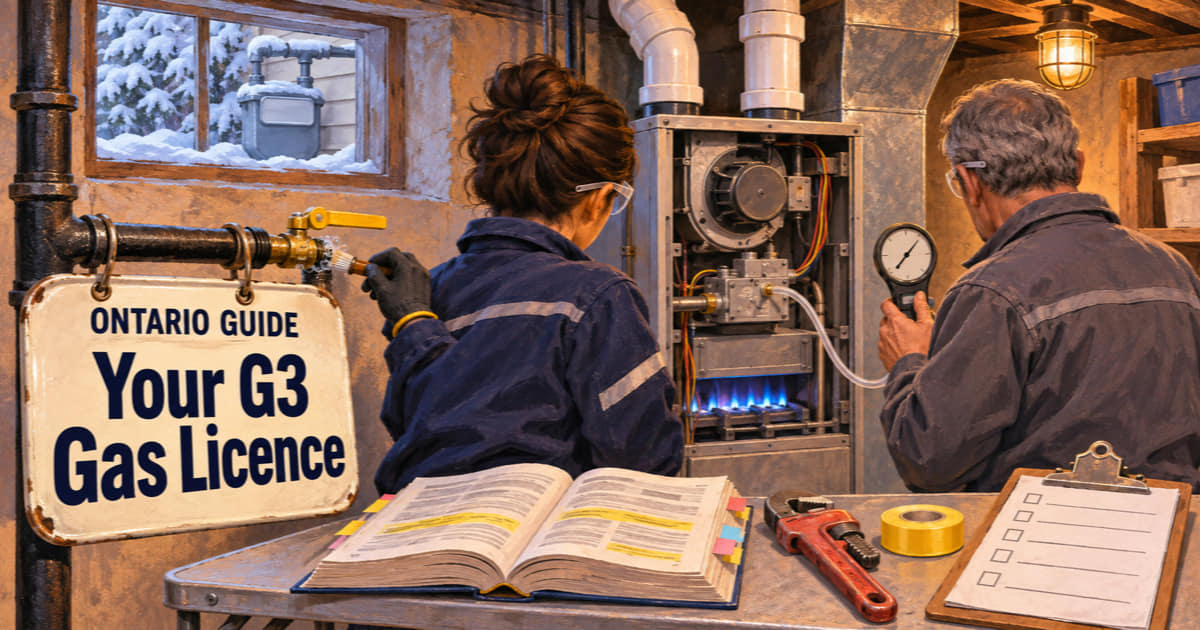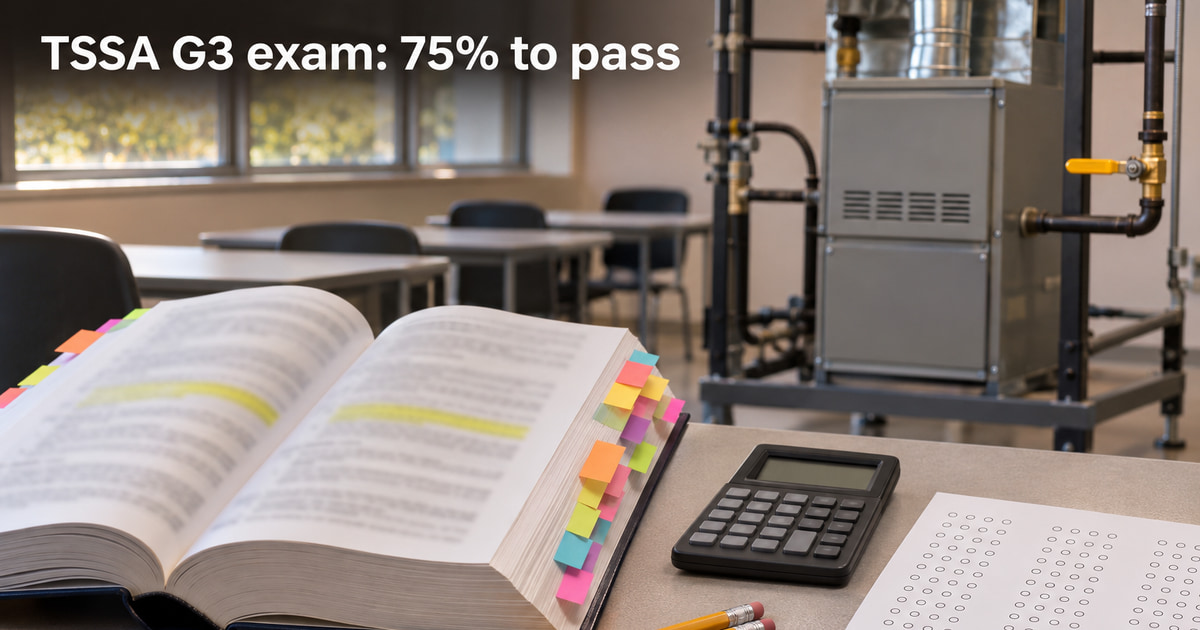
Checked 28 Nov 2026. Exam rules from TSSA's Certification Examination Preparation Guide (16 March 2026), its Gas Technician/Oil Burner Technician Policies and Procedures (March 2025), its fee schedule (1 May 2026) and code adoption document FS-279-26, plus college exam pages, all read 28 Nov 2026. TSSA revises these documents, and your training provider or test centre may add its own rules, so check the linked pages before you sit.
The TSSA G3 exam is the written, multiple-choice certification exam for Ontario's Gas Technician 3 certificate. The pass mark is 75%, the rate TSSA sets for every Fuels exam. TSSA's March 2026 exam guide gives no G3 question count: it says only that typical TSSA exams range from 50 to 165 questions, with up to 3.5 hours depending on the exam type. Algonquin College's test centre, which hosts TSSA sittings, gives the G3 exam a strict limit of 3 hours 30 minutes. It is open book, but only with the references TSSA lists for G3: the Technical Standards and Safety Act, 2000, the Fuels regulations and their code adoption documents, CSA B149.1 and CSA B149.2, plus the optional Supplement No. 1 to B149.2. They must have no writing or notes; highlighting, page dividers and tabs are allowed.
This guide covers the exam from booking to result: the 75% bars on the training route and the one-year window after your program, what the nine G3 training modules put on the paper, exactly which books you may bring, why Ontario's code adoption document matters as much as the CSA book (B149.1-25 has been in force with Ontario amendments since 1 June 2026), fees, rewrites, and a checker for your mock scores. The steps to the licence are in our G3 gas licence guide, and TSSA's rule since 1 January 2026 that G3 holders certified by challenge must show 450 hours of G3 work before enrolling in a G2 program (TSSA notice, 4 July 2025) is covered in our guide to the 450-hour rule before G2. TSSA and college rules are sourced, and our own advice is labelled as ours.
TSSA Certification Examination Preparation Guide (16 Mar 2026), TSSA Policies and Procedures (Mar 2025), Algonquin College TSSA testing page, read 28 Nov 2026.
FreeTests: Safety, tools and gas properties · Acts, regulations and certificates · Piping, tubing, pressure controls and testing · Appliances, venting and air supply
TSSA G3 Practice Test: free sample
Answer 4 questions against the clock, like the real exam. You then see the right answer, the reason and your time on each. About 8 minutes · free · no sign-in.
4 questions to answer
Start nowabout 8 minThis one is free · no sign-in needed
Your result shows how long each question took you.
The G3 exam at a glance
| Point | What the sources say | Source |
|---|---|---|
| Who runs it | TSSA (Technical Standards and Safety Authority), under O. Reg. 215/01; written at an approved test centre or a training provider's sitting | TSSA prep guide; P&P s.5 |
| Question type | All multiple choice (TSSA's only stated exception is the SOPEEC Operating Engineer exams, which may include essay responses) | TSSA prep guide s.2 |
| Number of questions | No G3 count in TSSA's exam guide, which says "typical exams range from 50 to 165 questions depending on the certificate type" | TSSA prep guide s.2 |
| Time | TSSA: up to 3.5 hours depending on the exam, no extra time unless approved as an accommodation. Algonquin: G3 has a strict limit of 3 hours 30 minutes | TSSA prep guide s.2; Algonquin |
| Pass mark | 75% (all Fuels exams) | TSSA prep guide s.7; P&P s.6 |
| Open book? | Yes, with the G3 permitted references only, brought by you, unmarked apart from highlighting, page dividers and tabs | TSSA prep guide s.5 and s.8 |
| Calculator | Algonquin lists a non-programmable calculator among what to bring | Algonquin |
| Breaks | Not permitted, except as an approved disability accommodation, an emergency, or a bathroom break the invigilator allows; for an emergency or bathroom break the clock keeps running. At test centres you may not leave the premises once the exam starts | TSSA prep guide s.7 |
| If you fail | A mastery report by module; rewrite after 30 days; after three successive failures, a full accredited program first | TSSA prep guide s.7; O. Reg. 215/01 s.5(4) |
Many pages quote an exact G3 question count, such as 50, 75 or 100. We could not find that figure in TSSA's exam guide or its Policies and Procedures; the exam guide gives only a typical range of 50 to 165 questions across TSSA exams, so treat any exact count as unconfirmed. Our advice: train to the time limit (3 hours 30 minutes at Algonquin's test centre) and to 75% on a full-length mock, whatever its length.
The 75% bars and the one-year window
On the accredited-program route the written exam is one of three marks with the same 75% bar. TSSA's Policies and Procedures (section 6) require all of the following for a certificate:
| Hurdle | What you need | When |
|---|---|---|
| 1. Training modules | At least 75% in each curriculum module of an accredited program; separately, at least 80% attendance across the program | During the program |
| 2. Practical evaluation | 75% or higher on the practical evaluation in the applicable modules (second and third attempts can be requested from TSSA if your provider does not offer them) | Within one year of finishing the program |
| 3. TSSA certification exam | 75% or higher on the written exam | Within one year of finishing the program |
Miss the one-year window and you must reapply, and the policy says a candidate who misses a requirement may have to rewrite the exam, have the practical evaluated by TSSA or redo the program. On the challenge route, for people who have not done an accredited program, there is no approval letter for G3: the one-year clock starts the day you pass the written exam, and you must complete TSSA's practical skills assessment inside it (P&P s.6.1 and s.7). Challenge questions are drawn from a weighted database (P&P s.7). The exam pass mark is the same 75%.
TSSA Certification Examination Preparation Guide, 16 March 2026, s.7, read 28 Nov 2026. Fuels has TSSA's highest pass mark.
What the exam covers: the nine G3 modules
We found no published G3 exam blueprint with marks per topic in TSSA's exam guide or its Policies and Procedures. What TSSA does publish is the curriculum: a G3 program is modules 1 to 9, with 180 suggested program hours (P&P s.19 and s.21), and the policy notes that "the examinations are based in large part upon the theoretical training". A candidate who fails gets a mastery report broken down by exam module, which suggests, though no source says so outright, that the paper follows the curriculum modules. The right-hand column is our own guide to how much each module leans on the code book.
| Module | Code book use (our view) |
|---|---|
| 1. Protect self and others | Some: safety practice, plus the regulations' duties |
| 2. Fasteners, hand tools and power tools | Little: mostly trade knowledge |
| 3. Properties, characteristics and safe handling of propane and natural gas | Some: definitions; the rest is gas science |
| 4. Installation codes, acts and regulations | Heavy: B149.1, B149.2, the TSS Act, O. Reg. 212/01 and 215/01, the CAD |
| 5. Introduction to electricity | Little: Ohm's law and basic circuits |
| 6. Technical manuals, specifications, schematics, drawings and graphs | Some: reading tables and manufacturer instructions |
| 7. Customer relations | Little |
| 8. Introduction to piping and tubing systems | Heavy: piping, tubing, testing and sizing rules |
| 9. Introduction to gas appliances | Some: installation, clearance and venting basics |
Two of the nine modules, codes and piping, are where an open book helps most and where time goes fastest if you cannot find a clause. Our advice: learn where things are in the book, not the wording, and keep your look-ups for those questions.
The code book rules: what you may bring
TSSA's exam guide (appendix, "Permitted Materials") lists the references for each Fuels certificate. Gas Technician 2 and 3 share one list. You bring your own copies; the test centre provides none.
| Reference | Allowed for G3? |
|---|---|
| Technical Standards and Safety Act, 2000, all Fuels regulations and their code adoption documents | Yes |
| CSA B149.1, Natural gas and propane installation code | Yes |
| CSA B149.2, Propane storage and handling code | Yes |
| B149.2S1, Supplement No. 1 to CSA B149.2 | Optional |
| B149.3, Field approval of fuel-related components on appliances and equipment | Not on the G3 list (it is on the G1 list) |
| Study guides, notes, the training textbook, phones | Not on the list |
How the books may look: TSSA says reference materials must not contain any writing or notes, and that highlighted text, page dividers and tabs are allowed. Any prohibited material or electronic device found on you may be seized and used as evidence against you, and TSSA can refuse or revoke a certificate. Your sitting may add rules of its own. George Brown's EX 01 and EX 9000 pages say only the CSA Group hard-copy code book will be allowed in the exam room, so a printout, photocopy or PDF of the code will not do there. Read literally, that wording permits nothing else, so at George Brown do not assume the wider TSSA list (Act, regulations, CAD) applies unless the college confirms it. TSSA's list does not mention calculators: Algonquin's list of what to bring includes a non-programmable calculator, so confirm your own venue's rule. Algonquin's list of what to bring is two pencils and one pen, valid government photo ID, unmarked code books and a non-programmable calculator.
Our advice on tabs, one of the three aids you may add alongside highlighting and page dividers: tab the definitions, the piping and tubing section, the pressure-test requirements, venting and air supply, and the pages where Ontario's CAD amendments land. Highlight sparingly; a page that is all yellow is a page you cannot scan.
Which edition: B149.1-25 and Ontario's amendments
Ontario adopts the CSA code through a code adoption document (CAD), and a new one is in force. TSSA's Gaseous Fuels CAD amendment FS-279-26, published 2 April 2026, took effect on 1 June 2026, superseding FS-225-21 of 1 May 2021. It adopts CSA B149.1-25 with Ontario amendments (and B149.3-25 and B149.6-25). It also says that where the CAD and a code it adopts conflict, the CAD prevails.
For the exam that means two things. First, the CSA book on its own is not the Ontario rule wherever the CAD replaces a clause, and TSSA lists the CAD among the permitted references, so our advice is to bring it, tabbed, if your sitting allows it (check with your venue). Second, TSSA's exam guide names the code but not an edition. Our advice: confirm with your accredited training provider or TSSA which edition, and which CAD, your exam is set on before you buy a new book or the CAD. The two worked questions below rest on Ontario's substituted clauses in the CAD.
FreeTests: Safety, tools and gas properties · Acts, regulations and certificates · Piping, tubing, pressure controls and testing · Appliances, venting and air supply
TSSA G3 Practice Test: free sample
Answer 4 questions against the clock, like the real exam. You then see the right answer, the reason and your time on each. About 8 minutes · free · no sign-in.
4 questions to answer
Start nowabout 8 minThis one is free · no sign-in needed
Your result shows how long each question took you.
Worked question 1: manufacturer's instructions against the code
A codes question of our own, written to Ontario's CAD. Neither question here is a real exam item.
Worked question 1 · codes, Ontario
In Ontario, a gas technician finds that the manufacturer's certified installation instructions for an appliance and the Natural gas and propane installation code (B149.1-25, as adopted by Ontario) contain conflicting requirements for the same aspect of the installation. Which applies?
A. The manufacturer's certified instructions, always
B. The code, always
C. Whichever of the two is the more stringent
D. Whichever the appliance owner chooses
Answer: C, the more stringent of the two
Ontario's CAD FS-279-26 (item 1.5) revokes clause 4.1.5 of B149.1-25 and substitutes its own: where the manufacturer's certified installation instructions and the code conflict, the most stringent of the two prevails. So neither source wins automatically: you compare them and follow the stricter requirement.
Why the others are wrong: A and B each pick one source regardless of what it says, which the Ontario clause does not do; D hands a safety decision to the customer, which no clause allows. Exam lesson: on an Ontario question, check whether the CAD has replaced the clause before you answer from the CSA book alone.
Worked question 2: reactivating a flood-damaged appliance
A codes question of our own on the same CAD. It tests the damaged-appliance condition only, not what work a G3 may do or under what supervision (our G3 gas licence guide covers G3 scope).
Worked question 2 · codes, Ontario
A furnace in a basement was under water during a flood. The owner asks a G3 technician to reconnect and reactivate it. Under Ontario's CAD amendment to B149.1-25, what must happen before the appliance is reactivated or reconnected to the supply?
A. Nothing more, if it lights and runs normally
B. Approval of the authority having jurisdiction, or inspection and confirmation by a G1 or G2 (as appropriate for its input rating) that it is fit for continued use
C. A new appliance must be installed; flood-damaged appliances can never be reused
D. The G3 must replace the gas valve, then may reactivate it
Answer: B
CAD FS-279-26 (item 1.8) substitutes clause 4.5.5: an appliance that has been exposed to fire, explosion, flood or other damage shall not be offered for sale, installed, reactivated or reconnected to the supply without (a) approval of the authority having jurisdiction or (b) inspection and confirmation by a Gas Technician 1 or 2, as appropriate for the appliance's input rating, that it is fit for continued use. A G3's own check is not one of the two routes.
Why the others are wrong: A skips the required approval or inspection; C goes further than the clause, which allows reuse after approval or a G1/G2 confirmation; D invents a repair that the clause does not mention and still skips the inspection. Exam lesson: read "who may confirm" questions for the certificate level the clause names. This question covers only the damaged-appliance condition; it does not settle what work a G3 may then do or under what supervision.
Both answers rest on substituted clauses in Ontario's CAD (items 1.5 and 1.8), which is why we suggest tabbing it. The wrong options are the slips we expect from candidates who answer from memory.
Booking the exam
How you book depends on your route. TSSA says that in some instances an accredited training provider makes exam arrangements for candidates enrolled in its in-class program, so ask your provider first. Some colleges also host TSSA sittings you register for with them (George Brown lists EX 01 for its own G3 students and EX 9000 as a challenge sitting; Algonquin runs a TSSA test centre). Otherwise you apply to TSSA. TSSA's exam guide and job aid set out the steps:
| Step | Detail |
|---|---|
| Accommodation (if you need one) | Get TSSA's approval before you register, and request the approved accommodation with every application you submit. |
| Apply | In the TSSA Client Portal: TSSA's March 2026 guide says to select the applicable program, then under Applications choose "Apply for an Examination, Certification or Training Provider Services" (its 2024 job aid shows older labels: Examination Booking, program area "Fuels Safety"). You say whether it is a rewrite, a challenge, and whether you completed a full accredited program. Payment is by credit card only. |
| Training-program candidates | TSSA cannot schedule your exam until your accredited training provider has sent your completed "Application for an Ontario Certificate of Qualification". |
| Eligibility | TSSA reviews the application and, if you are eligible, emails you within 48 hours (10 to 15 business days where experience has to be assessed). |
| Schedule | You schedule with Prometric, following the steps in TSSA's eligibility email. |
| Cancel | With Prometric. No charge if you cancel 22 days or more before the exam; cancel later and you forfeit the fee. |
| Reschedule | With Prometric, at least 22 days before the exam date. Only one reschedule is allowed. |
| Exam day | Arrive at least 30 minutes early with valid government photo ID showing your legal name, date of birth, photo and signature. No food or drink in the room. Late arrivals may be refused and get no extra time. |
George Brown's exam pages add their own rules for the college's sittings: withdraw or transfer at least 15 business days before, or the fee is forfeited; bring valid government photo ID and your payment receipt; and since 1 September 2024 you must have a TSSA customer account to write.
What it costs
| Item | Fee | Source |
|---|---|---|
| TSSA "Other Examination" fee, each attempt (the non-challenge exam) | $89.00 | TSSA fee schedule, from 1 May 2026 |
| TSSA "Challenge Examination" fee | $255.50 | TSSA fee schedule, from 1 May 2026 |
| Certificate, initial or renewal (two-year term) | $136.00 | TSSA fee schedule, from 1 May 2026 |
| Example college sitting, EX 01 (exam) | $275 | George Brown EX 01 page |
| Example college sitting, EX 9000 (challenge) | $285 | George Brown EX 9000 page |
| Example test centre package: exam $89 + certificate $136 + test centre $60 | $285 | Algonquin Test Centre (from 29 April 2026) |
TSSA fees are subject to HST where applicable. TSSA's schedule says exam fees are payable for every exam and rewrite, pass or fail, and a rewrite is billed as a separate exam. College prices are those colleges' own and may include more than TSSA's fee. Read 28 Nov 2026.
Scoring: what 75% means when the count is not published
Every question is multiple choice and the exam is scored electronically. Since TSSA's exam guide gives no G3 count, here is what 75% means at a few lengths inside its typical 50 to 165 range, with the time per question in a 3 hour 30 minute (210-minute) sitting. These lengths are examples, not a claim about the real paper.
| If the paper had | Correct needed for 75% | Minutes per question |
|---|---|---|
| 50 questions | 38 (can miss 12) | 4.2 |
| 75 questions | 57 (can miss 18) | 2.8 |
| 100 questions | 75 (can miss 25) | 2.1 |
| 150 questions | 113 (can miss 37) | 1.4 |
Our advice: time yourself on look-ups. Finding the relevant clause quickly leaves time to read it carefully and choose the right answer; a clause you hunt for for five minutes can cost questions you never reach. Answer the questions you know first, then come back to the look-ups.
75% checker: did your mock reach the TSSA pass mark?
TSSA's exam guide does not give the G3 question count, so enter the number of questions on the mock you sat and how many you got right. The checker gives your score against 75%, the lowest number of correct answers that reaches 75% on that many questions, and the time per question in a 3 hour 30 minute sitting.
Pass mark from TSSA's Certification Examination Preparation Guide (Fuels: 75%), read 28 Nov 2026; 3 hours 30 minutes is the G3 time limit on Algonquin College's TSSA testing page. A mock score is a guide, not a prediction of your result.
Results, rewrites and the three-attempt rule
TSSA emails a result letter whether you pass or fail. If you fail a multiple-choice exam you also get an individual mastery report, a breakdown by exam module, so you know where to study. TSSA does not reassess multiple-choice exams. You may rewrite a Fuels exam after 30 days, and TSSA bills a rewrite as a separate exam. If you think a question is wrong, you must challenge it during the exam, following the invigilator's procedure and giving your supporting reference (such as the code clause); a technical expert reviews it and awards the mark if you are right, but TSSA will not tell you the outcome or discuss the question, and you cannot raise it after the exam (TSSA prep guide s.7).
Two limits are written into the regulation and the policy. Under O. Reg. 215/01 section 5(4), anyone who fails the exam on three successive attempts must complete an accredited program before writing it again. And TSSA's policy says an individual may not challenge a certificate after failing the examination for that same certificate (P&P s.5 and s.7); if you fail a challenge exam, ask TSSA how your next attempt is booked and charged.
How to prepare, in five steps
1. Get your books now. Confirm the exam edition and the CAD that applies with your provider or TSSA, then get those, plus the Act and regulations, and study from the same copies you will take in (if your venue allows them). 2. Tab before you revise. Tab and highlight as you learn, so the book you bring is one you can find your way around fast; no handwriting or notes, or it can be taken from you. 3. Learn modules 4 and 8 by location, the rest by understanding. Codes and piping are where look-ups pay; gas properties, electricity and appliances are faster from memory. 4. Learn the Ontario changes. Read the CAD's list of amended clauses against your CSA book and flag each one with a tab or highlight only, never handwriting. 5. Sit a full mock in 3 hours 30 minutes with only the permitted books, then check your score above. Our TSSA G3 practice test is built for step 5: timed mocks we wrote ourselves on the G3 modules, marked against 75%, with the code clause cited on answers that rest on the code so you practise finding it in your own book.
FreeTests: Safety, tools and gas properties · Acts, regulations and certificates · Piping, tubing, pressure controls and testing · Appliances, venting and air supply
TSSA G3 Practice Test: free sample
Answer 4 questions against the clock, like the real exam. You then see the right answer, the reason and your time on each. About 8 minutes · free · no sign-in.
4 questions to answer
Start nowabout 8 minThis one is free · no sign-in needed
Your result shows how long each question took you.
Frequently asked questions
How many questions are on the TSSA G3 exam?
TSSA's exam guide gives no count for G3; it says only that typical TSSA exams range from 50 to 165 questions depending on the certificate type. Plan to the time limit (3 hours 30 minutes for G3 at Algonquin College's test centre) and to 75%.
What is the pass mark for the TSSA G3 exam?
75%, the pass mark TSSA sets for all Fuels exams. On the training route you also need at least 75% in each training module and 75% on the practical evaluation, with the exam and practical passed within one year of finishing the program.
Is the TSSA G3 exam open book?
Yes, with the permitted references only: the Technical Standards and Safety Act, 2000, the Fuels regulations and their code adoption documents, CSA B149.1 and CSA B149.2 (plus, optionally, B149.2 Supplement 1). They must have no writing or notes; highlighting, page dividers and tabs are allowed. Some sittings add rules: George Brown's pages say only the CSA Group hard-copy code book will be allowed, so ask your venue what form each reference must take.
How long is the G3 exam?
TSSA says its exams allow up to 3.5 hours depending on type, with no extra time unless approved as an accommodation. Algonquin College's test centre gives G3 a strict limit of 3 hours 30 minutes.
Can I bring a calculator to the TSSA exam?
Algonquin College's TSSA testing page lists a non-programmable calculator among the things to bring. TSSA says a prohibited electronic device found on you may be seized. Check your own test centre's calculator rule.
Which edition of B149.1 is in force in Ontario?
CSA B149.1-25, with Ontario amendments, adopted by TSSA's code adoption document FS-279-26, in force since 1 June 2026 (it replaced FS-225-21 of 2021). Where the CAD and the code conflict, the CAD prevails. TSSA's exam guide names the code without an edition, so ask your training provider which edition your exam uses.
How much does the TSSA G3 exam cost?
TSSA's fee schedule lists $89 for an "Other Examination" and $255.50 for a "Challenge Examination", plus $136 for the certificate (fees from 1 May 2026, plus HST where applicable). Colleges that host sittings charge their own prices, for example $275 for George Brown's EX 01.
What happens if I fail the G3 exam?
You get a mastery report by module and may rewrite after 30 days, paying the fee again. Multiple-choice exams are not reassessed. After three successive failures you must complete an accredited program before writing again (O. Reg. 215/01 s.5(4)).
Can I write the G3 exam without taking a course?
Yes. Someone who has never held a certificate may challenge the G3 exam, then must pass a practical skills assessment by a TSSA advisor within one year of passing the written exam. The licence route is in our G3 gas licence guide.
Do G3 practice tests use real TSSA questions?
They should not: by sitting the exam, candidates agree not to copy it or pass on any information about it. ProSyllabus is independent and not affiliated with or endorsed by TSSA or any college; our practice tests are our own writing on the published G3 curriculum.
More in this series
Sources
- official — TSSA: Certification Examination Preparation Guide, version of 16 March 2026 (basic details, scheduling, exam day, FAQ, permitted materials; read 28 Nov 2026)
- official — TSSA: Gas Technician/Oil Burner Technician Policies and Procedures, March 2025 (s.5 examination, s.6 certificate requirements, s.7 challenge, s.19 and s.21 modules; read 28 Nov 2026)
- official — TSSA: Natural Gas & Hydrogen Fee Schedule (fees effective 1 May 2026; read 28 Nov 2026)
- official — TSSA: How to book a "Fuels Safety" examination in the Client Portal (job aid, 2024; read 28 Nov 2026)
- official — TSSA: Gaseous Fuels Code Adoption Document amendment FS-279-26 (published 2 April 2026, effective 1 June 2026; read 28 Nov 2026)
- official — Ontario e-Laws: O. Reg. 215/01, Fuel Industry Certificates, s.5 (read 28 Nov 2026)
- official — George Brown Polytechnic: TSSA Gas Technician 3 Exam (EX 01) course page (read 28 Nov 2026)
- official — George Brown Polytechnic: TSSA Gas Technician 3 Exam: Challenge (EX 9000) course page (read 28 Nov 2026)
- official — Algonquin College Test Centre: TSSA testing (what to bring, time limits, fees; read 28 Nov 2026)
- official — Conestoga College: Gas Technician professional designation (certification requirements; read 28 Nov 2026)
- official — TSSA: New Requirement for Fuels G2 Enrolment: Proof of G3 Work Experience for Challenge Certificate Holders (published 4 Jul 2025, enforced from 1 Jan 2026; read 28 Nov 2026)
official = a document published by the conducting body. reported = a news or coaching site we could not check against an original. Where sources disagree this page says so rather than picking one.