Checked 8 November 2026. Interview dates, timetables, technology and admissions statistics were read on Oxford's own pages on 8 November 2026 and may change from year to year; the timetable says candidates may be asked to attend outside the published dates. Check your invitation and your course page.
Oxford interview questions are questions about the subject you applied for, asked in an academic conversation that Oxford compares to a short tutorial: tutors may give you a problem, a text, a graph or an idea you have not met and listen to how you think it through aloud. In 2026 shortlisted applicants are interviewed online in December, with each course's dates in a published timetable, and decisions for 2027 entry come out on 12 January 2027 via UCAS.
This guide sets out what the interviews are, the dates by subject, the technology you need, what the questions are like in maths, physics, chemistry, PPE and history (each with its own guide) and how to answer when you do not know. Oxford admissions information is checked against the University of Oxford's own pages, read on 8 November 2026 and listed at the end; our practice material and calculations are labelled separately.
ProSyllabus is independent practice, not affiliated with the University of Oxford or any of its colleges. The example questions on this page are ours, not Oxford's, and nobody outside the interview can know what your tutors will ask.
University of Oxford interviews guide, read 8 November 2026. Oxford says it "typically" receives these numbers each year.
Practice packs by subject (PDF, with a free 4-question warm-up)
- Oxford Interview Questions: Maths: 25 original questions worked aloud, a mock-interview script for a parent or friend and a self-review checklist.
- Oxford Interview Questions: Physics: 25 problems talked through the same way.
- Oxford Interview Questions: Chemistry: 25 questions talked through the same way.
Independent practice, not affiliated with the University of Oxford. Ways of thinking to practise aloud, not answers to memorise.
What an Oxford interview is
Oxford describes its interviews as focused conversations about your chosen subject, "more like a short tutorial with someone who knows it well". Much of Oxford's teaching happens in small classes and tutorials, and the interviewers, who may become your tutors, are judging how well you could study that way. They are looking at your academic potential and your motivation for the subject; Oxford says decisions are not based on your manners, appearance or background.
The conversation develops from your answers. You may be asked to explore unfamiliar ideas, think through problems aloud or consider new perspectives, and in some subjects the tutors may draw on your UCAS personal statement or written work you submitted. Oxford is explicit that interviewers "are not trying to make you feel ignorant or catch you out, but to stretch you".
| Question | What Oxford says |
|---|---|
| Who gets an interview? | Only shortlisted applicants. Oxford typically receives over 23,000 applications for around 3,300 places and shortlists about 10,000. Not being shortlisted means the application has not been successful. |
| How will I be told? | By letter or email, usually between the middle of November and early December, normally from the college you applied to (or were allocated to). You may get only a week's notice, and another college may invite you as part of reallocation. |
| How many interviews? | Quite likely more than one, possibly at more than one college. Some subjects add an interview at another college after the first ones, with at least 24 hours' notice. |
| Who interviews? | Oxford academic tutors, typically two, occasionally more. Joint courses have tutors from each subject. |
| Can the time be changed? | No: with around 20,000 interviews to arrange, times cannot be rearranged, except after technical problems. |
From the Oxford interviews guide and interview timetables page, read 8 November 2026.
Want to feel what thinking aloud is like before reading on? Try the free interview warm-up. Four questions from our maths pack, one free try, with reasoning shown after each answer.
FreeTests: Number: counting factors · Proof: contradiction · Series: bounds · Probability: complement
Oxford Interview Questions: Maths: interview warm-up: free sample
Answer 4 questions against the clock, like the real exam. You then see the right answer, the reason and your time on each. About 8 minutes · free · no sign-in.
4 questions to answer
Start nowabout 8 minThis one is free · no sign-in needed
Your result shows how long each question took you.
Oxford interview dates 2026: the timetable by subject
Each course publishes its own timetable. Times are UK time (GMT), and Oxford warns that you may be asked to attend outside these dates, and that a rearranged interview may also fall outside them.
| Course | Most interviews | Additional interviews |
|---|---|---|
| Mathematics (also Maths and Statistics, Maths and Computer Science, Maths and Philosophy) | Monday 14 to Thursday 17 December; some colleges from the week of 7 December | Told by 2pm Wednesday 16 December; held 16 and 17 December |
| Physics (also Physics and Philosophy) | Two colleges, between Wednesday 9 and Tuesday 15 December | None listed |
| Chemistry | First college Monday 7 to Thursday 10 December | Second college decisions by 11am Monday 14 December; held 15 and 16 December |
| Philosophy, Politics and Economics | First college Monday 7 and Tuesday 8 December (some overseas candidates the week of 30 November; some on the morning of 9 December) | Told by 4pm Thursday 10 December; held 11, 14, 15 and 16 December |
| History | First college Monday 7 to Friday 11 December | Second college decisions by 11am Monday 14 December; held 14 to 17 December |
| Computer Science | Monday 14 to Thursday 17 December; some colleges from the week of 7 December | Told by 2pm Wednesday 16 December; held 16 and 17 December |
| Engineering | Monday 14 to Wednesday 16 December, some on Thursday 17; overseas candidates may be the week of 7 December | None listed |
| Economics and Management | First college Wednesday 9 to Friday 11 December | Second college decisions by 10am Monday 14 December; held 15 and 16 December |
| Biology | Two colleges, between Monday 7 and Friday 11 December | None listed |
| Biochemistry | Mostly Monday 7 to Thursday 10 December; some the week of 30 November | None listed |
| Medicine | Two colleges, on Monday 14 or Tuesday 15 December | None listed |
| Earth Sciences | Monday 14 to Wednesday 16 December | None listed |
Summarised from Oxford's 2026 interview timetables, read 8 November 2026. Other courses are on the same page; check the row for your own course.
The online set-up: three technology tiers
Interviews are held on Microsoft Teams, joined from the calendar invitation for each interview (a browser such as Chrome or Edge is enough, and you do not need a Microsoft account). Oxford divides courses into three tiers:
| Tier | What you use | Courses (examples from Oxford's lists) |
|---|---|---|
| Tier 1 | Video call only | History, English, Law, Biology, Biomedical Sciences, Classics, Geography, Archaeology and Anthropology |
| Tier 2 | Video call and a shared online whiteboard | PPE, Economics and Management, History and Economics, Biochemistry, Music |
| Tier 3 | Video call, a Miro whiteboard and handwriting with a basic stylus on a touchscreen | Mathematics (and its joint courses), Physics, Chemistry, Computer Science, Engineering, Earth Sciences |
From Oxford's interview technology page, read 8 November 2026. Oxford says no candidate or school is expected to buy a touchscreen device; for tier 3 subjects, colleges discuss arrangements with schools and applicants where needed.
If you are in a tier 3 subject, practise writing mathematics with a stylus before the day: an unfamiliar pen is one more thing to think about while you are solving a problem.
What Oxford interview questions are like
Oxford says tutors will probably start with a few simple questions, perhaps about your personal statement or why you applied for the course, then move to the subject. Depending on the course you may be given a text, a poem, a graph or an object to comment on, sometimes before the interview (pre-reading is normally emailed the day before). Questions may be about what you study at school, but you will also get chances to show reading beyond the syllabus.
Many questions test whether you can apply logic and reason to an idea you have never met, and there may be more than one right way to answer. That is why the best preparation is practising unfamiliar problems out loud, not learning answers.
Oxford interview questions by subject
- 25 original questions: number, proof, sequences, graphs, calculus, geometry, probability, logic
- For each: what to say first, the approach step by step, and the trap
- Where a tutor may take the conversation next, for every question
- What to say when you are stuck, and how to use a hint
- Writing maths on the shared whiteboard
- A 25-minute mock-interview script a parent or friend can run
The format is shared, but the questions follow the subject. Each guide below has example questions with ways of thinking them through; these lines are only a taste.
- Maths interview questions: unfamiliar problems worked through on a shared whiteboard with a stylus, from proof to sketching graphs and counting. The guide shows how to start talking before you know the answer.
- Physics interview questions: problems that begin with a principle you know and take it somewhere new, often with an estimate. The guide shows how to check units, sizes and what you ignored.
- Chemistry interview questions: explaining what you see from structure and bonding, and having a go when you cannot see the way. The guide offers ways to practise explaining your reasoning aloud.
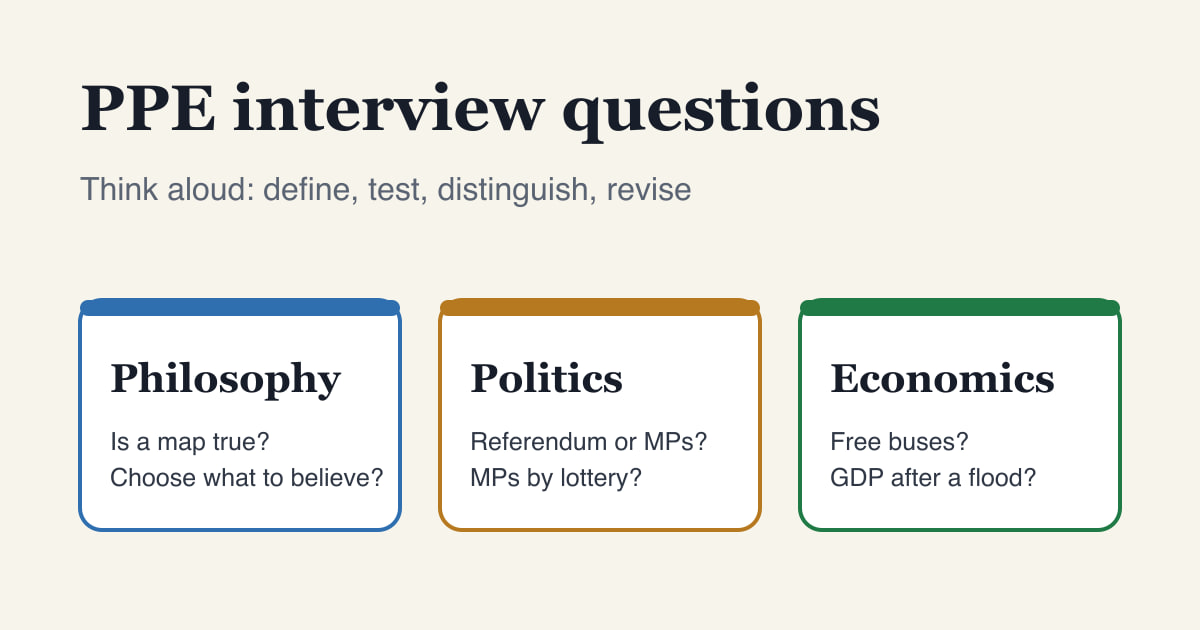
- PPE interview questions: a tier 2 interview with a shared whiteboard, where you define terms, take a position and weigh the other side. The guide gives lines of argument to practise.
- History interview questions: a tier 1 video interview about evidence and argument. The guide shows how to question a source and defend a reading of it.
Our own summaries of what to practise; none is a question Oxford has asked or will ask.
Oxford interview tips: how to answer when you do not know
- Start talking. Restate the question and say what you would try first. Oxford advises working through a question aloud if you do not know the answer at once: your final answer is only part of what tutors find out.
- It is fine not to know a topic. Oxford suggests you may say you have not covered it yet, then reason from what you do know; "the key thing is to appear interested".
- Use hints. Tutors may suggest another way of looking at the problem; they are looking for willingness to engage with new ideas and flexible thinking.
- Ask for the question again if you did not catch it. Oxford says not to be afraid to.
- Correct yourself out loud. Spotting your own error is good evidence of careful thinking (our advice).
- Questions at the end are optional. Oxford says your own questions do not form any part of the assessment.
From the Oxford interviews guide, read 8 November 2026, except where marked as our advice.
Two rules from Oxford's interviewee code of conduct also shape preparation: you agree not to share the content of your interviews with anyone, and not to use AI, transcription or other assistive tools beyond those your subject needs. Candidates who break the code are at serious risk of having an offer withdrawn. So be wary of any page that claims to sell real interview content or to know what will be asked; Oxford's own published sample questions are the official examples. Practise ways of thinking instead.
Oxford interview success rate
The Mathematics, Physics and Chemistry course pages publish the share of applicants interviewed and the share who were successful, as three-year averages. Dividing one by the other (successful ÷ interviewed, using the published averages) gives a rough comparison between courses; it is our arithmetic, not an Oxford offer rate.
| Course | Interviewed (share of applicants) | Successful (share of applicants) | Successful ÷ interviewed (our arithmetic) | Average intake |
|---|---|---|---|---|
| Mathematics / Mathematics and Statistics | 32% | 9% | about 28% | 183 |
| Physics | 31% | 11% | about 35% | 173 |
| Chemistry | 63% | 17% | about 27% | 180 |
From the Mathematics, Physics and Chemistry course pages, read 8 November 2026. Chemistry interviews about twice the share of applicants that Maths and Physics do.
Interviewed and successful shares and intake from each Oxford course page (3-year average, 2023 to 2025), read 8 November 2026. The fourth column is successful ÷ interviewed, rounded; the figures are three-year averages, so single years differ.
Across the university, Oxford's own figures give around 3,300 places for about 10,000 shortlisted candidates: roughly one place for every three shortlisted (our arithmetic, a ratio of places to candidates, not an offer rate). Oxford adds that being shortlisted is "a fantastic achievement in its own right" and that interviewees are strong contenders.
Practise the habit the interview rewards: thinking aloud on a question you have not seen. Four questions from our maths pack, one free try, with reasoning shown after each answer.
FreeTests: Number: counting factors · Proof: contradiction · Series: bounds · Probability: complement
Oxford Interview Questions: Maths: interview warm-up: free sample
Answer 4 questions against the clock, like the real exam. You then see the right answer, the reason and your time on each. About 8 minutes · free · no sign-in.
4 questions to answer
Start nowabout 8 minThis one is free · no sign-in needed
Your result shows how long each question took you.
Admissions tests and the interview
Oxford suggests thinking about your admissions test answers before the interview (without worrying if you cannot remember them in detail). For the three science courses in this guide:
| Course | Admissions test (2026) | What tutors say they look for |
|---|---|---|
| Mathematics | TMUA, Papers 1 and 2, taken 12 to 16 October 2026 | The potential to think imaginatively, deeply and in a structured manner about the patterns of mathematics |
| Physics | ESAT, modules Mathematics 1, Mathematics 2 and Physics, taken 12 to 16 October 2026 | The ability to apply basic principles to unfamiliar situations, and to put a problem in mathematical terms and extract the physical consequences |
| Chemistry | None: Oxford says you do not need to take a written test | Analysing, explaining and applying current knowledge, and a readiness to have a go at problems even when you cannot see how |
From the Mathematics, Physics and Chemistry course pages, read 8 November 2026.
Applying next year? The tests come before the interview: ProSyllabus has independent TMUA practice tests and an ESAT timed practice set.
A seven-day plan before your interview (ours)
| Day | Do |
|---|---|
| 7 | Re-read your personal statement and any written work; note two topics you could talk about for five minutes each. |
| 6 | Work two unfamiliar problems aloud, alone; record one and listen back for silences. |
| 5 | Check your technology tier; for tier 3, practise writing on a touchscreen with a stylus. |
| 4 | A mock interview with a teacher, parent or friend reading a problem you have not seen. |
| 3 | Revisit the topic you found hardest in your school course and your admissions test. |
| 2 | Read something in your subject beyond the syllabus and think about what you would ask its author. |
| 1 | Light practice, check your Teams link, paper, pen, water and a quiet room; read any pre-reading carefully. |
Our plan. Oxford's own preparation advice is to practise explaining your thinking with teachers, friends or family rather than formal mock interviews, and to explore your subject in the wider world.
One last practice run before you read the questions people ask most. Four questions from our maths pack, one free try, with reasoning shown after each answer.
FreeTests: Number: counting factors · Proof: contradiction · Series: bounds · Probability: complement
Oxford Interview Questions: Maths: interview warm-up: free sample
Answer 4 questions against the clock, like the real exam. You then see the right answer, the reason and your time on each. About 8 minutes · free · no sign-in.
4 questions to answer
Start nowabout 8 minThis one is free · no sign-in needed
Your result shows how long each question took you.
Frequently asked questions
When are Oxford interviews in 2026?
Shortlisted applicants are interviewed online in December 2026. Each course publishes its own timetable: for example, most Mathematics interviews are on 14 to 17 December, Physics between 9 and 15 December, and Chemistry first-college interviews on 7 to 10 December. Candidates may be asked to attend outside these dates.
When will I hear if I have an Oxford interview?
Oxford says invitations usually arrive by letter or email between the middle of November and early December, and you may get only a week's notice. Different courses send them on different days.
What questions are asked at an Oxford interview?
A few simple opening questions, perhaps about your personal statement or why you chose the course, then questions about your subject, which may involve a problem, text, graph or object you have not seen before. Tutors want to hear how you think, and there may be more than one valid way to answer.
What is the Oxford interview success rate?
Oxford's course pages publish the share of applicants interviewed and successful; we checked Mathematics, Physics and Chemistry. For 2023 to 2025 on average, Mathematics interviewed 32% of applicants and 9% were successful; Physics 31% and 11%; Chemistry 63% and 17%. Overall, Oxford has about 3,300 places for about 10,000 shortlisted applicants.
How should I prepare for an Oxford interview?
Oxford's top tip is to practise explaining what you are thinking, almost as if thinking out loud, in conversations with teachers, friends or family. Re-read your personal statement, think about your admissions test, read beyond the syllabus and practise unfamiliar problems aloud rather than learning answers.
What happens if I do not know the answer?
Oxford says not to panic: try to apply your mind to the question, explain your reasoning aloud, and say if you have not covered the topic yet. Tutors may suggest another way of looking at the problem, and they want to see how you respond to new ideas.
What if my internet fails during the interview?
Tell the interviewers if the connection is poor. If the interview cannot continue, Oxford says you will be offered another interview time.
When do Oxford decisions come out?
Shortlisted candidates for entry in 2027 are told the outcome on 12 January 2027 via UCAS, and colleges follow up directly later that day.
More in this series
Sources
- official — University of Oxford: Interviews (what they are, invitations, who interviews, what you will be asked, code of conduct, how to prepare; read 8 Nov 2026)
- official — University of Oxford: 2026 interview timetables, by course (read 8 Nov 2026)
- official — University of Oxford: Interview technology (Microsoft Teams, tiers 1 to 3, whiteboard and stylus; read 8 Nov 2026)
- official — University of Oxford: Mathematics course page (TMUA, interview, admissions statistics, what tutors look for; read 8 Nov 2026)
- official — University of Oxford: Physics course page (ESAT modules, interview, admissions statistics, what tutors look for; read 8 Nov 2026)
- official — University of Oxford: Chemistry course page (no admissions test, interview, admissions statistics, what tutors look for; read 8 Nov 2026)
official = a document published by the conducting body. reported = a news or coaching site we could not check against an original. Where sources disagree this page says so rather than picking one.