Checked 2 November 2026. The Stage 3 and Stage 4 descriptions and dates are as NATS’s careers page stated them on 2 November 2026. The NATS pages we read give no interview questions, knowledge test syllabus or pass marks, and do not describe the Stage 4 practical beyond the words quoted here; your invitation sets the details that apply to you.
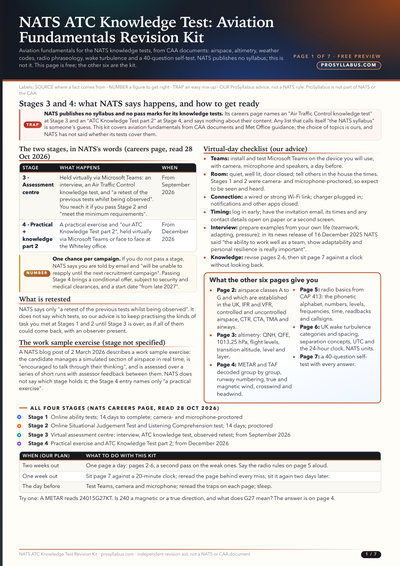
NATS Stage 3 is a virtual assessment centre on Microsoft Teams: an interview, an Air Traffic Control knowledge test and an observed retest of the previous tests. Stage 4 is a practical exercise and ATC Knowledge Test part 2, on Teams or at NATS’s Whiteley office. NATS says Stage 3 runs from September 2026 onwards and Stage 4 from December 2026 onwards.
That is close to everything the NATS pages we read say about these two stages. This guide sets out its words exactly, marks what it leaves unsaid, and then gives our own preparation: a free checklist for a day on Teams, a way to build interview examples around the qualities NATS names, where to start on the knowledge tests, and what NATS has said in public about a practical work sample exercise.
ProSyllabus is an independent study site, not part of NATS or the Civil Aviation Authority. Facts about NATS come from its careers page and the NATS news and blog items listed under Sources, read on 2 November 2026. Our own advice, our method and our example answers are marked as ours.
NATS, Training to be an Air Traffic Controller, read 2 Nov 2026.
FreeTests: Listening
NATS Stage 2 Practice · Listening Clip 1 · A descent with a correction: free sample
Answer 4 questions against the clock, like the real exam. You then see the right answer, the reason and your time on each. About 5 minutes · free · no sign-in.
4 questions to answer
Start nowabout 5 minThis one is free · no sign-in needed
Your result shows how long each question took you.
Stage 3 and Stage 4, in NATS’s words
| Stage | What NATS says | When |
|---|---|---|
| Stage 3: assessment centre | “If you pass the stage 2 assessments and meet the minimum requirements, you’ll be invited to attend an assessment centre. This is held virtually (via Microsoft Teams). You will take part in an interview and an Air Traffic Control knowledge test, as well as a retest of the previous tests whilst being observed.” | “Stage 3 assessment centres will take place from September 2026 onwards.” |
| Stage 4: practical exercise and knowledge test part 2 | If you pass the Stage 3 assessments, you are invited to take part in “a practical exercise” and “our ATC Knowledge Test part 2.” It is “held either virtually (via Microsoft Teams) or Face to Face at our Whiteley office.” | “Stage 4 assessment centres will take place from December 2026 onwards.” |
| If you do not pass | “If you don’t pass one of these stages, you will be notified by email and you will be unable to reapply until the next recruitment campaign.” | No date is given for the next campaign. |
| After Stage 4 | A conditional offer of employment, “subject to achieving relevant security and medical clearances”. Once you hold a Class 3 medical clearance, NATS assigns you to “the next available start date which will be from late 2027.” Security clearance begins approximately nine months before the start date. | Start dates from late 2027 |
Two details are worth reading slowly. First, the dates are start dates for each stage, “from September … onwards” and “from December … onwards”, with no end date, so your own invitation sets your day. Second, NATS lists the eligibility requirements for applying on the same careers page, but does not say whether the “minimum requirements” for Stage 3 include any further threshold. Our guide to all four NATS stages, eligibility and pay summarises the application requirements.
What NATS says, and what it does not
| Question | NATS’s page (2 Nov 2026) |
|---|---|
| Where is Stage 3 held? | Virtually, via Microsoft Teams. |
| Where is Stage 4 held? | Virtually via Microsoft Teams, or face to face at the Whiteley office. |
| Which previous tests are retested at Stage 3? | Not said. Only “a retest of the previous tests whilst being observed.” |
| Interview questions, panel or format | Not given on the NATS pages we read, beyond the virtual assessment centre on Teams. |
| Knowledge test syllabus, length or pass mark (either part) | Not given on the NATS pages we read. |
| What the practical exercise involves | Only “a practical exercise”. (A NATS blog describes a work sample exercise without naming its stage; see below.) |
| Pass rate for either stage | Not given on the NATS pages we read. |
So be wary of anything that claims to list “the questions NATS asks at Stage 3” or “the Stage 4 practical exercise answers”: the NATS pages we read give nothing such a list can be checked against. That is why this guide offers a method and our own example answers, clearly labelled, rather than a list of questions.
Before the day: the Teams checklist (free)
Stage 3 is on Microsoft Teams, and Stage 4 may be. Our advice is to check the practical arrangements early. NATS’s page does not give equipment rules for Stages 3 and 4; for Stages 1 and 2 it describes camera and microphone proctoring. The checklist below is ours.
Free · our checklist
Virtual assessment day on Microsoft Teams: our checklist
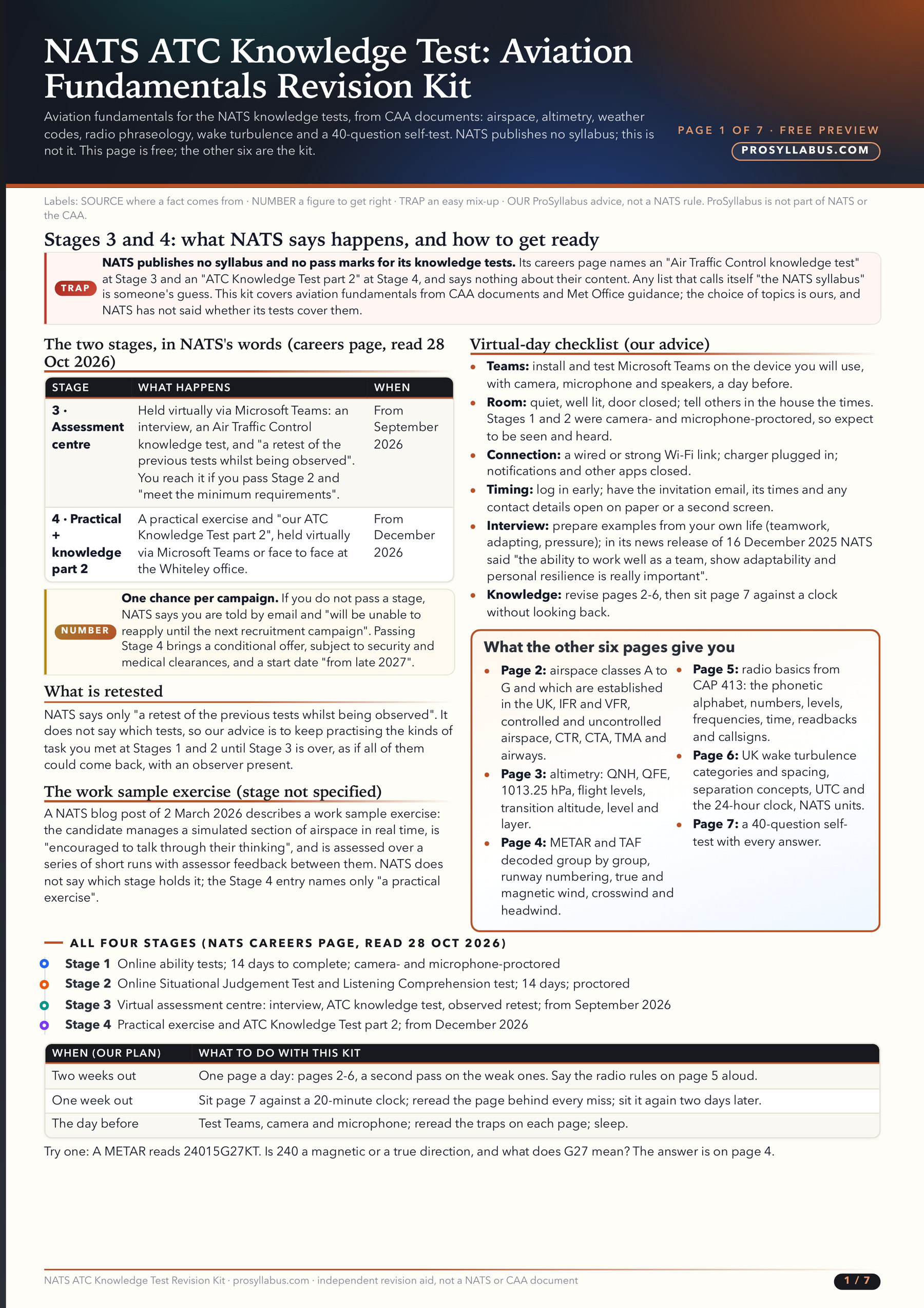
- Teams: install and test Microsoft Teams on the device you will use, with camera, microphone and speakers, a day before.
- Room: quiet, well lit, door closed; tell others in the house the times. For Stages 1 and 2 NATS describes virtual proctoring (camera photos where you consent, and the microphone detecting audio); follow whatever your invitation says for Stages 3 and 4.
- Connection: a wired or strong Wi-Fi link; charger plugged in; notifications and other apps closed.
- Timing: read the joining instructions beforehand and join at the time requested. During the assessments, use only the materials, screens and applications NATS permits.
- Interview: prepare true examples from your own life for teamwork, adapting and coping under pressure (the section below shows how).
- Knowledge: revise the aviation fundamentals you choose to study (our suggestions are in the knowledge test section), then test yourself without notes.
This checklist is adapted from page 1 of our NATS ATC knowledge test revision kit, whose page 1 is free to read in full: open page 1 free (full-size image to save), or read it on the kit page. Page 1 also sets out Stages 3 and 4 in NATS’s words and a two-week plan; no sign-in, nothing to pay.
Our advice, not NATS’s instructions. Your invitation from NATS is what counts: follow anything it says about equipment, ID or timing over this list.
FreeTests: Listening
NATS Stage 2 Practice · Listening Clip 1 · A descent with a correction: free sample
Answer 4 questions against the clock, like the real exam. You then see the right answer, the reason and your time on each. About 5 minutes · free · no sign-in.
4 questions to answer
Start nowabout 5 minThis one is free · no sign-in needed
Your result shows how long each question took you.
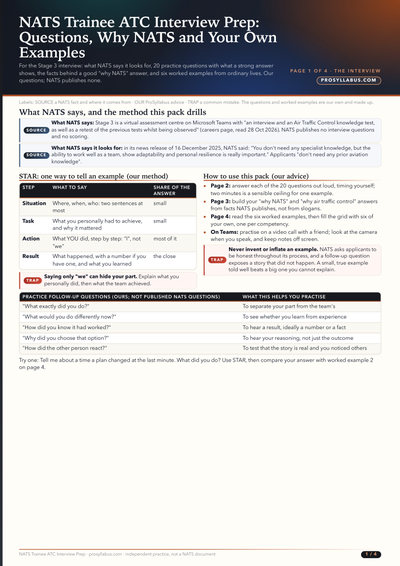
The Stage 3 interview: what NATS says it values
The NATS pages we read give no interview questions and no scoring. What NATS has said in public is which qualities matter, and those are the obvious themes to prepare examples for. Each line below quotes NATS; the right-hand column is our suggestion.
| Theme | What NATS has said | An example to prepare (our suggestion) |
|---|---|---|
| Teamwork | “the ability to work well as a team, show adaptability and personal resilience is really important” (news release, 16 Dec 2025) | A time you made a group succeed, with your own part clear |
| Adaptability | Same quotation; and from its 2 Mar 2026 blog: training “isn’t about being perfect on the first attempt; it’s about learning, applying feedback and building safe, repeatable habits” | A plan that changed at short notice, and feedback you acted on |
| Personal resilience | Same quotation; and on its careers page: “as air traffic controllers, you need to be able to be calm and measured in the face of setbacks and manage pressure and stress” | A setback you recovered from, and how you stay steady under pressure |
| Decisions under pressure | “What matters most is your ability to learn, make sound decisions under pressure and operate confidently in a safety-critical environment” (blog, 2 Mar 2026) | A decision you made with the clock running, and how you checked it |
| Honesty | An eligibility requirement: “Be 100% honest with all your answers, failure to declare something important may impact your clearance” (careers page) | A mistake you owned and put right |
| Why NATS, and moving | “An Air Traffic Controller is a mobile grade”; “you could be posted to any of these sites based on the company's needs” (careers page) | An honest answer about relocation and the long training |
STAR: one way to tell an example (our method)
A competency example is easier to follow when it has a shape. STAR is a common one, and our suggestion, not something NATS prescribes: Situation (where and when, in a sentence or two), Task (what you personally had to achieve), Action (what you did, step by step, saying “I” rather than “we”; this should be most of the answer) and Result (what happened, with a fact or number if you have one, and what you learned). In practice, aim for about two minutes per example, follow any timing the panel gives, and leave room for follow-up questions. Never invent or inflate an example: follow-up questions may expose invented details, and NATS asks for honesty throughout its process.
Here are two worked examples of our own. They are made up, from ordinary lives, to show the shape; yours should be true and yours.
Our example answer 1 of 2 (made up)
Adaptability: acting on feedback
Situation. In my part-time job on a council helpline, my team leader listened to my calls and told me I was interrupting callers before they had finished.
Task. I needed to fix it within a month, because my call reviews counted towards passing probation.
Action. I asked her for two recordings where it happened, so I knew exactly what to change. I started noting the caller’s key details on a pad while they spoke, waited until they had finished, then repeated the details back to check them before I replied. I asked her to review two more calls after a fortnight.
Result. At the next review she marked me as no longer interrupting, and I passed probation. Repeating details back also cut the number of callers who had to ring again. I learned to ask for specific examples of feedback, not just the summary.
Why this shape works (our view): the feedback was uncomfortable, the action is specific and personal, and the result is checked rather than assumed. NATS’s blog says its work sample observes how candidates “respond and adapt” to feedback between runs.
Our example answer 2 of 2 (made up)
Resilience: calm under pressure
Situation. I was a volunteer steward at a charity fun run when the radio link to the finish line failed twenty minutes before the start.
Task. My job was the start pen: I had to get 300 runners away safely without knowing whether the course was clear.
Action. I told the lead organiser straight away rather than starting on schedule. We agreed to hold the start, and I sent a marshal on a bike to check the course while I kept runners informed every five minutes with one short announcement each time.
Result. The course was clear and we started twelve minutes late with no complaints logged. The organisers now carry a spare radio. I learned that saying “we wait” early is easier than stopping something once it has started.
Why this shape works (our view): the safe choice is made early, the problem is passed to the right person, and people are kept informed. A “rule-breaking hero” story would show the opposite instinct.
Use these examples to structure your own. For more practice, our NATS practice bundle includes interview prep with 20 practice questions, what a strong answer shows for each, the facts behind a “why NATS” answer and six other worked examples with a grid for your own.
The ATC knowledge test, parts 1 and 2
NATS names an “Air Traffic Control knowledge test” at Stage 3 and “our ATC Knowledge Test part 2” at Stage 4. The pages we read give no syllabus, sample questions, length or pass mark for either, and NATS also says applicants need no prior aviation knowledge. Our suggestion, which is ours and not a NATS list, is to learn the vocabulary of air traffic control from the CAA’s own public documents: airspace classes, altimetry (QNH, QFE, flight levels and the transition), METAR and TAF weather codes, CAP 413 radio phraseology and readbacks, wake turbulence categories, and UTC.
| If you want… | Read |
|---|---|
| what to revise, topic by topic, with sources and a two-week plan | <a href="/hub/nats-atc-knowledge-test-what-to-study" style="color:#255a45;font-weight:600">NATS ATC knowledge test: what to study</a> |
| worked practice questions with answers | <a href="/hub/nats-atc-knowledge-test-practice-questions" style="color:#255a45;font-weight:600">NATS ATC knowledge test practice questions</a> |
| everything on seven pages, with a 40-question self-test | <a href="/kits/nats-atc-knowledge-test-revision-kit" style="color:#255a45;font-weight:600">the revision kit (page 1 free)</a> |
The observed retest at Stage 3
NATS’s whole description is “a retest of the previous tests whilst being observed.” It does not say which of the Stage 1 and Stage 2 tests come back, whether all of them do, or how the observation works. Stage 1 was, in NATS’s words, eleven online ability tests assessing skills “such as spatial awareness, logical thinking, numerical ability, sense of direction and reaction speed”; Stage 2 was an online Situational Judgement Test and an online Listening Comprehension test.
Our advice for the retest
Treat every kind of task you met at Stages 1 and 2 as live until Stage 3 is over, and keep practising them on independent practice tasks, this time with a friend watching you on a video call so that being observed feels ordinary. We have no Stage 1 practice; for the Stage 2 kind of task, our Stage 2 listening and judgement guide explains what NATS says, and the free sample below is four of our judgement questions in our quiz player.
FreeTests: Listening
NATS Stage 2 Practice · Listening Clip 1 · A descent with a correction: free sample
Answer 4 questions against the clock, like the real exam. You then see the right answer, the reason and your time on each. About 5 minutes · free · no sign-in.
4 questions to answer
Start nowabout 5 minThis one is free · no sign-in needed
Your result shows how long each question took you.
The Stage 4 practical exercise: what NATS has said
On the trainee page, Stage 4 contains “a practical exercise”, and nothing more is said there. Separately, a NATS blog post of 2 March 2026 describes a new “realistic work sample exercise as part of the assessment process.” In NATS’s words, it “puts the candidate in the seat of an operational controller, managing a simulated section of airspace in real-time.” “Candidates are briefed on the task, encouraged to talk through their thinking and assessed across a series of short runs. Between runs assessors provide feedback, and candidates are observed on how they respond and adapt.” The exercise is “mapped against the competencies required for training”, and “assessment decisions remain human-led.” A NATS news item of 19 January 2026 says a digital-twin platform, BLADE, was used in the Autumn 2025 trainee assessments.
NATS does not say that this work sample is the Stage 4 practical exercise, and we do not claim it is. The NATS pages we read give no detailed scoring, length, number of runs or candidate equipment, and we do not guess. The January 2026 news item does say candidates were “evaluated against key performance metrics including safety, efficiency and task completion”, and that recruiters could assess skills “such as situational awareness, communication and problem-solving”; it does not say these are Stage 4 criteria. What the blog does say is useful whichever stage it describes: the structure is deliberate, because “Air traffic control training isn’t about being perfect on the first attempt; it’s about learning, applying feedback and building safe, repeatable habits.” Our reading, which is ours: in your own preparation, practise explaining your thinking as you work through a problem, and practise taking a correction and visibly using it on the next attempt. On the day, speak aloud only when you are asked or allowed to. Our first worked example above shows acting on feedback; the second shows raising a safety concern early.
A plan from invitation to Stage 4 (ours)
Your Stage 3 and Stage 4 plan, ticked off as you go
Our suggested steps from the invitation to Stage 4. Tick each one when it is done.
0 of 14 done
Ticks are saved only in this browser on this device.
For where Stages 3 and 4 sit in the whole process, see the NATS trainee air traffic controller exam page, the four-stage guide and our guide to NATS practice tests by stage.
Everything we make for Stages 2 to 4, in one purchase
Our NATS practice bundle holds three things: interview prep for the Stage 3 interview (20 practice questions with our view of what a strong answer shows, the facts behind a “why NATS” answer, and six worked examples with a grid for your own); the seven-page knowledge test revision kit (airspace, altimetry, METAR and TAF, CAP 413 radio basics, wake turbulence and a 40-question self-test); and the Stage 2 practice test (six listening clips and 12 judgement scenarios) for the kinds of task the observed retest may bring back.
See the NATS practice bundle · read page 1 of the kit free · try the free Stage 2 sample. Independent practice by ProSyllabus; not made, endorsed or reviewed by NATS. Nothing in it is a NATS question, and nothing for Stage 1.
FreeTests: Listening
NATS Stage 2 Practice · Listening Clip 1 · A descent with a correction: free sample
Answer 4 questions against the clock, like the real exam. You then see the right answer, the reason and your time on each. About 5 minutes · free · no sign-in.
4 questions to answer
Start nowabout 5 minThis one is free · no sign-in needed
Your result shows how long each question took you.
Frequently asked questions
What happens at NATS Stage 3?
A virtual assessment centre on Microsoft Teams with an interview, an Air Traffic Control knowledge test and “a retest of the previous tests whilst being observed.” NATS says Stage 3 assessment centres take place from September 2026 onwards.
What happens at NATS Stage 4?
NATS says Stage 4 is “a practical exercise” and “our ATC Knowledge Test part 2”, held on Microsoft Teams or face to face at its Whiteley office, from December 2026 onwards. Passing it leads to a conditional offer.
What questions are asked in the NATS interview?
The NATS pages we read give no interview questions. It has said that the ability to work well as a team, show adaptability and personal resilience is really important, and its careers page says controllers need to be calm and measured in the face of setbacks and manage pressure and stress, so our suggestion is to prepare true examples for those themes, told with a clear structure such as STAR.
What is the NATS Stage 4 practical exercise?
The trainee page says only “a practical exercise”. A NATS blog of 2 March 2026 describes a work sample exercise in which candidates manage a simulated section of airspace over short runs with assessor feedback between them, but NATS does not say which stage that exercise belongs to.
What is retested at NATS Stage 3?
NATS says “a retest of the previous tests whilst being observed” and does not name which tests. Our advice is to keep practising the kinds of task you met at Stages 1 and 2 until Stage 3 is over.
Is it difficult to get into NATS?
The NATS pages we read give no pass rate for any stage. Its careers page says the path to becoming a controller “is not a quick and easy one”, and if you do not pass a stage you cannot reapply until the next recruitment campaign.
What happens after NATS Stage 4?
If you pass, NATS makes a conditional offer, subject to security and medical clearances. Once you have a Class 3 medical clearance it assigns the next available start date, from late 2027; security clearance begins about nine months before that date.
Sources
- official — NATS: Training to be an Air Traffic Controller (eligibility, the four assessment stages, Stage 3 and Stage 4 dates, onboarding, workplace conduct), read 2 November 2026
- official — NATS news, 16 December 2025: Air traffic control recruitment reopens for new trainees
- official — NATS blog, 2 March 2026: Innovation outside the Ops Room, how we’re evolving air traffic controller recruitment (the work sample exercise), read 2 November 2026
- official — NATS news, 19 January 2026: NATS unveils digital-twin platform for air traffic controller recruitment
- official — NATS FAQ: When do applications open for training as an Air Traffic Controller?, read 2 November 2026
official = a document published by the conducting body. reported = a news or coaching site we could not check against an original. Where sources disagree this page says so rather than picking one.