Checked 2 November 2026. Stage dates and wording are as NATS’s careers page stated them on 2 November 2026. NATS’s careers page gives no syllabus, sample questions or pass mark for its knowledge tests, so the questions here are our own practice on aviation fundamentals. CAA documents are revised from time to time; the editions read are named under Sources.
The short answer: NATS’s careers page gives no sample questions, syllabus or pass mark for the Air Traffic Control knowledge test it sets at Stage 3, or for “ATC Knowledge Test part 2” at Stage 4, so that page offers nothing to check practice questions against. What you can practise is the aviation vocabulary of air traffic control, and below are two worked practice questions of ours, a METAR to decode and a radio readback to check, each answered and traced to the CAA or Met Office document it comes from.
Checked 2 November 2026 against the NATS careers page and the CAA and Met Office documents listed under Sources. ProSyllabus is an independent study site, not part of NATS or the Civil Aviation Authority. The two questions below are our own, written for practice; they are not NATS questions and NATS has not seen or approved them. Facts about NATS come from its careers page; aviation facts come from the CAA and Met Office documents listed under Sources. Our own advice is marked as ours.
NATS, Training to be an Air Traffic Controller, read 2 Nov 2026.
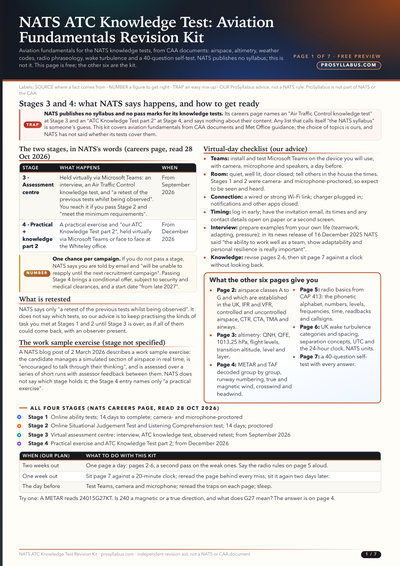
- Airspace classes and who needs a clearance
- QNH, QFE, flight levels and the transition
- METAR and TAF decoded group by group
- CAP 413: alphabet, numbers, readbacks, callsigns
- UK wake turbulence categories and spacing
- 40-question self-test with answers
What NATS says about the knowledge test, and what it does not
Everything in the left column is NATS’s own wording or a close summary of it, from its trainee controller careers page as read on 2 November 2026. The right column is what that page leaves out, so you know which claims elsewhere cannot be checked against NATS.
| Topic | What NATS says | What NATS does not say |
|---|---|---|
| Is there a knowledge test? | Yes. Stage 3 includes “an Air Traffic Control knowledge test”; Stage 4 includes “our ATC Knowledge Test part 2.” | What either test is called beyond that, or how the two parts differ. |
| When and where | Stage 3 is held virtually via Microsoft Teams, from September 2026. Stage 4 is held on Teams or face to face at the Whiteley office, from December 2026. | Exact dates for individual candidates. |
| Topics | Nothing. | Any syllabus, topic list or reading list. |
| Format | Nothing. | The number of questions, the time allowed or the question style. |
| Pass mark | Nothing. | A pass mark, a pass rate or how the test is weighed against the interview. |
| Prior knowledge | The Level 5 apprenticeship course “requires no prior aviation experience”. | How much aviation knowledge the tests assume. |
| If you do not pass | You are notified by email and “will be unable to reapply until the next recruitment campaign.” | A separate retake of the knowledge test, or when the next campaign opens. |
Because NATS’s careers page gives no syllabus, the topics we practise are our choice: the fundamentals set out in public CAA manuals. Our reasoning, and a topic-by-topic summary, is in our guide NATS ATC knowledge test: what to study. This page is the practice that goes with it.
Revise the fundamentals on seven pages
Our NATS ATC Knowledge Test Revision Kit covers the topics these questions come from: airspace classes, altimetry (QNH, QFE, flight levels and the transition), METAR and TAF, CAP 413 radio basics and UK wake turbulence categories, drawing on CAA documents and the Met Office decode sheet, with a 40-question self-test and every answer. Page 1 is free to read in full.
Preparing for Stage 2 as well? The NATS practice bundle adds our Stage 2 listening and judgement practice test and our interview preparation to the kit, for less than the kit and the Stage 2 test cost separately.
Independent practice by ProSyllabus, not made, endorsed or reviewed by NATS or the CAA. NATS’s careers page gives no syllabus; the choice of topics is ours.
How these practice questions work
Each question has four options and one correct answer. Read the question, choose your answer before you open the reveal, then compare your reasoning with ours. The explanation names the paragraph or table it relies on, so you can check it in the source rather than take our word for it. The aerodrome code, the callsign and the weather in both questions are made up; real aerodromes and airlines are not used.
- Airspace classes and who needs a clearance
- QNH, QFE, flight levels and the transition
- METAR and TAF decoded group by group
- CAP 413: alphabet, numbers, readbacks, callsigns
- UK wake turbulence categories and spacing
- 40-question self-test with answers
Worked question 1: read a METAR
A METAR is a routine report of the weather actually observed at an aerodrome. Controllers pass parts of it to pilots, so being able to read one group by group is basic vocabulary. The Met Office publishes a decode sheet for every group used below.
Worked question 1: which cloud layer matters?
A made-up aerodrome reports:
METAR EGXX 021050Z 25012G24KT 4500 -SHRA SCT008 BKN014CB 09/07 Q0996
Which statement about the cloud is correct?
- A. There is broken cloud with its base at 800 ft above the aerodrome.
- B. The lowest cloud covering more than half of the sky is cumulonimbus with its base at 1,400 ft above the aerodrome.
- C. The cumulonimbus base is 1,400 ft above mean sea level.
- D. BKN014CB means one to two eighths of cumulonimbus at 14,000 ft.
Show the answer and why
Answer: B
Cloud groups are written as an amount, a height and, for the two cloud types reported, a type. The Met Office decode gives the amounts in oktas, eighths of the sky: FEW is 1 to 2, SCT (scattered) 3 to 4, BKN (broken) 5 to 7, and OVC overcast. Heights are in hundreds of feet, and the decode says cloud heights are “given in feet above airfield height”, not above sea level.
So SCT008 is 3 to 4 oktas with its base at 800 ft: not more than half the sky, which rules out A. BKN014CB is 5 to 7 oktas of cumulonimbus (CB) with its base at 1,400 ft above the aerodrome, which is B. C uses the wrong datum, and D reads BKN as FEW and the height as thousands instead of hundreds.
The rest of the report, decoded the same way: issued on the 2nd at 1050 UTC (the Z); wind from 250 degrees true at 12 knots, with a maximum of 24; prevailing visibility 4,500 metres; light rain showers (“-” is light, SH showers, RA rain); temperature 9 °C and dew point 7 °C; QNH 996 hectopascals.
Source: Met Office, Aerodrome Actual Weather: METAR decode (wind, visibility, present weather, cloud, temperature and QNH groups).
Our tip: decode the cloud groups first and say each one aloud as amount, height, type. Check the height unit (hundreds of feet) and the datum (above the aerodrome) every time.
Worked question 2: check a readback
CAP 413, the CAA’s radiotelephony manual, lists the instructions a pilot must read back in full, and says why the rule is strict: the stringency of the readback requirement “is directly related to the possible seriousness of a misunderstanding.” Spotting a gap in a readback is one of the habits controller training builds.
Worked question 2: is this readback complete?
A controller transmits: “Redwing 418, descend to altitude 3,000 feet, QNH 996 hectopascals.”
The pilot replies: “Descend to altitude 3,000 feet, Redwing 418.”
Under CAP 413, which statement is correct?
- A. The readback is complete: only the level instruction has to be read back.
- B. The readback is incomplete: the altimeter setting must be read back in full, with “hectopascals” because it is below 1000.
- C. The readback is incomplete only because the callsign should come before the instruction.
- D. The pilot should have replied “WILCO” instead of repeating the level.
Show the answer and why
Answer: B
CAP 413 paragraph 2.69 lists the messages a pilot reads back in full. They include level instructions and “Altimeter Settings, including units when value is below 1000 hectopascals”. The pilot read back the level but left out the QNH, so the readback is incomplete, and A is wrong. Paragraph 3.4 is why the controller gave the units in the first place: the word ‘hectopascal’ is appended to any pressure setting below 1000 hPa (CAP 413’s own phraseology examples say “hectopascals”), so QNH 996 is read back with its units.
C is wrong because CAP 413 paragraph 2.68 requires a readback to include the callsign, and this one does; CAP 413’s own examples put the callsign at the end of the pilot’s readback, as here. D is wrong because WILCO, which CAP 413 defines as “I understand your message and will comply with it”, does not replace the readback of items on the paragraph 2.69 list.
What happens next? Paragraph 2.69 says that if a readback is not received, the pilot will be instructed to give it. If a pilot reads an item back wrongly, paragraph 2.71 says the controller transmits “NEGATIVE” followed by the correct version.
Source: CAA CAP 413 Edition 24, Chapter 2 paragraphs 2.68, 2.69 and 2.71; Chapter 3 paragraph 3.4.
Our tip: learn the paragraph 2.69 list as a set, then practise saying an instruction and its correct readback aloud. Remember to include the units for pressure settings below 1000 hPa.
Read page 1 of the revision kit free
Want to go further before you buy anything? Page 1 of our NATS ATC Knowledge Test Revision Kit is free to read in full: Stages 3 and 4 as NATS describes them, what NATS says about the observed retest, and our checklist for a virtual assessment day on Microsoft Teams. The other six pages cover the fundamentals and end in the 40-question self-test.
What the 40-question self-test covers
The two questions above are free. The kit’s self-test is longer and quicker-fire: 40 short questions across five areas, with every answer at the foot and a pointer back to the page that explains it. This is how its questions are spread.
| Self-test questions | Area | Kit page to reread |
|---|---|---|
| 1 to 8 | Airspace: the classes, flight rules, who needs a clearance, control zones | Page 2 |
| 9 to 15 | Altimetry: QNH, QFE, flight levels, transition altitude and layer | Page 3 |
| 16 to 25 | Weather, runways and wind: METAR and TAF groups, runway numbers, crosswind | Page 4 |
| 26 to 34 | Radio: phonetic alphabet, numbers, readbacks, callsigns, standard words | Page 5 |
| 35 to 40 | Time, wake turbulence and NATS: UTC, UK wake categories and spacing, the control centres | Page 6 |
Source: the self-test on page 7 of our NATS ATC Knowledge Test Revision Kit. The spread is our choice of emphasis, not a NATS weighting: NATS’s careers page gives no syllabus or topic weights.
- Airspace classes and who needs a clearance
- QNH, QFE, flight levels and the transition
- METAR and TAF decoded group by group
- CAP 413: alphabet, numbers, readbacks, callsigns
- UK wake turbulence categories and spacing
- 40-question self-test with answers
How to use practice questions well (our advice)
Practice questions are most useful as a check on understanding, not as something to memorise. Since NATS’s careers page gives no questions, a remembered answer is worth little; knowing why the answer is right is what carries over to a question worded differently. Our suggestions:
- Answer before you look. Commit to an option, then open the reveal; a guess you check teaches more than an answer you read.
- Trace every miss to its source. Each explanation names the CAA or Met Office paragraph; read the paragraph, not only our summary.
- Say radio phrases aloud. Readbacks, numbers and units are spoken skills, and a written answer can hide a spoken mistake.
- Mix the topics. Once each area feels familiar, shuffle them so you practise switching between airspace, weather and radio.
- Follow a plan. Our two-week plan for the knowledge test gives the order we suggest, with a self-test in the last days.
- Keep the earlier stages warm. NATS says Stage 3 includes “a retest of the previous tests whilst being observed”, without naming which, so our advice is to keep practising the kinds of task you met at Stages 1 and 2.
A word on question banks you find elsewhere
Search results for the NATS knowledge test include flashcard decks and question lists made by other users and by prep companies. NATS’s careers page gives no knowledge test questions, so none of them can be checked against that page, whatever they are called. Our advice is to judge any practice material by one test: does each answer point to a source you can open and read? If it does, it can teach you something true about air traffic control, whether or not NATS asks it. That is the standard we hold our own questions to.
Where this fits in the NATS process
The knowledge tests come late. NATS’s process has four stages: eleven online ability tests at Stage 1, then a situational judgement test and a listening comprehension test at Stage 2, then the Stage 3 assessment centre and, at Stage 4, a practical exercise and ATC Knowledge Test part 2. Our overview of every stage, with eligibility and pay, is in NATS trainee air traffic controller: stages and eligibility. If you are still at Stage 2, read our Stage 2 listening and SJT guide and try our NATS Stage 2 practice test.
We have no Stage 1 practice pack. NATS describes the skills its eleven Stage 1 ability tests assess, such as spatial awareness, logical thinking, numerical ability, sense of direction and reaction speed, but its careers page does not name or describe each test individually, and we have not produced a Stage 1 practice pack; our guide to NATS practice tests by stage explains what NATS does say about each stage. For the assessment centre as a whole, including the interview, see our NATS Stage 3 and Stage 4 guide. Every NATS page we have is gathered on the NATS trainee air traffic controller exam page.
Ready for the rest of the fundamentals?
The NATS ATC Knowledge Test Revision Kit is seven pages of aviation fundamentals from CAA documents and the Met Office decode sheet, with a 40-question self-test and every answer; page 1 is free. If you are also preparing for Stage 2 or the interview, the NATS practice bundle includes the kit, our Stage 2 practice test and our interview preparation, for less than the kit and the Stage 2 test cost separately.
Independent practice by ProSyllabus. Not made, endorsed or reviewed by NATS or the CAA, and not a NATS syllabus.
Frequently asked questions
Are there NATS ATC knowledge test sample questions?
Not on NATS’s careers page. It names an Air Traffic Control knowledge test at Stage 3 and an ATC Knowledge Test part 2 at Stage 4, and gives no sample questions, syllabus or pass mark. Practice questions you find, including ours, are written by others.
Are these real NATS questions?
No. Both questions on this page are our own, written for practice from CAA and Met Office documents. NATS has not seen or approved them, and we do not know what NATS asks.
How many questions are in the NATS knowledge test?
NATS’s careers page does not say. It gives no number of questions, time limit or question style for either part of the knowledge test.
What is the pass mark for the NATS knowledge test?
Its careers page gives no pass mark or pass rate. NATS says only that a candidate who does not pass a stage is told by email.
What should I revise for the NATS ATC knowledge test?
NATS’s careers page gives no topic list. Our suggestion is the fundamentals in the CAA’s own manuals: airspace classes, altimetry, METAR and TAF, CAP 413 radio phraseology and readbacks, wake turbulence categories and UTC. That is our choice, not a NATS list.
Can I retake the NATS knowledge test?
NATS’s careers page describes no separate retake. It says a candidate who does not pass a stage cannot reapply until the next recruitment campaign, and gives no date for that.
More in this series
- NATS ATC knowledge test: what to study (our suggestions, 2026)
- NATS trainee air traffic controller: eligibility, stages and pay
- NATS Stage 2 listening comprehension and SJT: what to expect
- NATS practice tests: what each stage tests and how to practise
- NATS Stage 3 and Stage 4: interview, knowledge test, practical
Sources
- official — NATS: Training to be an Air Traffic Controller (the four stages, Stage 3 and Stage 4 content and dates, reapply rule), read 2 November 2026
- official — CAA CAP 413 Radiotelephony Manual, Edition 24 (pages dated 1 July 2026): Chapter 2 paragraphs 2.68 to 2.71, Chapter 3 paragraph 3.4
- official — Met Office: Aerodrome Actual Weather, METAR decode (aviation training resources, METARs and TAFs)
- official — CAA CAP 493 Manual of Air Traffic Services Part 1, Edition 12 (effective 31 October 2025)
official = a document published by the conducting body. reported = a news or coaching site we could not check against an original. Where sources disagree this page says so rather than picking one.