Checked 3 October 2026. Pattern and marking are those of Recruitment Notification 01/2025 (unchanged by Corrigenda 1 to 3, which touch other clauses) and the CBSE schedules for the 2026 sittings. The notification says the examining body may change the mode and criteria at any stage. The Tier-2 syllabus PDF is on the KVS and NVS websites and we could not open it through their script-loaded listing, so no topic list is printed as official.
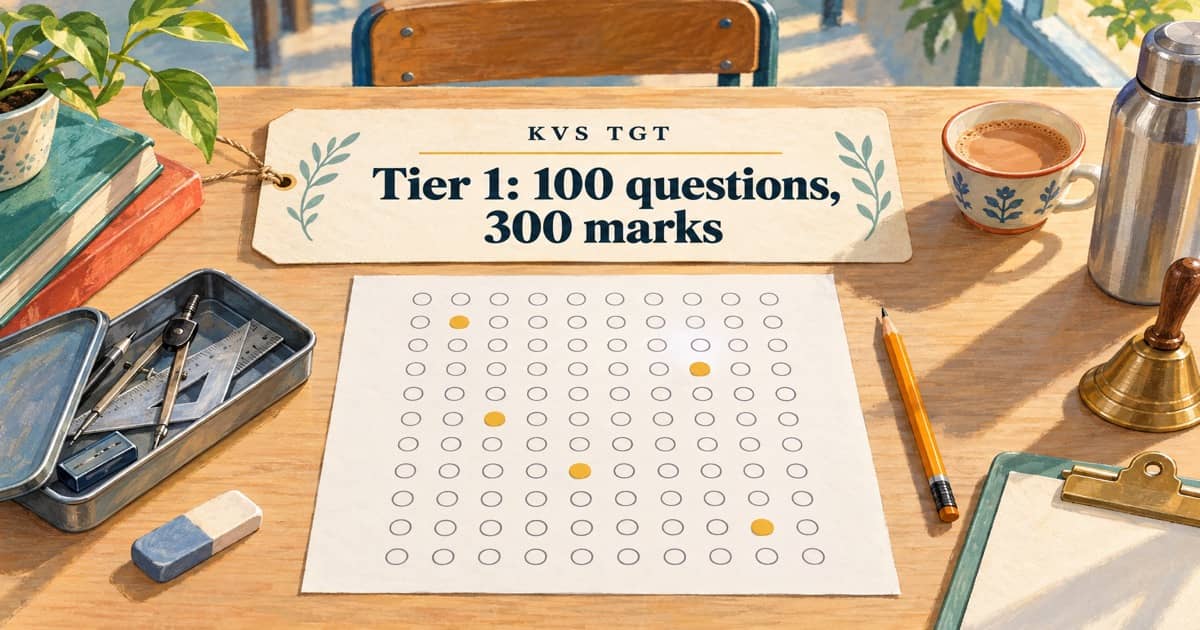
The KVS TGT recruitment has two written tiers and an interview. Tier 1 only shortlists; merit is built from Tier 2 and the interview. Tier 1 is a 100-question OMR screening test worth 300 marks, with one mark taken off for every wrong answer. Tier 2 is a subject paper of 70 questions worth 100 marks: 60 objective questions with a quarter-mark penalty and 10 descriptive questions worth 40. The notification, issued jointly by KVS and NVS and run by CBSE as Recruitment Notification 01/2025, fixes all of this in section 11. This guide sets it out part by part, gives a calculator for each tier, and is explicit about what the notification does not say.
All four figures are printed in Notification 01/2025, section 11.
ProSyllabus is an independent study site. We are not affiliated with, or endorsed by, the Kendriya Vidyalaya Sangathan, the Navodaya Vidyalaya Samiti or CBSE. Every rule below is quoted or summarised from their published documents, and the documents control if anything here differs.
Tier 1: six parts, one two-hour paper
Tier 1 is a preliminary, qualifying OMR test. It runs for two hours "without any time limit for each part of the test individually", so you can spend the 120 minutes as you like across the parts. Every question carries 3 marks. The total is 100 questions and 300 marks for every teaching post except Multi-Tasking Staff in NVS, which has its own pattern. For TGT, CBSE scheduled it on 11 January 2026 in the afternoon shift (2.30 to 4.30 PM), together with the other TGT and miscellaneous teacher posts, the Librarian, and several non-teaching posts.
| Part | Component | Questions | Marks | Language |
|---|---|---|---|---|
| I | General Reasoning | 20 | 60 | English and one of 12 Indian languages |
| II | Numeric Ability | 20 | 60 | English and one of 12 Indian languages |
| III | Basic Computer Literacy | 20 | 60 | English and one of 12 Indian languages |
| IV | General Knowledge | 20 | 60 | English and one of 12 Indian languages |
| V | Language Competency Test (English) | 10 | 30 | English only |
| VI | Language Competency Test (one other modern Indian language) | 10 | 30 | The language you chose at application |
| Total | Two hours, OMR | 100 | 300 |
Marks per part as printed in the notification. Every part is worth 3 marks a question.
Three details decide how you handle the paper. First, Parts I to IV (questions 1 to 80) are bilingual, in English and one of twelve languages: Hindi, Assamese, Bengali, Gujarati, Kannada, Malayalam, Marathi, Odia, Punjabi, Tamil, Telugu or Urdu. Second, Part VI is set only in the language you chose on the application form, and that choice, like the medium, "once filled, will not be changed under any circumstances". Third, the knowledge level for TGT is graduation. For comparison, the notification sets Tier-1 at post-graduation level for PGT and Principal and senior-secondary level for PRT, so a PRT or PGT preparation plan is not a TGT plan.
Tier 1 does not enter your final merit. It exists to shortlist candidates for Tier 2 "in the ratio of 1:10 (relative to notified vacancies)", with candidates tied with the last shortlisted candidate in each category also shortlisted. The notification publishes no minimum qualifying mark for Tier 1. How that shortlist behaved in practice is in the vacancies guide, which uses CBSE's registered, appeared and shortlisted counts.
Tier 2: 60 objective questions and 10 written ones
Tier 2 is a separate paper for each post, set in Hindi and English, and lasts two and a half hours, again without a time limit for each part. It is "a combination of Pen-Paper and OMR Based" test: the 60 objective questions are marked on an OMR sheet and the 10 descriptive questions are answered on paper. The notification says the detailed syllabus is on the KVS and NVS websites under the Recruitment heading. CBSE held it for TGT on the morning of 29 March 2026; the first schedule had said 28 March, and the notice of 10 March 2026 moved it.
| Component | Questions | Marks each | Total marks | Negative marking |
|---|---|---|---|---|
| Objective | 60 | 1 | 60 | 0.25 for each wrong answer |
| Descriptive | 10 | Not published | 40 | None stated |
| Total | 70 | 100 | 2.5 hours |
The 40 per cent that is written decides close cases; the notification does not state a per-question split.
The descriptive block is the part many candidates under-prepare. Forty of the 100 marks, and so 40 per cent of the only written paper that enters the merit list, come from ten questions answered in your own words. The notification gives no per-question split. If the 40 were divided equally each answer would be worth 4 marks; that is our arithmetic and the paper may differ. A useful way to plan the clock is also our arithmetic: if you give the 60 objective questions 60 minutes, you have 90 minutes of the 150 for ten written answers, about 9 minutes each. Nothing in the notification requires that split.
Marks calculator: Tier-1 and Tier-2 under the printed rules
Enter how many questions you got right and wrong. Tier-1 gives 3 marks for a right answer and takes away 1 for a wrong one (out of 300). Tier-2 gives 1 mark for a right objective answer and takes away 0.25 for a wrong one (out of 60), and you add your estimate for the 40 descriptive marks. Unanswered questions score nothing.
Our arithmetic from the printed rules (Notification, section 11, points d, o, r and s). The notification does not publish a minimum qualifying mark for Tier-1 or Tier-2, so this tool never says "qualified". Tier-1 marks are not carried into the merit list. The descriptive marks are your own estimate; nothing official says how the 40 are divided across the 10 questions.
| Stage | Right answer | Wrong answer | More than one bubble | Blank | Maximum |
|---|---|---|---|---|---|
| Tier-1 | +3 | -1 | Wrong: -1 | 0 | 300 |
| Tier-2 objective | +1 | -0.25 | Wrong: -0.25 | 0 | 60 |
| Tier-2 descriptive | Marks per answer | No deduction stated | Not applicable | 0 | 40 |
The table is the notification's marking rule in one place. It says "filling up/darkening more than one response in any question will be treated as wrong response", and deducts the full wrong-answer penalty for it. Unanswered questions get nothing in either tier, and "there is only one correct response for each question."
Negative marking, and when guessing pays
In Tier 1 a right answer is worth 3 and a wrong one costs 1, which is one third of the question's marks. With four options a blind guess has a one-in-four chance, so its expected value is 3 x 0.25 minus 1 x 0.75, which is exactly zero: guessing blind neither helps nor hurts on average. Rule out one option and the expected value rises to +0.33. In Tier 2 the objective rule is gentler: 1 mark for a right answer against 0.25 for a wrong one gives a blind guess an expected +0.0625, so guessing is mildly positive and any option you can eliminate improves it. The calculator below does the arithmetic for any number of options and eliminations; it assumes four options because the notification does not state the number.
Should you guess? Expected marks per blind answer
Pick the stage and how many options you can rule out. The tool shows the expected marks from answering one question against 0 for leaving it blank. The notification does not say how many options each question has; four is the usual OMR layout, so that is the default and you can change it.
These are averages over many questions, not advice for any one. What the arithmetic does say is that the two tiers want different habits: a disciplined, accuracy-first Tier 1 where blind guesses are a coin flip with no edge, and a Tier 2 where a reasoned guess on the objective part is cheap and the written part carries the paper.
What happens after the paper: keys, challenges and re-evaluation
CBSE displays the scanned OMR sheet and the provisional answer key for Tier 1 and Tier 2 objective questions; the notification says the keys "are likely to be displayed for two to three days". A candidate can challenge a key answer for a non-refundable fee of Rs 1,000 per question, refunded if the subject expert accepts the challenge. "There is no provision of re-evaluation" for the OMR tests or for the written and descriptive part of Tier 2, and no request for it will be entertained. If a question is misprinted or ambiguous, "a policy decision will be taken as per the recommendation of subject experts". The result follows the final key, and no grievance about the key is entertained after the result.
| Item | What the notification says |
|---|---|
| Key challenge fee | Rs 1,000 per question, non-refundable unless the challenge is accepted |
| Challenge window | Keys "likely to be displayed for two to three days" under a public notice |
| Re-evaluation | None for OMR Tier-1, nor for OMR, written or descriptive Tier-2 |
| Scanned OMR copy | Displayed on CBSE, KVS and NVS websites for download |
| Record keeping | Response (OMR) sheets and related papers kept as record for six months from the date of publication of the result, then weeded out |
The syllabus: what is official and what is not
The notification does not print a Tier-2 topic list. It points to the KVS and NVS websites, and CBSE's FAQ answers the "Syllabus / Negative marking" question by sending candidates back to the notification. On 3 October 2026 we could not open an official Tier-2 TGT syllabus PDF: the KVS "Syllabus" page loads its documents by script and the saved page contained no document links. So this guide does not print a topic list and call it official. What the notification does fix, and what you can build a plan on, is below.
| Anchor | Fact | Source |
|---|---|---|
| Tier-1 level | Graduation level for TGT (post-graduate for PGT; senior secondary for PRT) | Notification 11(i) to (l) |
| Tier-1 content | Reasoning, numeric ability, basic computer literacy, general knowledge, English, one Indian language | Notification 11(d) |
| Tier-2 content | "Detailed syllabus on KVS and NVS website under Recruitment Heading" | Notification 11(r) |
| Subjects you must have studied | See the concerned-subject rules per post: Hindi, English and Sanskrit as elective or main subject for 3 years or 6 semesters; the Mathematics, Science and Social Studies combinations | Notification, section 2F and 2G |
The last row matters most for planning. A TGT subject paper is set at graduation level in the subject, and the notification's "concerned subject" rules tell you which graduation subjects you are expected to have studied. For example, TGT Mathematics requires Mathematics as the main or elective subject for three years or six semesters, plus Physics for at least a year and one of Chemistry, Electronics, Computer Science or Statistics. TGT Social Studies requires two of History, Geography, Economics and Political Science, one of which must be History or Geography for three years. Those lists are quoted in the eligibility guide. Download the Tier-2 syllabus itself from the KVS Recruitment page (kvsangathan.nic.in) or the CBSE recruitment page (cbse.gov.in) and check it against your degree.
Tier 1 and Tier 2 compared, and what they are not
| Feature | Tier-1 | Tier-2 |
|---|---|---|
| Purpose | Screening; shortlist for Tier-2 at 1:10 | Subject test; counts toward merit, shortlist for interview at 1:3 |
| Questions and marks | 100 questions, 300 marks | 70 questions, 100 marks |
| Time | 2 hours | 2.5 hours |
| Negative marking | 1 per wrong answer | 0.25 per wrong objective answer |
| Mode | OMR | OMR plus pen and paper |
| Medium | Parts I-IV bilingual; V English; VI chosen language | Hindi and English (language posts differ) |
| 2026 date for TGT | 11 January 2026, 2.30-4.30 PM | 29 March 2026, morning |
| Minimum qualifying mark | Not published | Not published |
The two tiers are not interchangeable preparation. Tier 1 rewards speed and accuracy across general topics at graduation level; Tier 2 rewards depth in your own subject, and its written half rewards the habit of writing a complete answer under time pressure. The notification's weights make the second the one that matters: merit is built on Tier-2 marks and the interview, as explained in the selection and merit guide. For salary and posting terms see the pay guide.
Frequently asked questions
What is the KVS TGT exam pattern?
Two written tiers and an interview. Tier 1 has 100 questions worth 300 marks (reasoning, numeric ability, basic computer literacy and general knowledge at 60 marks each, English and one Indian language at 30 each) in two hours. Tier 2 has 60 objective and 10 descriptive questions worth 100 marks in 2.5 hours.
Is there negative marking in KVS TGT?
Yes. In Tier 1, 1 mark is deducted for each wrong answer (one third of the 3 marks). In Tier 2 objective questions, 0.25 mark is deducted for each wrong answer. Unanswered questions carry no penalty, and marking more than one option counts as a wrong answer.
Do Tier 1 marks count in the final merit?
No. Tier 1 is a qualifying screening test. The merit list is built from Tier-2 marks (85 per cent) and interview marks (15 per cent). Tier 1 decides who is shortlisted for Tier 2, at a ratio of 1:10 against notified vacancies.
What are the qualifying marks for Tier 1 or Tier 2?
The notification does not publish a minimum qualifying mark for either tier, and we found none in the CBSE corrigenda or notices. Shortlisting is by rank within each category against a ratio of notified posts.
How many questions are descriptive in Tier 2, and how many marks?
Ten descriptive questions carry 40 of the 100 marks. The notification does not say how the 40 marks are divided across the ten questions or state a negative mark for them.
When were the KVS TGT exams held?
CBSE held Tier 1 for TGT on 11 January 2026 (afternoon shift) and Tier 2 on 29 March 2026 (morning shift), after a notice of 10 March 2026 moved Tier 2 from 28 March.
Where is the official KVS TGT syllabus?
The notification says the Tier-2 syllabus is on the KVS and NVS websites under Recruitment. We could not open it through the script-loaded KVS page on 3 October 2026, so we do not print a topic list as official. Use the KVS and CBSE recruitment pages.
Sources
- official — CBSE, KVS and NVS: Recruitment Notification 01/2025, detailed notification (KVS copy, 52 pages)
- official — CBSE: Corrigendum I dated 21 November 2025
- official — CBSE: Corrigendum 2 dated 4 December 2025 (TGT qualifications aligned across KVS and NVS)
- official — CBSE: Public Notice dated 8 January 2026 (Tier-1 schedule by post)
- official — CBSE: Public Notice dated 28 February 2026 (Tier-1 result; first Tier-2 schedule)
- official — CBSE: Public Notice dated 10 March 2026 (Tier-2 schedule modified; TGT on 29 March 2026)
- official — CBSE: Public Notice dated 21 November 2025 (Tier-1 on 10 and 11 January 2026)
- official — Kendriya Vidyalaya Sangathan: Recruitment page
- official — CBSE: Recruitment page listing every KVS/NVS 2025 notice, with the twelve result phases
official = a document published by the conducting body. reported = a news or coaching site we could not check against an original. Where sources disagree this page says so rather than picking one.
More in this series
- KVS TGT vacancies by subject and category
- KVS TGT selection process, merit formula and interview
- KVS TGT eligibility, age limit and CTET
- KVS TGT salary, pay level and allowances
- KVS TGT updates and alerts
- KVS PRT updates (PRT rules differ: Level 6, age 30, CTET Paper I)
- KVS PGT updates (PGT rules differ: Level 8, age 40, no CTET)
- KVS Principal and Vice-Principal updates