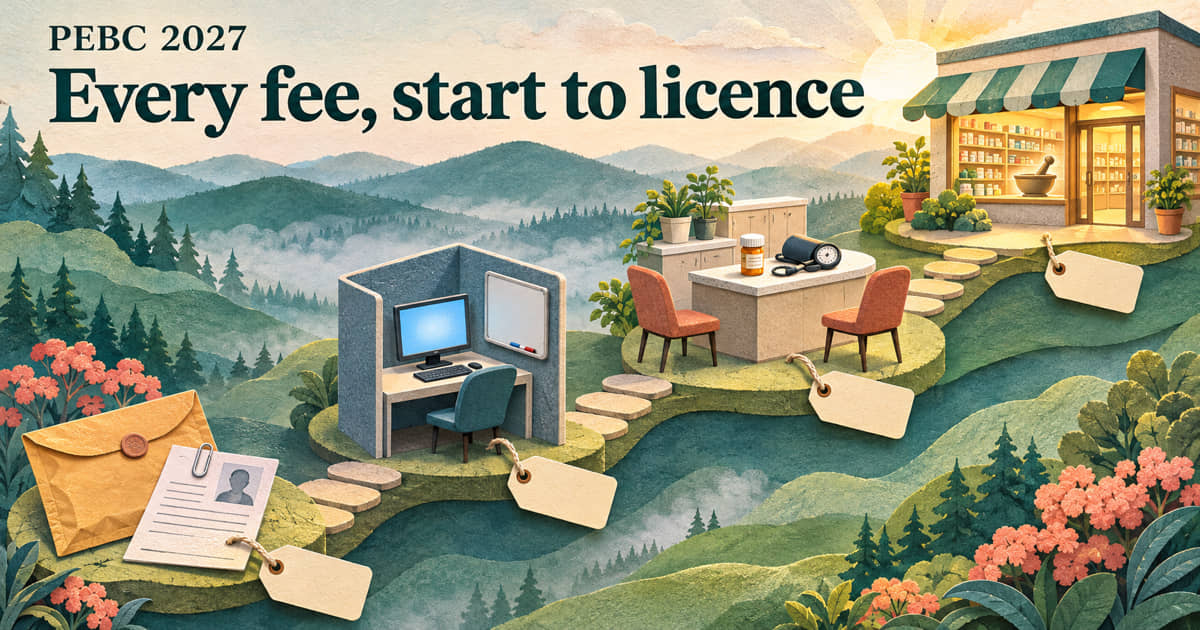
Checked 25 Nov 2026. Pathway, fees, dates and language scores from PEBC, Pharmacists' Gateway Canada (NAPRA), the Ontario College of Pharmacists and the University of Toronto, read 22-25 Nov 2026. PEBC's 2027 results dates are still to be confirmed and provincial steps change: check the linked pages before you book or pay.
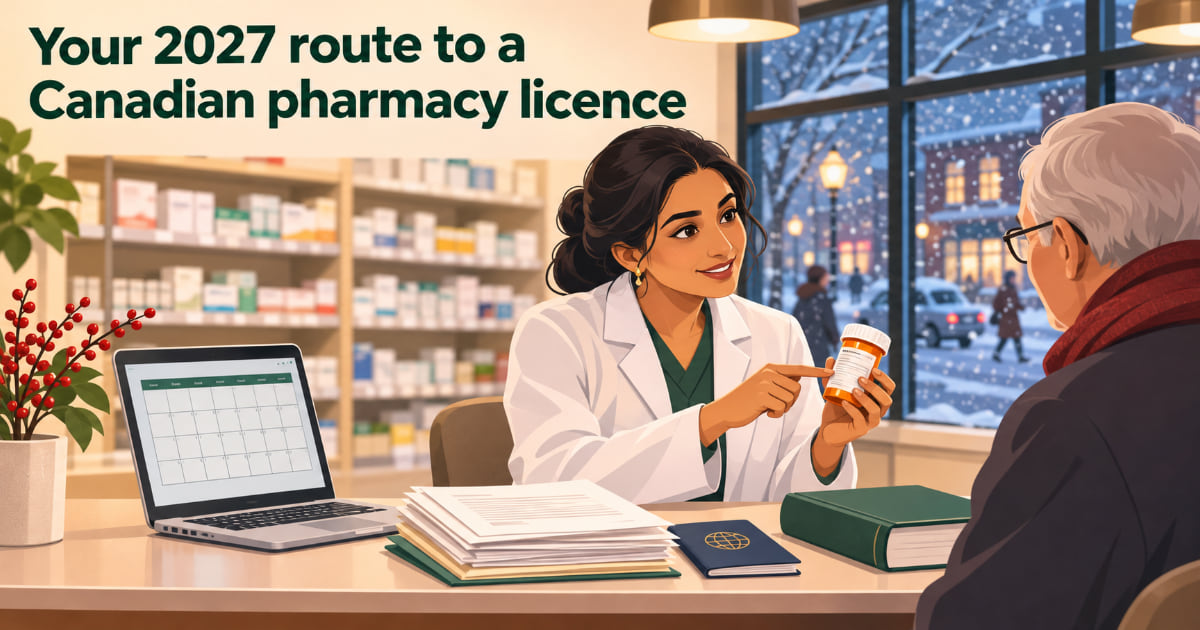
From January 2027, an international pharmacy graduate who wants to practise outside Quebec, has not passed the old Evaluating Exam and is not a graduate of an ACPE-accredited US PharmD program (their PEBC pathway is unchanged), becomes a pharmacist in five stages: enrol in Pharmacists' Gateway Canada, pass PEBC Document Evaluation, pass the PEBC Pharmacist Qualifying Examination Part I (multiple-choice), then Part II (OSCE), and meet your province's own requirements (language, then whatever mix of bridging program, practical training or assessment and jurisprudence exam it sets, then registration). The PEBC Evaluating Exam is gone: PEBC says the October 2026 sitting was the last one, and from January 2027 you go straight from a valid Document Evaluation to Part I. If you passed the Evaluating Exam, or you are heading to Quebec, your route differs: both are covered below.
Some official Gateway pages have not caught up: the Gateway's planning page still says PEBC exams are offered twice a year (PEBC's 2027 schedule has four Part I windows), and its province pages, while noting that the Evaluating Exam is discontinued from January 2027, still describe bridging-program entry in terms of it. This guide follows the official pages only: PEBC, NAPRA's Gateway, the Ontario College of Pharmacists (OCP) and the bridging program's own page, each linked at the end with the date we read it. Our timeline and checklist are labelled as ours. Quebec has its own route and is covered in one paragraph.
PEBC new pathway page and 2026/2027 schedule, read 22 Nov 2026.
FreeTests: 1A Providing Care: Clinical Care · 1B Providing Care: Distribution · 2 Knowledge and Expertise
PEBC Qualifying Exam Part I Practice Test: free sample
Answer 4 questions against the clock, like the real exam. You then see the right answer, the reason and your time on each. About 6 minutes · free · no sign-in.
4 questions to answer
Start nowabout 6 minThis one is free · no sign-in needed
Your result shows how long each question took you.
The PEBC Evaluating Exam has ended: what replaced it
PEBC's new pathway page (last updated 10 Aug 2026) says that effective January 2027 international pharmacy graduates (IPGs) no longer need to pass the Pharmacist Evaluating Examination to be certified. The October 2026 exam, held on 15 October with results on 5 November, was the last one. What you do now depends on where you were when the old exam stopped:
| Where you are | What PEBC says now |
|---|---|
| New to PEBC, or Document Evaluation in progress | Complete Document Evaluation, then apply for Part I (MCQ). Part II (OSCE) opens only after you pass Part I. |
| Passed the Evaluating Exam (up to and including October 2026) | No change: apply for Part I and Part II in the same session or in either order, unless you have failed Part II before, in which case you must pass Part I before applying for Part II again. Your Document Evaluation no longer expires. |
| Failed the Evaluating Exam, including after 4 attempts | You can continue under the new pathway with a valid Document Evaluation. Third-attempt remediation from the old exam is not required. If you used all 4 attempts and your Portal account was closed, PEBC says it has been reactivated (do not create a new one); with no account, email doceval@pebc.ca. |
| Document Evaluation expired, or expiring before the first day of the Part I window you want | Document Re-evaluation first (not needed once you have passed Part I or the old Evaluating Exam, after which your Document Evaluation stays valid). It must be officially complete at least 2 business days before the Part I application deadline, and PEBC warns it cannot be done in 2 business days. |
| US graduate of an ACPE-accredited Doctor of Pharmacy program | Not affected: PEBC says the US-graduate pathway is unchanged. |
PEBC also says it is adding more Qualifying Exam sittings in 2027 and an optional readiness tool for Part I. The number of attempts does not change: up to four at each Part, with exam-specific remediation after a third failure. Whatever your route, the photo from your Document Evaluation lasts 5 years: if it has expired or will expire before your next exam, a Photo Renewal must be completed and approved before you can apply. If you came here looking for the old exam itself, our Evaluating Exam page now explains the change and points to Part I.
The whole route at a glance
| Step | Who runs it | What it gives you | Official fee or time | Source |
|---|---|---|---|---|
| Stage 1: Pharmacists' Gateway Canada | NAPRA | National ID number needed to apply to PEBC; a profile your province can read | $390 plus taxes | Gateway |
| Stage 2: Document Evaluation | PEBC | Proof your degree and licensing are acceptable; valid 5 years until you pass Part I | $715; up to 8 weeks once your file is complete | PEBC |
| Stage 3: Qualifying Exam Part I (MCQ) | PEBC, at Prometric centres | Pass on Part I; unlocks Part II | $870 (2027); one 4.5-hour computer-based sitting | PEBC |
| Stage 4: Qualifying Exam Part II (OSCE) | PEBC, in person in Canadian cities | PEBC Certificate of Qualification once both parts are passed, within three years of each other | $1,950 (2027) | PEBC |
| Stage 5a: Language proficiency | Your provincial regulator; many adopt or adapt NAPRA's recommendations | Test scores (or other evidence your regulator accepts) in the language it requires; Ontario test scores valid two years | Set by the test provider | Gateway; OCP |
| Stage 5b: Provincial requirements | Your pharmacy regulatory authority (PRA) | Varies by province: a bridging program, practical training and/or an assessment, usually a jurisprudence exam (not in Prince Edward Island since July 2023), plus checks such as liability insurance and a police check in Ontario | Varies; see the Ontario, BC and Alberta sections below and your regulator's site | Gateway; OCP |
| Stage 5c: Registration (licence) | Your PRA | Licence to practise in that province (Ontario, BC and Alberta charge an annual fee) | Ontario: $111.10 application + $886.40 annual fee (pro-rated from 1 Sep to 9 Mar) | Gateway (Ontario) |
Every fee in this table, plus re-scoring, rescheduling and the provincial fees, is broken down in our PEBC exam cost guide. Only some provincial steps can run alongside the PEBC exams. In Ontario, the University of Toronto IPG Program now admits on Document Evaluation and English proficiency, and OCP lets you meet the Qualifying Exam requirement "at any time" before the final application; but the jurisprudence exam opens only after bridging (or a first-attempt pass on both parts), and your language scores must still be valid when your applications are processed.
- October 2026: Enrolled in Pharmacists' Gateway Canada (national ID), university and licensing authority already asked to send their documents straight to PEBC, PEBC Portal application paid.
- By about 24 Dec 2026: Every Document Evaluation item received and accepted: PEBC does not guarantee an exam application if requirements are not met 8 weeks before its deadline.
- By mid-February 2027: Document Evaluation officially complete (the confirmation letter in your Portal) at least 2 business days before the May 2027 Part I deadline of 18 Feb 2027, noon Eastern, with the exam application open in your Portal in time to submit it (the letter and the application can each take up to a week to appear; PEBC lists the date the May 2027 application opens as to be confirmed).
- 12-31 May 2027: Qualifying Exam Part I (MCQ) on one of PEBC's administration days. Results about six weeks later (the Gateway's estimate; PEBC lists the 2027 release dates as to be confirmed).
- By 5 Aug 2027: Only if your Part I pass has been released by then: apply for Part II (OSCE) on 6 Nov 2027 before noon Eastern on 5 August. If the result comes later, your OSCE moves to a 2028 session (2028 dates are not in the schedule we cite; check PEBC's current schedule).
- Autumn 2027: English or French test, so the scores are still valid when OCP processes your applications (in Ontario, two years).
- 6 Nov 2027: Part II (OSCE). PEBC certification follows a pass on both parts, within three years of each other.
- December 2027 to May 2028: Assuming the November OSCE result arrives in December (the November 2026 results are scheduled for 17 December; the 2027 date is to be confirmed): apply to OCP through your Gateway profile (4 to 6 weeks for an OCP number), register as an intern, then the Jurisprudence, Ethics and Professionalism Exam, PACE (one orientation week and a 70-hour assessment over two or three weeks) and the final application for a certificate of registration.
Starting from scratch now? Shift the first bars to your own start date: PEBC says it cannot guarantee an exam application if Document Evaluation requirements are not met 8 weeks before the deadline, which for May 2027 is about 24 December 2026. May is still possible if your documents arrive and are processed in time, but in our view July 2027 (deadline 13 May) is the safer target for Part I. On the Gateway's six-week estimate, July results would come after the 5 August deadline for the November OSCE, so plan on Part II in a 2028 session (2028 dates are not in the schedule we cite; check PEBC's current schedule); November stays possible only if your pass is released and you apply before that deadline.
Our illustration, not a PEBC or OCP schedule, and one conditional plan rather than the only or fastest one. Exam windows and deadlines are PEBC's 2027 schedule (read 22 Nov 2026); the other bars use the Gateway's and OCP's stated times. It assumes a pass on both PEBC parts at the first attempt, which in Ontario removes the bridging program, results released in time for the next application, and no waiting between steps. OCP itself says that route "could be completed within 18 months"; the Gateway quotes an older study's average of about 26 months. A slow university or a late Document Evaluation moves the exam bars; a failed attempt also means a new exam application and, in Ontario, the standard route with the bridging program, so you replan from the real deadlines and result dates.
Stage 1: enrol in Pharmacists' Gateway Canada
The Gateway, run by the National Association of Pharmacy Regulatory Authorities (NAPRA), is the mandatory first step for every IPG who needs a PEBC Certificate of Qualification, which the Gateway says every province except Quebec requires. Enrolment costs $390 plus applicable taxes and gives you the national ID number PEBC asks for when you apply for Document Evaluation. Your profile then holds what PEBC uploads and your language test report, and your province reads it once you apply there. The Gateway notes that a degree from an internationally CCAPP-accredited program gets no special standing: those graduates follow the same steps.
Stage 2: PEBC Document Evaluation
With your Gateway ID, create a PEBC Portal account. PEBC recommends contacting your university and licensing authority before you complete the online application. Two rules make the timing matter: PEBC tracks your 2-year application period from the day you pay, and it shreds a transcript if it has not received your application one year after receiving that transcript. Then complete the application and pay the $715 fee. PEBC then needs, in hard copy or sent directly by the institution: a properly witnessed printed application form, a certified copy of your identity documents, proof of graduation sent by your university, licensing statements sent by your licensing authority, and any statutory declarations, which you mail yourself. Copies are certified by a notary public, commissioner for oaths or embassy or consulate official (stamp or seal and signature), or by a lawyer or a pharmacist or pharmacy technician licensed in Canada (licence number and signature); the witness must be in good standing, the documents must show their original stamp or signature, and PEBC never returns documents.
Timing is the trap. PEBC tells you within 6 weeks of receiving your hard-copy application whether anything is missing, and the "up to 8 weeks" for the evaluation itself starts only when every item is in. If your file is not complete 8 weeks before an exam application deadline, PEBC does not guarantee you can apply for that exam. If documents are still missing 2 years after you paid, your file closes, the fee is not refunded, your documents are shredded 6 months later, and re-applying means paying the full fee again. A successful result is valid for 5 years from the date on your Document Evaluation results letter and must still be valid on the first day of the exam window you apply for. If you do not pass Part I within those 5 years, your file is closed and you must complete Document Re-evaluation before you can apply for another exam. Once you pass Part I it stays valid for the rest of your pathway; the 5-year photo limit still applies.
Document Evaluation checklist (our list, from PEBC's page)
- Gateway enrolment done and your NAPRA ID number to hand.
- PEBC Portal account created, online application completed, $715 paid (Visa or Mastercard online). Note the date you paid.
- Printed application form signed in front of an acceptable witness: a notary, commissioner for oaths or embassy or consulate official adds a stamp or seal and signature; a lawyer or a pharmacist or technician licensed in Canada adds a licence number and signature.
- Certified copies of your identity documents: a copy of the original (never a copy of a copy), each page stamped and/or signed by the witness as an exact duplicate.
- Your university asked to send proof of graduation straight to PEBC, by email or post.
- Your licensing authority asked to send licensing statements straight to PEBC; any statutory declarations mailed by you.
- Any document not in English or French: an English or French translation prepared by an official, certified translator (if translated in Canada, by a translator appointed by one of the provincial bodies PEBC lists), following PEBC's translation guidelines.
- A passport-acceptable photo taken within the past year, attached to the application: not a photocopy and not altered.
Our summary of PEBC's "Applying for Document Evaluation" page (read 25 Nov 2026). PEBC can ask for more; follow its page and Portal messages.
Stage 3: PEBC Qualifying Exam Part I (MCQ)
Part I is a single-day, computer-based multiple-choice exam at Prometric test centres: 200 questions (150 scored and 50 pre-test) in one 260-minute section, inside a 4 hour 30 minute sitting. By PEBC's blueprint, Part I weights clinical care 50%, distribution 20%, knowledge and expertise 11%, communication and collaboration 4%, leadership and stewardship 3% and professionalism 12%. PEBC sets the pass mark by expert standard-setting and equating, reports only pass or fail, and adds a feedback report to the Portal of candidates who fail, about 8 weeks after results. How to study each competency, with sample questions, is in our PEBC MCQ sample questions and syllabus guide.
| Part I window (2027; testing on set days only) | Application deadline (noon Eastern) | Part II (OSCE) in the same session |
|---|---|---|
| 10-25 February | 19 Nov 2026 (closed) | 21 Feb 2027 |
| 12-31 May | 18 Feb 2027 | 30 May 2027 |
| 12-23 July | 13 May 2027 | None (Part I only) |
| 1-12 November | 5 Aug 2027 | 6 Nov 2027 |
Source: PEBC Examination Dates and Fees, read 22 Nov 2026. Part I does not run on every day of a window (May, for example, has 14 administration days); the exact days, results dates and centres are in our PEBC exam dates 2027 guide. For someone who has not yet applied for Document Evaluation, July 2027 is, in our view, the safer first target. May may still be possible, depending on how fast your documents arrive and PEBC processes them, but PEBC gives no guarantee when requirements are met less than 8 weeks before the 18 February deadline. Which OSCE session follows depends on when your Part I result is released.
FreeTests: 1A Providing Care: Clinical Care · 1B Providing Care: Distribution · 2 Knowledge and Expertise
PEBC Qualifying Exam Part I Practice Test: free sample
Answer 4 questions against the clock, like the real exam. You then see the right answer, the reason and your time on each. About 6 minutes · free · no sign-in.
4 questions to answer
Start nowabout 6 minThis one is free · no sign-in needed
Your result shows how long each question took you.
Stage 4: PEBC Qualifying Exam Part II (OSCE)
Once you pass Part I you may apply for Part II (OSCE), the in-person exam held in Canadian cities (for February 2027: Calgary, Edmonton, Halifax, Hamilton, Kingston, London, Ottawa, Toronto and Vancouver; the May and November 2027 cities are still to be confirmed). You must have a Part I pass before you apply for Part II, and each session's application deadline falls months before the session, so on the new pathway your first Part I and your Part II are in different sessions (July 2027 offers Part I only, with no OSCE). Both parts must be passed within three years of each other; if not, you retake and pass the part you already passed, which on the new Part-I-first route means Part I again before another Part II application. Passing both puts your name on PEBC's register and brings the Certificate of Qualification.
Stage 5a, language: the scores Ontario asks for from 2026
Every province requires language proficiency from IPGs (Ontario does not ask it of US graduates), and each regulator decides which language and which evidence: Ontario accepts English or French, British Columbia and Alberta ask for English, and Quebec requires French. Most jurisdictions adopted or adapted NAPRA's 2024 policy from 1 Sep 2024, Manitoba from 24 Mar 2025 and Ontario from 1 Jan 2026. In Ontario, test scores are valid for two years and must be valid when each application is processed (OCP may extend them by one year under its policy, not automatically), so time your test for when you apply to your province, not years before. OCP's minimums for tests taken from 1 Jan 2026:
| Test | Reading | Writing | Listening | Speaking |
|---|---|---|---|---|
| IELTS Academic (at a test centre; IELTS Online not accepted) | 7 | 6.5 | 7 | 7 |
| IELTS General Training | 8 | 7 | 8.5 | 7.5 |
| CELPIP General | 10 | 9 | 10 | 10 |
| OET (computer or OET@Home; paper testing no longer offered from January 2027, valid paper results still accepted) | B | C+ | B | B |
| PTE Core | 88 | 88 | 89 | 89 |
| TEF Canada (French) | B2 / 503 | B2 / 512 | C1 / 546 | C1 / 556 |
| TCF Canada (French) | 524 | 14 | 549 | 16 |
Source: OCP, acceptable tests and cut scores effective 1 Jan 2026, read 25 Nov 2026. All parts must be taken in one session, and OCP does not accept TOEFL MyBest scores. Many other provinces adopted or adapted NAPRA's 2024 scores, but your regulator's own list of tests and scores is what counts: check it before you book.
Stage 5 in Ontario: the OCP route
Ontario has two routes for IPGs, and which one you take is decided by how you pass PEBC's Qualifying Exam:
| Requirement | Standard IPG route | Passed both PEBC parts on the first attempt |
|---|---|---|
| IPG Program (bridging, University of Toronto) | Required; the University of Toronto lists tuition of $6,965 for CPS 1 and $6,965 for CPS 2 ($13,930 together); the Spring/Summer 2027 cohort runs 8 Mar to 13 Sep 2027 (25 weeks); admission needs a successful PEBC Document Evaluation and English proficiency (even though OCP also accepts French) | Not required |
| OCP account and intern registration | After the IPG Program: OCP checks your PEBC and language results with the Gateway and creates your account (no initial application fee; 4 to 6 weeks for an OCP number); then evidence of identity and status in Canada, liability insurance, a police check and the intern application fee; intern certificate valid one year | Same, once OCP has confirmed your Qualifying Exam results |
| Jurisprudence, Ethics and Professionalism Exam | Required ($203.20); open once bridging is done | Required ($203.20) |
| PACE (practice assessment) | Required: one orientation week (35 hours) and a 70-hour assessment over two or three weeks; no training component | Required |
| PEBC Qualifying Exam, both parts | Required, at any point after Document Evaluation | Done |
| Final application | Application fee $111.10 + annual fee $886.40 (pro-rated to $443.25 from 1 Sep to 9 Mar); police check and language evidence still current; a Designated Practice Assessment site named. Currency rule: if more than two years have passed since you finished the IPG Program or the Qualifying Exam, any registration application goes to a Registration Committee panel | Same fees; the two-year currency rule runs from the Qualifying Exam and applies to the intern and pharmacist applications |
| OCP's own estimate | Could be done within 21 months; some take two to three years. College fees about $430 plus the annual fee; third-party fees about $19,411 plus the annual liability insurance premium | Could be done within 18 months; third-party fees about $5,231 plus the insurance premium, higher if a panel requires courses. OCP says these timelines may not apply to PEBC Streamlined Pathway candidates |
These are OCP's published estimates, not our 2027 budget; OCP's third-party figure is its own estimate, separate from the Gateway's component total quoted below, and excludes College fees and insurance. Sources: OCP IPG pathway pages, the Gateway's Ontario page and the University of Toronto IPG Program pages, read 25 Nov 2026. Both OCP pathway pages still mention the Evaluating Exam (the IPG page in step 2, the first-attempt page in step 1), and the Gateway's province pages still tie bridging entry to it; PEBC's own page governs, and the University of Toronto now asks for Document Evaluation, not the old exam, for IPG Program admission. Most PACE candidates are unpaid, says OCP. The Ontario law exam has its own format and study plan: see our Ontario jurisprudence exam guide.
The two-route rule is the strongest reason to treat the Qualifying Exam as a one-shot exam: a first-time pass on both parts removes the required 25-week IPG Program and its currently quoted $13,930 tuition. (How much total time that saves depends on your schedule, since bridging can overlap other steps.) Practise Part I under timed conditions with our PEBC Qualifying Exam Part I practice test before you book a window.
Other provinces: British Columbia and Alberta compared
Outside Quebec, the shared national requirements are Gateway enrolment and PEBC certification (Document Evaluation and both Qualifying Exam parts), subject to the pathway exceptions above; each provincial regulator then sets its language and other registration requirements. The Gateway's province pages add up their listed components, with one attempt at each PEBC part, to about $19,006 and 11.5 months for Ontario, $20,276 and 12.5 months for British Columbia, and $19,033 and 20.5 months for Alberta. Treat those as rough published estimates, not a 2027 plan: they use PEBC fees of $855 and $1,915 (PEBC's 2027 fees are $870 and $1,950), include the full bridging program (which Ontario and Alberta waive after a first-attempt pass on both PEBC parts), leave out language tests, insurance, taxes, BC's criminal record check fee and living costs, count months only for the steps the Gateway times, and were not rebuilt around the new Part-I-first exam calendar.
| Province | Bridging or training | Jurisprudence | Licence fee |
|---|---|---|---|
| Ontario (OCP) | University of Toronto IPG Program, unless both PEBC parts passed first time; then PACE | Jurisprudence, Ethics and Professionalism Exam, $203.20 | $111.10 + $886.40 a year (pro-rated from 1 Sep to 9 Mar) |
| British Columbia (CPBC) | Canadian Pharmacy Practice Programme (CP3) at UBC, which the Gateway calls a 24-week program (12 weeks in class, then 12.5 weeks of practicum), the way IPGs complete the required 500 hours of structured practical training; $14,200. The Gateway says US graduates with fewer than 1,000 patient-care hours in the US in the last three years must complete SPT through CP3; others should confirm with CPBC | The Gateway lists a $415 Jurisprudence Examination but says all future sittings are cancelled until further notice after legislation changes from 1 Oct 2026; check CPBC for what replaces it and its fee | Pre-registration application $664; licence $1,122 a year plus tax and a criminal record check fee |
| Alberta (ACP) | University of Alberta DCPP, 10 months (September to June), $13,500 (not needed if both PEBC parts were passed on the first attempt or you graduated from an ACPE-accredited US program; the former CCPP is accepted); plus structured practical training as a provisional pharmacist (intern). To join the provisional register you need English proficiency and a pass on Part I or Part II (or the DCPP), with PEBC results within 3 years. Training = online learning and two practical experiences of at least 320 hours each, started after the jurisprudence module, exam and SPT overview, with a preceptor and site ACP approves and a prior learning self-assessment first | Learning module + Ethics and Jurisprudence Exam (first attempt in the application fee; $185 a retake) | Provisional (intern) application $663; licence $995 a year |
Sources: the Gateway's How to apply pages for each province, read 25 Nov 2026; follow the regulator's own site for anything you pay for. One gap to check: those BC and Alberta pages still say you become eligible for CP3 or the DCPP after passing the Evaluating Exam. The University of Toronto has already switched its IPG Program entry to Document Evaluation, but confirm the current entry rule with UBC or the University of Alberta before you plan around their programs. The Gateway lists bridging as mandatory in Alberta, British Columbia, Ontario and Quebec, subject to the first-attempt and US-graduate exemptions above.
Quebec is the exception to all of this. The Gateway says the PEBC Certificate of Qualification is required in every province except Quebec, and IPGs applying in Quebec who do not need that certificate do not need to enrol in the Gateway. French proficiency is required to practise there. Quebec's own pharmacy regulator sets its route, so start with its site rather than this guide.
How long it takes and what can slow you down
The Gateway's own list of delays is the honest planner: universities and licensing authorities that are slow to send documents, exam application deadlines months before each exam, limited attempts, immigration (you must be allowed to study in Canada for a bridging program and to work for practical training) and language scores that expire. A failed Qualifying Exam attempt means a new application against the next deadline you can meet after your result, and in Ontario or Alberta it also brings back the bridging program (unless, in Alberta, you are an ACPE-accredited US graduate), so work out the delay from the real dates. The chart above is one conditional Ontario plan. Pay and job prospects once you are licensed are in our pharmacist salary guide.
FreeTests: 1A Providing Care: Clinical Care · 1B Providing Care: Distribution · 2 Knowledge and Expertise
PEBC Qualifying Exam Part I Practice Test: free sample
Answer 4 questions against the clock, like the real exam. You then see the right answer, the reason and your time on each. About 6 minutes · free · no sign-in.
4 questions to answer
Start nowabout 6 minThis one is free · no sign-in needed
Your result shows how long each question took you.
Frequently asked questions
Is the PEBC Evaluating Exam still required?
No. PEBC says the October 2026 Evaluating Exam was the last one, and from January 2027 international pharmacy graduates with a valid Document Evaluation go straight to Qualifying Exam Part I (MCQ), then Part II (OSCE). If you passed the Evaluating Exam, you may take Part I and Part II in either order, unless you have failed Part II before (then Part I comes first).
How long does it take for a foreign pharmacist to get licensed in Canada?
It depends on the province and on your PEBC results. OCP says an IPG who passes both PEBC parts on the first attempt could finish in Ontario within 18 months, and within 21 months on the standard route with the bridging program; some take two to three years. The Gateway quotes an older average of about 26 months. A failed exam attempt adds at least one more exam session, and in Ontario it brings back the bridging program.
How much does it cost to become a pharmacist in Canada as an international graduate?
The national part is Gateway $390 plus taxes, Document Evaluation $715, Part I $870 and Part II $1,950 (2027 fees), each exam per attempt. Provinces add bridging, jurisprudence and licence fees: the Gateway's component estimates come to about $19,006 for Ontario, $20,276 for British Columbia and $19,033 for Alberta (using PEBC fees of $855 and $1,915, and leaving out language tests, insurance and living costs). In Ontario and Alberta, a first-attempt pass on both PEBC parts removes the bridging tuition that those totals include.
Can I work as a pharmacist in Canada without the PEBC exam?
Not as a fully licensed pharmacist outside Quebec: the Gateway says the PEBC Certificate of Qualification is required in every province except Quebec, and that certificate means passing both parts of the Qualifying Exam. Quebec sets its own route. Some provinces register IPGs as interns or provisional pharmacists who work under supervision while they finish, but that is not a full licence.
How many times can you take the PEBC exam?
Up to four attempts at each Part of the Qualifying Exam. The new pathway did not change that. After a third failure you must complete remediation activities set out in your result letter before the fourth attempt.
What is the quickest way to become a pharmacist in Canada as an international graduate?
Get Document Evaluation done early, sit Part I in the first window your file allows and pass both PEBC parts on the first attempt. In Ontario and Alberta that first-attempt pass removes the bridging program (Alberta also exempts ACPE-accredited US graduates), and OCP says the Ontario route could then be completed within 18 months. Outside Quebec, full licensure requires PEBC certification, including both Qualifying Exam parts, and the Evaluating Exam no longer exists to take or skip.
Can an Indian pharmacist work in Canada? Is an Indian BPharm valid?
There is no automatic yes or no. An Indian pharmacy graduate is an international pharmacy graduate (IPG): PEBC's Document Evaluation decides whether your degree and licensing documents are acceptable. Outside Quebec, you then need both parts of the Qualifying Exam, acceptable evidence of language proficiency and your province's steps before you can practise as a fully licensed pharmacist.
Can I study pharmacy in Canada as an international student?
Some do, but it is a full degree, not a shortcut. The University of Toronto, for example, offers a three-year PharmD that follows two years of initial university study; for international students entering Year 1 in August 2026, tuition for 2026-27 was $57,280 plus incidental fees.
Can a pharmacist get permanent residence in Canada?
Licensing and immigration are separate processes, and the pharmacy steps on this page say nothing about permanent residence: check Immigration, Refugees and Citizenship Canada (IRCC) for that. Plan the two side by side: the Gateway notes you must be eligible to study in Canada for a bridging program and to work in Canada for practical training, and that getting that authorization from IRCC can cause delays; OCP also asks for evidence of your status in Canada.
How much do pharmacists make in Canada?
This guide covers licensing only. Official wage figures by province, from Job Bank, are in our pharmacist salary guide (/hub/pharmacist-salary-canada).
What English test do I need to become a pharmacist in Canada?
Each regulator sets its own list; many adopted or adapted NAPRA's 2024 policy. Ontario, for tests from 1 Jan 2026, accepts IELTS Academic (7, 6.5 writing), IELTS General Training, CELPIP General, OET (B, C+ writing), PTE Core, and in French TEF Canada or TCF Canada, valid two years. British Columbia and Alberta ask for English; Quebec requires French. Check your own regulator before you book.
Do I have to do a bridging program?
In Ontario and Alberta, yes, unless you pass both PEBC parts on the first attempt (the University of Toronto IPG Program in Ontario, the DCPP in Alberta, which also exempts ACPE-accredited US graduates). In British Columbia, the UBC CP3 program is how you complete the required structured practical training. The Gateway lists Quebec as requiring one too.
ProSyllabus is an independent study site. It is not part of PEBC, NAPRA, the Ontario College of Pharmacists or any other pharmacy regulator. The requirements on this page are taken from their own pages and the University of Toronto's, linked below with the date we read them; where those pages disagree or have not been updated, we say so.
More in this series
Sources
- official — PEBC: New Certification Pathway for International Pharmacy Graduates (effective January 2027; page last updated 10 Aug 2026; read 22 Nov 2026)
- official — PEBC: Certification pathway, International Graduates (Document Evaluation valid 5 years; three-year rule; read 22 Nov 2026)
- official — PEBC: Pharmacist Evaluating Examination, general information (October 2026 is the last administration; read 22 Nov 2026)
- official — PEBC: Examination Dates and Fees, pharmacists 2026/2027 (read 22 Nov 2026)
- official — PEBC: Pharmacist Qualifying Examination, about the examination (read 22 Nov 2026)
- official — PEBC: Candidate Information for Computer-based Exams at Test Centre (PDF; Part I: 200 questions, 150 scored + 50 pre-test, 1 x 260 min; read 25 Nov 2026)
- official — PEBC: Pharmacist Qualifying Examination Blueprint (PDF; Part I weightings; read 25 Nov 2026)
- official — PEBC: Applying for Document Evaluation (timeline, items to submit, witnesses; read 25 Nov 2026)
- official — Pharmacists' Gateway Canada (NAPRA): Enrol as a candidate ($390 plus taxes; read 25 Nov 2026)
- official — Pharmacists' Gateway Canada: Language requirements (read 25 Nov 2026)
- official — Pharmacists' Gateway Canada: Time commitments to licensure (read 25 Nov 2026)
- official — Pharmacists' Gateway Canada: Structured practical training and assessment (read 25 Nov 2026)
- official — Pharmacists' Gateway Canada: Bridging programs (mandatory in Alberta, British Columbia, Ontario and Quebec; read 25 Nov 2026)
- official — Pharmacists' Gateway Canada: Jurisprudence examinations (read 25 Nov 2026)
- official — Pharmacists' Gateway Canada: Frequently asked questions (PEBC certificate required in every province except Quebec; read 25 Nov 2026)
- official — Pharmacists' Gateway Canada: How to apply, Ontario (requirements, months and costs; read 25 Nov 2026)
- official — Pharmacists' Gateway Canada: How to apply, British Columbia (read 25 Nov 2026)
- official — Pharmacists' Gateway Canada: How to apply, Alberta (read 25 Nov 2026)
- official — Ontario College of Pharmacists: Register as a pharmacist, International Pharmacy Graduate (read 25 Nov 2026)
- official — Ontario College of Pharmacists: International Pharmacy Graduate, passed PEBC Qualifying Exam on 1st attempt (read 25 Nov 2026)
- official — Ontario College of Pharmacists: Language proficiency (read 25 Nov 2026)
- official — Ontario College of Pharmacists: Acceptable language proficiency tests and cut scores for applicants, effective 1 Jan 2026 (read 25 Nov 2026)
- official — Ontario College of Pharmacists: Jurisprudence, Ethics and Professionalism Exam (read 25 Nov 2026)
- official — Ontario College of Pharmacists: Practice Assessment of Competence at Entry (PACE) (read 25 Nov 2026)
- official — University of Toronto, Leslie Dan Faculty of Pharmacy: International Pharmacy Graduate Program (2027 cohort dates; read 25 Nov 2026)
- official — University of Toronto, Leslie Dan Faculty of Pharmacy: IPG Program admission requirements (read 25 Nov 2026)
- official — University of Toronto, Leslie Dan Faculty of Pharmacy: IPG Program tuition and financial assistance (read 25 Nov 2026)
- official — University of Toronto, Leslie Dan Faculty of Pharmacy: How to become a pharmacist (three-year PharmD; 2026-27 tuition; read 25 Nov 2026)
official = a document published by the conducting body. reported = a news or coaching site we could not check against an original. Where sources disagree this page says so rather than picking one.