Checked 25 September 2026. From GNDU's "CBGS Based Ordinances w.e.f. session 2023-24" for affiliated, constituent and university colleges, which govern every B.Com batch admitted under the credit-based system. Students admitted under the older non-credit system stay under their own ordinances until they pass (Note 6). The full attendance-condonation rules are in the University Calendar Vol. II, which GNDU does not publish online.
Failing a paper in GNDU's B.Com does not stop you moving on — within limits. The Credit Based Grading System ordinance lets you carry re-appear papers forward, but it puts three checkpoints in the four-year programme: you can enter Semester III, V and VII only if you have passed enough of the papers before them. It also fixes when re-appear papers are sat (with the next batch, not in a special exam), how long you have to finish (N+2 years), and a 75% attendance rule for each paper separately. This guide sets out those rules as the ordinance prints them, with a promotion check and an attendance calculator.
GNDU CBGS ordinance for colleges w.e.f. 2023-24, clauses 4, 6-IV, VII and 14.
The promotion rule, semester by semester
| Moving into | Condition (8-semester programme) |
|---|---|
| Semester II | None, provided you were issued a Semester I roll number |
| Semester III | Passed at least 50% of the papers of Semesters I and II, OR every paper of either Semester I or Semester II |
| Semester IV | None |
| Semester V | Passed at least 50% of the papers of Semesters I–IV |
| Semester VI | None |
| Semester VII | Passed at least 50% of the papers of Semesters I–VI |
| Semester VIII | None; after Semester VIII, two more years to pass |
Clause 6-IV of the CBGS ordinance. The six-semester rule (clause 6-III, for students on a three-year scheme) is the same up to Semester V. Note 2: "if 50% of the courses/papers required to pass involve a fraction, the fraction … will be treated as a full course" — 13 papers means you must pass 7.
Put in numbers for the 2026-30 B.Com (Honours): Semester I has eight papers and Semester II seven, if you count each theory and practical part separately as the gazette does — fifteen in all. So to enter Semester III you need 8 of those 15, or every paper of one of the two semesters. That count is ours from the syllabus; your college's count is the one that decides.
Will I be promoted? (8-semester B.Com)
Choose the semester you want to enter, then count the papers in all the semesters before it and how many of them you have passed. Count each theory and practical paper separately, as the gazette lists them.
From the CBGS ordinance for colleges, clause 6-IV and Note 2 (a half paper counts as a whole: 13 papers means pass 7). Your college and the gazette decide; this is a check, not a ruling.
A second rule sits on top. Clause 14(c) adds that if at the end of an even semester you have failed more than 50% of the papers of all semesters so far taken together, you are declared failed in that year and must seek readmission in the odd semester of that year. For the first year the same clause makes an exception: you still go to Semester III if you passed half the papers or every paper of Semester I or II — so a student who cleared all of Semester II but none of Semester I is promoted. And in the final semester your result is declared only if you have passed every earlier semester; if you have, and fail only final-semester papers, you re-appear in just those.
When and how you re-appear
Re-appear, as the ordinance prints it
- "Reappear of examination for an odd semester shall be conducted alongwith the next odd semester, and even semester alongwith the next even semester and there shall be no special supplementary examinations." An odd-semester paper is re-sat with the next odd-semester exams (November–December), an even-semester paper with the next even-semester exams (May–June); the date sheet gives the day.
- You re-sit only the paper you failed: "if the student fails in any of the papers of that subject and has passed other papers of that subject, he/she will be required to clear that paper only."
- An F must become at least a P (35%) within the maximum time for the degree.
- Re-appear papers are listed on the same date sheet as the regular papers; GNDU's May 2026 B.Com date sheet was headed "Also for Reappear/ Special Chance/ Improvement Candidates".
- Old-batch students re-sit from their own syllabus: the December 2025 date sheet carried papers marked "(Old Syll. Batch-2023-26)" beside the new ones.
So there is no quick second sitting a few weeks after the result, as some school boards run. A paper failed in December 2026 is next sat in December 2027, with the batch below you. Special chances exist, but only "as per University Norms prescribed from time to time" — they are not a routine second attempt, so plan as if the next regular sitting is your only one.
How long you have: N+2
| Programme length (N) | Maximum time to finish |
|---|---|
| 3 years (B.Com exit) | 5 years |
| 4 years (B.Com Honours) | 6 years |
| 5 years | 7 years |
Table-1 of the CBGS ordinance: "N stands for the Normal or minimum duration … and +2 stands for the extra period of 2 years immediately after completion of the normal duration of the course."
CBGS ordinance, Table-1. Finishing late or with any F makes you ineligible for a university merit position, medal or award.
Grace marks, special chance and missed semesters
| Rule | What the ordinance says |
|---|---|
| Grace marks | Up to 1% of the total aggregate marks (excluding internal assessment) to a candidate who appeared in all subjects and fails one or more, if that is enough to pass; at a re-appear, up to 1% of the marks of the re-appear subject(s) |
| Special chance | "Special chance/ Special chance under medical grounds may be given as per University Norms prescribed from time to time" |
| Missed a semester (regular student) | Seek admission to the missed semester as a regular candidate after the last semester of the programme, within the maximum time |
| Missed a semester (private, non-practical subjects) | May sit one missed semester alongside a higher one (odd with odd, even with even) for a special fee of ₹5,000 "or as prescribed by the University from time to time" |
| Merit positions | Not open to anyone who takes longer than the minimum duration or has an F in any paper |
| Two programmes at once | Allowed, one in full-time physical mode and the other in ODL or online mode |
CBGS ordinance for colleges, clauses 9, 14(b), (d)–(f) and Notes 3–4.
The 75% attendance rule
For a regular student the requirement to sit the exam is at least 75% of the lectures delivered in each theory and practical paper separately. It is not an overall average: 90% in Financial Accounting does not cover 60% in Business Statistics. If you are short in at most two papers in a semester, you may still sit the papers where you meet the requirement; in the short papers you are not allowed to sit and are "declared as having failed", and you must make up the missing lectures the next year when the paper is taught again. The ordinance does not spell out what happens if you are short in more than two papers; ask your college. A shortage may be condoned under Chapter 15(ii) of the University Calendar Vol. II — which GNDU does not publish online, so your college is the place to ask.
Attendance check for one paper
GNDU needs 75% of the lectures delivered in each theory and practical paper separately. Enter the numbers for one paper.
Your college counts the lectures; ask it for the official figure. Condonation of a shortage is under GNDU Calendar Vol. II, Chapter 15(ii).
Private candidates who take subjects with a practical component also need a 75% lecture-attendance certificate, and the missed-semester rule for regular students applies to them too.
Changing college
Moving from one GNDU college to another is an inter-college migration with its own fee — ₹5,000 for B.Com, B.Com (Hons.) and B.Com (Financial Services) in the fee table of GNDU's 2026-27 admission instructions (a table in force since 2019-20). All colleges sit the same university examinations, but get the new college and the university to confirm that your programme, semester, syllabus and options — the Punjabi paper and the specialisation group — are available there before you move.
Practise it, don't just read it
A re-appear paper is sat months later, with the next batch. Topic quizzes are an easy way to keep it fresh in between.
The ProSyllabus GNDU B.Com library has Semester I quizzes on Financial Accounting, Business Organisation, Business Statistics, computer fundamentals and English, each with an AI analysis of what you got wrong.
Can I go to the next semester with a re-appear in GNDU?
Yes. Promotion to Semesters II, IV, VI and VIII has no pass-percentage condition (you still need the other requirements, such as a roll number). Semesters III, V and VII need you to have passed at least 50% of the earlier papers (for Semester III, or every paper of Semester I or II).
When are GNDU re-appear exams held?
With the next odd or even semester: a December paper is re-sat next December, a May paper next May. There are no special supplementary exams.
How many papers must I pass to go to GNDU B.Com 3rd semester?
At least half the papers of Semesters I and II (a fraction counts as a whole paper), or every paper of either semester.
What is the attendance requirement in GNDU?
75% of the lectures delivered in each theory and practical paper separately.
What happens if my attendance is short in GNDU?
If you are short in up to two papers you may sit the others; you are declared failed in the short papers and must make up the lectures next year. Condonation is under the University Calendar Vol. II.
What is the maximum time to complete GNDU B.Com?
N+2: five years for the three-year B.Com and six years for the four-year B.Com (Honours).
Does GNDU have supplementary exams for B.Com?
There are no special supplementary examinations. A failed paper is re-sat with the next odd or even semester, and a special chance may be given under university norms.
How many grace marks does GNDU give?
Up to 1% of the total aggregate marks, only if that makes you pass.
Can I get a merit position in GNDU if I had a re-appear?
No. Anyone with an F in any paper, or who takes longer than the minimum duration, is not eligible for a merit position, medal or award.
What is the GNDU special chance?
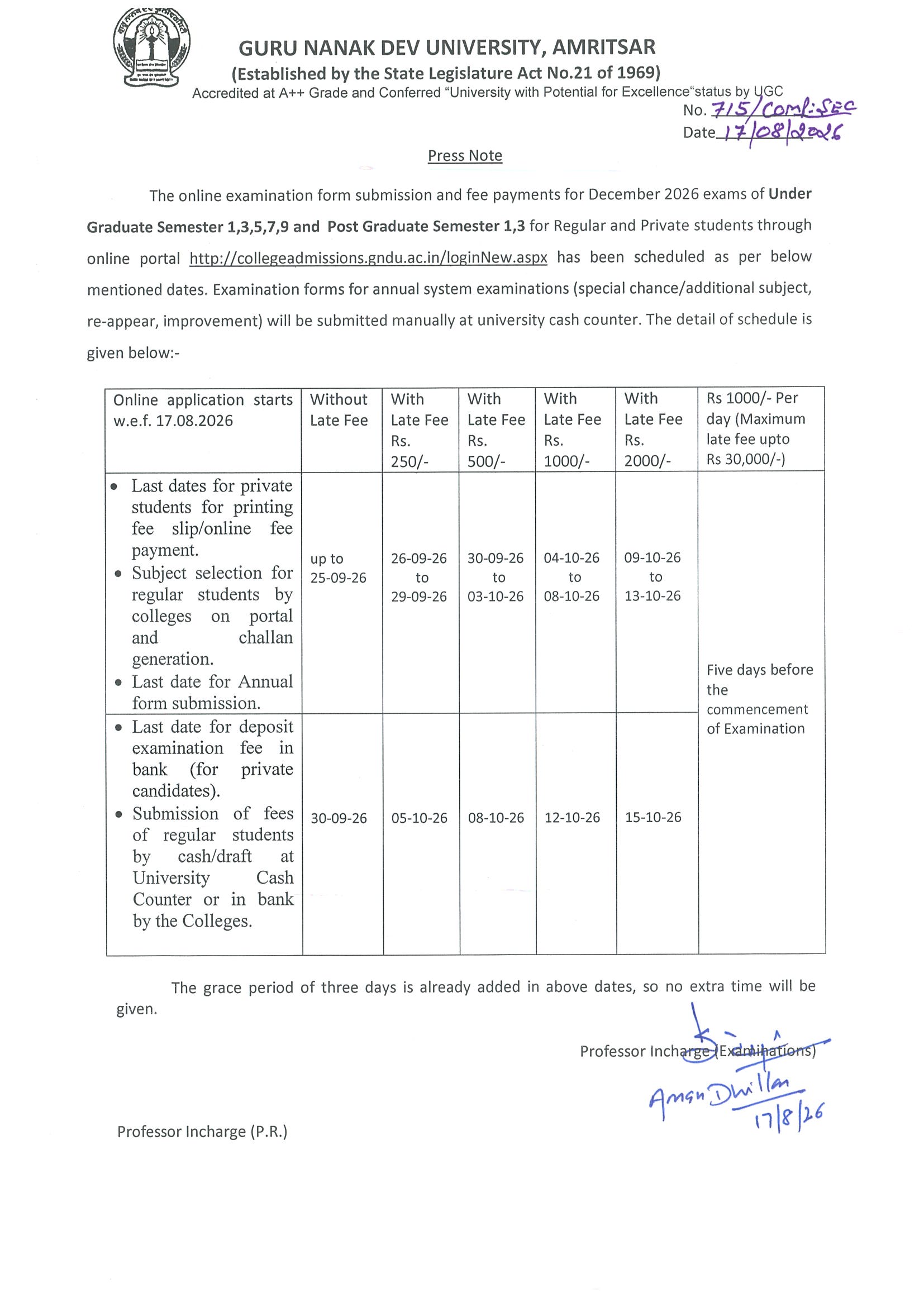
A discretionary extra chance that may be given "as per University Norms prescribed from time to time", including on medical grounds. GNDU's exam-form press notes say annual-system special-chance forms are submitted by hand at the university cash counter.
Sources
- official — GNDU — CBGS ordinances for colleges w.e.f. session 2023-24
- official — GNDU — NEP 2020 credit templates for colleges
- official — GNDU — B.Com (Honours) (CBGS) syllabus, Batch 2026-30 (updated 17 Jun 2026)
- official — GNDU — date sheet: B.Com (Hons.) / B.Com Sem II, IV, VI, May 2026
- official — GNDU — date sheet: B.Com (Hons.) Sem I & III / B.Com Sem I, III, V, Nov–Dec 2025
- official — GNDU — Press Note 715/Comp-Sec (17 Aug 2026): exam-form schedule, December 2026
- official — GNDU — Admission Instructions 2026-27 for colleges (23 Sep 2026)
official = a document published by the conducting body. reported = a news or coaching site we could not check against an original. Where sources disagree this page says so rather than picking one.