Checked 25 September 2026. Compared against the official GATE 2027 XH5 and XH0 PDFs (IIT Madras) and the 2026 XH-C5 and XH-B1 PDFs (IIT Guwahati), as published on 25 September 2026. Re-check the official page before the exam; IIT Madras has already posted one post-release syllabus update for another paper.
IIT Madras, which runs GATE 2027, has revised the GATE syllabi and renamed the Humanities sections. Psychology is now XH5 (it was XH-C5), and the compulsory Reasoning and Comprehension part is now XH0 (it was XH-B1). More importantly for your preparation, the Psychology syllabus itself changed: it grew from ten sections to eleven, gained a block of organisational-behaviour topics, and lost a handful of topics many coaching notes still teach.
We compared the official 2027 PDF with the 2026 one line by line. Below is every real change — additions, removals and topics that simply moved to a different section — and what each means for a candidate who started preparing from 2026 material.
Counts are ours, from the official 2026 and 2027 PDFs.
The paper, before the syllabus
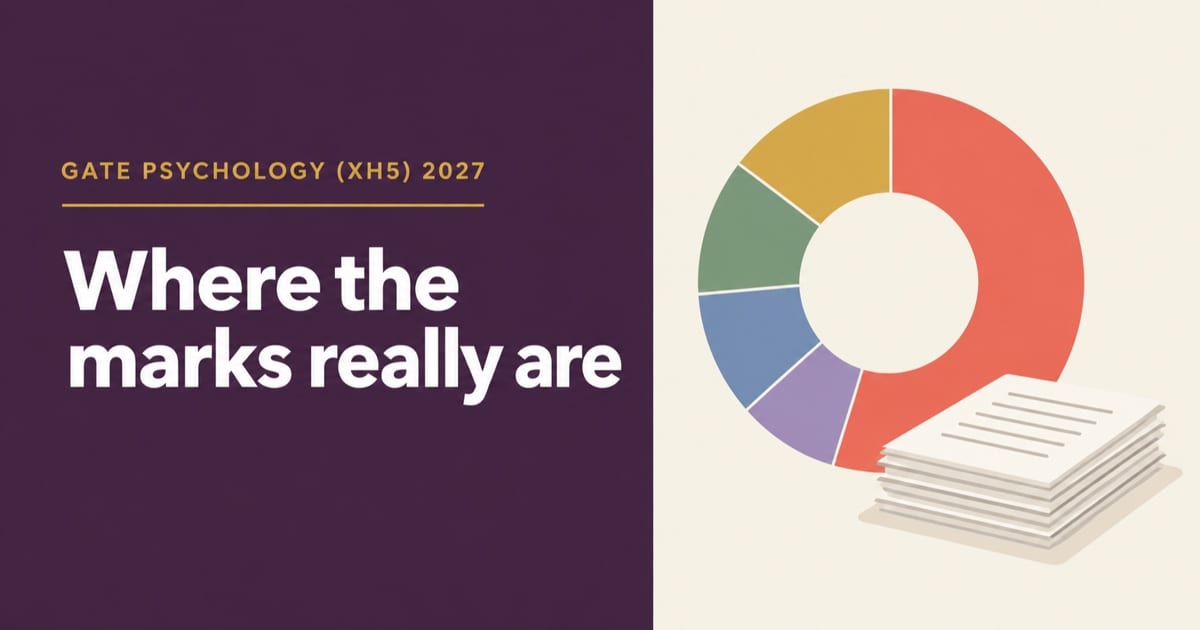
The shape of the XH paper is unchanged: 100 marks in 3 hours, 65 questions. General Aptitude carries 15 marks (10 questions), the compulsory Reasoning and Comprehension part (XH0) 25 marks (16 questions) and your Humanities section — Psychology here — 60 marks (39 questions). Unlike some GATE papers, the XH section is chosen on the application form and cannot be changed in the exam hall, and the GATE 2027 brochure says XH candidates receive a score and rank based on the section they chose. (Question counts are from the official answer keys: Reasoning is Q11–26, Psychology Q27–65.)
| Part | Code (2026 → 2027) | Marks | Changed in 2027? |
|---|---|---|---|
| General Aptitude | GA → GA | 15 | No |
| Reasoning and Comprehension | XH-B1 → XH0 | 25 | Renamed and numbered; content the same |
| Psychology | XH-C5 → XH5 | 60 | Yes — one new section, topics added, cut and moved |
How the Psychology sections map, 2026 to 2027
| 2026 | 2027 | What changed |
|---|---|---|
| C5.1 Research Methods and Statistics | XH5.1 Research Methods and Statistics | Latin square and time-series designs dropped; experimental designs regrouped with "statistics for experimental design: ANOVA, MANOVA, ANCOVA" |
| C5.2 Psychometrics | XH5.2 Psychometrics | No content change |
| C5.3 Biological and Evolutionary Basis | XH5.3 (same title) | Adds "biological basis of memory" (moved from the memory section) |
| C5.4 Perception, Learning, Memory, Forgetting | XH5.4 (same title) | "Physical aspects of memory" moved out to XH5.3 |
| C5.5 Cognition | XH5.5 Cognition | No content change |
| C5.6 Personality | XH5.6 Personality | Wording only ("social cognitive view" → "social, cognitive") |
| C5.7 Motivation, Emotion, Stress and Coping | XH5.7 (same title) | Named emotion theories and "biological basis of emotions" no longer listed here; REBT and meditation moved to XH5.10 |
| C5.8 Social Psychology | XH5.8 Social Psychology | Leadership style and effectiveness moved to XH5.10 |
| C5.9 Development Across the Life Span | XH5.9 (same title) | No content change |
| C5.10 Applications of Psychology | XH5.10 Clinical Psychology and Organizational Behavior + XH5.11 Applications of Psychology | Split in two; organisational behaviour added; PTSD and trauma dropped; mental-health intervention added |
Our count of named topics. "Removed" counts Latin square and time series (XH5.1), the named emotion theories (XH5.7, one item) and PTSD and trauma (XH5.10). Sections not shown had no change beyond wording.
What was added
A whole block of organisational behaviour (XH5.10)
- Organizational behaviour; organizational demographic and cultural diversity; organizational culture; making decisions in organizations.
- Power and politics; leadership theories, and leadership styles and effectiveness (moved here from Social Psychology).
- Positive organizational behaviour; performance management by reward and punishment.
This is the largest addition and the one most 2026 study material will not cover. An industrial-organisational psychology textbook chapter on each item is the natural source.
Mental-health intervention (XH5.11)
- "Intervention for Mental health and Wellbeing" is new in Applications of Psychology, alongside the old school, organisational and environmental (personal space, crowding, territoriality) applications.
What was removed
No longer named in the 2027 syllabus
- Latin square and time-series designs, from experimental designs (XH5.1).
- The named theories of emotion — James-Lange, Cannon-Bard, Schachter and Singer, Lazarus. The 2027 syllabus says only "Theories of emotions" (XH5.7). They are still the standard theories of emotion, so a question on "theories of emotions" can still involve them; what changed is that the syllabus no longer lists them by name.
- PTSD and trauma, from psychological disorders.
Removed from the syllabus means a question is less likely, not impossible — and none of these takes long to revise. Drop them from your priority list, not from your notes.
What moved
| Topic | From (2026) | To (2027) |
|---|---|---|
| Biological basis of memory | Memory and forgetting (C5.4, "physical aspects of memory") | Biological and Evolutionary Basis (XH5.3) |
| REBT and meditation | Stress and coping (C5.7) | Psychotherapies, Clinical Psychology (XH5.10) |
| Leadership style and effectiveness | Social Psychology (C5.8) | Organizational Behavior (XH5.10) |
| ANOVA, MANOVA, ANCOVA | Listed as experimental designs | "Statistics for experimental design" in XH5.1 |
A move changes where a topic sits, not whether it is examined — but it is a hint about framing. REBT now sits with psychotherapies rather than coping, so expect it to be asked as a therapy (its ABC model, its techniques) rather than as a stress-management strategy. Leadership now sits with organisational behaviour, so expect leadership theories in a workplace context.
Had the dropped and new topics been asked before?
Using our question-by-question classification of the official 2023–2026 Psychology papers (linked in the sources; method in our weightage guide), here is how often the changed topics actually appeared. It is a useful check on how much the changes matter in practice.
| Topic | Past questions | What it means |
|---|---|---|
| PTSD and trauma (dropped) | 2026 Q37 | Asked once in four years; low priority now |
| Named theories of emotion (no longer listed) | 2023 Q34, 2026 Q64 | Asked twice; still worth an hour, since "theories of emotions" remains |
| Latin square, time-series designs (dropped) | None identified | Safe to deprioritise |
| Leadership (moved to XH5.10) | 2024 Q60 (Fiedler), 2026 Q38 (transformational) | Already examined — now framed as organisational behaviour |
| Organisational commitment (OB family, now expanded) | 2023 Q62 | OB was examined lightly before; expect more now that it is written in |
The pattern is reassuring. The dropped topics were rarely asked, so losing them costs little; the organisational-behaviour block that was added had already been touched by leadership and commitment questions, so the examiners are formalising an interest rather than inventing one. The one real risk is a candidate who studied only from 2026 notes and never opened an organisational-behaviour chapter.
The compulsory part did not change
XH0 Reasoning and Comprehension tests reading comprehension, expression (stylistic and rhetorical aspects of a short passage), analytical reasoning and logical reasoning — word for word the same four skills XH-B1 tested in 2026, now numbered XH0.1 to XH0.4. The syllabus still says it does not directly test grammar or vocabulary, and compares its focus to critical-reasoning sections in exams such as the LSAT, GRE and GMAT. Every past XH-B1 paper remains fully valid practice.
Track the new and moved topics
GATE Psychology 2027: new and moved topics
Tick each once you have studied it and answered a few questions on it. Saved in this browser.
0 of 13 done
Ticks are saved only in this browser on this device.
What to do with this
| If you prepared from 2026 material | Do this now |
|---|---|
| You studied Latin square and time-series designs | Keep a one-page note; stop spending new time on them |
| You skipped organisational behaviour | Add it — eight named topics, a new part of the syllabus |
| You learned emotion theories under "stress and coping" | Keep them; the syllabus now just says "theories of emotions" |
| You learned REBT as a coping strategy | Re-learn it as a psychotherapy (ABC model, disputation) |
| You practised XH-B1 papers | Keep going — XH0 is the same part under a new name |
Practise it, don't just read it
Research methods and statistics is where most Psychology marks are computed rather than recalled — two of the four library quizzes are there.
The ProSyllabus GATE Psychology library currently has four topic quizzes: Measures of Central Tendency and ANOVA and Post Hoc Tests (XH5.1, Research Methods and Statistics), Classical Conditioning Paradigms (XH5.4, Learning) and Neurotransmitters and Limbic Functions (XH5.3, Biological Basis). Each has ten questions and a worked explanation for every option. For the other sections, work from the official past papers.
Has the GATE Psychology syllabus changed for 2027?
Yes. The GATE 2027 XH5 Psychology syllabus has eleven sections instead of ten: Applications was split, and a new Clinical Psychology and Organizational Behavior section adds organisational-behaviour topics. Latin square and time-series designs, PTSD and trauma, and the named theories of emotion are no longer listed.
What is XH5 in GATE 2027?
XH5 is the new code for the Psychology section of the GATE Humanities and Social Sciences paper. It was called XH-C5 until 2026. The compulsory Reasoning and Comprehension part, formerly XH-B1, is now XH0.
Did the GATE XH reasoning and comprehension syllabus change?
Not in content. XH0 in 2027 lists the same four skills XH-B1 listed in 2026: reading comprehension, expression, analytical reasoning and logical reasoning. Only the code and section numbering changed.
Is organisational behaviour in the GATE Psychology syllabus?
Yes, from 2027. Section XH5.10 covers organisational behaviour, demographic and cultural diversity, organisational culture, decision-making, power and politics, leadership theories and styles, positive organisational behaviour, and performance management by reward and punishment.
How many marks is the Psychology section in GATE XH?
Sixty of the 100 marks. General Aptitude carries 15 and the compulsory Reasoning and Comprehension part 25.
More in this series
- GATE Psychology topic-wise weightage, counted from 2023–2026 papers
- XH0 Reasoning and Comprehension — the compulsory 25 marks
- GATE Psychology marks vs score vs rank, with calculator
- GATE Psychology previous year papers 2021–2026, with answer keys
- GATE Psychology 2027 week-by-week plan, October to February
- What a GATE Psychology score opens — IIT PhDs, fellowships, GATE vs UGC NET
- GATE Psychology cutoffs, universities and careers
- GATE Psychology notice board — official updates
Sources
- official — GATE 2027 XH5 Psychology syllabus (IIT Madras)
- official — GATE 2026 XH-C5 Psychology syllabus (IIT Guwahati)
- official — GATE 2027 XH0 Reasoning and Comprehension syllabus (IIT Madras)
- official — GATE 2026 XH-B1 Reasoning and Comprehension syllabus (IIT Guwahati)
- official — GATE 2027 exam papers and syllabus
- official — GATE 2027 Information Brochure, revised 17 Sep 2026
- official — GATE 2026 XH Psychology question paper (IIT Guwahati)
- official — GATE 2026 XH answer key
- official — GATE 2025 XH Psychology question paper (IIT Roorkee)
- official — GATE 2025 XH answer key
- official — GATE 2024 XH Psychology question paper (IISc Bengaluru)
- official — GATE 2024 XH answer key
- official — GATE 2023 XH Psychology question paper (IIT Kanpur)
- official — GATE 2023 XH answer key
official = a document published by the conducting body. reported = a news or coaching site we could not check against an original. Where sources disagree this page says so rather than picking one.