Checked 24 October 2026. Fees, hours, the appointment list and booklet formats are as the FDNY pages and study booklets stated them on 23 and 24 Oct 2026. The FDNY asks candidates to check for the latest booklet before the exam, and says some Notices of Exam are being updated for online applications.
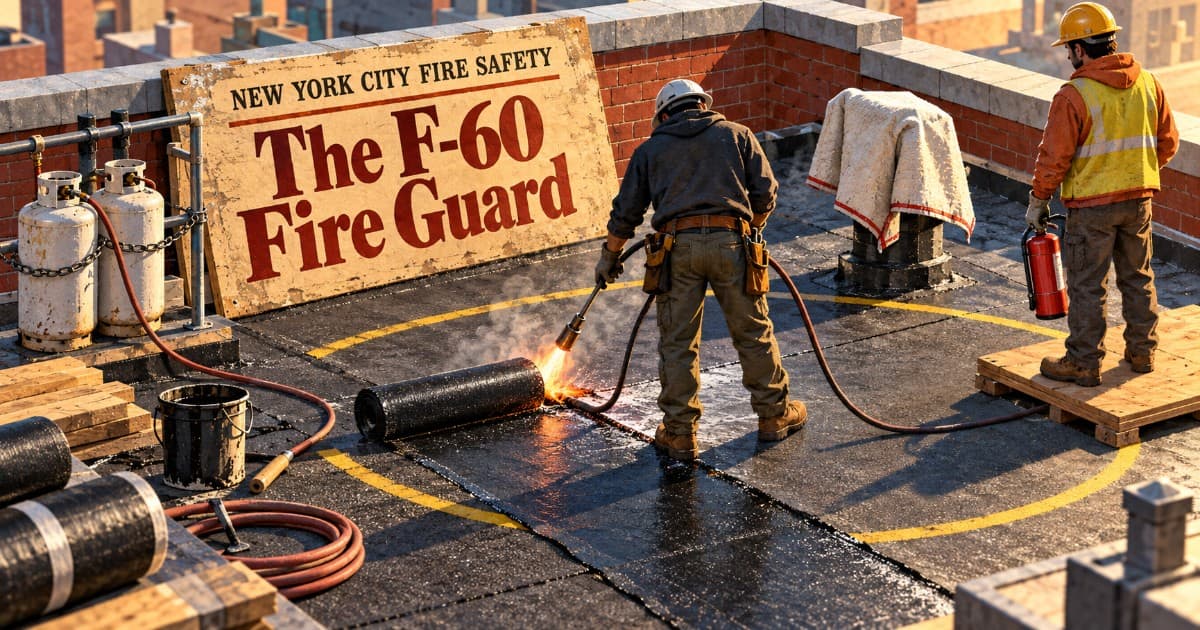
The F-60 is the FDNY Certificate of Fitness for the fire guard who watches a torch operation. The FDNY F-60 page says the fire watch for torch operations at construction sites, on any rooftop or torch-applied roofing job, and in any building where a person with a citywide permit for torch operations is working, "must be conducted by F-60 fire guards". The exam is 25 multiple-choice questions on the FDNY's free F-60 study booklet, and the booklet is packed with numbers: distances, minutes, hours, container sizes and extinguisher ratings. This guide maps the booklet part by part and lists the numbers so you can see what you must be able to recall, because study booklets cannot be used during the exam. The application steps and exam-room rules are in FDNY Certificate of Fitness: exam format, fee and how to apply. ProSyllabus is an independent study site, not part of the FDNY (Fire Department of the City of New York) or the City of New York. Every rule here is quoted or summarised from the FDNY pages and study booklets listed at the foot of the page.
FDNY F-60 study material (revised January 2026 (contact/payment info)), read 23 Oct 2026 and unchanged on 24 Oct 2026. The 18-of-25 figure is our arithmetic.
Who needs an F-60, and who needs something else
A torch job involves several roles, and the F-60 booklet separates them in its pre-hot-work checklist. The F-60 covers the fire watch only. The booklet adds two warnings on its cover: an F-60 does not qualify you to be a watchperson at a construction site (that is the S-60), and it does not qualify you as a fire guard for impairment at construction sites (that is the F-01).
| Role | Certificate or document | What the booklet says |
|---|---|---|
| Fire watch (fire guard) | F-60, at least one | The fire watch for torch operations at construction sites, in any building where the torch operation is conducted by a person holding a citywide permit for torch operations, and on any rooftop or in connection with any torch-applied roofing system operation, must be conducted by at least one F-60 fire guard. |
| Person using the torch | G-60 (or G-41 or G-42 for roofing) | G-60 certificates are required for torch operations using oxygen and a flammable gas. A G-60, G-41 or G-42 is required for a torch-applied roof system. |
| Responsible person | Designated by the owner of the premises | A person trained in the fire safety hazards of hot work who authorizes hot work and checks the area. Hot work must be under the general supervision of the responsible person. |
| The work itself | FDNY permit, site-specific or citywide | Everyone performing hot work that requires a permit must hold a site-specific or citywide permit authorizing the work. |
| Hot work authorization | Signed by the responsible person, not issued by the FDNY | A hot work program authorization is required for any project involving hot work. It must be available for inspection during the work and for 48 hours after the work is complete. |
The exam in brief
| Item | What the F-60 booklet says |
|---|---|
| Questions and time | 25 multiple-choice questions on a touch-screen computer, time-limited; 38 minutes. |
| Answers | Four alternative answers to each question; only one is most correct. An unanswered question, or one with more than one answer marked, is scored as incorrect. There is no penalty for guessing. |
| Pass mark | At least 70%. |
| Scope | The exam covers the entire booklet (3 parts). The booklet adds that you need to be familiar with NFPA 51B and Fire Code Chapter 35 to prepare fully, and that it does not contain all the information you need to work as a fire guard. |
| In the room | Study material and booklets may not be used. If the exam needs reference material, exam room staff provide it and the computer prompts you. The booklet's sample answer says only reference material provided by the FDNY is allowed; the General Notice separately lets you bring your own clean paperback dictionary, subject to inspection, and bars electronic dictionaries, so the two texts differ. |
| Special requirements | "None". No alternative issuance procedure: the certificate can only be obtained by passing the computer exam at FDNY Headquarters. |
The booklet, part by part
Page numbers are the booklet's own. The three sample questions in the booklet are about the exam room itself (what may be used, whom to ask), and the booklet says they show the format, not the content, of the real exam.
| Booklet section | Page | What it covers |
|---|---|---|
| Introduction: Certificate of Fitness and FDNY permits | 6-9 | The three places where an F-60 fire guard is required; the codes and rules the holder must follow (Fire Code Chapter 35, NFPA 51B, LPG Rule 6109-01, CNG Rule 5811-01); when an FDNY permit is needed; the LPG container table; site-specific and citywide permits; the hot work authorization. |
| Definitions | 11 | Fire guard, fire watch, hot work, hot work area, hot work equipment, hot work program and authorization, NFPA, PPE, responsible person, torch-applied roof system. |
| Part 1 opening: fire history and personal protective equipment | 12-14 | Why sparks and hot metal matter, the booklet's fire history table, and the protective clothing for cutting and welding. |
| 1.1 Responsible person and pre-hot work check | 14-16 | The 48-hour notice to the owner, the daily inspection, and the ten-point checklist (35-foot and 25-foot rules, protected openings, sprinklers and detectors, extinguishers, certificates and permits). |
| 1.2 Fire safety requirements | 16-18 | Gas torch precautions, protection of combustibles and waste, partitions and repair garages, hazard signs. |
| 1.3 Fire watch requirements | 18-22 | The fire watch and the fire guard; fire guards on construction sites and torch-applied roofs, including floors below; how long the fire watch lasts; the signed inspection report and the example daily logbook. |
| 1.4 Gas welding and cutting precautions | 23 | Keeping oxygen equipment free of oil and grease, shutting off the torch, and the unlawful operations. |
| Part 2: emergency notification, fire protection systems and extinguishers | 24-31 | Calling 911; fire hoses, sprinkler protection and fire detection systems during hot work; extinguisher use, classes, symbols, inspections and the FDNY tags. |
| Part 3: lithium-ion battery safety | 32-34 | Warning signs, charging and storage rules, and why extinguishers do not work on lithium-ion battery fires. |
The booklet opens Part 1 with the reason for all of this: sparks and pieces of hot metal, it says, are the source of ignition in about 60% of all fires in industrial occupancies, and its fire history table includes a December 2023 fire in a Queens apartment building started by a contractor using a torch illegally, which injured 14 people and displaced 160 residents.
The numbers the booklet gives
Distances, times and fire guard numbers
| Number | Rule | Section |
|---|---|---|
| 35 feet | Cutting or welding must be at least 35 feet from combustible materials and combustible waste, or have shielding that stops sparks, slag and heat. | 1.1 |
| 25 feet | All other hot work must be at least 25 feet from combustible materials and waste, or shielded. | 1.1 |
| 35 feet | If combustibles cannot be moved, combustibles and any openings or cracks in walls, floors, ducts or shafts within 35 feet of the hot work area must be covered, shielded or protected with curtains. | 1.2.2 |
| 48 hours before | For hot work under a citywide permit, the permit holder must notify the premises owner in writing at least 48 hours before the hot work starts. | 1.1 |
| 48 hours after | Pre-hot-work check reports are kept at the work site for a minimum of 48 hours after the work is completed. The hot work authorization must be available for inspection during the work and for 48 hours after. | 1.1 and Introduction |
| Once a day | The responsible person inspects the hot work area before authorizing the work and at least once a day while the authorization is in effect. | 1.1 |
| 30 minutes | The fire watch must continue for a minimum of 30 minutes after the hot work ends; the commissioner or the responsible person may extend it. | 1.3.4 |
| 30 minutes, then 1 hour | For any CNG or LPG torch operation, the first inspection is 30 minutes after the torch operation is completed and the second is 1 hour after it is completed. | 1.3.4 |
| One per torch operator | At a construction site and on a torch-applied roofing operation, every torch operator must also have a person doing fire watch, an F-60 fire guard. Fire guards must be on continuous duty during all torch operations on a roof. | 1.3.3 |
| 50 feet | One fire guard may watch more than one torch operation on the same floor or level only if each is no more than 50 feet from the fire guard, measured by the actual path of travel, and the fire guard's field of view covers all the horizontal fire exposures. | 1.3.3 |
| Floor below | An additional F-60 fire guard is required on the floor below if the torch is used at or near the edge of an unenclosed floor, near a floor opening, or anywhere sparks and slag may reach lower floors. That fire guard watches each lower floor with combustible surfaces or materials within 35 feet of the exposed area. | 1.3.3 |
| Four conditions | On a construction site, no fire watch is required on the floors below only when all four conditions are met: the torch is not at or near the edge of an unenclosed floor; the floor is noncombustible; there are no floor or exterior openings within 35 feet; and the fire safety manager or responsible person has inspected and protected the lower floors beforehand. If sparks or slag extend beyond 35 feet and so potentially expose lower floors or levels, the torch operation must be discontinued immediately and the floors or levels below inspected for any fire condition. | 1.3.3 |
| 1 hour | The torch valve must be closed and the gas supply completely shut off when hot work stops for 1 hour or more. | 1.4 |
| One torch | Each person operates only one torch at a time, and the torch must not be left unattended while ignited. | 1.2.1 |
FDNY F-60 study material, sections 1.1, 1.3.1 and 1.3.3, read 23 Oct 2026. The extinguisher figure is a travel distance; the 50 feet is measured by the actual path of travel.
Permits and gas limits
| Number | Rule | Section |
|---|---|---|
| 400 SCF and 504 SCF | An FDNY permit is needed to store, use or handle oxygen and a flammable gas; any flammable gas (LPG, CNG, acetylene) over 400 SCF; or any oxidizing gas such as oxygen over 504 SCF. For LPG, 400 SCF is approximately 47 lbs. | Introduction |
| LPG container table | Number of containers that need a permit: 14.1 oz, 54; 16.4 oz, 46; 20 lbs, 3; 33.5 lbs, 2; 40 lbs, 2; 100 lbs, 1. | Introduction |
| 100 lbs and 381 SCF | A single standard portable LPG container must not exceed 100 lbs; a single CNG container must not exceed 381 SCF. | Introduction |
| 16.4 oz and 8.7 SCF | Portable LPG containers over 16.4 oz and CNG containers over 8.7 SCF must not be stored, handled or used indoors or on the roof in residential, factory and industrial, educational or institutional occupancies, except as the commissioner may authorize by rule. | Introduction |
| 12 months | Permanent site-specific permits are valid for 12 months and every renewal needs an inspection. Temporary permits run from one day to 12 months. A hot work operation such as a construction site normally gets a temporary permit. | Introduction |
| 30 calendar days | A citywide permit covers activity at any one location for no more than 30 calendar days, with the hazardous materials removed at the end of the workday, and no more than 5 gallons of gasoline, 250 gallons of any other flammable liquid or 300 gallons of any combustible liquid. | Introduction |
| Affidavit | Using LPG or propane on an occupied roof requires an affidavit from a licensed professional (architect or engineer) stating the roof is constructed of non-combustible material. | Introduction |
Equipment, extinguishers and prohibited acts
| Number | Rule | Section |
|---|---|---|
| 2-A:20-B:C | At least one portable extinguisher with this minimum rating must be readily accessible within 30 feet of travel distance of where hot work is performed and where the fire guards are positioned. | 1.3.1 and 2.3 |
| 3-A:40-B:C | The minimum rating for roofing operations using heat-producing systems or other ignition sources, including torch-applied roofing. | 1.3.1 and 2.3 |
| Sprinklers | Sprinkler protection must not be shut off or impaired during hot work unless the commissioner approves. Heads close to the work are shielded with noncombustible barriers or damp cloth guards, removed when the work is completed or at the end of each workday. | 1.1 and 2.2.2 |
| Detectors | If the fire alarm system is taken out of service, the date and time, the reason, the person notified at the central station and the date and time it was restored go in the alarm logbook, and a fire watch for impairment must be provided while it is off-line. | 2.2.3 |
| 5 feet and 4 inches | The top of an extinguisher must be no more than 5 feet above the floor and the bottom at least 4 inches off it. | 2.3 |
| Monthly and annual | Extinguishers get a monthly "quick check" by a person the owner chooses and, at least annually, a check by a W-96 certificate holder from an FDNY-approved company, who replaces the tag. | 2.3.4 |
| Unlawful | Welding or cutting supported by or resting on compressed gas containers; torch-applied roofing on roofs of combustible construction; using an acetylene generator for hot work; testing pipes for leaks with a flame (soapy water must be used). | 1.3.3 and 1.4 |
| More than five devices | Charging more than five personal mobility devices or their removable batteries must be in a dedicated room with ventilation and a self-closing door. | Part 3 |
One edition detail: the booklet cites NFPA 51B, 2024 edition, in its list of codes. The exam is on the booklet, so learn the rules as the booklet states them. (It cites the 2024 edition in the 35-foot note in section 1.1 and the 2009 edition in the diagram notes in sections 1.1 and 1.3.3.)
Numbers that are easy to mix up
| Mix-up | How the booklet separates them |
|---|---|
| 35 feet or 25 feet? | 35 feet is for cutting and welding; 25 feet is for all other hot work. Both can be replaced by shielding. |
| Which 48 hours? | The 48 hours of written notice to the owner come before the hot work starts. The 48 hours for the pre-hot-work check reports and the hot work authorization run after the work is completed. |
| 30 minutes, 1 hour, or both? | The fire watch lasts at least 30 minutes after hot work ends. The CNG or LPG inspections are at 30 minutes and at 1 hour. The torch valve must be closed and the gas supply to the torch completely shut off when hot work is discontinued for a period of 1 hour or more. |
| 30, 35 or 50 feet? | 30 feet is the extinguisher travel distance, 35 feet is the cutting and welding clearance (and the distance for floors below), and 50 feet is the furthest a single fire guard may be from several torch operations. |
| Which extinguisher rating? | 2-A:20-B:C is the general minimum; 3-A:40-B:C is the minimum for roofing operations using heat-producing systems, including torch-applied roofing. |
| Permit or authorization? | The FDNY issues the permit (site-specific or citywide). The hot work authorization is signed and issued by the responsible person and is not issued by the FDNY. |
| Site-specific or citywide permit? | A permanent site-specific permit lasts 12 months and a temporary one one day to 12 months. A citywide permit is for activity at any one location of no more than 30 calendar days. |
| F-60, G-60, S-60 or F-01? | F-60 is the fire watch for torch work; G-60 (or G-41 or G-42 for roofing) is for the person using the torch; S-60 is the construction-site watchperson; F-01 is the fire guard for an out-of-service fire protection system. |
A sample question
The FDNY booklet shows three sample questions, all about the exam room, and says they show the format of the questions, not the content of the real exam. This example is one of our own, written from the F-60 booklet in the same four-option style. It is one of the three free questions on the practice exam page.
Example 1: F-60 Fire Guard for Torch Operations
A citywide permit holder will do hot work in a building owned by someone else. How far in advance must the owner of the premises be notified in writing?
- (A) At least 30 calendar days before the hot work starts
- (B) At least 30 minutes before the hot work starts
- (C) At least 1 hour before the hot work starts
- (D) At least 48 hours before the hot work starts
Show the answer
Answer: (D) At least 48 hours before the hot work starts. The study material (Part 1.1) says that for hot work with a citywide permit, the citywide permit holder must notify the owner of the premises in writing at least 48 hours before the hot work is started.
An original ProSyllabus question written from the FDNY study material, not an FDNY exam question.
How to use the booklet
A way to work through it, which is our suggestion and not FDNY advice. Read the booklet once through to see how the three parts fit together. Then copy the number tables above onto one sheet and cover the right-hand column, because the exam asks you to recall values with no booklet to hand. Finish with timed sets: the real exam allows about a minute and a half a question (38 minutes for 25 questions, our arithmetic). Do not skip the extinguisher and lithium-ion sections: they are in the booklet, and the exam covers all of it.
To apply, pay and book, see FDNY Certificate of Fitness: exam format, fee and how to apply. The F-60 booklet (January 2026) and the FDNY Certificates of Fitness page require the application and payment to be done online before you arrive, while the July 2023 General Notice still says other certificates can apply in person and the NYC Business F-60 page still says to apply in person; follow the central FDNY page. The F-60 is not on the FDNY's appointment list. It renews every three years, with a $15 renewal fee for most certificates. For the other fire guard certificates see how to get a fire guard certificate in NYC, and for every code on the FDNY list see the full list of Certificates of Fitness.
Practise the F-60 in the FDNY format
FDNY F-60 practice exam: Fire Guard for Torch Operations. 2 full exams of 25 questions, 38 minutes each, three questions free.
Independent practice by ProSyllabus: original questions written from the FDNY F-60 study booklet, four options each, timed like the real exam, with the reason behind every answer. Not FDNY questions.
Frequently asked questions
How many questions are on the F-60 exam and what is the pass mark?
25 multiple-choice questions in 38 minutes, with at least 70% needed to pass, which is 18 correct answers (our arithmetic). An unanswered question, or one with more than one answer marked, is scored as incorrect, and there is no penalty for guessing.
Who needs an F-60?
The fire guard who does the fire watch for torch operations at construction sites, on any rooftop or torch-applied roofing job, and in any building where the torch operation is done by a person with a citywide permit for torch operations.
What is the difference between the F-60 and the G-60?
The F-60 is for the fire watch. The G-60 is for the person using the torch with oxygen and a flammable gas. The F-60 booklet says a G-60, G-41 or G-42 is required for a torch-applied roof system.
Does an F-60 alone qualify me as a construction-site watchperson or as a fire guard for impairment?
No. The F-60 booklet says the F-60 is not qualified to serve as a watchperson at a construction site (it sends watchperson applicants to the S-60) or as a fire guard for impairment at construction sites (it sends those applicants to the F-01).
How long must the fire watch continue after the work stops?
At least 30 minutes after the hot work ends. The commissioner or the responsible person may extend it. For a CNG or LPG torch operation the first inspection is 30 minutes after completion and the second is 1 hour after.
Can I use the study booklet during the exam?
No. Study material and booklets may not be used. The booklet says only reference material provided by the FDNY is allowed, while the General Notice lets you bring your own clean paperback dictionary, subject to inspection; the two differ. The computer prompts you if the exam needs reference material.
How much does it cost?
The application fee is $25 for each exam attempt and the renewal fee is $15 every three years for most certificates (General Notice of Exam; NYC Business F-60 page). The FDNY page and the F-60 booklet say to apply and pay online before you arrive.
Sources
- official — FDNY: Study material for the F-60 Fire Guard for Torch Operations exam, revised January 2026 (contact/payment info)
- official — FDNY: Certificate of Fitness F-60 Fire Guard for Torch Operations page
- official — NYC Business: Certificate of Fitness F-60 (application fee, renewal fee and period)
- official — FDNY: General Notice of Exam (NOE) for Certificate of Fitness Examinations, revised 07/2023
- official — FDNY: Certificates of Fitness (walk-in exams, hours, ID, payment, online application, appointments, accommodations, renewals, list of certificates)
official = a document published by the conducting body. reported = a news or coaching site we could not check against an original. Where sources disagree this page says so rather than picking one.