Checked 24 October 2026. Fees, hours, the appointment list and booklet formats are as the FDNY pages and study booklets stated them on 23 and 24 Oct 2026. The FDNY asks candidates to check for the latest booklet before the exam, and says some Notices of Exam are being updated for online applications.
On the FDNY pages read for this guide, what people call a fire guard license in New York City is a Certificate of Fitness (COF), and the FDNY issues several different ones to people who do fire guard work. Which one you need depends on where you will stand watch: a building where a sprinkler or fire alarm system is out of service, a torch job, a shelter, or a boatyard. This guide sorts those out, sets out what the F-01 study booklet says a fire guard actually does on shift, and shows how you get the certificate. See also FDNY Certificate of Fitness: exam format, fee and how to apply. ProSyllabus is an independent study site, not part of the FDNY (Fire Department of the City of New York) or the City of New York. Every rule here is quoted or summarised from the FDNY pages and study booklets listed at the foot of the page.
FDNY F-01 and F-60 study materials (revised January 2026) and the FDNY F-01 page, read 23 Oct 2026 and unchanged on 24 Oct 2026.
The FDNY calls it a Certificate of Fitness, not a license
The FDNY F-01 page puts the rule in one sentence: "In any occupancy where a required fire protection system is out of service, a fire watch shall be maintained by one or more persons holding a Certificate of Fitness." The NYC Business page for the same certificate says it more simply: if a required fire protection system is not working in a building, a fire watch is needed, and a person with a Certificate of Fitness must do it. The F-01 study booklet defines a fire guard as a person "holding a Certificate of Fitness for such purposes, who is trained in and responsible for maintaining a fire watch", and a fire watch as a temporary measure for continuous and systematic surveillance of a building or part of it, to identify and control fire hazards, detect early signs of fire, raise the alarm and notify the FDNY.
Which fire guard certificate do you need?
The FDNY list has four fire guard certificates and one watchperson certificate, which the F-60 booklet distinguishes from the F-60. Match your job to the row. The right-hand column says what the FDNY pages say about where the certificate is valid.
| Situation | Certificate | What the FDNY says | Where it is valid |
|---|---|---|---|
| A required fire protection system (sprinkler, standpipe, fire alarm) in a building is out of service | F-01 Citywide Fire Guard for Impairment | A fire watch must be kept by one or more COF holders. The first four hours may be covered by a trained person in a small area (next section). | Citywide: the F-01 booklet says the holder may perform the duties in different buildings and occupancies. |
| Torch operations at a construction site, on any rooftop or torch-applied roofing job, or in any building or structure when the torch operation is conducted by a person holding a citywide permit for torch operations | F-60 Fire Guard for Torch Operations | The fire watch for these torch operations must be done by F-60 fire guards. The F-60 booklet says the F-60 does not qualify you for the F-01 job at construction sites or for the S-60 watchperson job. | NYC Business: valid only for the person it is given to and usable anywhere in New York City. |
| A building occupied, or operated to be occupied, as a homeless or emergency shelter | F-02 Fire Guard for Shelters (Citywide) | A COF is required by all fire guards in buildings or parts of buildings used as homeless or emergency shelters. | The name says "Citywide"; the F-02 page gives no more detail. |
| A boatyard or marina with no sprinkler system installed, or where a fire protection system is temporarily out of service | F-92 Supervise and Fire Guard Boatyards and Marinas | A COF is required by all fire guards in these places. The page lists a $25 new application fee, a $15 renewal fee and a 3-year renewal cycle. The F-01 booklet says current F-92 certificates are valid and renewable and that the F-92 test is available as a separate test. | Valid only for the person who applied and at the location applied for. |
| Watching a construction site on its own (a watchperson, not a fire guard) | S-60 Watchperson at Construction Site (Citywide) | Required for a watchperson at any construction site with a footprint between 5,000 and 40,000 square feet, who must be on duty at all hours when operations are not in progress. | Valid only for the specific person and usable anywhere within New York City. |
The S-60 and F-92 pages describe applying in person, the S-60 page mentions an appointment, and the S-60 page lists a renewal fee of $5, which differs from the $15 the General Notice of Exam gives for most 3-year certificates. The central FDNY page and the January 2026 F-01 and F-60 booklets instead require online application and payment before arrival, and the FDNY says its supporting instructions are being updated. The F-02 page lists no fees. For any of these, rely on the FDNY Certificates of Fitness page, which says all COF transactions are done online, and check the certificate's own page before you pay. This guide did not read a study booklet for the F-02 or S-60.
The first four hours: when a trained person may stand in
The first-four-hours exception has specific limits. The F-01 page and booklet say that for the first four hours of a planned or unplanned out-of-service condition, when the affected area does not exceed 50,000 square feet, the impairment coordinator, or a trained and knowledgeable person who can perform fire watch duties and is designated by the building owner, may do the fire watch. (The NYC Business F-01 page words the limit as less than 50,000 square feet, so the sources differ at exactly 50,000.) After four hours, patrols can only be done by fire guards holding the F-01 certificate. The booklet adds that no fire guard may patrol more than 50,000 square feet of floor area, so a larger area needs more than one.
| Area out of service | First 4 hours (planned or unplanned) | After 4 hours |
|---|---|---|
| 50,000 sq ft or less | An F-01 holder, or the impairment coordinator, or a trained and knowledgeable person designated by the owner | At least one F-01 holder |
| More than 50,000 sq ft | At least one F-01 holder for each 50,000 sq ft | At least one F-01 holder for each 50,000 sq ft |
The booklet calls this its recommended coverage and says the number of fire guards depends on the location and the size of the affected area. It also notes that FDNY personnel on scene may give directions, such as the number of fire guards required.
FDNY F-01 study material (revised January 2026), read 23 Oct 2026. These are different rules measured on one scale; each is explained in the table below.
What an impairment fire guard does on shift
The F-01 booklet is the FDNY's description of the job, and the exam covers the entire booklet. These are its main duties.
| Duty | What the F-01 booklet says |
|---|---|
| Orientation before starting | Before patrolling, a fire guard should know five things: the entry routes to the affected area, the level of the out-of-service condition, where hazardous materials are stored, handled or used (including fuel oil tanks), where the portable fire extinguishers are, and how to make the required notifications. The booklet gives an example orientation checklist. |
| Patrol | "A fire guard must be available to patrol all areas in which the fire protection system is out of service at least once every hour." The fire guard cannot be given any other responsibilities, and patrols must check there is no fire, egress routes are clear, and extinguishers and pull stations are available. |
| Exits and doors | Keep exits, stairways and hallways clear. Exit doors must open in the direction of travel and the exit aisle is generally required to be at least 3 feet wide. Locks, bolts and chains cannot be on exit doors while the building is in use, and self-closing doors must not be left open. |
| Ignition sources, smoking and trash | Check the location daily for ignition sources such as arcing or exposed wiring, enforce the smoking ban, and report a build-up of trash to the owner. |
| Hot work | Section 1.2 says hot work is not allowed in areas of a building where the sprinkler system is impaired, and on a construction site not allowed if the sprinkler or standpipe system is impaired. Appendix A qualifies this for construction sites (see below). |
| The record | A signed written or approved electronic record of the inspections, defects and violations, with the date, name and Certificate of Fitness number. Section 1.3 says the record is kept on the premises for at least 3 years and also maintained for at least 48 hours after the fire watch has finished; the booklet's example log has hourly entries. |
| If there is a fire | Call 911 immediately, with no delay, and sound the fire alarm pull station where there is one. Only after calling 911, notify the impairment coordinator, the Fire and Life Safety Director or other responsible person. Do not hang up until the 911 operator says so. Occupants on the fire floor and the floor above are in the greatest danger and are evacuated first, and they are told to use the stairwells, not the elevators. |
| The phone | Fire guards may use a cell phone to make notifications, but must make sure it has enough battery power to last the shift. |
| Your card | The holder must keep the Certificate of Fitness readily available for inspection by any representative of the Fire Department while carrying out the work. |
The booklet also lists when the FDNY must be told about an out-of-service condition, which is mainly the impairment coordinator's job but is examined: a standpipe system out of service for any period; a sprinkler or fire alarm system out of service, or going to be, on more than one floor; sprinkler work or repairs that cannot be completed, with the system restored, within 8 hours; a fire alarm system out of service for more than 8 hours in any 24-hour period; or another fire protection system in the same area also out of service.
Construction sites: Appendix A of the F-01 booklet
The F-01 booklet ends with a table of fire watch and hot work rules for out-of-service systems at construction sites, and the booklet's text says the fire guard for impairment must be maintained while the building is occupied. The table varies by the stage of the building and the system. In outline: for a new building under construction and occupied only by construction personnel, an installed and approved standpipe system that is out of service needs a fire watch at all times and allows no hot work anywhere on the site except hot work required to restore a fire protection system to service; a sprinkler or fire alarm system not yet installed and approved needs no fire watch except where the FDNY finds special circumstances; an installed and approved sprinkler or fire alarm system needs a fire watch as required by the Fire Code, with no fire watch needed when the entire building is vacant, except in special circumstances. New buildings partially occupied under a temporary certificate of occupancy, buildings under alteration and buildings under demolition have their own rows, including exceptions for floors under active demolition. Read the table itself before relying on this outline. Its footnote 3 also describes a construction-site watchperson as holding an F-60, which disagrees with the F-60 booklet, which sends watchperson applicants to the S-60.
Torch jobs: the F-60 fire guard
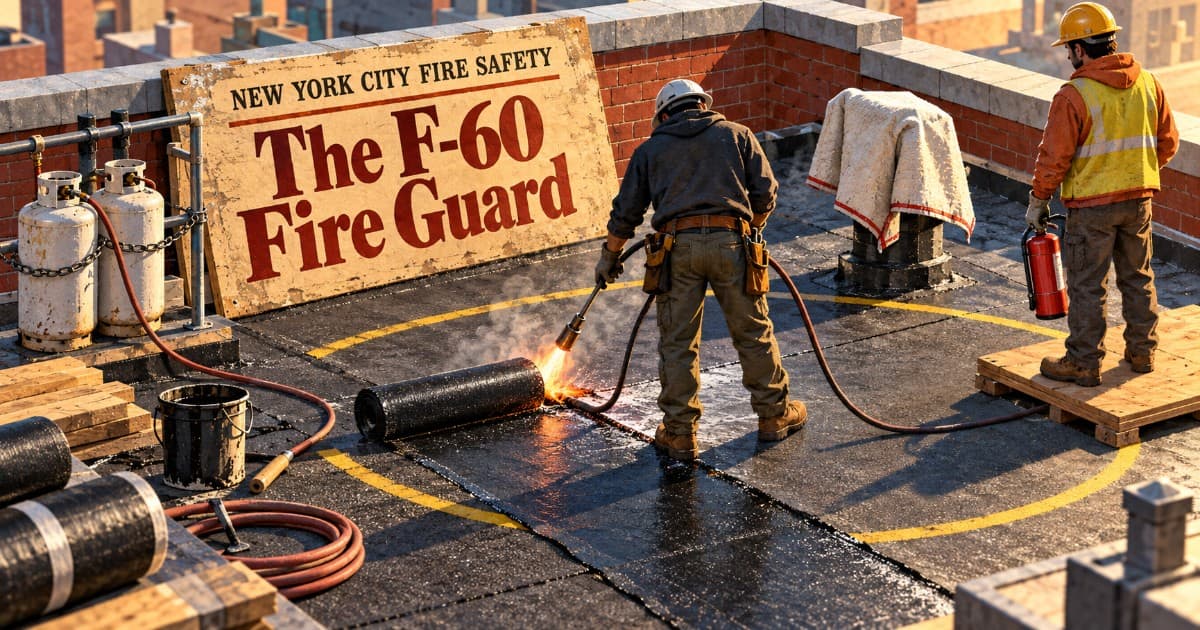
The F-60 fire guard watches a torch operation rather than an impaired system. The F-60 booklet says the fire watch must continue for at least 30 minutes after the hot work ends, that the person on fire watch must have no other duties, and that every torch operator at a construction site or on a torch-applied roof needs a fire watch by an F-60 fire guard (with an exception that lets one fire guard cover several torch operations on the same floor or level when each torch operation is no more than 50 feet from the fire guard, measured by the actual path of travel, and the fire guard's field of view encompasses all the horizontal fire exposures of those operations). See the F-60 exam guide.
How to get the certificate
The process is the same for the F-01, F-60 and most other certificates. In short (see also FDNY Certificate of Fitness: exam format, fee and how to apply): the FDNY page says all COF transactions are online and that applicants must "complete Certificate of Fitness (COF) application and payment online before coming to FDNY Headquarters"; the General Notice of Exam sets the application fee at $25 per attempt; and you bring a government-issued photo ID to FDNY Headquarters, 9 MetroTech Center, Brooklyn.
| Item | F-01 Fire Guard for Impairment | F-60 Fire Guard for Torch Operations |
|---|---|---|
| Exam | 20 multiple-choice questions, 30 minutes, at least 70% to pass (14 of 20, our arithmetic) | 25 multiple-choice questions, 38 minutes, at least 70% to pass (18 of 25, our arithmetic) |
| Special requirements | The booklet lists "None" | The booklet lists "None" |
| Alternative to the exam | No alternative issuance procedure: the certificate can only be obtained by passing the computer exam | No alternative issuance procedure: the certificate can only be obtained by passing the computer exam |
| What the exam covers | The entire booklet and any tables. You should also know 2022 Fire Code sections 401.3, 408, 901 and 906 and NFPA 25 Chapter 14 (2002 Ed.), which the booklet cites | The entire booklet. You should also know NFPA 51B and Fire Code Chapter 35, which the booklet cites |
| If you fail | A new application and payment; retesting on the same calendar day is not permitted | A new application and payment; retesting on the same calendar day is not permitted |
You do not need a job to take the exam. The General Notice says applicants who are not currently employed may take it without the employer documents. If they pass, the FDNY issues a temporary letter with a picture for job seeking, and the card itself is issued once they are employed and provide the documents (the General Notice makes an exception for certificates that have a school requirement; the F-01 and F-60 booklets list no special requirements). Applicants must be at least 18 and have a reasonable understanding of English. Most certificates renew every three years for $15, and a renewal made 90 days to a year after expiry costs a further $25 (one passage of the General Notice says 91 days).
Practice for the fire guard exam we cover
FDNY F-60 practice exam: Fire Guard for Torch Operations. 2 full exams of 25 questions, 38 minutes each, three questions free.
ProSyllabus's fire guard practice is for the F-60. It does not cover the F-01, F-02, F-92 or S-60. Independent practice with original questions written from the FDNY study booklet, four options each, with the reason behind every answer. Not FDNY questions.
Frequently asked questions
Is there a fire guard license in New York City?
The FDNY calls it a Certificate of Fitness. There are several fire guard certificates: F-01 (fire protection system out of service), F-02 (shelters), F-60 (torch operations) and F-92 (boatyards and marinas).
How much does a fire guard certificate cost?
The General Notice of Exam gives a $25 application fee for each exam attempt, and $15 to renew most 3-year certificates. The F-92 page lists $25 and $15. The S-60 watchperson page lists $25 to apply and a $5 renewal fee, which differs from the General Notice.
Do I need to be hired before I can take the exam?
No. Applicants who are not employed can take it without the employer documents; if they pass, the FDNY issues a temporary letter for job seeking, and the card once they are employed and provide the documents.
Can a building owner use their own staff as a fire guard?
Yes, if the staff member holds the F-01 certificate. Without it, the F-01 page and booklet allow the impairment coordinator, or a trained and knowledgeable person designated by the owner, to do the fire watch for the first four hours of an out-of-service condition when the area does not exceed 50,000 square feet. After four hours the patrols can only be done by fire guards holding the F-01 certificate.
What is the difference between the F-01 and the F-60?
The F-01 is for the fire watch when a required fire protection system is out of service. The F-60 is for the fire watch on torch operations. The F-60 booklet says an F-60 is not qualified to serve as a fire guard for impairment at construction sites.
How long is the F-01 exam and what score do I need?
20 multiple-choice questions in 30 minutes, with at least 70% needed to pass.
Is the fire guard certificate valid in every building?
The F-01 booklet calls the F-01 a citywide certificate. The F-92 page says its certificate is valid only for the person who applied and at the location applied for.
Sources
- official — FDNY: Study material for the F-01 Fire Guard for Impairment (Citywide) exam, revised January 2026 (contact/payment info)
- official — FDNY: Certificate of Fitness F-01 Citywide Fire Guard for Impairment page
- official — NYC Business: Certificate of Fitness for Citywide Fire Guard For Impairment (F-01)
- official — FDNY: Certificate of Fitness F-02 Fire Guard for Shelters (Citywide) page
- official — FDNY: Study material for the F-60 Fire Guard for Torch Operations exam, revised January 2026 (contact/payment info)
- official — FDNY: Certificate of Fitness F-60 Fire Guard for Torch Operations page
- official — NYC Business: Certificate of Fitness F-60 (application fee, renewal fee and period)
- official — FDNY: Certificate of Fitness F-92 Supervise and Fire Guard Boatyards and Marinas page
- official — FDNY: Certificate of Fitness S-60 Watchperson at Construction Sites page
- official — FDNY: General Notice of Exam (NOE) for Certificate of Fitness Examinations, revised 07/2023
- official — FDNY: Certificates of Fitness (walk-in exams, hours, ID, payment, online application, appointments, accommodations, renewals, list of certificates)
official = a document published by the conducting body. reported = a news or coaching site we could not check against an original. Where sources disagree this page says so rather than picking one.