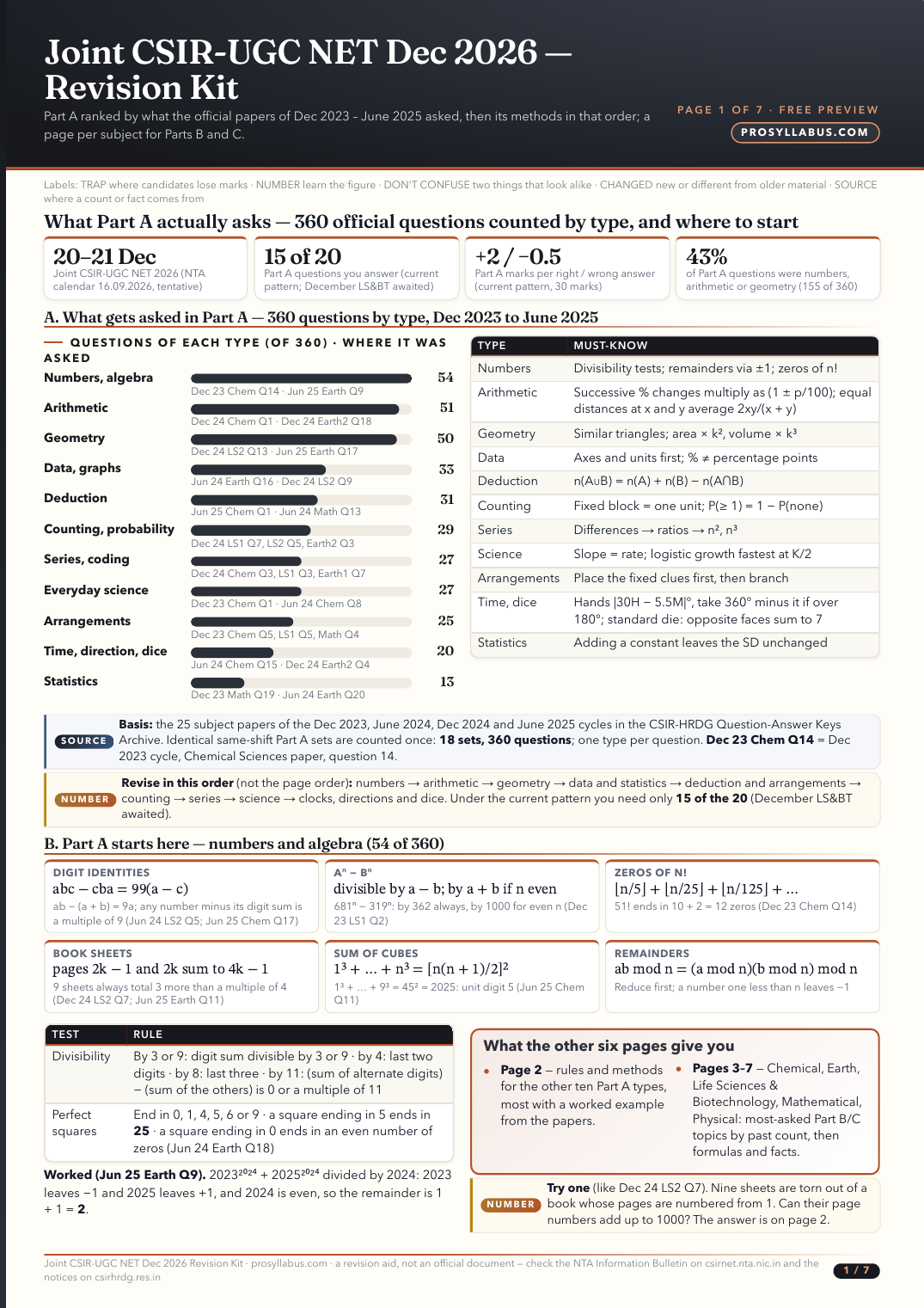

Checked 2 October 2026. The scheme cited is the June 2026 NTA bulletin, the latest published bulletin we found today. The December 2026 bulletin has not been released; check it when issued. Our 360-question sample is from December 2023 through June 2025 and is not a forecast of the next paper.
If you searched for a CSIR NET Part A syllabus PDF, the most useful starting point is the conducting body's own wording: Part A tests general aptitude, especially logical reasoning, graphical analysis, analytical and numerical ability, quantitative comparison, series and puzzles. There is no official chapter-by-chapter weightage table for Part A. The latest NTA information bulletin we found is for June 2026; it says every subject offers 20 Part A questions, you may attempt 15, and those 15 carry 30 of the paper's 200 marks.
This guide goes further than a copied syllabus list. We classified 360 Part A questions from 18 distinct official sets across four exam cycles. The largest three types in that sample are number/algebra (54), arithmetic (51) and geometry (50)—155 of 360 combined. Those are our labels and past counts, not CSIR's promised distribution for a future paper. The complete source and counting method are below.
20, 15 and 30: official June 2026 scheme. 360: our deduplicated count of official archive papers.
| What to know | Answer | Basis |
|---|---|---|
| Official broad Part A scope | Logical reasoning; graphical analysis; analytical and numerical ability; quantitative comparison; series formation; puzzles | NTA June 2026 bulletin, p. 10, and CSIR-HRDG model paper |
| Questions offered / may attempt | 20 / 15 | NTA June 2026 bulletin, p. 9 |
| Marks per correct / wrong Part A answer | +2 / −0.5 | NTA June 2026 bulletin, p. 9 |
| Maximum Part A marks / whole paper | 30 / 200 | NTA June 2026 bulletin, p. 9 |
| Separate Part A qualifying cutoff? | No; merit uses cumulative marks from Parts A, B and C | NTA June 2026 bulletin, result/merit section |
| Our observed sample | 18 distinct sets × 20 questions = 360 | Our classification of the CSIR-HRDG Dec 2023–June 2025 archive |
Where other pages get this wrong
A “topic-wise official weightage” chart for CSIR Part A is not published by CSIR or NTA.
Commonly published instead: A rigid chapter list saying a fixed number of percentage, geometry or reasoning questions must appear.
The official document names broad abilities. The topic figures below are our classification of past papers, disclosed set by set. Use them to choose practice, not to exclude a skill or predict December 2026.
The actual Part A syllabus: official scope versus a useful study map
Part A is common to the science subjects, so the official scope is written as abilities rather than as a textbook index. “General Aptitude” does not mean a second science-subject paper. You may meet a physics-flavoured graph, a biological population table or a simple geometry diagram, but the test is whether you can reason with the information supplied. Our 13 types below split that broad scope into trainable methods. The split is editorial; it is not an NTA chapter list.
| Our type | Official broad area it helps practise | Questions in 18 distinct sets | Share of 360 (ours) | Start with |
|---|---|---|---|---|
| Number properties and algebra (NUM) | Numerical ability | 54 | 15.0% | Remainders, digit rules and equations |
| Arithmetic word problems (ARITH) | Numerical ability | 51 | 14.2% | Rates, ratios, percentages and mixtures |
| Geometry and mensuration (GEO) | Numerical / spatial ability | 50 | 13.9% | Areas, volumes and similar figures |
| Data interpretation and graphs (DI) | Graphical analysis | 33 | 9.2% | Read scales, compare changes and infer cautiously |
| Deduction and logic (DED) | Logical reasoning | 31 | 8.6% | Venn sets, relations and what must follow |
| Counting and probability (PC) | Analytical / numerical ability | 29 | 8.1% | Count cases before calculating probability |
| Everyday science reasoning (SCI) | Analytical / graphical ability | 27 | 7.5% | Motion, density and measured change |
| Series, analogy and coding (SER) | Series formation / reasoning | 27 | 7.5% | Find a rule, then test a second position |
| Arrangement and ranking (ARR) | Puzzles / logical reasoning | 25 | 6.9% | Orders, seating and assignments |
| Averages and statistics (STAT) | Quantitative comparison | 13 | 3.6% | Mean, median and spread |
| Clocks, calendars and time zones (CAL) | Analytical / numerical ability | 8 | 2.2% | Elapsed time and date cycles |
| Directions and distances (DIR) | Spatial / analytical ability | 6 | 1.7% | Track orientation and displacement |
| Visual and spatial problems (VIS) | Puzzles / graphical ability | 6 | 1.7% | Cubes, mirrors and rolling figures |
For a beginner, the map suggests an order: get comfortable with number properties, ordinary arithmetic and geometry, then practise reading graphs and formal deduction. But “largest in this sample” should not become “ignore the rest.” The 18 sets differ, and the smaller types still cost marks when they appear. A candidate strong in geometry but weak in Venn problems should repair Venn reasoning first despite the aggregate count.
The label also matters when you review a mistake. If you missed a chart question because you divided by the wrong baseline, tag it as a data-interpretation percentage error, not as a general “graph weak” result. If your answer to a family-relation question relied on an unstated assumption, tag deduction. A practical topic plan emerges from repeated error causes, not a list of formulas you have already memorised.
Each question received exactly one primary type. These are past counts, not official weightage or a forecast.
How we counted the 360 questions—and what the chart cannot say
We began with 25 subject-paper PDFs in the CSIR-HRDG Question–Answer Keys Archive: December 2023, June 2024, the December 2024 cycle that sat in February–March 2025, and June 2025. Part A in subject papers held in the same shift often repeats exactly. Counting every copy would make a shift with more published subject PDFs look more important, even though the questions were identical. We therefore compared Part A sets and retained each identical same-shift set once. This leaves five sets in December 2023, six in June 2024, five in the December 2024 cycle and two in June 2025: 18 sets of 20 questions.
| Official exam cycle | Subject PDFs examined | Distinct Part A sets retained | Questions counted | Official paper index |
|---|---|---|---|---|
| December 2023 | 6 | 5 | 100 | CSIR-HRDG archive PDF (linked in sources) |
| June 2024 | 6 | 6 | 120 | CSIR-HRDG archive PDF (linked in sources) |
| December 2024 (sat Feb–Mar 2025) | 8 | 5 | 100 | CSIR-HRDG archive PDF (linked in sources) |
| June 2025 | 5 | 2 | 40 | CSIR-HRDG archive PDF (linked in sources) |
| Total | 25 | 18 | 360 | Our deduplicated audit |
The CSIR-HRDG archive hosts the paper indexes. The December 2023, June 2024, December 2024 and June 2025 index PDFs link to each official subject question paper. Our internal audit records the cycle, subject/shift, question number, type and a short original gist for every retained Part A item. We read scanned questions, so we checked the code against the question context rather than relying on OCR words alone.
A few choices are judgement calls. A question about a graph of moving objects could be coded as graphical interpretation or everyday science reasoning; a geometry question that turns on a divisibility trick could fit either geometry or number properties. We use the primary method a learner needs to get to the answer, one code per item. This counts question stems appearing in the official papers, not scored answers: a later key change or dropped item does not turn a printed question into a prediction. Repeated questions in different shifts or cycles are counted again because they are actual separate sittings; exact copies within the same shift are not. These rules make the chart reproducible, but no frequency chart can tell you what the next paper will contain.
The 18 distinct Part A sets retained in the audit
| Retained Part A set | Official paper sitting | Questions counted | Question-paper index |
|---|---|---|---|
| Dec23-Chem | 27-Dec-2023 | 20 | December 2023 |
| Dec23-Earth | 27-Dec-2023 15:00 | 20 | December 2023 |
| Dec23-LS1 | 26-Dec-2023 09:00 | 20 | December 2023 |
| Dec23-LS2 | 26-Dec-2023 15:00 | 20 | December 2023 |
| Dec23-Math | 28-Dec-2023 09:00 | 20 | December 2023 |
| Jun24-Chem | 27-Jul-2024 | 20 | June 2024 |
| Jun24-Earth | 25-Jul-2024 09:00 | 20 | June 2024 |
| Jun24-LS1 | 26-Jul-2024 09:00 | 20 | June 2024 |
| Jun24-LS2 | 26-Jul-2024 15:00 | 20 | June 2024 |
| Jun24-Math | 25-Jul-2024 15:00 | 20 | June 2024 |
| Jun24-Phys | 25-Jul-2024 09:00 | 20 | June 2024 |
| Dec24-Chem | 28-Feb-2025 15:00 | 20 | December 2024 |
| Dec24-Earth1 | 28-Feb-2025 09:00 | 20 | December 2024 |
| Dec24-Earth2 | 02-Mar-2025 09:00 | 20 | December 2024 |
| Dec24-LS1 | 01-Mar-2025 09:00 | 20 | December 2024 |
| Dec24-LS2 | 01-Mar-2025 15:00 | 20 | December 2024 |
| Jun25-Chem | 28-Jul-2025 Shift 2 | 20 | June 2025 |
| Jun25-Earth | 28-Jul-2025 Shift 1 | 20 | June 2025 |
Cycle-by-cycle counts, so the bars have a table fallback
| Our type | Dec 2023 · 5 sets | June 2024 · 6 sets | Dec 2024 · 5 sets | June 2025 · 2 sets | All 18 sets |
|---|---|---|---|---|---|
| Number properties and algebra (NUM) | 21 | 16 | 10 | 7 | 54 |
| Arithmetic word problems (ARITH) | 15 | 19 | 10 | 7 | 51 |
| Geometry and mensuration (GEO) | 11 | 15 | 16 | 8 | 50 |
| Data interpretation and graphs (DI) | 10 | 13 | 7 | 3 | 33 |
| Deduction and logic (DED) | 5 | 8 | 12 | 6 | 31 |
| Counting and probability (PC) | 6 | 9 | 13 | 1 | 29 |
| Everyday science reasoning (SCI) | 6 | 12 | 7 | 2 | 27 |
| Series, analogy and coding (SER) | 7 | 8 | 10 | 2 | 27 |
| Arrangement and ranking (ARR) | 9 | 10 | 5 | 1 | 25 |
| Averages and statistics (STAT) | 3 | 5 | 4 | 1 | 13 |
| Clocks, calendars and time zones (CAL) | 5 | 3 | 0 | 0 | 8 |
| Directions and distances (DIR) | 0 | 1 | 3 | 2 | 6 |
| Visual and spatial problems (VIS) | 2 | 1 | 3 | 0 | 6 |
| Dec 2023 | June 2024 | Dec 2024 | June 2025 | |
|---|---|---|---|---|
| Number properties and algebra | 21 | 16 | 10 | 7 |
| Arithmetic word problems | 15 | 19 | 10 | 7 |
| Geometry and mensuration | 11 | 15 | 16 | 8 |
| Data interpretation and graphs | 10 | 13 | 7 | 3 |
| Deduction and logic | 5 | 8 | 12 | 6 |
| Counting and probability | 6 | 9 | 13 | 1 |
| Everyday science reasoning | 6 | 12 | 7 | 2 |
| Series, analogy and coding | 7 | 8 | 10 | 2 |
| Arrangement and ranking | 9 | 10 | 5 | 1 |
| Averages and statistics | 3 | 5 | 4 | 1 |
| Clocks, calendars and time zones | 5 | 3 | 0 | 0 |
| Directions and distances | 0 | 1 | 3 | 2 |
| Visual and spatial problems | 2 | 1 | 3 | 0 |
Shading compares raw questions, not per-set rates. June 2025 has only two distinct sets, so its cells will generally be smaller.
Our coding of official CSIR-HRDG papers; the table above gives every exact value.
The June 2025 column must not be read as a collapse in a topic: it contains two distinct sets, while June 2024 contains six. If you want a fair per-set comparison, divide a column by the number of retained sets shown in the inventory. Even then the sample is too short to extrapolate a trend. The strongest use of the dataset is to spot methods you should be able to perform under time pressure, not to manufacture a “guaranteed” question list.
Turn the syllabus into a method: six original worked mini-examples
The short examples that follow are newly written practice illustrations, not copied CSIR paper questions or claims about an answer key. Each demonstrates the move behind a family of official-question types. Work each without a calculator, then use an official paper to see how the same method is disguised in a real stem.
1. Number properties: reduce before you expand
Suppose a question asks for the remainder when 99 to the power 12 is divided by 100. Because 99 is −1 modulo 100, an even power leaves 1. Expanding the huge number is wasted work. The transferable move is to rewrite a base near a convenient modulus and inspect whether the exponent is even or odd. In our audit, number properties and algebra were 54 of 360 items, the largest single label, but they covered several different operations—remainders, digits and equations—not one trick.
2. Arithmetic: keep the denominator honest
A sample solution is 20% smaller and then 20% larger. Start with 100; it becomes 80, then 96. The net change is −4%, not zero. The second percentage uses 80 as its base. This is the same reasoning you need for successive discounts, population change or mixture replacement. Write the starting quantity in the margin before doing mental percentages. Arithmetic word problems made 51 of our 360 labels.
3. Geometry: draw the constraint before reaching for a formula
A rectangle has sides 6 and 8. Its diagonal is 10 by the right-triangle relation. If the sides both double, the diagonal doubles to 20; the area instead becomes four times as large. The first question to ask in a geometry stem is whether the figure is scaling a length, an area or a volume. That unit decision often removes a wrong option before calculation. We coded 50 geometry and mensuration items in the sample.
4. Graphs: distinguish absolute change from percentage change
One series rises from 20 to 30, and another from 100 to 115. The second gained 15 units and the first only 10, but the first grew 50% against 15%. A graph question asking for “largest increase” is different from one asking for “largest relative increase.” Read the axis, unit and baseline before comparing. Graph and table interpretation accounted for 33 of our coded questions.
5. Deduction: separate “must” from “may”
If all researchers are graduates and some graduates are chemists, can we conclude that some researchers are chemists? No. Those chemists may be outside the researcher group. Sketch two nested or overlapping circles and try to produce a valid counterexample. Formal deduction, Venn counts and relation logic together formed 31 of our labels, while arrangement and ranking puzzles were another 25.
6. Counting: define the sample space once
A fair coin is tossed twice. The four equally likely ordered outcomes are HH, HT, TH and TT. The chance of at least one head is three of four, since only TT fails. The method is to count the complement when “at least one” makes direct counting messy. In past papers we classified 29 items as counting or probability. The same counting habit helps with digit arrangements and simple selection puzzles.
After each example, look for the specific trigger in the official paper: “remainder,” “relative,” “must follow,” “at least one,” or a unit of area versus length. A revision note should say which trigger made you choose a method and what error would have changed the answer. That is more useful than a page of isolated formulas.
CSIR REVISION KIT
The free analysis above shows what was asked and how to choose your next practice task. The seven-page CSIR revision kit puts the Part A rules and worked methods on pages 1–2, then gives each of the five subject papers its own compact Part B/C page.
See the free first page · View the seven-page kit and current price
The kit is a separate digital purchase. The official syllabus and the full analysis in this article remain free.
Part A marking, question selection and the first-15 rule
The June 2026 bulletin prints the same Part A offer, attempt limit and marks for Chemical, Earth, Life, Mathematical and Physical Sciences: 20 offered, at most 15 counted, 2 marks right, 0.5 deducted wrong. The subject differences sit chiefly in Parts B and C. If you answer too many questions, NTA says only the first 15 Part A questions answered are evaluated. That means the order of your clicks matters; do not use the 20 questions as a 20-attempt paper and expect NTA to choose your best 15.
There is no separate Part A qualifying cutoff in the June 2026 bulletin. Its merit rule uses cumulative marks from Parts A, B and C. Treat the Part A calculator below as section practice arithmetic, not a pass/fail prediction. The same bulletin prohibits carrying a calculator into the test, so solve the worked examples and official sets by hand.
| Practice scenario (ours) | Evaluated attempts | Part A arithmetic | Score of 30 |
|---|---|---|---|
| 10 right, 5 wrong | 15 | 10 × 2 − 5 × 0.5 | 17.5 |
| 12 right, 3 wrong | 15 | 12 × 2 − 3 × 0.5 | 22.5 |
| 9 right, 3 wrong | 12 | 9 × 2 − 3 × 0.5 | 16.5 |
| 15 right, 0 wrong | 15 | 15 × 2 − 0 × 0.5 | 30.0 |
Part A score and attempt calculator
Enter the answers that would be among your first 15 attempted questions. The June 2026 rule awards 2 for a correct answer and deducts 0.5 for an incorrect one. Your score here is a Part A practice score, not a NET qualification prediction.
Rule source: June 2026 NTA bulletin, p. 9. If you click more than 15 answers in the real exam, the bulletin says only the first 15 Part A answers are evaluated; this calculator cannot infer their click order.
A blind guess among four equally likely options has an arithmetic expected value of +0.125 marks under +2/−0.5. That observation alone does not mean “guess everything.” Reading a question, excluding choices and entering an answer takes time that could have helped in Part B or C. Worse, an early guess can occupy one of the first 15 Part A slots before you reach a question you know. If you can eliminate one or two choices, the expected value improves under the equal-likelihood assumption, but a personal mock log is a better guide than an abstract average.
| Choices you consider equally possible | Chance right under assumption | Expected marks (ours) | What it leaves out |
|---|---|---|---|
| 4 (none removed) | 1/4 | +0.125 | Time and first-15 opportunity cost |
| 3 (one removed) | 1/3 | +0.333 | Whether the exclusion is actually sound |
| 2 (two removed) | 1/2 | +0.750 | Time and later known questions |
| 1 (known answer) | 1 | +2.000 | Possible calculation error |
A practical two-pass approach is to scan for questions you can solve reliably and quickly, then return to the remaining methods if you still have Part A slots and time. This is a practice framework, not an official recommended order. In your mock review, write down how many correct answers came from fast recognised methods, how many came after long calculation, and whether a guess displaced a later known question. Those three numbers tell you more than a generic “attempt 15 at all costs” slogan.
A diagnostic revision plan that changes with your mistakes
First take one timed official Part A set. For each miss, record the source cycle, subject/shift, question number, our type, why your chosen method failed and the method you would use next time. Do not score a topic as “weak” from one awkward question. Look for repeated causes over two or three sets. Give a skill a higher weakness level when you are repeatedly wrong or consistently too slow, then allocate a modest weekly Part A block that still leaves time for the subject paper.
| Planner family | Our codes | Observed questions | Baseline in an 8-hour example |
|---|---|---|---|
| Number / algebra | NUM | 54 | 1.2 h |
| Arithmetic | ARITH | 51 | 1.1 h |
| Geometry | GEO | 50 | 1.1 h |
| Graphs / DI | DI | 33 | 0.7 h |
| Deduction / puzzles | DED + ARR | 56 | 1.2 h |
| Other Part A types | PC + SCI + SER + STAT + CAL + DIR + VIS | 116 | 2.6 h |
Build a Part A repair plan from your errors
This allocates your own weekly Part A study hours across six skill families. The weighting is our planning rule: observed question count × (1 + your weakness level), where confident = 0, needs practice = 1 and often wrong = 2. Each family's hours equal your weekly hours × its weight ÷ the sum of all six weights. It does not predict the next paper. Diagnose with an official set first, then change the selectors.
Sample base: the 360 coded questions below. The six families combine 13 analysis types; totals are shown in the table. A higher count is not a guaranteed future weight. Recalculate after each timed official paper.
The default eight-hour example above is deliberately mechanical: it divides hours by observed question counts when every family is set to the same weakness level. It is not a claim that every candidate should spend eight hours on Part A or that the next paper will copy the sample. In the planner, changing “Graphs / DI” from “needs practice” to “often wrong” increases its share; changing a strong family to “confident” reduces its share. Review the allocations against your exam date, subject workload and actual paper errors. If your science subject is the bottleneck, reduce total Part A hours rather than believing any Part A chart can compensate for neglected Part B/C work.
A useful weekly sequence is method repair, then one mixed timed set, then an error review. Method repair means doing a few carefully chosen examples with the solution hidden; the timed set tests whether you can recognise the method amid unfamiliar wording; the review turns misses into the following week’s tasks. If a type stays weak because the underlying mathematics is missing, step back to that prerequisite. If it stays weak only under time pressure, keep the concept and change the decision to skip or return.
Where to get the real papers, and how to use them without copying answers
Start at the official CSIR-HRDG question and answer archive, not a mystery PDF labelled “latest.” Open a cycle's index, select the subject/shift PDF, and find Part A. For the first pass, answer it under a reasonable self-imposed clock and mark your confidence. For the second, verify the official final key where available and explain the method in your own words. The archive indexes for our sample are linked above. The older CSIR Part A model paper illustrates the broad type of tasks, but it is a model, not a recent exam or an official weightage table.
The paper ledger matters because a past-paper article can accidentally multiply identical sets. If you study a Chemical Sciences and Physical Sciences PDF from the same shift and find the same Part A, treat it as one practice set. You can still practise both subject papers for Parts B/C, but for Part A frequency analysis it is one observation. Our 18-set count already applies that rule.
The June 2026 papers with recorded responses were made available through NTA’s answer-key challenge process, but the public CSIR-HRDG archive set used in this analysis ends at June 2025. We therefore do not mix an unarchived 2026 key or candidate response into the 360-question dataset. When an accessible official question paper and final key are published together, add that cycle as a dated extension and show how the chart changes; do not quietly relabel the old sample “2026 trend.”
What changes for the December 2026 sitting
The December 2026 information bulletin had not been published at this check. Our pattern table therefore reports the latest available June 2026 bulletin, not an invented December rule. CSIR has separately announced a Life Sciences and Biotechnology subject change for December 2026; that concerns the subject syllabus and potentially Parts B/C. Do not assume a new Life Sciences & Biotechnology Part B/C pattern from the June Life Sciences table. This page is about common Part A, and its official rules must be refreshed as soon as NTA issues the December bulletin.
If the new bulletin changes a Part A value, the top answer box, scoring tool, static examples and kit copy must all be checked together. If it does not change the rules, the old question dataset still needs a clear date because the public archive can grow. The “checked” banner at the top tells you which documents this version relied on.
CSIR REVISION KIT
Keep the complete Part A methods and subject-page formulas beside your revision log.
See the free first page · View the seven-page kit and current price
The kit is a separate digital purchase. The official syllabus and the full analysis in this article remain free.
Is there an official chapter-by-chapter CSIR NET Part A syllabus PDF?
CSIR and NTA describe Part A as general aptitude with logical reasoning, graphical analysis, analytical and numerical ability, quantitative comparison, series and puzzles. They do not publish a fixed chapter-by-chapter weightage table. Use the official bulletin and model paper for scope; the 13 types here are ProSyllabus study labels.
How many Part A questions can I attempt?
The June 2026 NTA bulletin offers 20 Part A questions and evaluates a maximum of 15. It says that if more than 15 are answered, only the first 15 Part A answers are evaluated. Check the new December bulletin when released.
Does CSIR NET Part A have negative marking?
Yes, the June 2026 bulletin gives +2 for a correct Part A answer and deducts 0.5 for an incorrect one. Parts B and C differ by subject, so do not copy a Part A rule into those sections.
Is there a separate cutoff for Part A?
No. The June 2026 NTA bulletin says there is no separate cutoff for Parts A, B and C; the merit list uses their cumulative marks. Its category benchmarks concern the combined result, not a required Part A score.
Are the 360-question topic counts official weightage?
No. The papers are official, but the 13-type classification and deduplication are ProSyllabus analysis of 18 distinct Part A sets from December 2023 through June 2025. They describe a sample, not the next paper.
Where are the previous Part A papers?
The CSIR-HRDG Question–Answer Keys Archive links official cycle indexes, which in turn link each subject paper. Part A sits at the start of the relevant paper. Same-shift subject PDFs may contain identical Part A questions.
Is the seven-page revision kit included with a quiz membership?
No membership entitlement is promised here. The CSIR revision kit is a separate digital product; its offer page shows the current price and a free preview of page 1.
Sources
- official — NTA Joint CSIR-UGC NET June 2026 Information Bulletin, pp. 9–10 (latest bulletin checked)
- official — CSIR-HRDG examination scheme and broad Part A scope
- official — CSIR-HRDG Part A model question paper
- official — CSIR-HRDG Question–Answer Keys Archive
- official — CSIR-HRDG December 2023 question-paper index
- official — CSIR-HRDG June 2024 question-paper index
- official — CSIR-HRDG December 2024 question-paper index
- official — CSIR-HRDG June 2025 question-paper index
official = a document published by the conducting body. reported = a news or coaching site we could not check against an original. Where sources disagree this page says so rather than picking one.