Checked 29 September 2026. The pattern is IREM Vol I Appendix 3 as amended by ACS 282 (21.08.2023) and ACS 288 (07.03.2024). It was first used in June 2024. No notification for the next sitting had been published on 29 September 2026.
The Appendix-3 (IREM) examination is the qualifying test that accounts staff of Indian Railways pass to become supervisors. Para 20 of the IREM reserves 99% of Sr. SO/A posts and all Traffic and Stores Inspection posts for Appendix-3 qualified staff; the other 1% of Sr. SO/A posts go to Sr. Accounts Assistants who have not passed it. Since the 2023 merger, a pass qualifies you for all three streams: Senior Section Officer/Accounts (Sr. SO/A), Senior Section Officer/Traffic Inspection (Sr. SO/TI) and Senior Section Officer/Stores Inspection. The Railway Board sets and conducts it; zones and production units only nominate candidates. This guide gives the full list of topics the IREM prints for each paper. The live summaries we checked, our own notice board included, cut that list short. It also shows how the pattern changed in 2024 and what you may and may not take into the hall.
ProSyllabus is an independent study site. We are not affiliated with Indian Railways, the Railway Board or any zonal railway or production unit. Every rule below is quoted or summarised from the Board's published letters, and your Accounts office decides every nomination.
IREM Vol I Appendix 3, paras 3(i), 3(ii) and 3(xi).
Where other pages get this wrong
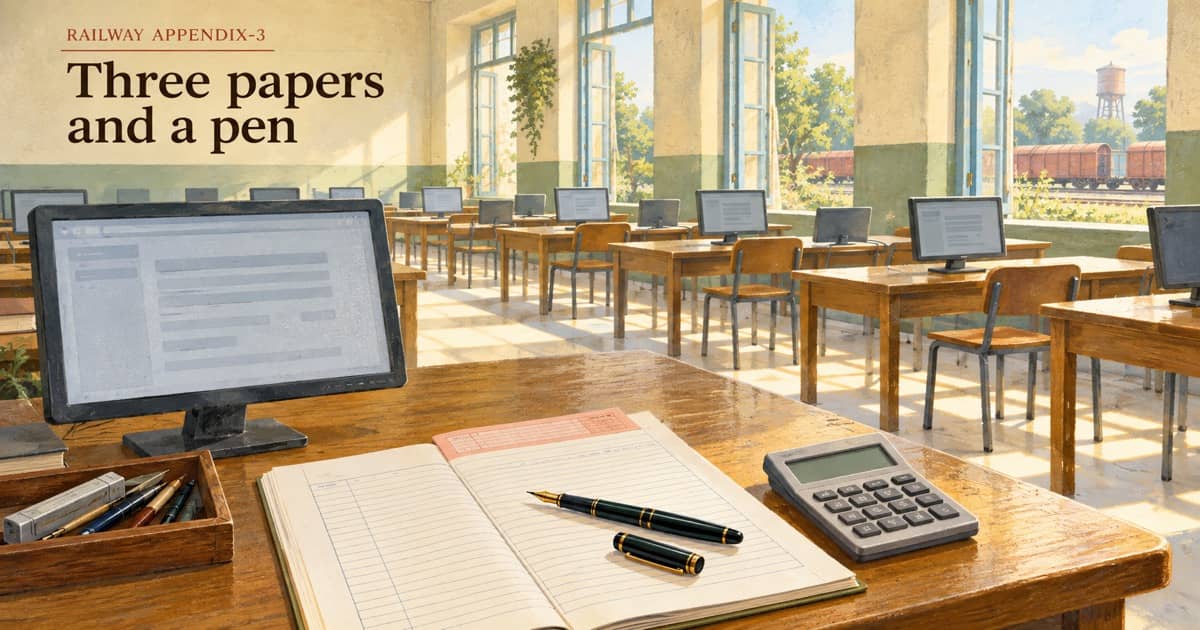
The subjective paper is shown on a computer screen, but you write your answers by hand, on paper, in an answer book.
Commonly published instead: "Subjective, typed on computer", with advice to practise typing speed. Our own notice board for this exam said this until this guide replaced it.
IREM Appendix 3 para 3(v), as amended by ACS 288 (07.03.2024): "Question paper will be available on computer and candidate will have to write answers on paper." The 2024 model subjective paper gives instructions for the answer book: write your roll number only on the detachable slip, and tie extra books together with thread. The same instructions sheet still carries the general CBT lines, such as logging in with a PIN. That is why the paper is easy to misread as typed. Practise writing, not typing.
The four papers at a glance
All four papers are part of one examination. The objective papers are computer-based tests (CBT) of multiple-choice questions. The subjective paper uses the same CBT hall to show its questions, and you answer them in a written answer book. The examination is bilingual in Hindi and English, in the medium you choose. Where the two versions differ, the model paper says the English version prevails.
| Paper | What the IREM says it covers | Marks and time | Format |
|---|---|---|---|
| Paper I (objective) | GRP, Establishment, PF, Pension/NPS, Labour Laws and Associated Finance, Expenditure, Books & Budget, Book-Keeping | 100 marks, 2 hours | MCQ on computer, −0.25 per wrong answer |
| Paper II (objective) | Stores, Workshop, COS Procedure, Workshop Costing and Associated Finance, Expenditure & WMS & Stores Account | 100 marks, 2 hours | MCQ on computer, −0.25 per wrong answer |
| Paper III (objective) | Traffic Accounts, Finance, Traffic Statistics/Costing, Station Accounts and Inspection | 100 marks, 2 hours | MCQ on computer, −0.25 per wrong answer |
| Subjective paper | One section on General Essay, Letter & Precis and a question on Rajbhasha (the IREM says "as per ACS No.283"; see below); practical aspects of Finance and Accounts cases; numerical questions on Advanced Book Keeping | 200 marks, 3 hours | Questions on screen, answers handwritten on paper; basic calculator allowed |
Paper names and coverage are quoted from IREM Vol I Appendix 3 para 3(iii). The official texts number the objective papers I, II and III and call the fourth simply "the subjective paper". Some pages call it Paper IV; the 2024 model paper is headed "Model Paper-IV". The abbreviations are the IREM's own: GRP is General Rules and Procedure, PF is Provident Fund, NPS is the National Pension System, COS is the Controller of Stores and WMS is the Workshop Manufacturing Suspense.
One conflict to know: 100 questions or 110?
The IREM says each objective paper has 100 multiple-choice questions. The Board's model papers of 01.05.2024 say something slightly different: 110 questions are set, and you attempt any 100. Each carries 1 mark, so the paper is still out of 100. The 2024 papers followed the model. We read the Paper I scan to question 110, and Paper III also runs to about 110. So in practice you get ten questions to skip. The model paper does not say what happens if you answer more than 100. Treat 100 as a hard limit and count as you go.
| Point | IREM Appendix 3 | Model papers (01.05.2024) and the 2024 papers |
|---|---|---|
| Questions per objective paper | 100 MCQs | 110 set, answer any 100 |
| Marks per question | Not stated per question; 100 marks per paper | 1 mark; −0.25 per wrong answer |
| Options | Not stated | 4 options, one shown at a time on screen |
| Calculator in objective papers | Not stated | Not permitted |
| Calculator in the subjective paper | Permitted for Advanced Book Keeping numericals | Basic model allowed; scientific calculators not permitted |
| Rough work | Not stated | Rough sheets provided at the centre; bring your own pens and pencils |
Both columns are official. We print them side by side because the IREM text and the Board's own instructions differ on the question count. For the next sitting, the instructions issued with it will decide.
The syllabus, paper by paper
The IREM gives headings, not a detailed syllabus. RBA 71/2021 promised that a "detailed syllabus will follow", and we found none on the Board's compendium pages up to 09.09.2026. What exists instead is better for revision: an 818-page objective question bank for "Appendix III A IREM", issued on 27.03.2023; three model objective papers with answer keys and a model subjective paper (01.05.2024); and all four actual 2024 papers. The tracker below splits the IREM headings into the units you revise, in the order the IREM lists them. The split into units is ours; every objective heading is the IREM's. For the subjective paper the IREM names only three parts, so the examples in brackets come from the 2024 model paper.
Appendix-3 syllabus tracker
Tick a unit when you have revised it from the codes and done the matching questions in the Board's question bank. Objective units are the IREM headings, split by us for revision. The subjective items name the IREM's three parts, with examples from the 2024 model paper in brackets; they are not an official syllabus.
0 of 24 done
Ticks are saved only in this browser on this device.
What the headings mean in practice is best read from the papers themselves. The first pages of the 2024 papers ask about GFR 2017, Constitution articles and appropriation accounts. The model Paper I asks when the General Manager may sanction an excess over an estimate, which plan heads count as umbrella works, and when an Additional Post Allowance is admissible. Those are code-and-rule questions, not general knowledge. Paper II was the one that sank most candidates in 2024. Our count of the official marks list of 07.08.2024 puts 1,354 of the 2,446 candidates with a Paper II mark (55%) below 40, against 772 of 2,446 (32%) in Paper I. Absentees have no mark and are left out; the list shows no exempt candidates in 2024, the first sitting of the new pattern. Stores and workshop accounting deserves more than its one-in-three share of your time. The results guide breaks this down.
Old pattern and new pattern
Until 2022 the examination ran on the pattern of ACS 239 (RBA 133/2017): compulsory papers plus one combination of optional subjects. Each optional subject was split into a with-books part and a without-books part. The 2022 special examination, held 14 to 24 March 2022, was described as the last exam in the old pattern. It was open only to candidates who already held an exemption in at least one paper. The 2024 sitting was the first under the merged scheme.
| Feature | Old pattern (ACS 239, to 2022) | New pattern (ACS 282/288, from 2024) |
|---|---|---|
| Streams | Separate streams chosen through optional subjects: Accounts, Traffic (TIA), Stores (ISA) | One merged examination; preference among the three streams given on the application |
| Papers | Compulsory subjects (Advanced Book Keeping, GRP) plus one optional combination; 100 marks a paper | Three objective papers of 100 marks plus a 200-mark subjective paper |
| Books | Optional papers had with-books and without-books parts | All papers Without Books |
| Mode | Written | CBT for objective papers; subjective questions on screen, answers on paper |
| Pass marks | Compulsory 40% (30% SC/ST); optional 40% each and 45% aggregate (30/35% SC/ST) | 40% a paper and 45% aggregate of the objective papers (30/35% for SC/ST/PwBD); subjective 40%, relaxed as for other papers |
| Exemption | 60% in a paper | 60% in a paper, valid for 5 attempts |
| Frequency in the text | "held once each year" | "at regular intervals" |
| Attempts | Not capped in the text we read | No cap on the number of attempts |
Old-pattern rows are from RBA 133/2017 and the 2022 special result sheet. New-pattern rows are from IREM Appendix 3 as it stands. If a coaching note or forum post talks about "with books" papers, it is describing the retired scheme.
Books, calculators and what you carry
What the 2024 instructions allowed
- No books, notebooks or codes in any paper. The IREM makes all papers Without Books, and the model instructions list books, notebooks and logarithmic tables among banned items.
- No calculator in the objective papers. The model instructions say calculators are not permitted in objective papers. Practise percentage and ratio arithmetic by hand.
- A basic calculator in the subjective paper, for the Advanced Book Keeping numericals. Scientific calculators, electronic diaries, pagers and phones are not permitted.
- Your own pens and pencils. Rough sheets are given at the centre. Sharing stationery counts as unfair means.
- The admit card, downloaded twice. In 2024 the centre details were updated on 3 June, and the photo had to be attested by your controlling officer. You also need one photo identity document.
- A different roll number for each shift. Enter the one printed for that paper.
From the model paper instructions issued on 01.05.2024 for the June 2024 sitting. The next sitting's instructions may differ.
Where the official practice material is
| Material | Issued | What it is |
|---|---|---|
| Question Bank, "Appendix III A IREM" | 27.03.2023 | 818 pages of objective questions for the new pattern |
| Model Papers I, II and III with answer keys | 01.05.2024 | 110 questions each, the exact format used in June 2024 |
| Model subjective paper | 01.05.2024 | Nine questions in three sections, answer five of 40 marks each |
| All four 2024 question papers | posted 14.08.2024 | The actual papers of 18-19 June 2024, 202 scanned pages |
| Response sheets and final key | 30.08.2024 | Downloadable for a week from 30.08.2024 on the CBT portal; the window has closed |
All five are on the Railway Board Accounts Directorate pages; links are in the sources below. The question bank predates the 2024 papers, so it does not reflect how the questions were actually pitched. Use the 2024 papers to judge the level and the bank for coverage.
How the pattern came to be
The scheme was announced by RBA 71/2021 (15.12.2021): objective papers, a subjective paper and a compulsory Rajbhasha question. It entered the IREM as ACS 282 on 21.08.2023, which also merged the three supervisory streams. ACS 288, issued with RBA 07/2024 on 07.03.2024, rewrote six clauses: the subjective paper's contents (3(iii)(b), where "one compulsory question on Rajbasha" became a "question on Rajbhasha as per ACS No.283 dated 4.12.2023"), answers written on paper (3(v)), the 30/35% relaxation named for SC/ST/PwBD (3(viii) and (x)), exemption for 5 attempts instead of 5 years (3(ix)), evaluation of the subjective paper only for candidates who qualify all objective papers (3(xii)), and the rule for being declared passed (3(xiv)). The cross-reference to ACS 283 looks like an error: ACS 283 of 04.12.2023, issued as RBE 134/2023, amends IREM Chapter II on Group C to Group B promotion, as reported by gconnect.in. We found no Rajbhasha provision in it. Since then, RBA 19/2025 (17.06.2025) has told accounts departments to hold their examinations as CBTs through an agency engaged by the Railway Recruitment Board. It names the DF/CCA of the Railway Board as nodal officer for Appendix III. How the next Appendix-3 sitting will be run under that letter has not been published.
For pass marks, exemptions and a pass checker, see the pass marks guide. For the written paper, see the subjective paper guide. For who may sit, see eligibility and the promotion ladder.
How many papers are there in the Appendix-3 IREM exam?
Four: three objective papers of 100 marks and 2 hours each (Paper I general and establishment, Paper II stores and workshops, Paper III traffic and finance), and one subjective paper of 200 marks and 3 hours.
Is the Appendix-3 subjective paper typed on a computer?
No. The questions appear on the computer, but you write your answers on paper in an answer book. This is IREM Appendix 3 para 3(v) as amended by ACS 288 of 07.03.2024.
Are books allowed in the Appendix-3 exam?
No. Under the current scheme every paper is Without Books. The with-books parts belonged to the old pattern, which ended with the 2022 special exam.
Is a calculator allowed?
Not in the objective papers. In the subjective paper a basic calculator is allowed for the Advanced Book Keeping numericals; scientific calculators are not.
How many questions are in each objective paper?
The IREM says 100. The 2024 model papers and actual papers set 110 and asked candidates to attempt any 100, at 1 mark each with 0.25 deducted per wrong answer.
Is there an official detailed syllabus?
Only the paper headings in IREM Appendix 3. RBA 71/2021 said a detailed syllabus would follow; we found none up to September 2026. The Board has published an 818-page question bank, model papers and the 2024 papers instead.
Can I write the exam in Hindi?
Yes. The exam is bilingual. In 2024 the notification asked candidates to state Hindi medium when nominated, with no change allowed later.
Sources
- official — Railway Board — IREM Vol I, Appendix 3 (current text incorporating ACS 282 and 288)
- official — Railway Board — ACS 282, RBA 27/2023, letter A(E)/A3/2023/10/2 dated 21.08.2023 (merged three-stream Appendix-3 scheme)
- official — Railway Board — corrigendum RBA 07/2024 dated 07.03.2024 enclosing ACS 288 (answers on paper, 30/35% for SC/ST/PwBD, exemption for 5 attempts)
- official — Railway Board — model Papers I to III and model subjective paper, A(E)/A3/2024/1/2 dated 01.05.2024
- official — Railway Board — all four 2024 Appendix-III question papers (202 scanned pages)
- official — Railway Board — Question Bank "Appendix III A IREM", 2015/ACII/20/App.III dated 27.03.2023 (818 pages)
- official — Railway Board — response sheets and final key notice, A(E)/A3/2024/1/2 dated 30.08.2024
- official — Railway Board — RBA 71/2021 dated 15.12.2021: the new objective-plus-subjective scheme announced
- official — Railway Board — RBA 133/2017, ACS 239 dated 25.09.2017 (old pattern, superseded)
- official — Railway Board — special Appendix-3 exam notification A(E)/A3/2022/1/1 dated 05.01.2022 (last exam on the old pattern)
- official — Railway Board — special exam result, June 2022
- official — Railway Board — RBA 19/2025 dated 17.06.2025: accounts departmental exams in CBT mode through an agency engaged by RRB
- official — Railway Board — 2024 notification with Corrigenda 1 to 3 (24.02, 26.02 and 29.02.2024)
- official — Railway Board — Appendix-III (IREM) result A(E)/A3/2024/5/2 dated 07.08.2024, exam of 18-19.06.2024
- reported — gconnect.in — ACS 283, RBE 134/2023 dated 04.12.2023: amendment to IREM Vol I on promotion of Group C staff to Group B (reported)
official = a document published by the conducting body. reported = a news or coaching site we could not check against an original. Where sources disagree this page says so rather than picking one.