GATE Psychology Topic-Wise Weightage 2023–2026, From Official Papers
All 156 Psychology questions from the official 2023–2026 GATE XH papers, classified by syllabus section — marks per section, question types, recurring themes and what it means for 2027.
Updated : 14 hours ago
 View Complete Article
Checked 25 September 2026. Counts are from the official papers and keys and will not change. GATE publishes no official weightage; the 2027 paper can differ, and its syllabus added an organisational-behaviour block.
GATE publishes no weightage for Psychology, so we counted it. We took the official XH Psychology papers and answer keys for 2023, 2024, 2025 and 2026, placed every one of the 156 Psychology questions in one of the ten sections of the syllabus those papers were set on, and added the marks from the key. Each year adds up to exactly 60. (2022 is left out: the 2022 key file on the official GATE site covers only Reasoning and Sociology. 2021 is left out because the Psychology answers in its official key appear to be placeholders — every MCQ keyed A.)
Where other pages get this wrong
Research Methods & Statistics is not "one of ten sections" — it is close to a third of the paper.
Commonly published instead: Topic lists that give every section equal space, or that treat statistics as a small numerical corner of the paper.
In our count it carried 12, 26, 17 and 17 of the 60 Psychology marks in 2023–2026 — 72 of 240, more than the next two sections combined (28 + 27 = 55). And it is mostly conceptual: by our count only nine questions across four papers needed arithmetic beyond reading off a value, and 2026 had no numerical-answer question at all.
Marks per section, year by year
| 2024 | 2025 | 2026 | Section (2026 syllabus) | 2023 (Q / marks) | Four-year marks | Share |
|---|---|---|---|---|---|---|
| 17 / 26 | 11 / 17 | 11 / 17 | Research Methods & Statistics | 7 / 12 | 72 | 30.0% |
| 4 / 7 | 5 / 8 | 5 / 8 | Biological & Evolutionary Basis | 3 / 5 | 28 | 11.7% |
| 2 / 4 | 3 / 4 | 5 / 9 | Social Psychology | 5 / 10 | 27 | 11.3% |
| 7 / 9 | 3 / 4 | 3 / 4 | Perception, Learning, Memory | 7 / 8 | 25 | 10.4% |
| 0 / 0 | 2 / 4 | 3 / 5 | Applications / Clinical & OB | 5 / 9 | 18 | 7.5% |
| 2 / 3 | 5 / 9 | 2 / 2 | Personality | 3 / 3 | 17 | 7.1% |
| 2 / 4 | 2 / 4 | 4 / 7 | Psychometrics | 0 / 0 | 15 | 6.3% |
| 1 / 1 | 3 / 3 | 1 / 2 | Motivation, Emotion, Stress | 5 / 7 | 13 | 5.4% |
| 1 / 2 | 3 / 5 | 2 / 2 | Development Across the Life Span | 2 / 4 | 13 | 5.4% |
| 3 / 4 | 2 / 2 | 3 / 4 | Cognition | 2 / 2 | 12 | 5.0% |
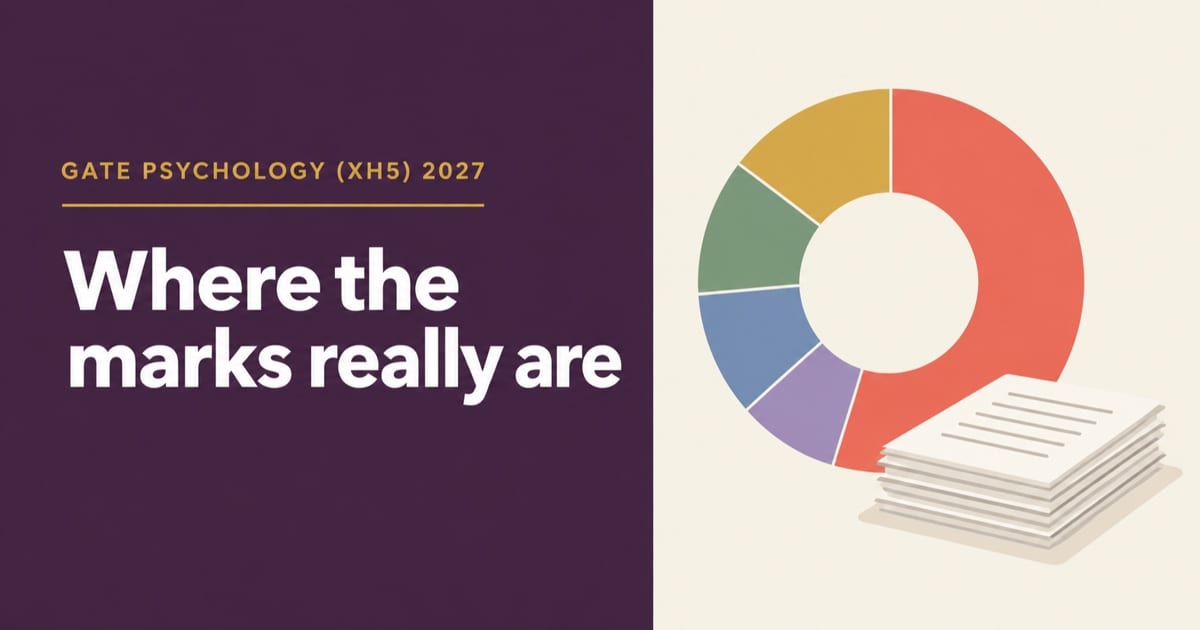
Eight sections shown (a section with zero marks in a year simply has no segment); Development and Cognition, 2–5 marks a year each, make up the rest of each 60.
How the questions were asked
| Paper | MCQ | MSQ | NAT | Calculation questions |
|---|---|---|---|---|
| 2023 | 22 | 15 | 2 | SD from variance (Q44), F-ratio (Q65) |
| 2024 | 18 | 19 | 2 | Effect size (Q64), SD (Q65) |
| 2025 | 22 | 15 | 2 | Mean/SD comparison (Q62), α/β ratio (Q64), % above IQ 115 (Q65) |
| 2026 | 24 | 15 | 0 | Standard error (Q43), SD (Q44) — both as MCQs |
Only MCQs carry negative marking — one third of a mark for a wrong 1-mark MCQ, two thirds for a 2-mark one; MSQs and NATs carry none, though an MSQ scores only for exactly the right set of options. Two things matter here. MSQs are a large share — 15 to 19 of 39 questions every year, and in 2024 every 2-mark question was an MSQ or NAT. An MSQ scores only if you pick exactly the correct set of options, so precise knowledge beats recognition. And MCQs, which carry negative marking, were 18 to 24 per paper: enough that careless guessing can cost several marks.
The themes that keep coming back
| Section | Recurring themes (year · question) |
|---|---|
| Research Methods & Statistics | Hypothesis testing, Type I/II errors (24 Q32, Q45; 25 Q64; 26 Q54); SD/variance (23 Q44; 24 Q54, Q65; 25 Q62; 26 Q44); normal curve, standard error (23 Q61; 24 Q36; 25 Q65; 26 Q43, Q56); qualitative methods (23 Q53; 24 Q35; 25 Q40; 26 Q39, Q55); ethics (24 Q47; 25 Q44; 26 Q36); ANOVA, regression, factor analysis (23 Q65; 24 Q52; 25 Q33, Q53; 26 Q57, Q58) |
| Biological Basis | Nervous-system divisions (24 Q51; 25 Q47, Q49); brain structures (23 Q45; 25 Q28; 26 Q45); neurons and myelin (24 Q53; 26 Q27); neurotransmitters (25 Q46; 26 Q52); hunger and the hypothalamus (24 Q50; 26 Q46); evolution and behaviour genetics (23 Q39; 24 Q33; 25 Q31) |
| Social Psychology | Attribution biases (23 Q50; 25 Q35, Q36); groupthink (23 Q60; 24 Q59); leadership (24 Q60; 26 Q38); persuasion, dissonance, reactance (23 Q54, Q56; 26 Q61); conformity and minority influence (25 Q63; 26 Q60); prejudice and contact (23 Q63; 26 Q63) |
| Perception, Learning, Memory | Reinforcement and schedules (23 Q28; 24 Q38, Q55); classical conditioning (25 Q37; 26 Q53); memory interference and reconstruction (23 Q29, Q30; 24 Q39, Q56; 26 Q30); psychophysics (23 Q27, Q33, Q35, Q47); perception and illusions (24 Q37; 25 Q38, Q61; 26 Q29) |
| Personality | Rogers and humanistic theory (23 Q36; 24 Q44; 26 Q34); Jung, Adler, defence mechanisms (24 Q63; 25 Q50; 26 Q31); Big Five and Type A (23 Q37; 25 Q57) |
| Psychometrics | Reliability (24 Q62; 25 Q58; 26 Q47, Q48); item response theory (24 Q58); MMPI (26 Q33) |
| Applications / Clinical | Therapies — conditioning-based, humanistic, CBT (23 Q57; 25 Q51, Q59; 26 Q59); disorders (23 Q43, Q48, Q64; 26 Q37) |
| Motivation, Development, Cognition | Arousal and motivation theories (23 Q32, Q51; 25 Q34, Q41); ageing theories (23 Q49; 25 Q45); intelligence theories (24 Q43; 25 Q29, Q43); creativity (23 Q38; 26 Q51) |
Judgement calls in our classification
Psychology topics overlap, so some questions could sit in two sections. We placed each by the syllabus wording and list the ones worth knowing about; moving them would shift no section by more than a few marks.
| Paper | Our choice (alternative) |
|---|---|
| 2026 | Q32 dual coding → Cognition (Memory); Q33 MMPI → Psychometrics (Personality); Q37 PTSD → Applications (Stress); Q38 transformational leadership → Social (Applications); Q46 hypothalamus and hunger → Biological (Motivation); Q49 Wechsler scores → Psychometrics (Cognition) |
| 2025 | Q31 evoked culture → Biological (Social); Q35 confirmation bias → Social (Cognition); Q48 cross-sequential design → Research Methods (Development); Q51 behaviour modification → Applications (Learning); Q55 language development → Development (Cognition); Q57 Type A → Personality (Stress) |
| 2024 | Q31 case-study psychoanalysis → Research Methods (Personality); Q50 hunger hormones → Biological (Motivation); Q60 Fiedler → Social (Applications); Q61 culture-fair tests → Cognition (Psychometrics) |
| 2023 | Q27 blind spot, Q33 hair cells → Perception (Biological); Q43 gender dysphoria → Applications (Development); Q48 sleep disorders → Applications (Biological); Q58 Wernicke's aphasia → Biological (Cognition); Q59 theory of mind → Development (Cognition) |
What this means for 2027
| Priority | Section | Why |
|---|---|---|
| 1 | Research Methods & Statistics | 30% of four years' marks; the most stable large section |
| 2 | Biological Basis | 5–8 marks every year, steadily |
| 3 | Social Psychology | 4–10 marks; leadership now shared with OB |
| 4 | Perception, Learning, Memory | 8–9 marks in 2023–24, 4 since — still core |
| 5 | Clinical Psychology & OB (new XH5.10) + Applications | Organisational behaviour newly written in; no past papers cover it |
| 6 | Psychometrics, Personality | Psychometrics rose from 0 to 7 marks (0, 4, 4, 7) |
| 7 | Motivation, Development, Cognition | 2–7 marks each; compact syllabi |
Psychometrics is the one to watch: 0, 4, 4 and 7 marks across the four papers, with reliability asked three years running. And remember the 2027 syllabus adds organisational behaviour, which no past paper can show you — budget time for it on top of anything the table suggests.
Practise it, don't just read it
Research methods and statistics is where two of the four library quizzes sit — start there.
The ProSyllabus GATE Psychology library currently has four topic quizzes: Measures of Central Tendency and ANOVA and Post Hoc Tests (XH5.1, Research Methods and Statistics), Classical Conditioning Paradigms (XH5.4, Learning) and Neurotransmitters and Limbic Functions (XH5.3, Biological Basis). Each has ten questions and a worked explanation for every option. For the other sections, work from the official past papers.
Which topic has the highest weightage in GATE Psychology?
Research Methods and Statistics. In our question-by-question count of the official 2023 to 2026 papers it carried 12, 26, 17 and 17 of the 60 Psychology marks — 72 of 240, or 30%.
Are there numerical questions in GATE Psychology?
Very few. Across the 2023 to 2026 papers only nine Psychology questions needed a calculation, such as a standard deviation, standard error, F-ratio or effect size, and only six were numerical-answer questions. The 2026 paper had none.
How many questions are in the GATE Psychology section?
Thirty-nine questions for 60 marks: 18 one-mark and 21 two-mark questions. The full XH paper adds 10 General Aptitude questions and 16 Reasoning and Comprehension questions, for 65 questions and 100 marks.
Does GATE publish official weightage for Psychology?
No. GATE publishes the syllabus and the papers. Any weightage table, including this one, is a count or estimate from past papers.
Is organisational behaviour important for GATE Psychology 2027?
It is new to the syllabus in 2027 as part of section XH5.10, so no past paper shows its weight. Related topics such as leadership and organisational commitment were asked in 2023, 2024 and 2026, which suggests examiner interest.
More in this series
- GATE Psychology 2027 syllabus changes, section by section
- XH0 Reasoning and Comprehension — the compulsory 25 marks
- GATE Psychology marks vs score vs rank, with calculator
- GATE Psychology previous year papers 2021–2026, with answer keys
- GATE Psychology 2027 week-by-week plan, October to February
- What a GATE Psychology score opens — IIT PhDs, fellowships, GATE vs UGC NET
- GATE Psychology cutoffs, universities and careers
- GATE Psychology notice board — official updates
Sources
- official — GATE 2026 XH Psychology question paper (IIT Guwahati)
- official — GATE 2026 XH answer key
- official — GATE 2025 XH Psychology question paper (IIT Roorkee)
- official — GATE 2025 XH answer key
- official — GATE 2024 XH Psychology question paper (IISc Bengaluru)
- official — GATE 2024 XH answer key
- official — GATE 2023 XH Psychology question paper (IIT Kanpur)
- official — GATE 2023 XH answer key
- official — GATE 2026 XH-C5 Psychology syllabus (IIT Guwahati)
- official — GATE 2027 XH5 Psychology syllabus (IIT Madras)
official = a document published by the conducting body. reported = a news or coaching site we could not check against an original. Where sources disagree this page says so rather than picking one.


