Checked 24 October 2026. Fees, hours, the appointment list and booklet formats are as the FDNY pages and study booklets stated them on 23 and 24 Oct 2026. The FDNY asks candidates to check for the latest booklet before the exam, and says some Notices of Exam are being updated for online applications. The S-12/S-15 booklet was revised March 2024 (apply/pay) and is built on the 2014 Fire Code, the Fire Department Rules and NFPA 25 (2011 Edition); its Notice of Examination still describes in-person steps and cash although pages 2 and 5 say to apply and pay online first.
The S-12 is the FDNY Certificate of Fitness for Supervision of Sprinkler Systems (Citywide). The FDNY S-12 page says an individual who "inspects, tests, and maintains sprinkler systems in buildings or structures in New York City is required to hold a Certificate of Fitness". The exam is long: 75 multiple-choice questions in about 135 minutes, on chapters 1 to 16 of a long booklet that is built on the New York City Fire Code, the Fire Department Rules and NFPA 25. This guide shows how the S-12 differs from the S-15 and T-15, what the booklet says an S-12 holder may and may not do, a map of the chapters, and the numbers worth knowing. The application steps and exam-room rules are in FDNY Certificate of Fitness: exam format, fee and how to apply. ProSyllabus is an independent study site, not part of the FDNY (Fire Department of the City of New York) or the City of New York. Every rule here is quoted or summarised from the FDNY pages and study booklets listed at the foot of the page.
FDNY S-12/S-15 study material (revised March 2024 (apply/pay)), General Notice of Exam and NYC Business S-12 page, read 23 Oct 2026 and unchanged on 24 Oct 2026. The 53-of-75 figure is our arithmetic.
S-12, S-15 and T-15: which exam is which
One booklet serves three exams. The cover states them for new applicants and notes that an existing S-12 is renewable and can be upgraded to an S-15 by taking the T-15.
| Exam | For | Questions | Time | Booklet chapters |
|---|---|---|---|---|
| S-12 Supervision of Sprinkler Systems (Citywide) | Facilities without foam-water sprinkler systems | 75 | about 135 minutes | 1 to 16 |
| S-15 Supervision of Foam-Water Sprinkler Systems (Citywide) | Facilities with foam-water sprinkler systems | 100 | about 175 minutes | 1 to 19, the whole booklet (citywide sprinkler questions and foam-water questions) |
| T-15 (foam-water systems only) | A holder of a valid S-12 who wants the S-15; applicants without a valid S-12 must apply for the S-12/S-15 | 25 | about 38 minutes | 1 to 19, with the majority of questions on chapters 17 to 19 |
The S-12 exam in brief
| Item | What the booklet says |
|---|---|
| Format | 75 multiple-choice questions on a touch-screen computer; time-limited (approximately 135 minutes). Four alternative answers to each question and only one correct answer. An unanswered question, or one with more than one answer marked, is scored as incorrect, and there is no penalty for guessing. |
| Pass mark | At least 70%. |
| Reference material in the room | The booklet itself is not provided. It says three materials are provided, then lists four: the Temperature Ratings Classifications and Color Coding Table; a reference guide for inspection, testing and maintenance; Inspection, Testing and Maintenance of Sprinkler Systems Activities and Records; and a reference guide for inspection, testing and maintenance for S-95 Supervision of Fire Alarm Systems and related systems. |
| Where the booklet comes from | Information from the 2014 New York City Fire Code Chapter 9, Fire Department Rules Chapter 9 and NFPA 25 (2011 Edition), Inspection, Testing and Maintenance of Water Based Fire Protection Systems. |
| Applying | The booklet contradicts itself. Pages 2 and 5 say all applicants must apply and pay online before arriving at the FDNY, while its Notice of Examination still describes applying in person with two forms of ID, an employer letter, an A-20 form and a $25 fee payable in cash among other methods. The FDNY Certificates of Fitness page says all COF transactions are online and cash is no longer accepted. Follow the FDNY page. |
| Not employed? | Applicants not currently employed may take the exam without the employer documents; if they pass, the FDNY issues a temporary letter with a picture for job seeking, and the card once they are employed and provide the documents. |
| Renewal | Every three years for $15; a $25 penalty from 90 days up to a year after expiry (the booklet and NYC Business page say 90 days; the General Notice gives both 90 and 91 days); an expired certificate more than a year old is not renewed and a new exam is required (the NYC Business page also says to renew within 364 days of expiry, so the boundary wording differs). The FDNY reserves the right to require a re-examination at renewal. |
The booklet's three sample questions are about the exam room, and it says they show the format, not the content, of the real exam. They teach that only reference material provided by the FDNY may be used (the General Notice separately lets you bring your own clean paperback dictionary, subject to inspection, so the texts differ), that computer problems go to the examiner in the testing room, and that you should not ask about test questions because FDNY staff cannot assist applicants with their tests.
What an S-12 holder may and may not do
The FDNY page says individuals who inspect, test and maintain sprinkler systems in New York City must hold a Certificate of Fitness. The booklet's chapter 5 sets out which tasks each category of holder may perform, and the exam is set on the booklet. Chapter 5, "Individuals authorized to perform tasks as specified in the New York City Fire Code", lists four groups:
| Who | What the booklet says they may do |
|---|---|
| S-12/S-15 holder | Visual inspections only, proper notification, and recording the inspection results for examination by the FDNY. (S-12: water-based fire protection systems. S-15: foam-water suppression systems and water-based systems.) |
| S-12/S-15 holder employed by a site-specific building owner and also certified as a Refrigeration Operating Engineer (Q-99 or Q-01), High Pressure Operating Engineer or NYS High Pressure Operating Engineer | Visual inspections, testing of notification appliances, daily and weekly routine maintenance, and recording all inspection, testing and maintenance results for the FDNY. This applies to employees of one or several properties under common ownership employed by the same owner or management company. |
| Master Fire Suppression Piping Contractor (A or B) with an S-12/S-15 | Inspect, test, maintain and repair or replace sprinkler system components, and record maintenance, inspection and test results for the FDNY. |
| Master Plumber with an S-12/S-15 | Limited to residential (R) occupancies with 30 sprinkler heads or less and no booster pump. |
The booklet also puts duties on the building owner: to maintain the sprinkler system and to determine the qualifications of the Certificate of Fitness holder who does the work, and to assign an impairment coordinator who takes action when a standpipe, sprinkler or fire alarm system is out of service. In the absence of a specific designee, the owner is the impairment coordinator.
The booklet, chapter by chapter
Page numbers are from the booklet's contents page. The cover limits the S-12 exam to chapters 1 to 16.
| Chapter | Page | What it covers |
|---|---|---|
| 1 Introduction (and 1.1 maintenance and inspections) | 12 | What a sprinkler system is; inspection, testing and maintenance to NFPA 25 (2011) by an S-12 holder; the six spare heads; the five-year Fire Department connection test. |
| 2 Responsibility of the building owner | 13 | The owner's duties and the impairment coordinator. |
| 3 Out of service systems | 13 | Planned and unplanned out-of-service conditions; fire watch; when to notify the FDNY; tags and discs; protection of sprinkler systems from freezing. |
| 4 Record keeping, impairments and safety | 18 | Records, the riser card, reporting defects, and revocation for failing to inspect, keep records or report. |
| 5 Individuals authorized to perform tasks | 19 | The four groups in the table above. |
| 6 Definitions | 20 | Terms used in the Fire Code and the booklet. |
| 7 System types | 26 | Automatic wet, automatic dry, preaction, deluge, non-automatic dry and garbage compactor sprinkler systems. |
| 8 Water supplies | 33 | Control valves and their signage, Fire Department connections, gravity tanks, pressure tanks and fire pumps. |
| 9 Water-flow alarms and supervision | 36 | Alarms, supervisory signals and the devices and equipment supervised. |
| 10 System components | 38 | Sprinkler heads and their types and response, the temperature rating chart, build-up of foreign material, spare heads, pressure and gravity tanks, fire pumps. |
| 11 Hanging, bracing and restraint of piping | 51 | Piping support fundamentals. |
| 12 Inspection, testing and maintenance frequencies | 60 | Tanks and pumps, common deficiencies, and summaries of inspection, testing and maintenance tasks. Other requirements, such as the five-year Fire Department connection test, appear elsewhere in the booklet. |
| 13 Inspection, testing and maintenance of water-based systems: activities and records | 89 | Inspection activities and records for water-based systems. A document with a similar title is listed among the reference material provided in the exam room. |
| 14 Local Law 58 of 2009 | 103 | Which fire suppression piping must be identified and which need not be. |
| 15 Obstruction investigation | 105 | When and how to check for obstructions in the piping. |
| 16 Different types of sprinkler heads and components | 106 | Head types and components. |
| 17 to 19 Foam-water systems; former and new S-12 changes; lithium-ion battery safety | From 115 | Outside the S-12 scope on the cover; part of the S-15 and T-15 exams. Chapter 20 is reference material. |
The numbers the booklet gives
Records, out-of-service conditions and tags
| Number | Rule | Chapter |
|---|---|---|
| 3 years | Records of all system inspections, tests, servicing and maintenance are kept on the premises or another approved location for a minimum of 3 years and made available to any FDNY representative. | 1.1, 2 and 4 |
| Riser card | An approved card with the dates of each inspection, the Certificate of Fitness number and the signature of the holder is posted near the main water supply control valve. It does not replace the detailed record. | 4 |
| 30 days | A minor defect is reported to the owner. If it is not corrected within 30 days it is deemed an impairment and reported in writing to the FDNY; after 30 days uncorrected defects are reported to the Fire Department Borough Communication Office. | 3 and 4 |
| When to tell the FDNY | When a sprinkler or fire alarm system is out of service on more than one floor; when a sprinkler system cannot be restored within 8 hours; when a fire alarm system is out for more than 8 hours in any 24-hour period; or when another fire protection system in the area is also out. | 3 |
| 30 minutes | For a planned removal from service, the impairment coordinator notifies the occupants of the affected areas if the sprinkler or fire alarm system will be out of service for an estimated more than 30 minutes. | 3 |
| Fire watch | For the first 4 hours, when the area is no more than 50,000 square feet, the impairment coordinator or trained building staff may do the fire watch instead of a fire guard. Enough fire guards must be provided that each floor or area is patrolled at least once an hour. The fire watch record is kept on the premises during the watch and for at least 48 hours after it ends. | 3 |
| Red, white, blue, green | System fully out of service: red tag and white disc. Partially out of service: red tag and blue disc (page 15 introduces discs for an unplanned out-of-service condition; the full and partial descriptions on pages 15-17 do not repeat that limit). System appears free of defects or deficiencies: green tag, no disc. Discs are 8 to 9 inches in diameter and go on all affected Fire Department connections. Only the FDNY, the owner, a Master Fire Suppression Piping Contractor or a Master Plumber (as restricted) may place a tag. | 3 |
| Less than 8 hours | In a building that must have a Fire Safety Director (F-58 or F-25), an engineer (Q-01 or Q-99) with the S-12 may take a system out of service for less than 8 hours and place the tag; the Fire Safety Director and the engineer must both be on the premises at all times. | 3 |
| 48% and 38% | Approved non-freezing solutions: glycerin not greater than 48% and propylene glycol not greater than 38%. | 3 |
Equipment, tests and clearances
| Number | Rule | Chapter |
|---|---|---|
| Six spare heads | At least six extra sprinkler heads are kept available on the premises, replaced with heads of similar operating temperature, orifice size, deflector orientation and thermal sensitivity. | 1.1 |
| 6, 12 or 24 | Spare stock: under 300 sprinklers, six; 301 to 1,000, twelve; over 1,000, twenty-four. Kept where the temperature does not exceed 100 degrees F, covering every type and rating installed, with the proper wrenches. | 10.4 |
| 5 years | The Fire Department connection gets a hydrostatic pressure test at least once every five years, conducted by a Master Fire Suppression Piping Contractor in the presence of an FDNY representative. | 1.1 |
| 5 years | Obstruction investigation at least every five years: chapter 15 says to open a flushing connection at the end of one main per system and remove one sprinkler head near the end of one branch line per system, while section 12.5.3 A says that in buildings with multiple wet-pipe systems every other system gets an internal piping inspection every 5 years, extended to all wet-pipe systems if an obstruction is found, so the booklet gives differing scopes. It is also done after pinhole leaks, nearby public water main breaks, foreign material in drain-test water, or a plugged inspector's test connection. | 15 |
| 75 psig in 3 hours | The compressor must build a pressure tank up to 75 psig within 3 hours or less. The structure housing the tank is checked daily in cold weather to be at least 40 degrees F. | 12.1 |
| 40 degrees F | All areas of buildings with water-filled piping are kept at a minimum of 40 degrees F; buildings are inspected annually for this. | 7.1 and 12.5.1 |
| 10 or 30 minutes | Section 12.3 says a pump is run for 10 minutes in line with the manufacturer's specifications, but section 12.5.2 B gives no-flow run times of at least 30 minutes weekly for diesel pumps and at least 10 minutes monthly for electric pumps (chapter 13 labels the electric-pump 10-minute check a weekly test, so the frequency also differs), so the booklet has no single 10-minute rule. Fire, booster and special service pumps are fully tested annually. | 12.3 and 12.5.2 |
| 10 heads | With permission from the local fire house, a maximum of 10 sprinkler heads on a wet pipe system may be shut off using cold weather valves. | 7.1 |
| 18 and 22 inches | Building contents less than 18 inches below the sprinkler deflectors are among the most common deficiencies. Heads located more than 22 inches below the ceiling or structure need further investigation by a Master Fire Suppression Piping Contractor. | 12.4 |
| Caps and straps | Orange caps and straps on glass bulb sprinklers are removed before the system is put in service; the sprinkler will not operate with them in place. | 10.3 and 12.4 |
FDNY S-12/S-15 study material, chapter 10.4, read 23 Oct 2026. The booklet also says "not less than 6" in all cases.
How often: the inspection frequencies for sprinkler systems
Chapter 12.5 summarises inspection, testing and maintenance tasks, and further requirements appear elsewhere in the booklet. The booklet says the activity and record tables are provided in the exam room, so learn how they are organised rather than memorising each line. These are the inspection frequencies for the sprinkler system itself (chapter 12.5.1 A), plus the weekly pump checks from 12.5.1 B:
| Frequency | What the booklet says to inspect |
|---|---|
| Weekly | Gauges on dry, preaction and deluge systems, to confirm normal air and water pressures. Also the pump house heat and ventilating louvers, and the pump suction, discharge and by-pass valves. |
| Monthly | Gauges on wet pipe systems (normal water supply pressure) and gauges where air pressure supervision is connected to a constantly attended location. |
| Quarterly | Alarm devices and supervisory signal devices (free of physical damage); the hydraulic nameplate (securely attached and legible). |
| Annually | Heat tape (before freezing temperatures); the information sign; buildings (minimum 40 degrees F, water-filled piping not exposed to freezing); hangers and seismic braces; pipe and fittings; the supply of spare sprinklers and a wrench for each type; and the sprinklers themselves, from floor level. For hangers and braces, pipe and fittings and sprinklers, concealed components are not required to be inspected, and components in areas inaccessible for safety reasons because of process operations are inspected during each scheduled shutdown. |
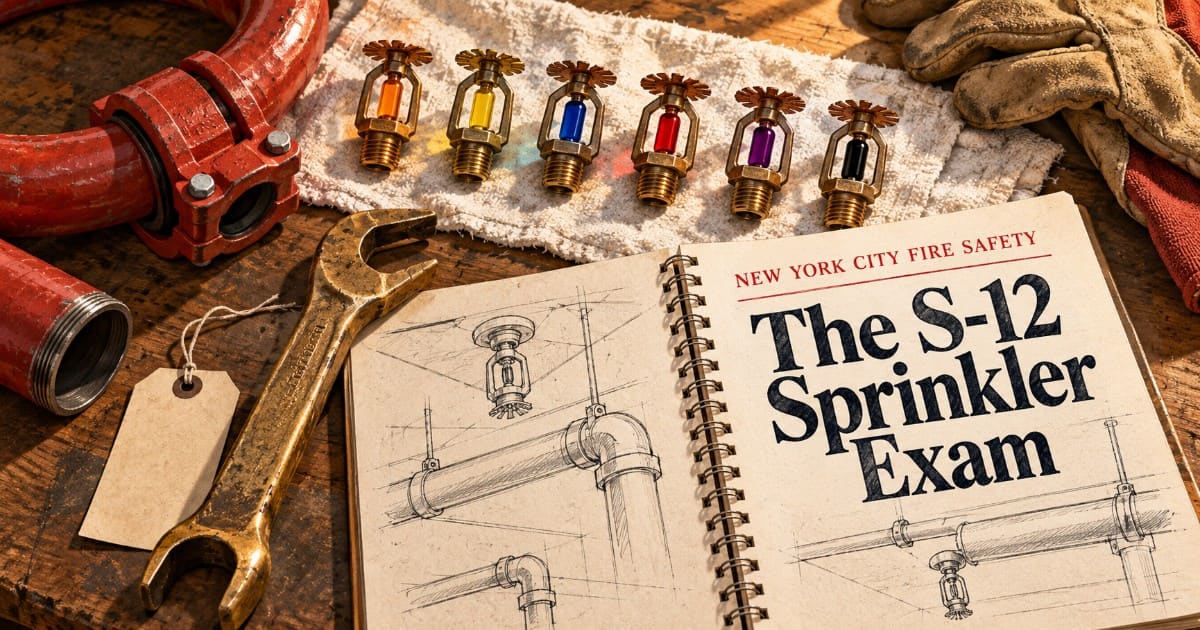
Details of the temperature chart: it is headed "this chart will be provided when taking this test", so the skill is reading it, not memorising it. The booklet lists, for each classification, the temperature rating, frame colour and glass bulb colour:
| Classification | Temperature rating (F) | Frame colour | Glass bulb colour |
|---|---|---|---|
| Ordinary | 135 to 170 | Uncolored or black | Orange or red |
| Intermediate | 175 to 225 | White | Yellow or green |
| High | 250 to 300 | Blue | Blue |
| Extra high | 325 to 375 | Red | Purple |
| Very extra high | 400 to 475 | Green | Black |
| Ultra high | 500 to 575, and 650 | Orange | Black |
The booklet adds that high-rating heads are used where temperatures are normally high (boilers, ovens, drying rooms), and that using high-rating heads in an ordinary room greatly reduces the value of the sprinkler protection because the temperature has to rise much higher before they open.
Numbers that are easy to mix up
| Mix-up | How the booklet separates them |
|---|---|
| 3 years, 5 years or 48 hours? | Inspection, test and maintenance records are kept 3 years. The Fire Department connection test and the obstruction investigation are each every 5 years. The fire watch record is kept 48 hours after the watch ends. |
| Which 8 hours? | A sprinkler system not restored within 8 hours, and a fire alarm system out for more than 8 hours in any 24-hour period, must be reported to the FDNY. The engineer exception is for taking a system out of service for less than 8 hours. |
| 30 days or 30 minutes? | 30 days is how long a minor defect may stay uncorrected before it counts as an impairment. 30 minutes is the outage length beyond which occupants are told in a planned removal from service. |
| Planned or unplanned? | A planned removal from service includes construction affecting not more than 1 floor. Construction-related shutdowns affecting more than one floor are listed as an unplanned out-of-service condition. |
| Red tag, white disc or blue disc? | Red tag plus white disc means fully out of service; red tag plus blue disc means partially out of service (page 15 asks for discs for unplanned outages, while the descriptions and table on pages 15-17 show the disc colours without repeating that limit); green tag means the system appears free of defects or deficiencies. |
| 18 inches or 22 inches? | 18 inches is the clearance below deflectors that contents should not intrude on. Heads located more than 22 inches below the ceiling or structure need further investigation by a qualified Master Fire Suppression Piping Contractor. |
| Six spare heads, or 6, 12, 24? | At least six is the floor. The stock scales with the number of sprinklers installed: under 300, six; 301 to 1,000, twelve; over 1,000, twenty-four. |
| Who does what? | Chapter 5 gives an ordinary S-12 holder visual inspections, notification and records. Certified engineers employed by the owner may also test notification appliances and do routine maintenance; section 12.6 gives task-by-task permissions. A Master Fire Suppression Piping Contractor with the certificate may inspect, test, maintain and repair, and a Master Plumber is limited to small residential systems. |
A sample question
This example is one of our own, written from the S-12/S-15 booklet in the same four-option style, and is one of the three free questions on the S-12 practice exam page.
Example 1: S-12 Citywide Sprinkler Systems
A construction project requires the sprinkler system to be shut down on three floors of a building. How does the study material classify this shutdown?
- (A) A planned removal from service
- (B) An unplanned out-of-service condition
- (C) A non-critical deficiency
- (D) A minor defect to be corrected within 30 days
Show the answer
Answer: (B) An unplanned out-of-service condition. Part 3 counts a construction shutdown as a planned removal from service only when it affects not more than 1 floor, and lists construction-related shutdowns affecting more than one floor as an unplanned out-of-service condition.
An original ProSyllabus question written from the FDNY study material, not an FDNY exam question.
How to use the booklet
Our suggestion, not FDNY advice. The booklet is long, but the exam is set on chapters 1 to 16, and the reference tables are provided in the room. Spend the most time on chapters 1 to 5 (duties, out-of-service rules, records and who may do what), then on the system types, water supplies and components in chapters 7 to 10, then the deficiencies and clearances in chapter 12.4, Local Law 58 in chapter 14 and the obstruction investigation in chapter 15. Count the time: about 135 minutes for 75 questions is 1 minute 48 seconds a question (our arithmetic).
To apply, pay and book, see FDNY Certificate of Fitness: exam format, fee and how to apply. For every code on the FDNY list see the full list of Certificates of Fitness, and for the fire guard certificates see how to get a fire guard certificate in NYC.
Practise the S-12 in the FDNY format
FDNY S-12 practice exam: Citywide Sprinkler Systems. 1 full exam of 75 questions, 135 minutes, three questions free.
Independent practice by ProSyllabus: original questions written from the FDNY S-12/S-15 study booklet, four options each, timed like the real exam, with the reason behind every answer. Not FDNY questions.
Frequently asked questions
How many questions are on the S-12 exam and how long is it?
75 multiple-choice questions in approximately 135 minutes, on chapters 1 to 16 of the S-12/S-15 booklet. At least 70% is needed to pass, which is 53 correct answers (our arithmetic). There is no penalty for guessing.
What is the difference between the S-12, S-15 and T-15?
The S-12 is for facilities without foam-water sprinkler systems (75 questions). The S-15 is for facilities with them (100 questions, about 175 minutes). The T-15 is a 25-question upgrade exam for a holder of a valid S-12 who wants the S-15.
What can an S-12 holder do?
The FDNY page says an individual who inspects, tests and maintains sprinkler systems must hold the certificate. The booklet's chapter 5 says an S-12/S-15 holder does visual inspections, proper notification and recording of results, with wider tasks for holders who are also certified engineers employed by the owner, and testing and repair for a Master Fire Suppression Piping Contractor with the certificate.
What reference material is provided in the exam?
The booklet says the temperature ratings and color coding table, a reference guide for inspection, testing and maintenance, the Inspection, Testing and Maintenance of Sprinkler Systems Activities and Records tables and an S-95 fire alarm reference guide are provided. The booklet itself is not.
Do I need a job to take the exam?
No. Applicants who are not employed can take it without the employer documents; if they pass, the FDNY issues a temporary letter for job seeking, and the card once they are employed and provide the documents.
How much does it cost and how long does it last?
The application fee is $25 for each exam attempt and the certificate renews every three years for $15. A renewal made 90 days to a year after expiry costs a further $25 (the booklet and NYC Business page say 90 days; one passage of the General Notice says 91 days), and over a year late means a new exam (the NYC Business page also says to renew within 364 days of expiry).
Is the booklet current?
It was revised in March 2024 for the application and payment pages and is built on the 2014 Fire Code and NFPA 25 (2011 Edition). The FDNY tells candidates to check for the latest revised booklet before the exam.
Sources
- official — FDNY: Study material for the S-12 / S-15 / T-15 sprinkler system exams, revised March 2024 (apply/pay)
- official — FDNY: Certificate of Fitness S-12 Citywide Sprinkler Systems page
- official — NYC Business: Certificate of Fitness for Citywide Sprinkler Systems (S-12)
- official — FDNY: General Notice of Exam (NOE) for Certificate of Fitness Examinations, revised 07/2023
- official — FDNY: Certificates of Fitness (walk-in exams, hours, ID, payment, online application, appointments, accommodations, renewals, list of certificates)
official = a document published by the conducting body. reported = a news or coaching site we could not check against an original. Where sources disagree this page says so rather than picking one.


