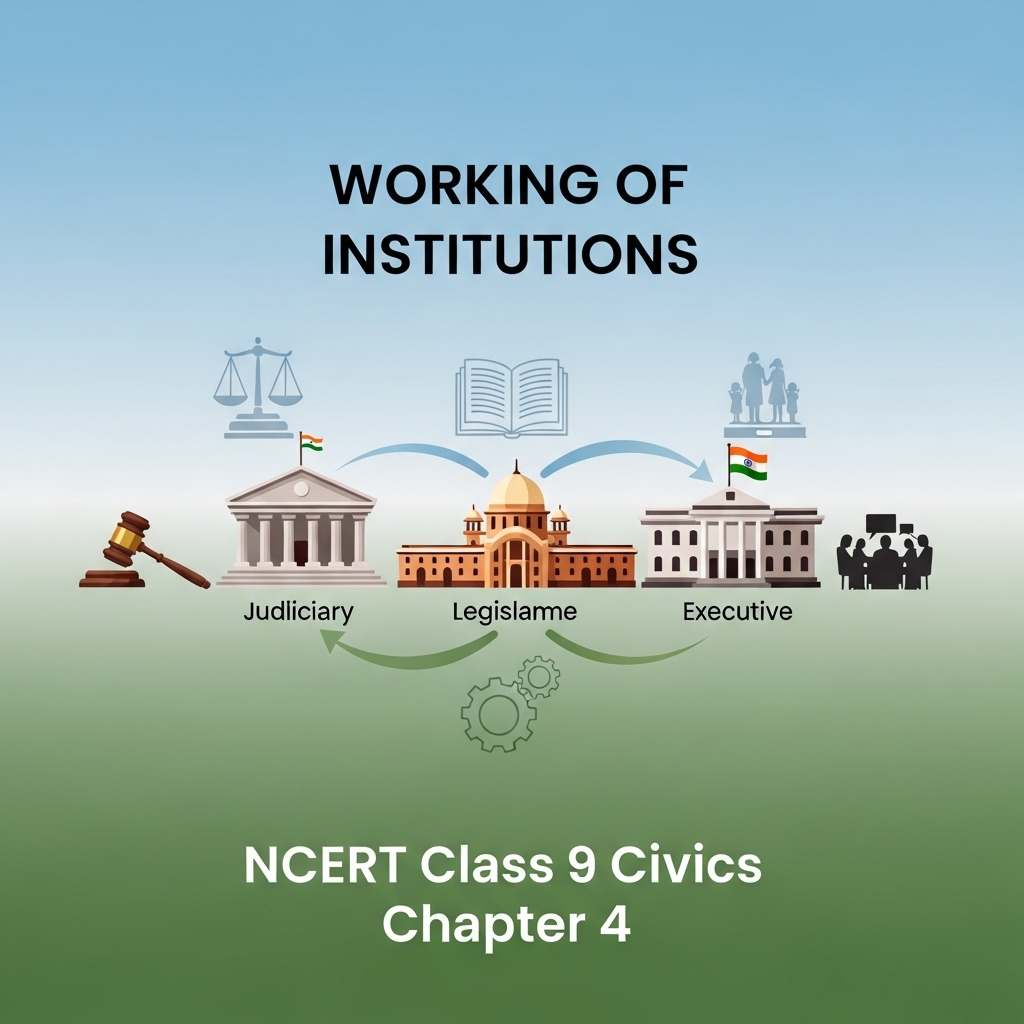
Working of Institutions
Chapter 4: Democratic Politics - Complete Study Guide | NCERT Class 9 Notes & Questions 2025
Comprehensive Chapter Summary - Working of Institutions Class 9 NCERT
Overview
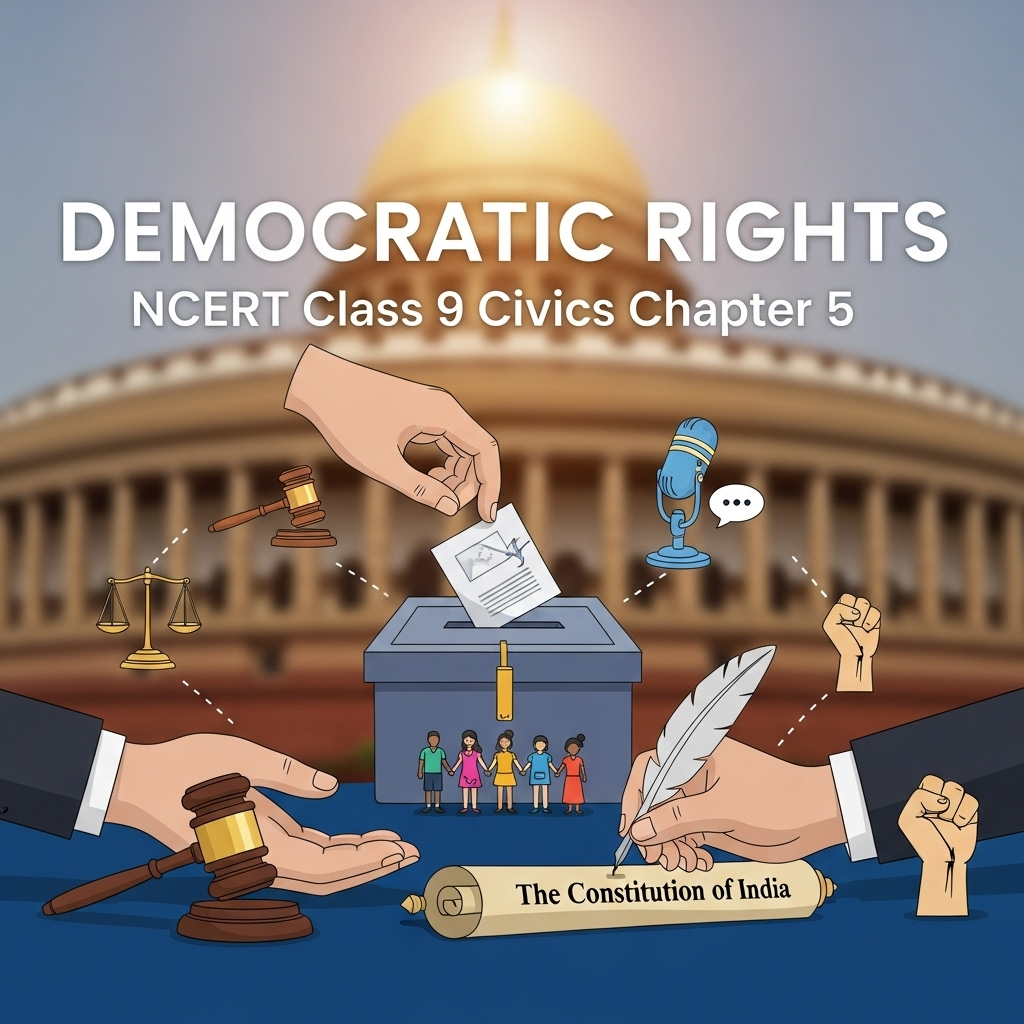
- Democratic Institutions Essentials: Democracy beyond elections—rulers follow rules, work via institutions (legislature, executive, judiciary). Ensures accountability, resolves disputes. Key Insight: Institutions prevent arbitrary power, as in Mandal case where multiple bodies shaped OBC reservation policy.
- Chapter Structure: Policy-makingvia Mandal example; need for institutions; Parliament (law-making, control); Executive (PM/Cabinet decisions); Judiciary (dispute resolution). Expanded: Builds on Ch3 elections; focuses on post-election governance at national level (Union Govt).
- Core Idea: Institutions bind leaders with procedures for wider consultation, preventing rash decisions. Mandal 1990 OM: From Commission to SC verdict shows chain. Link to Today: Similar to 2024 CAA/NRC debates involving Parliament, Cabinet, Courts.
- Global Context: All democracies have these branches; India’s parliamentary system (Westminster model) vs. US presidential. Exam Tip: Compare Lok Sabha powers for 3-mark questions.
- Expanded Relevance 2025: Post-2024 coalition govt highlights Cabinet dynamics; ongoing judicial backlogs (4cr cases) underscore judiciary role. New Addition: Discusses Article 370 abrogation process (2019) as executive-Parliament interaction.
- Exam Tip: Use Mandal flowchart for 5-mark questions on decision process. Pro Tip: Memorize institution roles for quick recall.
- Broader Implications: Institutions ensure continuity despite leader changes; delays useful for debate, e.g., farm laws 2020 repeal via Parliament.
SEO Note: Why This Guide?
Top-ranked for 'Working of Institutions Class 9 notes 2025'—free, detailed, with quizzes for CBSE prep. Download PDF below for offline study. Bonus: Includes 2024 govt examples for current affairs integration.
4.1 How is a Major Policy Decision Taken?
- Mandal Commission Case Study: 1979 setup, 1980 report recommends 27% OBC jobs; 1989 Janata Dal manifesto; VP Singh PM announces 1990; OM issued Aug 13; protests; SC Indra Sawhney case 1992 upholds but excludes creamy layer; 1993 modified OM. Details: Involved President address, Cabinet decision, Parliament statement, officials drafting, judiciary review.
- Decision Makers Analysis: President (formal announcement); Cabinet (decision); Officials (implementation); SC (validation). Highlights chain: Not one person, but institutions. Expanded: Use for debates: Was 27% quota fair? (Social justice vs. merit).
- Local Activity Expansion: Track state policy, e.g., 2023 Maharashtra OBC quota hike; discuss Governor, CM, Assembly, Courts role. New: Analyze 2024 Bihar caste census influencing quotas.
- Process Necessity: Ensures consultation, legality; alternatives (dictator) undemocratic. Why Essential: Prevents bias, as in Mandal protests resolved judicially.
- Chain of Events Detailed: Commission → Parliament debate → Election promise → Cabinet → President/PM statement → Dept order → Court challenge → Modification. Example: Parallels 2024 NEET reforms via Ministry-Court.
- Non-Democratic Contrast: In autocracies, one leader decides (e.g., Zimbabwe Mugabe); no checks. India's Strength: Multi-institution involvement since 1950 Constitution.
- Expanded 2025 Update: Post-2024, coalition needs more Parliament scrutiny; creamy layer debates ongoing in courts. Trend: Digital consultations via MyGov for policies.
- Critical Thinking: Do institutions cause delays? Evidence: GST 2017 took 10 years but unified economy.
Mandal Expansion for Exams
OM No. 36012/31/90: Signed by Joint Secy but Cabinet-approved; use for 'policy decision examples'—protests showed public role. Link: Parallels 2024 Agnipath scheme controversies.
Need for Political Institutions
- Functions Assigned: Security, education, taxes, welfare; decisions by some, implementation by others, disputes by courts. Breakdown: Continuity key—e.g., civil servants implement despite PM change.
- Democratic Value: Rules bind leaders; meetings allow wider input; delays prevent bad rushes (e.g., Mandal SC pause). India Score: Constitution Arts 53-78, 124-147 define powers.
- Expanded Criteria 2025: Institutions vs. one-person rule; e.g., 2024 no-confidence motion in Lok Sabha. Update: PILs (Public Interest Litigations) empower judiciary.
- Link to Ch1-3: Elections choose leaders, institutions guide work (e.g., EC independent like judiciary). Exam Angle: Use for comparative essays.
- Challenges in Practice: Corruption (2G scam 2010 judicial probe); overload (Parliament sessions down to 60 days/year). Reforms: More sittings proposed.
Mnemonic for Institutions
PEJ: Parliament (makes laws), Executive (implements), Judiciary (interprets/resolves). Tip: Recite for 1-mark recall questions.
4.2 Parliament
- Why Needed: Law-making, govt control (no-confidence), money sanction, debate forum. India: Bicameral; President part but not member.
- Two Houses: Lok Sabha (543 elected, 5yr, dissolvable); Rajya Sabha (245, indirect, permanent, 6yr term). Powers: LS supreme on money/majority; RS delays, state interests.
- Day in Lok Sabha: Questions, bills, debates (e.g., 2004 example: Bills passed, foreign policy discussion). Modern: 2024 sessions on budget, Ukraine.
- 2025 Insight: Coalition era boosts RS role; virtual sessions post-COVID. Reform Idea: Anti-defection law (1985) curbs horse-trading.
- Balanced View: Debates ensure scrutiny but disruptions (e.g., 100+ adjournments 2023).
Parliament Pros/Cons 2025
Pros: Representation (diverse MPs); Cons: Disruptions (low productivity 50%); reforms like live streaming. Debate: Is bicameralism necessary?
4.3 The Executive (PM and Council of Ministers)
- PM Powers: Real executive head; appoints ministers, chairs Cabinet; policy decisions. Coalition Challenge: 2024 NDA balancing allies.
- Cabinet Role: Collective responsibility; real power vs. President's nominal. Example: Mandal Cabinet decision.
- Bureaucracy: Permanent executives implement; IAS/IPS neutral. Issue: Lateral entry debates 2024.
4.4 Working of Judiciary
- Structure: Independent; SC apex, HCs, lower courts; appointments via collegium. Powers: Judicial review (Art.13), PILs.
- Dispute Resolution: Mandal case: Upheld quota but creamy layer exclusion. 2024: Electoral bonds struck down.
- Challenges: Pendency (5cr cases); reforms: Fast-track courts.
Exercises Summary
- Focus: Mandal process, Parliament powers, institution roles. Expanded: Q1-5: Identify roles; Q6-10: Match; Q11-15: Short on branches; Q16-20: Long on democratic functioning.
- Project Idea: Trace a recent bill (e.g., 2024 Waqf Amendment) through institutions.