Sound
Chapter 11: Science - Complete Study Guide
Chapter Overview
What You'll Learn
Sound Production
By vibrating objects like tuning fork.
Propagation
Through medium as compressions/rarefactions.
Characteristics
Frequency, amplitude, speed.
Human Ear
Receives and interprets sound.
Key Highlights
Sound is energy produced by vibrations, propagates as longitudinal mechanical waves through mediums like air, characterized by wavelength, frequency, and amplitude. Speed varies with medium; reflection causes echo, used in sonar. Human ear converts vibrations to nerve impulses.
Comprehensive Chapter Summary
1. Introduction to Sound
- Sound from sources like humans, birds, bells, machines, vehicles, TVs, radios; form of energy causing hearing sensation.
- Other energies: Mechanical (previous chapters), light; conservation: Cannot create/destroy, only transform.
- Clapping produces sound using energy; question: Can sound be produced without energy? Which form used?
- Chapter covers production, transmission through medium, reception by ears.
- To double: Everyday sounds vary in pitch/loudness; sound needs medium, unlike light; energy transformation e.g., clapping: Mechanical to sound energy.
Activity 11.1: Tuning Fork Vibration
Strike tuning fork, hear sound near ear; touch prong (feels vibration); touch suspended ball (ball moves away then attracted); discuss vibration causes sound.
Activity 11.2: Tuning Fork in Water
Touch water surface with prong (small ripples); dip both prongs (large waves); vibration transfers energy to water particles.
2. Production of Sound (11.1)
- Sound by vibrating objects: Strike tuning fork, pluck rubber band, flap bird wings, buzz bee wings, vocal cords vibrate for voice.
- Vibration: Rapid to-fro motion; without vibration, no sound.
- Produce by striking, plucking, scratching, rubbing, blowing, shaking.
- Musical instruments: List types, discuss vibrating parts e.g., guitar strings, drum membrane, flute air column.
- To double: Human voice: Air from lungs vibrates vocal cords; bird/bees: Wing beats; rubber band: Tension affects pitch; activities show vibration essential.
Activity 11.3: Musical Instruments
List instruments (guitar, drum, flute); vibrating parts: Strings/membrane/air column produce sound via vibration.
3. Propagation of Sound (11.2)
- Medium: Solid, liquid, gas; sound travels from source to listener via particle vibration.
- Vibrating object displaces adjacent particle, chain reaction; disturbance travels, not particles.
- Wave: Disturbance moving through medium; particles oscillate, disturbance propagates.
- Sound waves: Mechanical, longitudinal; air common medium.
- Compression (C): High pressure/density region (forward motion compresses air).
- Rarefaction (R): Low pressure/density (backward motion rarefies air).
- Propagation: Series of C and R; density/pressure variations.
- To double: Particles oscillate about equilibrium; no net forward movement; speed depends on medium (fastest in solids); vacuum no sound (no medium).
Compression & Rarefaction
- C: High density/pressure.
- R: Low density/pressure.
- Sound as wave of these variations.
Medium Requirement
- Needs particles to propagate.
- No sound in vacuum (moon example).
4. Sound Waves are Longitudinal Waves (11.2.1)
- Activity with slinky: Push-pull creates C (coils close) and R (coils apart); dot moves parallel to propagation.
- Longitudinal: Particles oscillate parallel to wave direction.
- Transverse: Perpendicular oscillation (e.g., water ripples, light); not mechanical for light.
- Sound: Longitudinal mechanical wave; particles back-forth, disturbance forward.
- To double: Slinky simulates air particles; in solids/liquids, similar but faster; transverse needs tension (strings), longitudinal compression.
Activity 11.4: Slinky Waves
Stretch slinky, push: Observe C/R; mark dot: Parallel motion confirms longitudinal.
5. Characteristics of a Sound Wave (11.2.2)
- Describe by frequency (f), amplitude (A), speed (v).
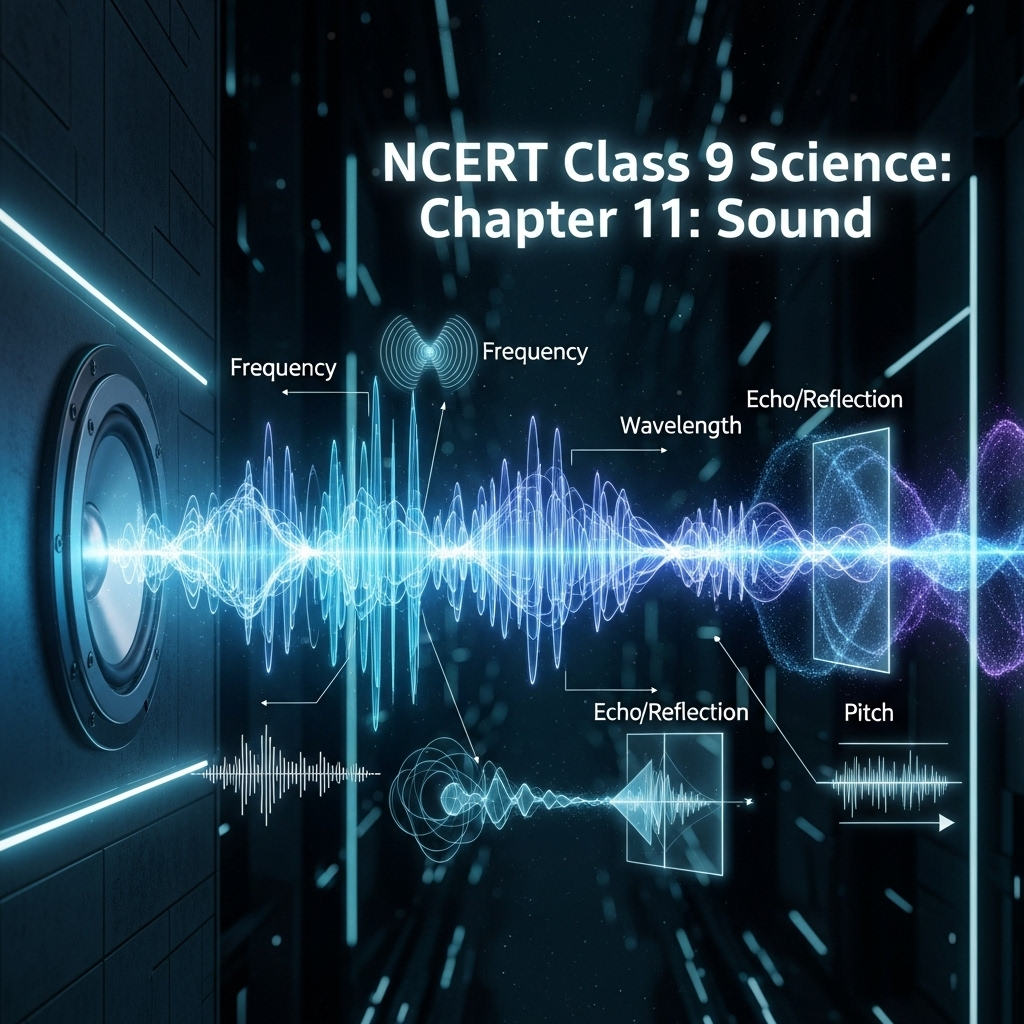
- Graphic: Density/pressure vs distance; crest (peak C), trough (valley R).
- Wavelength (\( \lambda \)): Distance between consecutive C or R; unit m.
- Frequency (f): Vibrations per second; unit Hz (hertz); loudness relates to amplitude, pitch to f.
- Amplitude: Max displacement; larger A = louder sound.
- Speed: \( v = f \lambda \); depends on medium temperature.
- To double: Graphs show variations above/below average; high f = shrill (e.g., mosquito), low f = grave (e.g., lion); audible 20Hz-20kHz; ultrasound >20kHz, infrasound <20Hz.
Hertz Biography
Heinrich Hertz confirmed electromagnetic theory, discovered photoelectric effect; unit Hz named after him.
6. Reflection of Sound
- Sound reflects off surfaces; angle incidence = reflection.
- Echo: Reflected sound heard after original; minimum distance 17m for distinction.
- Reverberation: Multiple reflections, prolonged sound.
- To double: Used in halls for acoustics; echo for distance measurement.
7. Sonar and Applications
- Sonar: Sound Navigation Ranging; echoes measure depth/time.
- Time t, speed v: Distance = \( \frac{v t}{2} \).
- Uses: Ocean depth, submarine detection, fish finding.
- To double: Active/passive sonar; medical ultrasound imaging.
8. Human Ear Structure
- Outer: Pinna collects, canal to eardrum.
- Middle: Hammer, anvil, stirrup amplify vibrations to oval window.
- Inner: Cochlea (fluid, hair cells detect frequency), auditory nerve to brain.
- To double: Eardrum vibrates like tuning fork; cochlea separates pitches; hearing range 20-20kHz, decreases with age.
Range of Hearing
Audible: 20Hz-20kHz; ultrasound for bats/medicine; infrasound for elephants.
Key Concepts and Definitions
Vibration
Rapid to-fro motion producing sound.
Medium
Matter for sound propagation.
Longitudinal Wave
Particles parallel to propagation.
Wavelength
\( \lambda \): Distance C to C.
Frequency
f: Cycles per second, Hz.
Speed
\( v = f \lambda \).
Echo
Reflection after 0.1s.
Important Facts
Questions and Answers from Chapter
Short Questions (1 Mark)
Q1. How does sound produced by vibrating object reach ear?
Q2. Explain sound by school bell.
Q3. Why sound waves mechanical?
Q4. Hear friend on moon?
Q5. What is vibration?
Q6. Medium for sound?
Q7. What is compression?
Q8. What is rarefaction?
Q9. Sound waves type?
Q10. Wavelength symbol?
Q11. Frequency unit?
Q12. Crest represents?
Q13. Trough represents?
Q14. Speed formula?
Q15. Transverse wave example?
Q16. Sound in vacuum?
Q17. Amplitude relates to?
Q18. Frequency relates to?
Q19. Slinky activity shows?
Q20. Human voice produced by?
Medium Questions (3 Marks)
Q1. How sound reaches ear from vibrating object?
Q2. Explain school bell sound production.
Q3. Why sound waves mechanical?
Q4. Why no sound on moon?
Q5. Differentiate compression and rarefaction.
Q6. Why longitudinal waves for sound?
Q7. Define wavelength.
Q8. What is frequency?
Q9. Differentiate longitudinal and transverse waves.
Q10. Crest and trough in sound wave?
Q11. Role of medium in propagation.
Q12. Amplitude effect?
Q13. Speed of sound formula.
Q14. Why no sound in space?
Q15. Slinky activity observation.
Q16. Vocal cords role.
Q17. Density variation in sound.
Q18. Audible frequency range.
Q19. Echo condition.
Q20. Sonar principle.
Long Questions (6 Marks)
Q1. Explain sound propagation with compression/rarefaction.
Q2. Differentiate longitudinal and transverse waves with examples.
Q3. Describe sound wave characteristics: Frequency, wavelength, amplitude.
Q4. Why no sound on moon? Explain propagation need for medium.
Q5. Explain production of sound with examples from activities.
Q6. Describe slinky activity for longitudinal waves.
Q7. Explain echo and reverberation.
Q8. Principle and use of sonar.
Q9. Structure and function of human ear.
Q10. How frequency/amplitude affect sound?
Q11. Role of medium particles in propagation.
Q12. Differentiate audible, ultrasound, infrasound.
Q13. Explain graphic representation of sound wave.
Q14. Why sound faster in solids?
Q15. Describe tuning fork activities.
Q16. How musical instruments produce sound?
Q17. Explain conservation in sound production.
Q18. Role of cochlea in ear.
Q19. Conditions for echo.
Q20. Speed of sound variations.
Interactive Knowledge Quiz
Test your understanding of Sound
Quick Revision Notes
Production & Propagation
- Vibration → C/R in medium
- Longitudinal mechanical wave
Characteristics
- \( \lambda \): C to C
- f: Pitch, Hz
- A: Loudness
- \( v = f \lambda \)
Applications
- Echo: 17m
- Sonar: \( d = vt/2 \)
- Ear: Pinna-cochlea-nerve
Exam Strategy Tips
- Draw wave diagrams
- Explain C/R
- Formulas with units
- Activities detail
- Differentiate wave types