Checked 31 October 2026. RSHQ is moving the Board of Examiners written exams online during 2026 and changing underground certificates to a 3-stage process in 2027, so formats and venues can change. RSHQ pages read on 31 October 2026 (updated 26 May, 28 Oct and 29 Oct 2026); Act current as at 1 July 2026, Regulation as at 1 September 2026.
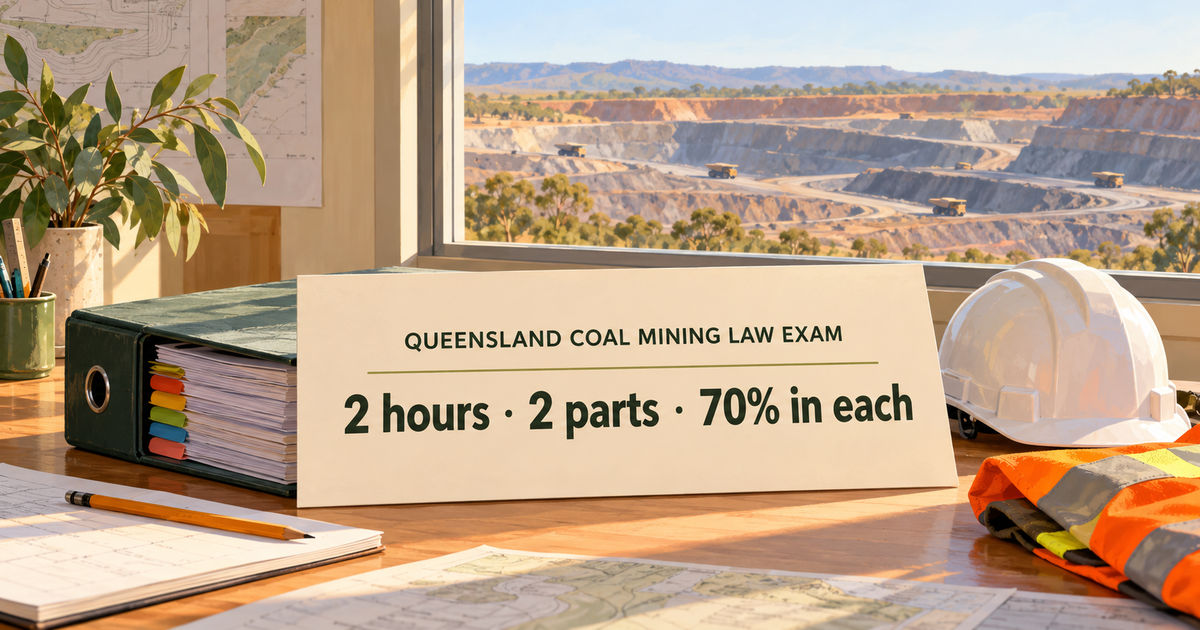
For a site senior executive (SSE) notice, or a deputy's or open-cut examiner's certificate of competency, the Board of Examiners' checklists say that once your application is approved you sit a written law exam, and RSHQ says assessment for the other coal certificates may include one too. Resources Safety and Health Queensland (RSHQ) describes it like this: a 2-hour, 2-part, closed book exam on the Coal Mining Safety and Health Act 1999 and the Coal Mining Safety and Health Regulation 2017, with a pass mark of 70% for each part. This guide covers who sits it, the format, what to read in the Act and the Regulation, the resit rules, what comes after the exam, and a four-week plan.
ProSyllabus is an independent study site. It is not part of Resources Safety and Health Queensland (RSHQ) or the Board of Examiners, and our practice questions are written by us, not taken from any Board of Examiners exam.
RSHQ, Examinations (updated 28 Oct 2026) and Certificates of competency (updated 29 Oct 2026), read 31 Oct 2026.
Who has to sit the coal law exam
Part 10 of the Act deals with the Board of Examiners, and section 188 provides for the appointment of its members. The Board assesses applicants for the statutory positions the Act and Regulation reserve for people who hold a board qualification. RSHQ says that once your application is assessed as eligible, further assessment may include a law examination, a technical examination and an oral examination, and that you must pass the law exam (and the technical exam, where there is one) before you can sit the oral. SSE notice applicants are the exception: they have no oral.
| Board qualification | Why you need it | Assessment after eligibility |
|---|---|---|
| Site senior executive notice (surface or underground) | A coal mine operator must not appoint an SSE who does not hold an SSE notice and a practising certificate (Act s 54(4)); the same applies to an acting SSE (s 57(4)) | Legislation exam only |
| Deputy's certificate of competency (underground) | Control of underground activities when the underground mine manager is not there, and control of activities in explosion risk zones (Act s 60(8) and (9)); supervising shotfiring (Reg s 210); inspections for hot work and underground workshops (Reg ss 265(3), 266(3)) | Legislation exam, then oral |
| Open-cut examiner's certificate of competency | The SSE of a surface mine must appoint an open-cut examiner holding it, with a practising certificate, for each surface mine excavation (Act s 59(1)) | Legislation exam, then oral; RSHQ says a technical exam starts for open cut examiners in November 2026 |
| First class certificate of competency (underground) | The underground mine manager must hold it, with a practising certificate (Act s 60(5)); a first or second class certificate is also accepted for the roles in s 60(8) and (9) | RSHQ says assessment may include law, technical and oral exams; underground certificates move to a 3-stage process in 2027, so confirm your stages with the Board |
Sources: Coal Mining Safety and Health Act 1999 ss 54, 57, 59, 60 and 188; Coal Mining Safety and Health Regulation 2017 ss 210, 265 and 266; RSHQ, Certificates of competency, and the Board of Examiners application checklists. RSHQ's Certificates of competency page links a separate checklist for each of the other coal certificates, including ventilation officer, second class mine manager and the electrical, mechanical and surface mine manager certificates introduced in June 2025.
Every one of these appointments also needs a current practising certificate. RSHQ says that since 10 June 2025 it has been mandatory for competency and notice holders who work in statutory positions to be registered in the Board of Examiners' Practising Certificate Scheme and hold a current practising certificate. Passing the exam and getting the certificate is the start, not the end.
The format: what RSHQ says about the exam
| Item | What RSHQ says |
|---|---|
| Length | 2 hours |
| Structure | 2 parts |
| Book | Closed book |
| Laws tested | Coal Mining Safety and Health Act 1999 and Coal Mining Safety and Health Regulation 2017 |
| Pass mark | 70% for each part |
| Question types | Depending on the competency, short answer or multiple choice; questions cover the legislation relevant to the position, plus general health and safety topics |
| Written exam venues | Written exams for all mining applicants monthly in Brisbane, Dysart, Mackay, Moranbah and Rockhampton; Townsville and Mount Isa depending on availability; or a courthouse, library, school or similar government office with an approved external supervisor |
| Online | Moving from paper to online examinations via a secure platform during 2026 (see below); confirm your format and venue when you book |
Source: RSHQ, Examinations, updated 28 October 2026. The 2026 and 2027 written examination schedules are PDFs on the same page; check the date for your sitting there.
Two points to remember. The first is the 70% rule: it applies to each part, so a strong result in one part cannot carry a weak one. The second is the question type. The RSHQ exam information we read gives no fixed mix of multiple choice and short answer for the coal exam; it says the format depends on the competency. So practise both: choosing the right option fast, and writing a short answer that names the obligation, the person who owes it and the section.
For the mineral mines and quarries law exam, RSHQ publishes a topic table: Section 1 on the Mining and Quarrying Safety and Health Act and Section 2 on its Regulation. The coal exam information we read gives no such split, so we do not guess how the coal questions are divided between the two parts. Read both the Act and the Regulation as if either could fill a part.
Online exams: where RSHQ is up to
RSHQ is replacing paper with online exams on a secure platform, and its two pages put the timing slightly differently, so here are both as written. The Certificates of competency page (updated 29 October 2026) says Site Senior Executive Coal and Open Cut Examiners now complete legislation examinations online, with technical exams for open cut examiners from November 2026, first class mine managers (mineral mines and quarries) moving online late 2026 or early 2027, and underground certificates moving to a 3-stage examination process in 2027. The Examinations page (updated 28 October 2026) lists the electrical engineering manager, mechanical engineering manager, surface mine manager and open cut examiner competencies as online, with all others following in the second half of 2026, SSE next. Ask the Board of Examiners Secretary which way your exam will run when you are told to book.
Free practice questions
Our suggestion: find your weaker areas by answering questions on them. Try a few free questions on the Coal Mining Safety and Health Act 1999 and Regulation 2017 in our quiz player. You get a result page and an explanation for every answer, with the section it comes from.
Written by ProSyllabus from the current Act and Regulation. They are not Board of Examiners questions.
What to read in the Act
The Act sets the framework: what risk means, who owes which obligation, how mines must be managed and what must happen after an accident. This is our selection of Parts to start with; tailor it to your position. The section numbers come from the current reprint.
| Part of the Act | Start with |
|---|---|
| Part 1, Division 4: interpretation | s 18 meaning of risk, s 19 meaning of hazard, and the other meanings in ss 15–26 (for example s 25 site senior executive, s 26 supervisor) |
| Part 2: control and management of risk and other basic concepts | s 29 what is an acceptable level of risk, s 30 how it is achieved, s 31 what happens if risk is unacceptable |
| Part 3: safety and health obligations | ss 33–38 who owes obligations and how they are discharged; s 39 obligations of persons generally; s 41 coal mine operators; s 42 site senior executive; s 43 contractors; s 44 designers, manufacturers, importers and suppliers of plant; use s 33 to see every class of obligation holder |
| Part 4: provisions about the operation of coal mines | s 54 limits on appointing an SSE; s 55 management structure; s 56 supervisors; s 59 open-cut examiner; s 60 additional requirements for underground mines; s 62 safety and health management system |
| Part 5: recognised standards | s 71 purpose of recognised standards |
| Parts 7 and 8: site and industry safety and health representatives | The two kinds of safety and health representative: site representatives (Part 7) and industry representatives (Part 8) |
| Part 9: inspectors and other officers and directives | Inspectors' powers, and the SSE's duty to help an officer when required to, unless the SSE has a reasonable excuse (s 142) |
| Part 10: board of examiners | s 188 appointment of the board; s 193A the register it keeps |
| Part 11: accidents and incidents | s 198 notice of accidents, deaths or incidents; s 199 inspection of the place; s 200 site not to be interfered with; s 201 action at the site |
Source: Coal Mining Safety and Health Act 1999 (Qld), current as at 1 July 2026, table of contents and sections named. This is a reading order, not a list of exam questions; RSHQ says questions cover the legislation relevant to your position.
What to read in the Regulation
The Regulation sets out detailed requirements organised by mine type. Chapter 2 applies to all coal mines, Chapter 3 to surface mines and Chapter 4 to underground mines; Chapter 4A covers continuing professional development. Read Chapter 2 whatever your position, then the chapter for your mine type.
| Chapter | Parts to know |
|---|---|
| Chapter 2: all coal mines | Part 2 safety and health management system; Part 3 accidents, high potential incidents, diseases and injuries; Part 3A supervisor's responsibilities; Part 5 emergencies; Part 6 fitness for work; Part 7 hazardous chemicals and dangerous goods; Part 8 mine plans; Part 10 plant; Part 11 training; Part 11A supervising workers; Part 12 work and work environment |
| Chapter 3: surface mines | Part 2 surface mine manager and open-cut examiner (s 105 the open-cut examiner's main responsibility, s 106 inspecting surface excavations, s 107 reducing an unacceptable level of risk); Part 4 explosives; Part 5 hazardous areas; Part 6 highwall mining; Part 8 mine roads; Part 10 stockpile and coal waste dump operations |
| Chapter 4: underground mines | Part 3 emergencies; Part 4 rescue and communication; Part 6 explosives (s 210 shotfiring supervised by a first class, second class or deputy's certificate holder); Part 7 gas monitoring; Part 8 mechanical, including Division 5 hot work (ss 265–266); Part 9 mine design; Part 10 mining operations; Part 11 ventilation; Part 12 working environment |
| Chapter 4A: continuing professional development | The CPD that goes with holding a practising certificate |
Source: Coal Mining Safety and Health Regulation 2017 (Qld), current as at 1 September 2026, table of contents and sections named.
Fees
The application fees are set in Schedule 8, Part 1 of the Regulation in fee units, and RSHQ's fact sheet converts them to dollars for 2026–27. Schedule 8, Part 1 lists 26.60 fee units for an application for assessment for a deputy's or open-cut examiner's certificate of competency, and 44.95 fee units for a first class, second class or surface mine manager's certificate. RSHQ's fact sheet gives these as $30.14 and $50.93 excluding GST, and lists no fee for SSE notices.
If you fail: the resit rules
| Attempt | What happens next |
|---|---|
| Written exam, 1st unsuccessful attempt, result above 30% but below 70% | You can sit again 3 months from the date of the exam result notification |
| Written exam, 1st unsuccessful attempt, result of 30% or less | Treated as a second unsuccessful attempt (next row) |
| Written exam, 2nd fail | Send the Board a written report of the study you have done (dates and topics). If it approves, you can sit again 3 months from its decision |
| Written exam, 3rd fail | A show cause request from the Board, which decides whether you can sit again and may set conditions; if approved, 3 months from its decision |
| Oral exam, 1st unsuccessful attempt, result above 30% but below 70% | At least 6 months from receipt of the result letter, and a report of the actions you have taken to fix the deficiencies in the result letter (topics, dates, mentors or coaches), endorsed by your SSE, and the underground mine manager if applicable |
| Oral exam, 1st unsuccessful attempt, result of 30% or less | Treated as a second unsuccessful attempt (next row) |
| Oral exam, 2nd fail | A report of the actions you have taken to fix the deficiencies the Board identified (topics, dates, mentors or coaches), endorsed by your SSE and, for underground positions, the underground mine manager; the Board decides whether you can be assessed again; a 12-month wait from the date of notification of the result letter |
| Oral exam, 3rd fail | A show cause request; the Board decides whether you can proceed to further examination and may set conditions; at least 12 months before you can reapply |
RSHQ, Examinations: written and oral exam resit conditions, read 31 Oct 2026.
Remember the clock. RSHQ says you must complete both the application and the examination process within 3 years of submitting your application; if you have not received your certificate in that time, you apply again. It also says a written exam passed for an earlier application is not considered for a new one. Two failed written attempts with the 3-month waits and a Board report in between can use a real share of that time.
A four-week plan for the law exam
This is our plan, built on what RSHQ says the exam covers. Adjust the third week to your position: surface for SSE (surface) and open cut examiner, underground for deputy, undermanager-level and SSE (underground).
| Week | Focus | How to practise |
|---|---|---|
| 1 | Act Part 1 meanings (ss 18–19), Part 2 acceptable level of risk (ss 29–31) and Part 3 obligations (s 33, then ss 39–44) | Write a one-line summary of each section from memory, then check it; timed questions on the Act |
| 2 | Act Parts 4, 5, 9, 10 and 11: management of mines, appointments (ss 54–62), recognised standards, inspectors, the Board, accidents and incidents (ss 198–201) | For each appointment, say who appoints, who can be appointed and which board qualification they need |
| 3 | Regulation Chapter 2, then Chapter 3 (surface) or Chapter 4 (underground) | Timed questions on the Regulation; for every miss, open the section and read the whole of it |
| 4 | Both parts under time | Full practice sets at exam pace; check you score at least 70% on Act questions and on Regulation questions separately (our split: RSHQ does not say how the coal parts are divided), then rework your lowest topic |
Three study habits we suggest for a closed book law exam. Learn the section numbers for the duties your position carries, as a way to find your way around the Act. Check that each answer names the right duty holder, because the Act gives different duties to the coal mine operator, the SSE, the underground mine manager and supervisors. And read the current reprint on legislation.qld.gov.au, checking its "current as at" date, so you do not learn from an old printout.
Queensland coal mining law exam practice test
When you can pass both parts on your own, practise under time. The ProSyllabus practice test has 120 questions in 6 topic sets of 20 (3 on the Coal Mining Safety and Health Act 1999, 3 on the Regulation 2017), plus three mixed mocks of 40 (20 Act + 20 Regulation, the same questions regrouped) that hold your Act score and your Regulation score each to 70%, all played in our quiz player. Every answer is explained with the section of the Act or Regulation it comes from. Start with the free questions.
Frequently asked questions
How long is the Queensland coal mining law exam?
RSHQ says it is a 2-hour, 2-part, closed book exam on the Coal Mining Safety and Health Act 1999 and the Coal Mining Safety and Health Regulation 2017.
What is the pass mark?
70% for each part. You need 70% in both parts, not 70% overall.
Is the exam multiple choice?
RSHQ says written exam questions may be short answer or multiple choice, depending on the competency, so be ready for both.
Who has to sit it?
RSHQ's Board of Examiners checklists list the legislation exam for site senior executive notices and for the deputy's and open-cut examiner's certificates of competency, and RSHQ says assessment for other certificates may include a law exam. SSE notice applicants have no oral; the deputy and open cut examiner checklists add an oral after the law exam.
Where can I sit the exam?
RSHQ says written exams are held monthly in Brisbane, Dysart, Mackay, Moranbah and Rockhampton, and sometimes in Townsville and Mount Isa. You can also arrange a courthouse, library, school or similar government office with an approved external supervisor. RSHQ is moving exams online during 2026, and SSE coal and open cut examiner legislation exams are listed as online or moving online first. Confirm your format and venue when you book.
What happens if I fail?
After a first unsuccessful written attempt with a result above 30% but below 70%, you can sit again 3 months from the exam result notification. A result of 30% or less is treated as a second unsuccessful attempt: you send the Board a written report of your study (dates and topics), and if it approves, you can sit again 3 months from its decision.
Does a pass from an old application count?
No. RSHQ says a previously passed written exam will not be considered for a new application, and you must finish the application and exam process within 3 years of applying.
Are ProSyllabus questions taken from the Board of Examiners exam?
No. ProSyllabus is independent of RSHQ and the Board of Examiners. Our questions are written by us from the current Act and Regulation, and each answer cites the section it comes from.
Sources
- official — RSHQ: Examinations (coal mining exam format, 70% per part, venues, resit conditions), updated 28 Oct 2026
- official — RSHQ: Certificates of competency (Practising Certificate Scheme, 3-year limit, online exams), updated 29 Oct 2026
- official — RSHQ: Coal mining competencies recognised by the Coal Mining Safety and Health Advisory Committee, updated 26 May 2026
- official — RSHQ Board of Examiners: Application checklist, Deputy underground coal (DOCX)
- official — RSHQ Board of Examiners: Application checklist, Open Cut Examiner (DOCX)
- official — RSHQ Board of Examiners: Application checklist, Site Senior Executive (surface coal mines) (DOCX)
- official — RSHQ Board of Examiners: Application checklist, Site Senior Executive (underground coal mines) (DOCX)
- official — RSHQ: Fees for Board of Examiners applications fact sheet 2026–27 (PDF)
- official — RSHQ: 2026 written examination schedule (PDF)
- official — RSHQ: 2027 written examination schedule (PDF)
- official — Coal Mining Safety and Health Act 1999 (Qld), current as at 1 July 2026
- official — Coal Mining Safety and Health Regulation 2017 (Qld), current as at 1 September 2026
official = a document published by the conducting body. reported = a news or coaching site we could not check against an original. Where sources disagree this page says so rather than picking one.