Checked 25 September 2026. Weights from the SCFHS Laboratory – Technician blueprint (2024) and Qatar DHP blueprint; calculations are standard laboratory formulas.
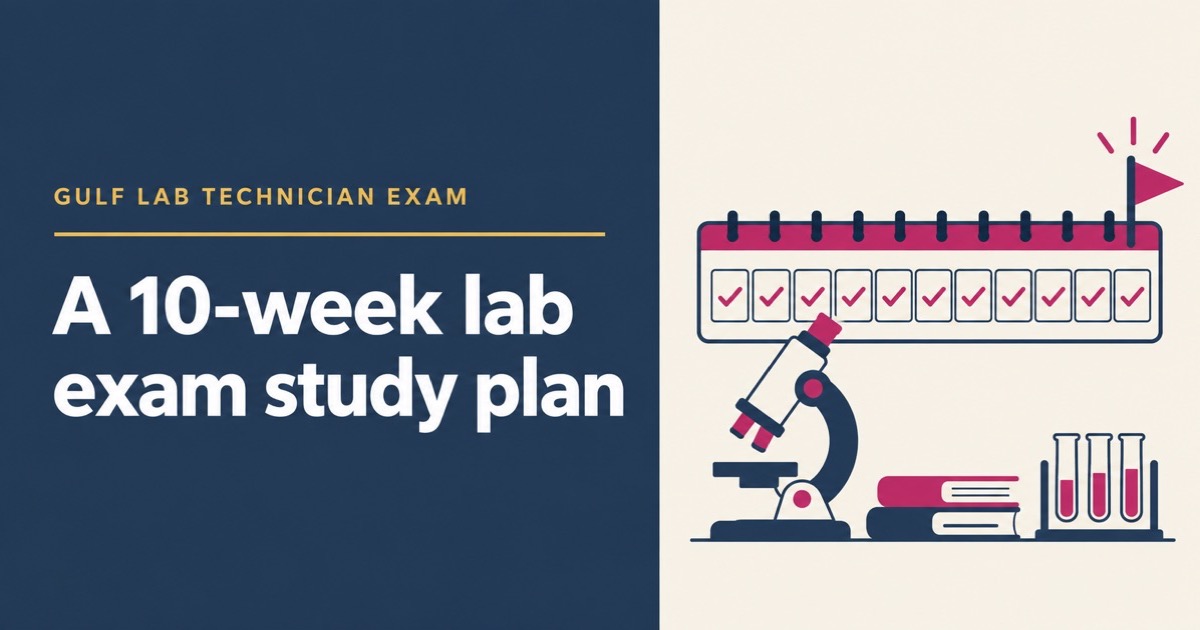
This plan is built for a working lab professional: about 12 hours a week for 10 weeks. It follows the SCFHS technician weights — 20% each for microbiology, clinical chemistry, hematology and blood bank, 15% immunology and serology, 5% histology, which Qatar's item counts (30, 30, 30, 30, 23, 7 of 150) match within a fraction — and ends with four weeks of timed practice, because 150 questions in 3 hours — the SCFHS and DHA format — is 72 seconds a question.
Hours by discipline
| Discipline | Weight | Hours (of ≈120) |
|---|---|---|
| Microbiology (bacteriology, virology, parasitology, mycology) | 20% | 24 |
| Clinical chemistry (general, hormones, urinalysis, body fluids) | 20% | 24 |
| Hematology | 20% | 24 |
| Blood bank | 20% | 24 |
| Immunology / serology | 15% | 18 |
| Histo / cyto techniques | 5% | 6 |
Lab exam study-hours planner
Choose your likely exam day and how many hours a week you can study. The planner counts the weeks left from today and splits your total hours across the paper.
The 10 weeks
| Week | Focus | Practice |
|---|---|---|
| 1 | Hematology: cell counts, indices, morphology | Diagnostic mixed set (baseline) |
| 2 | Hematology: coagulation; anaemias; lab safety basics | Topic questions + index calculations |
| 3 | Clinical chemistry: general chemistry, electrolytes, renal and liver tests | Topic questions |
| 4 | Clinical chemistry: hormones, urinalysis, body fluids; QC basics | Topic questions; Levey–Jennings practice |
| 5 | Microbiology: bacteriology — identification, culture, sensitivity | Topic questions |
| 6 | Microbiology: virology, parasitology, mycology | Topic questions |
| 7 | Blood bank: ABO/Rh, antibody screening, crossmatch, components, reactions | First 75-question timed block |
| 8 | Immunology/serology; histology and cytology techniques | Second timed block |
| 9 | Weakest two disciplines from your blocks | Full 150-question, 3-hour session |
| 10 | Light review; calculations; exam logistics | One final full session early in the week |
Blood bank gets one dedicated week plus its share of review — it is 20% of the technician paper, so revisit it in week 9 if your blocks show it weak.
Calculations you must do fast
Every lab exam includes quick calculations. These use standard formulas; practise until each takes under a minute.
Red-cell indices
- Given Hb 15 g/dL, Hct 45%, RBC 5.0 × 10¹²/L (5.0 million/µL):
- MCV = Hct (%) × 10 ÷ RBC (millions/µL) = 45 × 10 ÷ 5 = 90 fL.
- MCH = Hb (g/dL) × 10 ÷ RBC = 15 × 10 ÷ 5 = 30 pg.
- MCHC = Hb ÷ Hct × 100 = 15 ÷ 45 × 100 = 33.3 g/dL.
Dilutions
- Make 100 mL of 0.9% saline from a 9% stock: C₁V₁ = C₂V₂ → V₁ = 0.9 × 100 ÷ 9 = 10 mL stock made up to 100 mL.
- Three serial 1:10 dilutions give a final dilution of 1:1,000; a result read on the final tube is multiplied by 1,000.
- A 1:5 dilution means 1 part sample in 5 parts total (1 + 4), not 1 + 5.
Corrected reticulocyte count
- Retic 6%, patient Hct 30%, normal Hct taken as 45%: corrected = 6 × 30 ÷ 45 = 4%.
Standard laboratory formulas; follow your laboratory's reference values in practice.
Quality control — the Westgard basics
- A control value more than 3 SD from the mean (1₃s) rejects the run; two consecutive values beyond 2 SD on the same side (2₂s) reject it; one value beyond 2 SD (1₂s) is a warning.
- Plot controls on a Levey–Jennings chart: a shift is several points on one side of the mean; a trend is a steady drift in one direction.
Standard quality-control rules; your laboratory's QC policy governs in practice.
How to practise
Three rules for question practice
- Time every set. At 150 questions in 3 hours (SCFHS, DHA) you have 72 seconds each — less at DHA, whose 3 hours include registration and the introduction; Qatar's 3½ hours gives 84. Leave hard items and come back.
- Read every rationale, including for questions you got right, and note the discipline of every miss.
- Revisit weak disciplines in week 9 using your error log rather than rereading what you already know.
Three chemistry calculations
- Creatinine clearance = (urine creatinine × urine volume per minute) ÷ plasma creatinine. With urine 100 mg/dL, 1,440 mL in 24 h (1 mL/min) and plasma 1 mg/dL: 100 mL/min.
- Friedewald LDL (mg/dL) = total cholesterol − HDL − triglycerides ÷ 5. With 200, 50 and 150: 200 − 50 − 30 = 120 mg/dL (not valid when triglycerides are very high).
- Anion gap = Na⁺ − (Cl⁻ + HCO₃⁻). With 140, 104 and 24: 12 mmol/L.
Standard formulas; reference ranges and methods follow your laboratory.
Two more hematology calculations
- Absolute count = total WBC × differential %. With WBC 8.0 × 10⁹/L and neutrophils 60%: 8.0 × 0.60 = 4.8 × 10⁹/L.
- WBC corrected for nucleated red cells = WBC × 100 ÷ (100 + nRBC per 100 WBC). With WBC 10.0 × 10⁹/L and 25 nRBC per 100 WBC: 10.0 × 100 ÷ 125 = 8.0 × 10⁹/L.
Standard formulas; follow your laboratory's procedure in practice.
Reading your week-1 baseline
The diagnostic set in week 1 is not a score to feel good or bad about; it is data for the plan. Record the result by discipline, not only the total. A discipline more than 15 points below your average is the one to move earlier in the plan or give an extra week in week 9. A discipline where you score well but slowly — common in blood bank and calculations — needs timed sets rather than more reading. Repeat the same breakdown after each timed block in weeks 7 and 8, and let those two results, not your impression of what feels hard, choose the week-9 topics.
Common traps, by discipline
| Discipline | Trap | Remember |
|---|---|---|
| Pre-analytical | Hemolysed samples falsely raise potassium; delayed separation lowers glucose; wrong tube for the test | Tube additive and order of draw matter as much as the analyser |
| Hematology | Mixing up EDTA (counts) and citrate (coagulation) samples; misreading indices | Coagulation needs the correct blood-to-citrate ratio |
| Blood bank | Forward and reverse grouping discrepancies; skipping the antibody screen logic | Resolve discrepancies before release; follow the crossmatch steps in order |
| Microbiology | Gram-stain over- or under-decolourisation; wrong medium for the organism | Check controls and the decolourisation step |
| Quality control | Treating a warning rule as a rejection, or ignoring a shift | 1₂s warns; 1₃s and 2₂s reject |
Using the shared reading list
| Weeks | Read |
|---|---|
| 1–2 (Hematology) | Cheesbrough (hematology chapters); Henry's for depth; Rodak atlas for morphology |
| 3–4 (Chemistry) | Gunatillaka (SOPs, collection, reference ranges); Tietz or Bishop for principles |
| 5–6 (Microbiology) | Cheesbrough (microbiology volume); Bailey and Scott for identification |
| 7 (Blood bank) | Harmening |
| 8 (Immunology, histology) | Stevens; Bancroft |
| Throughout | Fischbach for test interpretation |
Only six weeks?
| Week | Focus |
|---|---|
| 1 | Hematology + calculations |
| 2 | Clinical chemistry + urinalysis |
| 3 | Microbiology (bacteriology first) |
| 4 | Blood bank + immunology |
| 5 | Full timed session; weakest areas |
| 6 | Review; one final session |
10-week plan tracker
Tick each week when done. Saved in this browser.
0 of 10 done
Ticks are saved only in this browser on this device.
Practise it, don't just read it
The library's eight quizzes line up with the weeks — Hematology for weeks 1–2, Clinical Chemistry for 3–4, Clinical Microbiology and Parasitology for 5–6, Blood Banking for 7, Immunology and Histopathology for 8, Safety and QC throughout.
The ProSyllabus lab-technician library has eight topic quizzes that line up with the Gulf blueprints: Clinical Chemistry, Hematology, Clinical Microbiology, Blood Banking and Immunohematology, Immunology and Serology, Clinical Parasitology and Urinalysis, Histopathology and Cytology, and Laboratory Safety, Quality Control and Ethics. Each explains every option.
How long does it take to prepare for the Prometric lab technician exam?
For a working lab professional, about 10 weeks at 12 hours a week is a realistic plan: roughly 120 hours weighted by the blueprints — 20% each for microbiology, clinical chemistry, hematology and blood bank, 15% immunology and serology, 5% histology.
How much time per question in the lab exam?
The SCFHS and DHA lab exams have 150 questions in 3 hours, 72 seconds each (DHA counts registration and the introduction inside the 3 hours). Qatar allows 3½ hours for 150, 84 seconds each, and Oman's OEMLS 2½ hours for 100, 90 seconds each.
How do you calculate MCV, MCH and MCHC?
MCV = haematocrit (%) × 10 ÷ RBC (millions per µL); MCH = haemoglobin (g/dL) × 10 ÷ RBC; MCHC = haemoglobin ÷ haematocrit × 100. With Hb 15, Hct 45 and RBC 5, they are 90 fL, 30 pg and 33.3 g/dL.
Which books should I read for the Gulf lab exam?
Six titles appear on the Saudi, Dubai and Qatari reference lists: Cheesbrough, Gunatillaka, Stevens, Henry's, Harmening and Fischbach. One general text plus Harmening for blood bank covers most of the technician paper.
Which subject should I study first for the lab technician exam?
Any of the four 20% disciplines; this plan starts with hematology because its calculations and morphology recur across the paper, then chemistry, microbiology and blood bank.
What calculations come up in the Gulf lab exams?
Commonly used standard calculations include red-cell indices (MCV, MCH, MCHC), dilutions and serial dilutions, corrected reticulocyte count, creatinine clearance, Friedewald LDL and the anion gap, plus quality-control interpretation on Levey-Jennings charts.
What are the Westgard rules for quality control?
Commonly used rules include 1-2s as a warning (one control beyond 2 SD), 1-3s as a rejection (one control beyond 3 SD) and 2-2s as a rejection (two consecutive controls beyond 2 SD on the same side), read from a Levey-Jennings chart.
How do I prepare for the lab exam while working shifts?
Plan by weekly hours rather than fixed daily slots — about 12 hours a week — keep timed practice blocks for rested days, and use an error log so that weeks 9 and 10 target your actual weak disciplines.
More in this series
- DMLT, B.Sc. MLT or M.Sc.: which Gulf lab title you get
- The Saudi (SCFHS) lab exam blueprints, section by section
- Dubai (DHA) lab exams: titles, codes and pass marks
- Eight Gulf lab licences compared
- What every Gulf lab exam tests — blueprints compared
- Lab technician exam notice board — official updates
- Gulf nursing licences compared (for comparison)
Sources
- official — SCFHS Laboratory – Technician blueprint (2024)
- official — Qatar DHP allied health blueprint
- official — DHA computer-based test guideline (updated Sep 2026)
- official — OMSB OEMLS booklet (Aug 2025)
official = a document published by the conducting body. reported = a news or coaching site we could not check against an original. Where sources disagree this page says so rather than picking one.