ProSyllabus Journal

Complete Solutions and Summary of Physical Features of India – NCERT Class 9, Geography, Chapter 2 – Summary, Questions, Answers, Extra Questions

Detailed summary and explanation of Chapter 2 ‘Physical Features of India’ covering the Himalayan mountains, Northern plains, Peninsular plateau, Indian desert, Coastal plains, and Islands, their formation, characteristics, and significance with all question answers, map skills, and extra questions from NCERT Class IX Geography.

Updated 1 year agoNCERT · Class IX · Geography · Summary · Extra Questions · Physical Features · Himalayas · Northern Plains · Peninsular Plateau · Indian Desert · Coastal Plains · Islands · Chapter 2
#Himalayas#Northern Plains#Peninsular Plateau#Indian Desert#Coastal Plains#Andaman and Nicobar Islands#Lakshadweep Islands#Physical Geography#Major Landforms#River Systems#Map Skills#NCERT#Class 9#Geography#Chapter 2#Answers#Extra Questions
Complete Solutions and Summary of Physical Features of India – NCERT Class 9, Geography, Chapter 2 – Summary, Questions, Answers, Extra Questions
Physical Features of India Class 9 NCERT Chapter 2 - Complete Study Guide, Notes, Questions, Quiz 2025

Physical Features of India

Chapter 2: Geography - Complete Study Guide | NCERT Class 9 Notes & Questions 2025

Comprehensive Chapter Summary - Physical Features of India Class 9 NCERT

Overview

  • Chapter Purpose: Explains India's diverse physical features: mountains, plains, deserts, plateaus, islands. Varied landforms from vast stretches of plain land to rugged terrain with mountains and valleys. In fact, India has practically all major physical features of the earth. The land displays great physical variation, with geological differences: Peninsular Plateau as one of the ancient landmasses, supposed to be stable; Himalayas and Northern Plains as recent landforms, with Himalayas being unstable zone with youthful topography including high peaks, deep valleys, fast flowing rivers. Northern Plains formed of alluvial deposits, Peninsular Plateau of igneous and metamorphic rocks with gently rising hills and wide valleys. Key Insight: These features complement each other, making the country richer in natural resources—mountains for water and forests, plains for agriculture, plateau for minerals, coasts and islands for fishing and ports.
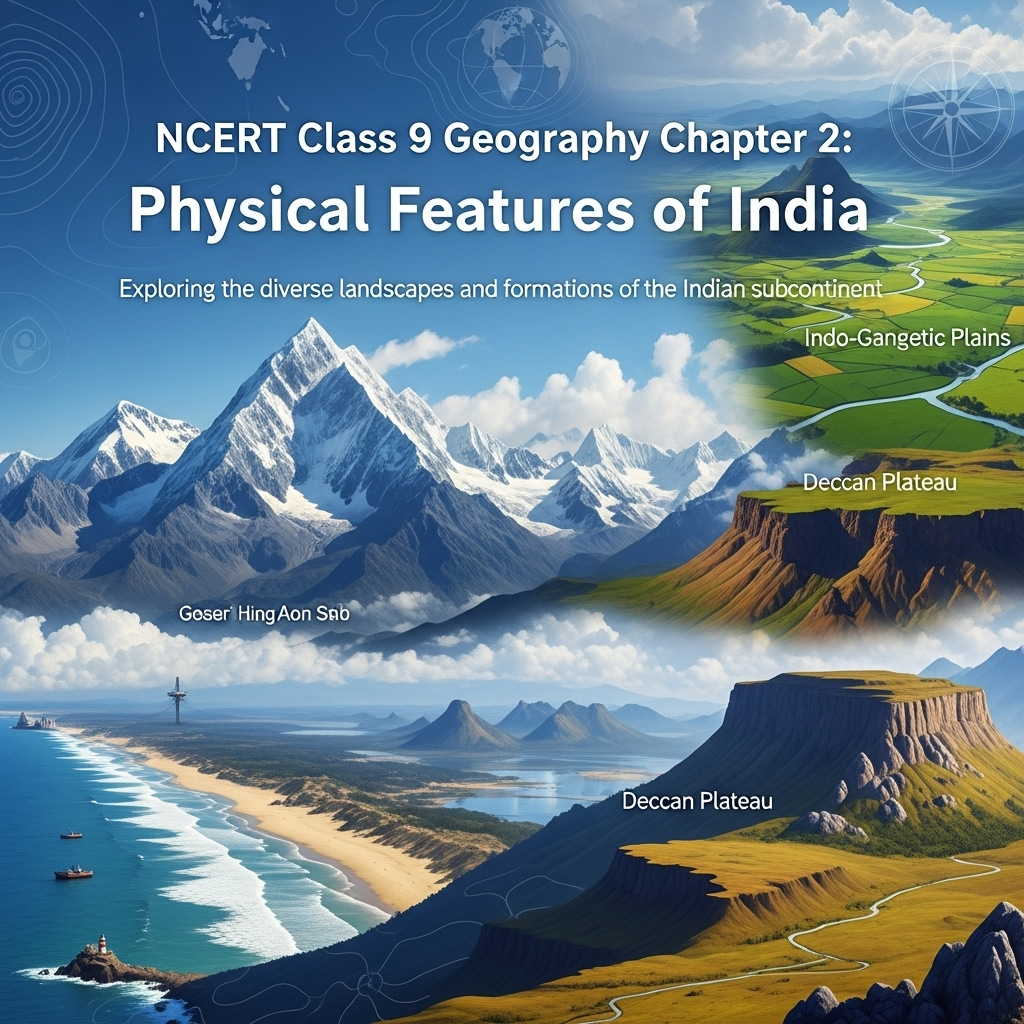
  • Major Divisions: Grouped under six physiographic divisions (Figure 2.2: Relief): (1) Himalayan Mountains, (2) Northern Plains, (3) Peninsular Plateau, (4) Indian Desert, (5) Coastal Plains, (6) Islands. Each division has unique characteristics contributing to India's geography. Figure 2.1: Himalayas map showing ranges and peaks.
  • Himalayan Mountains (Expanded): Geologically young and structurally fold mountains stretching over northern borders from Indus to Brahmaputra in west-east direction, forming an arc of about 2,400 km. Width varies from 400 km in Kashmir to 150 km in Arunachal Pradesh. Altitudinal variations greater in eastern half. Consists of three parallel ranges: Great or Inner Himalayas (Himadri)—most continuous, loftiest peaks avg 6,000 m, asymmetrical folds, granite core, perennially snow-bound, glaciers descend; Lesser Himalaya (Himachal)—rugged, compressed/altered rocks, altitude 3,700-4,500 m, avg width 50 km, prominent ranges like Pir Panjal (longest), Dhaula Dhar, Mahabharat, famous valleys Kashmir, Kangra, Kullu, hill stations; Outer Himalayas (Shiwaliks)—width 10-50 km, altitude 900-1,100 m, unconsolidated sediments, thick gravel/alluvium in valleys called Duns (Dehra Dun, Kotli Dun, Patli Dun). Besides longitudinal, divided regionally: Punjab Himalaya (Indus-Satluj, known as Kashmir/Himachal), Kumaon (Satluj-Kali), Nepal (Kali-Teesta), Assam (Teesta-Dihang). Beyond Dihang gorge, bend south to Purvachal or Eastern hills/mountains (Patkai, Naga, Manipur, Mizo hills)—sedimentary sandstones, dense forests, parallel ranges/valleys. Figure 2.3: The Himalayas; Figure 2.4: Mizo Hills. Peaks list: Mt. Everest (Nepal, 8848 m), Kanchenjunga (India, 8598 m), etc.
  • Northern Plains (Expanded): Formed by interplay of Indus, Ganga, Brahmaputra and tributaries, alluvial soil deposited in vast basin at Himalayan foothills over millions of years—area 7 lakh sq km, 2400 km long, 240-320 km broad, densely populated, agriculturally productive due to rich soil, water, climate. Rivers from mountains do depositional work; lower course gentle slope decreases velocity, forms riverine islands (e.g., Majuli largest inhabited in Brahmaputra). Divided into Punjab Plains (Indus tributaries, doabs, larger part Pakistan—Jhelum, Chenab, Ravi, Beas, Satluj), Ganga Plain (Ghaggar-Teesta, Haryana/Delhi/UP/Bihar/part Jharkhand/West Bengal), Brahmaputra Plain (Assam). Not flat—diverse relief: Bhabar (8-16 km pebble belt parallel Shiwaliks, streams disappear), Terai (south, wet/swampy/marshy, thick forests/wildlife cleared for agriculture, Dudhwa Park), Bhangar (older alluvium above floodplains, terrace-like, calcareous kankar), Khadar (newer younger floodplains renewed yearly, fertile for intensive agriculture). Distributaries in lower course from silt. Doab from 'do' (two) 'ab' (water); Punjab 'punj' (five) 'ab'.
  • Peninsular Plateau (Expanded): Tableland of old crystalline, igneous, metamorphic rocks from breaking/drifting Gondwana land, oldest landmass with broad/shallow valleys, rounded hills. Two divisions: Central Highlands (north Narmada, major Malwa plateau, bounded Satpura south/Aravalis northwest, merges Rajasthan desert; rivers Chambal/Sind/Betwa/Ken southwest-northeast slope; wider west, narrower east; eastward Bundelkhand/Baghelkhand, further Chotanagpur drained Damodar), Deccan Plateau (triangular south Narmada, Satpura base north, Mahadev/Kaimur/Maikal eastern extensions; higher west slopes east; northeast Meghalaya/Karbi-Anglong/North Cachar separated fault; hill ranges Garo/Khasi/Jaintia). Western Ghats (parallel western coast, continuous, crossed passes Thal/Bhor/Pal, avg 900-1600 m, cause orographic rain, height increases south, peaks Anai Mudi 2695 m/Doda Betta 2637 m, local names), Eastern Ghats (Mahanadi Valley to Nilgiris south, discontinuous/irregular/dissected rivers to Bay Bengal, peaks Mahendragiri 1501 m, Shevroy/Javadi southeast, hill stations Ooty/Kodaikanal). Deccan Trap black soil volcanic origin, igneous rocks denuded. Aravali Hills western/northwestern margins, highly eroded/broken, Gujarat-Delhi southwest-northeast. Figure 2.6: A Waterfall in Chotanagpur Plateau.
  • Indian Desert (Expanded): Lies towards western margins Aravali Hills, undulating sandy plain with sand dunes, receives very low rainfall below 150 mm per year, arid climate low vegetation. Streams appear rainy season, disappear sand not enough water to sea. Luni only large river. Barchans (crescent-shaped dunes) cover larger areas, longitudinal dunes more prominent near Indo-Pakistan boundary—visit Jaisalmer for barchans group. Figure 2.7: The Indian Desert.
  • Coastal Plains (Expanded): Peninsular plateau flanked by narrow coastal strips along Arabian Sea west/Bay Bengal east. Western coast sandwiched Western Ghats/Arabian Sea narrow plain: northern Konkan (Mumbai-Goa), central Kannad Plain, southern Malabar coast. Plains along Bay Bengal wide/level: northern Northern Circar, southern Coromandel Coast. Large rivers Mahanadi/Godavari/Krishna/Kaveri formed extensive deltas. Lake Chilika important feature eastern coast, largest salt water lake India, Odisha south Mahanadi delta. Figure 2.8: The Coastal Plains.
  • Islands (Expanded): Besides vast mainland, two groups: Lakshadweep (close Malabar coast Kerala, small coral islands, earlier Laccadive/Minicoy/Amindive, renamed 1973, 32 sq km, Kavaratti administrative HQ, great diversity flora/fauna, Pitti uninhabited bird sanctuary), Andaman and Nicobar (elongated chain Bay Bengal north-south, bigger/more numerous/scattered, divided Andaman north/Nicobar south, elevated submarine mountains, great strategic importance, diversity flora/fauna, close equator equatorial climate thick forest cover, India's only active volcano Barren Island Andaman Nicobar group). Corals: Short-lived microscopic organisms live colonies shallow mud-free warm waters, secrete calcium carbonate form reefs—three kinds: barrier reef (e.g., Great Barrier Reef Australia), fringing reef, atolls (circular/horse shoe-shaped). Figure 2.9: An Island.
  • Expanded Relevance 2025: Emphasizes resource complementarity and future development possibilities. With climate change, focus on impacts like Himalayan instability, desert expansion, coastal erosion. Update: Sustainable practices for each feature, e.g., conservation in Terai, mining regulations in plateau.
  • Exam Tip: Memorize divisions, sub-parts; use figures for map questions; distinguish features like Ghats, alluvium types.
  • Broader Implications: Diverse features support biodiversity, economy; unstable zones prone to earthquakes/floods need disaster management.

SEO Note: Why This Guide?

Top-ranked for 'Physical Features of India Class 9 notes 2025'—free, with 60 Q&A from PDF, quizzes. Integrates geological insights.

Key Themes

  • Geological Variations: Ancient/stable vs young/unstable landforms.
  • Divisions Details: Formations, characteristics, economic roles. Figure 2.2: Relief map.
  • Resource Links: Complementary for development.
  • Regional Names: Punjab Himalaya, Purvachal, etc.
  • Critical Thinking: Why Himalayas unstable? How plateau aids industrialization? Impact of alluvium on agriculture.

Cases for Exams

Use Figure 2.2 for relief identification; discuss alluvium formation and its fertility; analyze dune types in desert.

Exercises Summary

  • Focus: Expanded to 60 Q&A from PDF: 20 short (2M), 20 medium (4M), 20 long (8M) based on NCERT exercises + similar.
  • Project Idea: Puzzle for features; map marking of peaks, ranges, plateaus.
This chapter is part of the CBSE Class 9 Annual Assessment Board ExaminationExplore every chapter — summary, notes, extra questions & MCQ quizzes
Practice Quiz

Test your CBSE Class 9 Annual Assessment prep

Dual AI-verified questions Real exam pattern 1 free quiz every month, then ₹9 per quiz — or a monthly plan

#1

Cell: The Building Block of Life

Start here
Science 10 Qs · ~10 min

Instant score, answer review and weak-topic diagnosis

7.6/10avg score
10/10best
#2

The Pot Maker

English 10 Qs · ~10 min

Instant score, answer review and weak-topic diagnosis

6.8/10avg score
10/10best
#3

Journey Inside the Atom

Science 10 Qs · ~10 min

Instant score, answer review and weak-topic diagnosis

7.4/10avg score
10/10best
#4

Describing Motion Around Us

Science 10 Qs · ~10 min

Instant score, answer review and weak-topic diagnosis

7.1/10avg score
10/10best
#5

Tissues in Action

Science 10 Qs · ~10 min

Instant score, answer review and weak-topic diagnosis

6.9/10avg score
10/10best
#6

दो बैलों की कथा

Hindi 10 Qs · ~10 min

Instant score, answer review and weak-topic diagnosis

9.3/10avg score
10/10best
#7

How I Taught My Grandmother to Read

English 10 Qs · ~10 min

Instant score, answer review and weak-topic diagnosis

9.2/10avg score
10/10best
#8

How Forces Affect Motion

Science 10 Qs · ~10 min

Instant score, answer review and weak-topic diagnosis

7.2/10avg score
10/10best
#9

The World of Numbers

Maths 10 Qs · ~10 min

Instant score, answer review and weak-topic diagnosis

8/10avg score
10/10best
#10

Science and Sports

Physical Education 10 Qs · ~10 min

Instant score, answer review and weak-topic diagnosis

8.8/10avg score
10/10best
#11

Physical Education and Well-being

Physical Education 10 Qs · ~10 min

Instant score, answer review and weak-topic diagnosis

9.8/10avg score
10/10best
#12

Exploring Mixtures and their Separation

Science 10 Qs · ~10 min

Instant score, answer review and weak-topic diagnosis

5.3/10avg score
9/10best
#13

संवादहीन

Hindi 10 Qs · ~10 min

Instant score, answer review and weak-topic diagnosis

1.7/10avg score
5/10best
#14

Exploring Algebraic Identities

Maths 10 Qs · ~10 min

Instant score, answer review and weak-topic diagnosis

3/10avg score
7/10best
#15

Introduction to Linear Polynomials

Maths 10 Qs · ~10 min

Instant score, answer review and weak-topic diagnosis

6.3/10avg score
10/10best
#16

रैदास के पद

Hindi 10 Qs · ~10 min

Instant score, answer review and weak-topic diagnosis

5.5/10avg score
6/10best
#17

Winds of Change

English 10 Qs · ~10 min

Instant score, answer review and weak-topic diagnosis

9.5/10avg score
10/10best
#18

Measuring Space: Perimeter and Area

Maths 10 Qs · ~10 min

Instant score, answer review and weak-topic diagnosis

9/10avg score
10/10best
#19

घर की याद

Hindi 10 Qs · ~10 min

Instant score, answer review and weak-topic diagnosis

10/10avg score
10/10best
#20

राम-लक्ष्मण-परशुराम संवाद

Hindi 10 Qs · ~10 min

Instant score, answer review and weak-topic diagnosis

3/10avg score
3/10best
#21

आखिरी चट्टान तक

Hindi 10 Qs · ~10 min

Instant score, answer review and weak-topic diagnosis

10/10avg score
10/10best
#22

क्या लिखूँ?

Hindi 10 Qs · ~10 min

Instant score, answer review and weak-topic diagnosis

2/10avg score
2/10best
#23

Olympism

Physical Education 10 Qs · ~10 min

Instant score, answer review and weak-topic diagnosis

9/10avg score
9/10best
#24

Follow That Dream

English 10 Qs · ~10 min

Instant score, answer review and weak-topic diagnosis

10/10avg score
10/10best
#25

Vitamin-M

English 10 Qs · ~10 min

Instant score, answer review and weak-topic diagnosis

10/10avg score
10/10best
#26

The Mathematics of Maybe: Introduction to Probability

Maths 10 Qs · ~10 min

Instant score, answer review and weak-topic diagnosis

8/10avg score
8/10best
#27

Orienting Yourself: The Use of Coordinates

Maths 10 Qs · ~10 min

Instant score, answer review and weak-topic diagnosis

3/10avg score
3/10best
#28

Reproduction: How Life Continues

Science 10 Qs · ~10 min

Instant score, answer review and weak-topic diagnosis

#29

Atomic Foundations of Matter

Science 10 Qs · ~10 min

Instant score, answer review and weak-topic diagnosis

7/10avg score
7/10best
#30

Entering the World of Secondary Science

Science 10 Qs · ~10 min

Instant score, answer review and weak-topic diagnosis

1/10avg score
1/10best
#31

तब याद तुम्हारी आती है

Hindi 10 Qs · ~10 min

Instant score, answer review and weak-topic diagnosis

#32

निर्मल जीत सिंह सेखों

Hindi 10 Qs · ~10 min

Instant score, answer review and weak-topic diagnosis

#33

झाँसी की रानी

Hindi 10 Qs · ~10 min

Instant score, answer review and weak-topic diagnosis

#34

भारति, जय, विजयकरे!

Hindi 10 Qs · ~10 min

Instant score, answer review and weak-topic diagnosis

#35

मैं और मेरा देश

Hindi 10 Qs · ~10 min

Instant score, answer review and weak-topic diagnosis

#36

रीढ़ की हड्डी

Hindi 10 Qs · ~10 min

Instant score, answer review and weak-topic diagnosis

#37

ऐसी भी बातें होती हैं (लता मंगेशकर से साक्षात्कार)

Hindi 10 Qs · ~10 min

Instant score, answer review and weak-topic diagnosis

#38

Yoga for Holistic Health and Personal Excellence

Physical Education 10 Qs · ~10 min

Instant score, answer review and weak-topic diagnosis

#39

Sports

Physical Education 10 Qs · ~10 min

Instant score, answer review and weak-topic diagnosis

#40

Sports for All

Physical Education 10 Qs · ~10 min

Instant score, answer review and weak-topic diagnosis

#41

Carrier of Words

English 10 Qs · ~10 min

Instant score, answer review and weak-topic diagnosis

#42

Twin Melodies

English 10 Qs · ~10 min

Instant score, answer review and weak-topic diagnosis

#43

The World of Limitless Possibilities

English 10 Qs · ~10 min

Instant score, answer review and weak-topic diagnosis

#44

Predicting What Comes Next: Exploring Sequences and Progressions

Maths 10 Qs · ~10 min

Instant score, answer review and weak-topic diagnosis

#45

I'm Up and Down, and Round and Round

Maths 10 Qs · ~10 min

Instant score, answer review and weak-topic diagnosis

#46

Earth as a System: Energy, Matter, and Life

Science 10 Qs · ~10 min

Instant score, answer review and weak-topic diagnosis

#47

Patterns in Life: Diversity and Classification

Science 10 Qs · ~10 min

Instant score, answer review and weak-topic diagnosis

#48

Sound Waves: Characteristics and Applications

Science 10 Qs · ~10 min

Instant score, answer review and weak-topic diagnosis

#49

Work, Energy, and Simple Machines

Science 10 Qs · ~10 min

Instant score, answer review and weak-topic diagnosis

#50

Fundamental Rights and Duties Fundamentals | CBSE Class 9 Annual Assessment

10 Qs · ~10 min

Instant score, answer review and weak-topic diagnosis

#51

Motion Along a Straight Line Fundamentals | CBSE Class 9 Annual Assessment

10 Qs · ~10 min

Instant score, answer review and weak-topic diagnosis

#52

Number Systems and Operations Fundamentals — Free CBSE Class 9 Annual Assessment Quiz

10 Qs · ~10 min

Instant score, answer review and weak-topic diagnosis

More on CBSE Class 9 Annual Assessment19 guides

Alerts and Updates for CBSE Class 9 Annual AssessmentStay up-to-date with the latest news and updates for the CBSE Class 9 Annual Assessment examComplete Solutions and Summary of Money and Credit – NCERT Class 10, Economics, Chapter 3 – Summary, Questions, Answers, Extra QuestionsComprehensive summary and explanation of Chapter 3 'Money and Credit', covering the evolution and functions of money, role of banks and modern money, demonetisation, digital transactions, importance of credit, types of credit arrangements, Grameen Bank, challenges for financial inclusion, and credit availability for the poor—all with question answers and extra questions from NCERT Class X Economics.Complete Solutions and Summary of Population – NCERT Class 9, Geography, Chapter 6 – Summary, Questions, Answers, Extra QuestionsDetailed summary and explanation of Chapter 6 ‘Population’ covering population size and distribution, growth, density, processes of change (birth rate, death rate, migration), age and sex composition, literacy, occupational structure, and National Population Policy, with all question answers, map skills, and extra questions from NCERT Class IX Geography.Complete Solutions and Summary of Natural Vegetation and Wildlife – NCERT Class 9, Geography, Chapter 5 – Summary, Questions, Answers, Extra QuestionsDetailed summary and explanation of Chapter 5 ‘Natural Vegetation and Wildlife’ covering the types of vegetation (evergreen, deciduous, thorn, montane, mangrove), forest and biodiversity zones, medicinal plants, endangered species, conservation efforts, and India’s wildlife heritage with all question answers, mapping skills, and extra questions from NCERT Class IX Geography.Complete Solutions and Summary of Climate – NCERT Class 9, Geography, Chapter 4 – Summary, Questions, Answers, Extra QuestionsDetailed summary and explanation of Chapter 4 ‘Climate’ covering weather versus climate, elements, controlling factors, India's climatic zones, seasons, temperature and rainfall patterns, monsoon characteristics, and their unifying role, with all question answers, map skills, and extra questions from NCERT Class IX Geography.Complete Solutions and Summary of Drainage – NCERT Class 9, Geography, Chapter 3 – Summary, Questions, Answers, Extra QuestionsDetailed summary and explanation of Chapter 3 ‘Drainage’ including river systems, drainage basins, Himalayan and Peninsular rivers, tributaries, major lakes, economic importance, pollution, with all question answers, map skills, and extra questions from NCERT Class IX Geography.Complete Solutions and Summary of People as Resource – NCERT Class 9, Economics, Chapter 2 – Summary, Questions, Answers, Extra QuestionsDetailed summary and explanation of Chapter 2 'People as Resource' focusing on population as human capital, education, health, skill formation, productive activities, the three economic sectors, unemployment types, and measures for improvement, with all question answers and extra questions from NCERT Class IX, Economics.Complete Solutions and Summary of India - Size and Location – NCERT Class 9, Geography, Chapter 1 – Summary, Questions, Answers, Extra QuestionsDetailed summary and explanation of Chapter 1 ‘India - Size and Location’ covering India’s geographical extent, boundaries, neighbours, latitude and longitude, time zones, physical features, and strategic location with all question answers, map skills, and extra questions from NCERT Class IX Geography.Complete Solutions and Summary of Food Security in India – NCERT Class 9, Economics, Chapter 4 – Summary, Questions, Answers, Extra QuestionsDetailed summary and explanation of Chapter 4 'Food Security in India' covering the concept, necessity, dimensions, role of PDS and buffer stock, causes of food insecurity, Green Revolution, government schemes, persistent challenges, and the role of co-operatives in ensuring access, with all question answers and extra questions from NCERT Class IX, Economics.Complete Solutions and Summary of Poverty as a Challenge – NCERT Class 9, Economics, Chapter 3 – Summary, Questions, Answers, Extra QuestionsDetailed summary and explanation of Chapter 3 'Poverty as a Challenge' covering the multidimensional nature of poverty, indicators, measurement methods (consumption and MPI), causes, poverty estimates and reduction trends, vulnerable groups, global scenario, anti-poverty measures, and government initiatives, with all question answers and extra questions from NCERT Class IX, Economics.Complete Solutions and Summary of The Story of Village Palampur – NCERT Class 9, Economics, Chapter 1 – Summary, Questions, Answers, Extra QuestionsDetailed summary and explanation of Chapter 1 'The Story of Village Palampur' introducing basic concepts of production, factors of production (land, labour, capital), farming and non-farm activities, modern farming methods, land distribution, surplus, and loans, with all question answers and extra questions from NCERT Class IX, Economics.Complete Solutions and Summary of Democratic Rights – NCERT Class 9, Civics, Chapter 5 – Summary, Questions, Answers, Extra QuestionsDetailed summary and explanation of Chapter 5 'Democratic Rights' covering the need and meaning of rights, fundamental rights in the Indian Constitution, enforcement and protection, right to constitutional remedies, expansion of rights, and real-life cases with all question answers and extra questions from NCERT Class IX Civics.Complete Solutions and Summary of Working of Institutions – NCERT Class 9, Civics, Chapter 4 – Summary, Questions, Answers, Extra QuestionsDetailed summary and explanation of Chapter 4 'Working of Institutions' covering the structure and functions of Parliament, Prime Minister and Cabinet, President, Judiciary, their interconnections, checks and balances, and real-life government decision-making with question answers and extra questions from NCERT Class IX Civics.Complete Solutions and Summary of Electoral Politics – NCERT Class 9, Civics, Chapter 3 – Summary, Questions, Answers, Extra QuestionsDetailed summary and explanation of Chapter 3 'Electoral Politics' covering why elections are needed, how representatives are elected, electoral competition, process and fairness, challenges, Election Commission, with question answers and extra questions from NCERT Class IX Civics.Complete Solutions and Summary of Constitutional Design – NCERT Class 9, Civics, Chapter 2 – Summary, Questions, Answers, Extra QuestionsDetailed summary and explanation of Chapter 2 'Constitutional Design' covering the need for a constitution, making of the Indian constitution, foundational values and philosophy, key makers and debates, with question answers and extra questions based on NCERT Class IX Civics.Complete Solutions and Summary of What is Democracy? Why Democracy? – NCERT Class 9, Civics, Chapter 1 – Summary, Questions, Answers, Extra QuestionsDetailed summary and explanation of Chapter 1 ‘What is Democracy? Why Democracy?’ covering the meaning of democracy, features of democratic government, challenges, benefits, and broader meanings of democracy with all question answers and extra questions from NCERT Class IX, Civics.Complete Solutions and Summary of Pastoralists in the Modern World – NCERT Class 9, History, Chapter 5 – Summary, Questions, Answers, Extra QuestionsDetailed summary and explanation of Chapter 5 ‘Pastoralists in the Modern World’ discussing nomadic pastoralist lifestyles, impacts of colonialism in India and Africa, changes in grazing patterns, taxation, social changes, and contemporary adaptations with all question answers and extra questions from NCERT Class IX, History.Complete Solutions and Summary of Forest Society and Colonialism – NCERT Class 9, History, Chapter 4 – Summary, Questions, Answers, Extra QuestionsDetailed summary and explanation of Chapter 4 ‘Forest Society and Colonialism’ covering deforestation, colonial forest policies, impact on forest dwellers, scientific forestry, forest transformations in India and Java, and rebellions, with all question answers and extra questions from NCERT Class IX, History.Complete Solutions and Summary of Nazism and the Rise of Hitler – NCERT Class 9, History, Chapter 3 – Summary, Questions, Answers, Extra QuestionsDetailed summary and explanation of Chapter 3 ‘Nazism and the Rise of Hitler’ including the rise of Nazi Germany, impact of World War I, Weimar Republic, Hitler’s ideology, racial state, propaganda, Holocaust, and legacy, with all question answers and extra questions from NCERT Class IX, History.

Group Discussions

No forum posts available.

Share this article