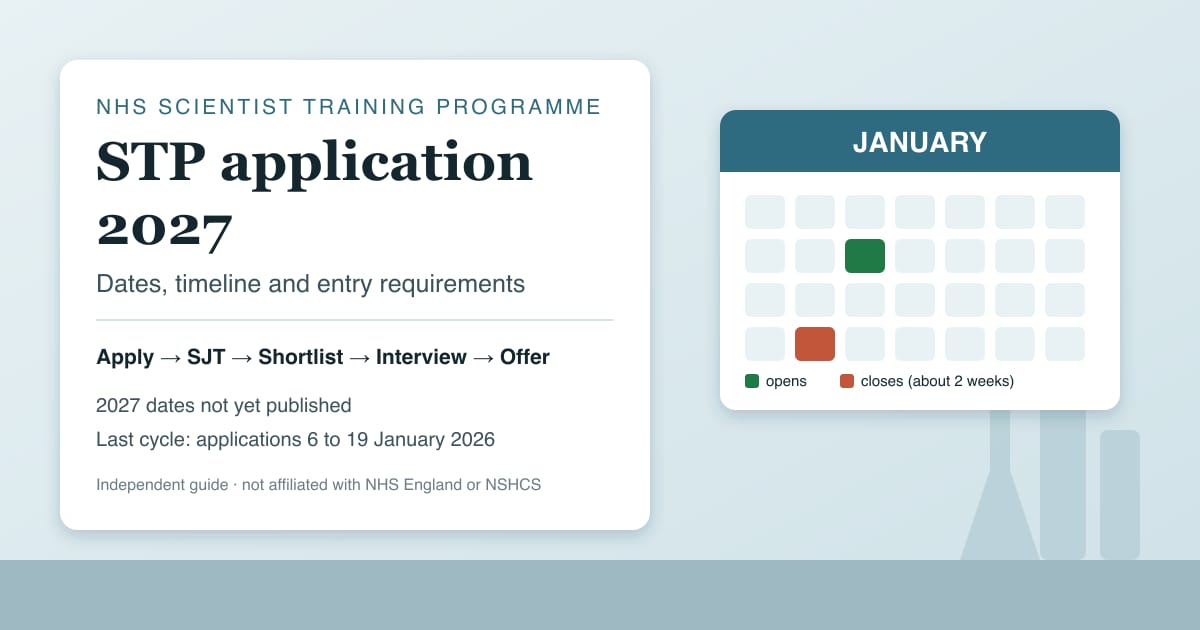
Checked 8 November 2026. On 8 November 2026 the NSHCS pages we checked gave no 2027 recruitment dates. Its applying page says applications generally open in January for a September start, and the SJT has its own window after the application closing date. The format, marking and timing here are from the NSHCS SJT page last updated 23 September 2026; check it again when 2027 recruitment opens.
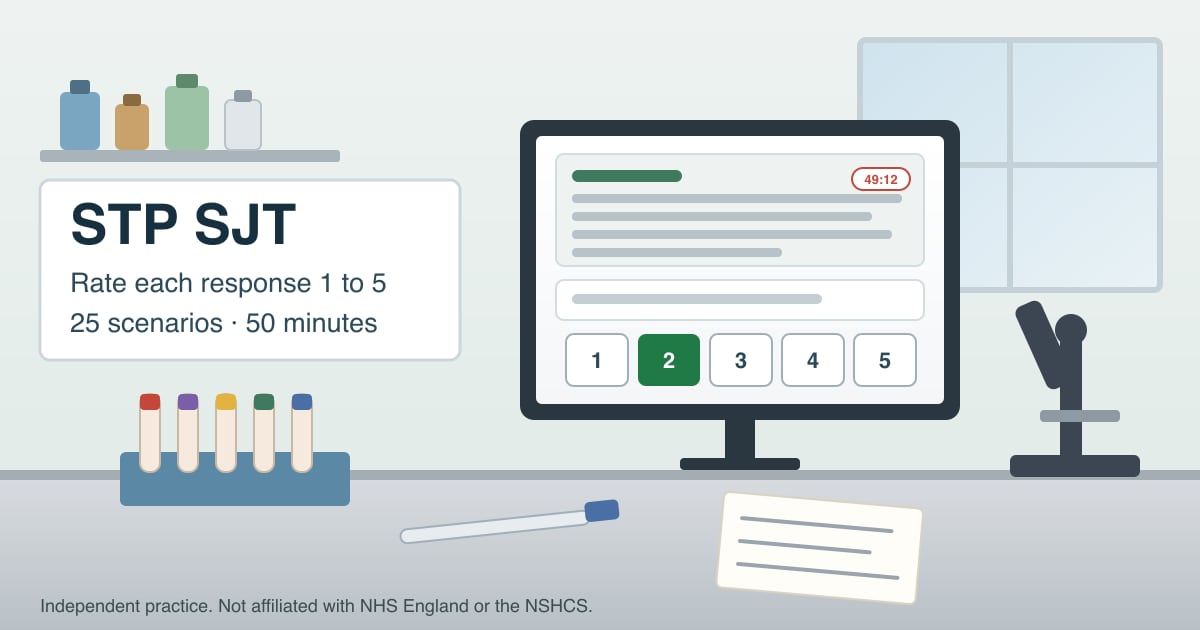
The NHS STP SJT is the online situational judgement test every Scientist Training Programme applicant takes after applying. You get 25 healthcare-science scenarios in 50 minutes, rate each of the 4 to 8 responses per scenario from 1 = Very Appropriate to 5 = Very Inappropriate, and NSHCS marks each rating by how close it is to its answer key, with no negative marking. You must score above a threshold to be longlisted, so the SJT decides whether the specialty panels ever read your application.
This guide summarises the format and the rules from the NSHCS guidance, with links to the pages, then adds our own commentary, clearly marked: what the four attributes look like in a scenario, what closeness marking means for how you rate, two worked scenarios of our own, and how to prepare. ProSyllabus is an independent study site. It is not affiliated with NHS England or the National School of Healthcare Science (NSHCS), and our practice test is independent practice: NSHCS did not write it and does not endorse it.
NSHCS page on longlisting and the SJT, last updated 23 September 2026, read 8 November 2026.
Key facts: the STP SJT
| Item | Detail |
|---|---|
| Who takes it | Every STP applicant, after the application closing date (NSHCS: all applicants access it on the Pearson website) |
| Format | 25 hypothetical scenarios that someone working in healthcare science may meet, each with 4 to 8 response options |
| What you do | Rate every response for appropriateness on a 5-point scale, from 1 = Very Appropriate to 5 = Very Inappropriate |
| Time | 50 minutes; the timer starts with the first question and stays on screen |
| Marking | By how close each answer is to the correct answer; no negative marking, so NSHCS advises attempting every question |
| Answer key | Set by a panel of NSHCS subject matter experts; the test was developed with the Work Psychology Group |
| What it measures | Empathy and compassion, professional integrity, team collaboration and adaptability |
| Where and when | Online on the Pearson website, in a set test window after the application closing date. Mobile devices are not supported |
| Before you start | Accept the non-disclosure agreement and terms of use; if you decline, your application cannot progress |
| Reasonable adjustment | 25% extra time is the only one offered, requested on the Oriel application form with evidence |
| Result | No score is shown. Your Oriel status changes to longlisted or longlist unsuccessful once the window closes and scoring is done (the applying page also calls the second status "longlist fail") |
| 2027 dates | Not on the NSHCS pages we checked on 8 November 2026. NSHCS says applications generally open in January for a September start |
Everything in this table is from the NSHCS page on longlisting and the SJT and its page on applying for a direct entry post. NSHCS says official guidance and sample questions for the SJT are only on its website and the Pearson platform, and warns that unofficial resources can be inaccurate, so treat those two pages as the rule book and everything else, including this guide, as practice and commentary.
FreeTests: Professional integrity
NHS STP SJT Practice Test: free sample
Answer 4 questions against the clock, like the real exam. You then see the right answer, the reason and your time on each. About 3 minutes · free · no sign-in.
4 questions to answer
Start nowThis one is free · no sign-in needed
Your result shows how long each question took you.
The 1 to 5 scale and what each rating means
NSHCS gives each rating a definition, and the definitions all turn on one question: how far the response aligns with, or opposes, what is expected of a trainee scientist. The middle column summarises the NSHCS definitions; the right-hand column is our reading.
| Rating | NSHCS definition (summary) | Our reading |
|---|---|---|
| 1 = Very Appropriate | A very appropriate thing to do in response to the scenario; aligns exactly with what is expected of a trainee scientist | What a good trainee should do: safe, honest, within their role. It does not have to solve everything |
| 2 = Somewhat Appropriate | A somewhat appropriate thing to do; somewhat aligned with what is expected of a trainee scientist | Reasonable and in the right spirit, but not quite what a good trainee should do, for example not the best person to go to |
| 3 = Neither Appropriate Nor Inappropriate | Does not oppose or align with what is expected of a trainee scientist | Neither aligned with nor opposed to what is expected; not a rating for "unsure" |
| 4 = Somewhat Inappropriate | A somewhat inappropriate thing to do; somewhat opposed to what is expected of a trainee scientist | Goes against what is expected in part: avoids a problem, oversteps your role, or adds avoidable risk |
| 5 = Very Inappropriate | A very inappropriate thing to do; directly opposes what is expected of a trainee scientist | Unsafe, dishonest, a breach of confidentiality, or ignores a patient at risk |
The rating rules NSHCS gives you
The NSHCS page sets out how it asks applicants to judge each response. Read these instructions before you practise:
How NSHCS tells you to rate
- Answer from the viewpoint of the trainee scientist and what they should do, not what you might be likely to do in the circumstances.
- Judge each response on its own. A response does not need to resolve every part of the scenario to be 1 = Very Appropriate.
- Within one scenario you can use a rating more than once or not at all: every response could be a 1 if that is right.
- If you would like more information, give your best answer on the information provided.
- The responses are not every possible option, so the best one may be missing. Rate the ones you are given.
- Rate a response on its appropriateness whatever its timeframe: an immediate action and a later discussion can both be appropriate.
Summarised from the NSHCS SJT page, section "Instructions for completing the SJT".
NSHCS gives its own example: if a patient is given the wrong lab result, several steps are needed, but "ask the patient if they are OK" should still be judged as appropriate, not as if it were the only action taken. The habit to build is to rate the response in front of you, not the response you wish were there.
How the STP SJT is marked: closeness, not right or wrong
NSHCS says marks are given based on how close an answer is to the correct answer, and there is no negative marking. The NSHCS pages do not give the points for each step away from the key.
Our practice test uses a simple split so you can see the effect: the key earns 1 mark, one step away 0.75, two steps 0.5, three steps 0.25 and four steps 0. That split is ours, not the official one. It follows the NSHCS principle that marks depend on how close a rating is to the correct answer.
Our practice test's split (1, 0.75, 0.5, 0.25, 0 by distance from the key). NSHCS says that marks depend on how close an answer is to the correct answer; the NSHCS pages we checked do not give the points per step.
Two practical points follow. First, NSHCS advises attempting every question because there is no negative marking, so do not leave responses blank. Second, under our practice formula the big losses come from getting the direction wrong, calling a harmful action appropriate or a sensible one inappropriate: being torn between 1 and 2 costs at most a quarter of a mark there, while confusing 2 with 4 costs half. If you find yourself torn between opposite sides of the scale, reread the scenario.
The score matters twice. You must score above the required threshold to be longlisted, and at shortlisting NSHCS says that, when required, the SJT score is used as a tie breaker where scores are the same. The NSHCS pages do not give the threshold.
The four attributes the SJT measures
NSHCS says the SJT maps closely to the person specification for an STP trainee and explores values, behaviours and professionalism. It names four target attributes. The left column is a short summary of the NSHCS description; the right is our reading of how each tends to show up in a scenario.
| Attribute | NSHCS describes it as | What it looks like in a scenario (our view) |
|---|---|---|
| Empathy and compassion | Recognising emotions and motivations from the patient or colleague's perspective; considering their situation; acknowledging and exploring the patient's wants and needs | An anxious patient before a test, a grieving relative, a colleague who is struggling |
| Professional integrity | Open and honest; takes responsibility and admits mistakes; ethical; acts in the patient's best interests; knows the limits of own knowledge and seeks advice | Your own error, a colleague cutting a corner, a request outside your competence, confidential data |
| Team collaboration | Working in partnership; respecting others' views; offering support and sharing tasks; understanding own and others' roles and consulting where appropriate | A disagreement over a protocol, an unfair share of work, a handover between teams |
| Adaptability | Calm under stress or change; seeks support when needed; manages own emotions, even in disagreement; accepts uncertainty and change; adapts behaviour | A rota change, a new system, a cancelled rotation, a deadline clash with your master's work |
A scenario can involve more than one attribute, so think about all of them as you read. When we write our own keys, the same priorities come up again and again: patient safety, honesty about errors, confidentiality, working within your competence, and raising concerns with the right person at the right time. That is our editorial approach, not a published NSHCS marking rule. NSHCS says the SJT maps closely to the person specification for an STP trainee, so it is worth reading once.
Worked scenario 1: an ECG saved to the wrong record (our own illustration)
Scenario (written by us, not an STP SJT item)
- You are a second-year trainee clinical scientist in cardiac science at Elmbridge Hospital. During an outpatient clinic you notice that the ECG you recorded for Mr Haddad an hour ago was saved under another patient with the same surname. Mr Haddad has gone home. The consultant has already reviewed the list. Your supervisor, Joanne, is in the next room.
- Response A: Tell Joanne straight away what happened, so the record can be corrected and the consultant told. Our key: 1 = Very Appropriate. Honest, prompt and through the right person; it protects both patients.
- Response B: Move the ECG to the right record yourself and say nothing, since the trace itself was recorded correctly. Our key: 5 = Very Inappropriate. The consultant may already have acted on the wrong record, and hiding an error directly opposes professional integrity.
- Response C: Finish the clinic first and tell Joanne about the ECG once the last patient has gone. Our key: 4 = Somewhat Inappropriate. Joanne is the right person, but waiting for the end of the clinic delays correcting a record error that may affect two patients, when she is in the next room.
- Response D: Phone Mr Haddad to repeat the ECG tomorrow before you have spoken to anyone. Our key: 4 = Somewhat Inappropriate. Well meant, but it acts alone and may alarm him before anyone knows whether a repeat is needed.
Our scenario and our keys, written to the NSHCS rating descriptions. It does not represent any real SJT question.
Notice that A and C both go to the right person. What separates them is the delay that C writes into the response. Under our practice formula, rating C a 3 or a 5 would still earn 0.75 of the mark, while rating B a 1 or 2 would earn little or nothing.
FreeTests: Professional integrity
NHS STP SJT Practice Test: free sample
Answer 4 questions against the clock, like the real exam. You then see the right answer, the reason and your time on each. About 3 minutes · free · no sign-in.
4 questions to answer
Start nowThis one is free · no sign-in needed
Your result shows how long each question took you.
Worked scenario 2: a team under pressure (our own illustration)
Scenario (written by us, not an STP SJT item)
- You are a first-year trainee in a genomics laboratory at Castlefield NHS Trust. Two practitioners are off sick and the team is behind on urgent samples. A senior colleague, Tomasz, asks you to stay late every day this week to help. You have a master's assignment due on Friday that you have not started, and you are already tired.
- Response A: Explain your assignment deadline to Tomasz and agree which evenings you can help. Our key: 1 = Very Appropriate. Honest about your limits while still supporting the team.
- Response B: Agree to every evening and plan to finish the assignment overnight. Our key: 4 = Somewhat Inappropriate. Helpful on the surface, but tired lab work and a rushed assignment both carry risk, and you have not been open about it.
- Response C: Ask your training officer for advice on balancing the extra hours with your assignment. Our key: 1 = Very Appropriate. Seeking support when under pressure is part of adaptability, and your training officer can help agree a plan.
- Response D: Tell Tomasz you cannot help because trainees are not there to cover staff shortages. Our key: 4 = Somewhat Inappropriate. You may have a fair point about your training time, but refusing outright ignores a team under real pressure.
Our scenario and our keys, written to the NSHCS rating descriptions. It does not represent any real SJT question.
Two responses earn a 1 here, which NSHCS says is allowed. Do not force a spread of ratings across a scenario: rate each response on its own.
Pacing: about 2 minutes a scenario
50 minutes for 25 scenarios is 2 minutes per scenario. With 4 to 8 responses each, that is roughly 15 to 30 seconds per response, before allowing time to read the scenario (our arithmetic). Read the scenario once carefully, rate the clear responses quickly, and spend the time you save on the one or two that sit between ratings. The Pearson screen has a Flag for Review option for items you want to come back to, and NSHCS says you must scroll to the bottom of each page before you can move on.
| Checkpoint | Where you want to be (our guide) |
|---|---|
| After about 10 minutes | Scenario 5 done |
| After about 25 minutes | Scenario 12 or 13 done |
| After about 45 minutes | All 25 seen; use the rest on flagged items |
| Last minute | No blank responses: NSHCS advises attempting every question because there is no negative marking |
When you take it, and what happens next
The NSHCS pages we checked on 8 November 2026 gave no 2027 dates. Its applying page says recruitment takes place each year and applications generally open in January for trainees to start in September. Confirmed timelines and deadlines are published on the NSHCS website, posts are advertised on Oriel and the NSHCS website, and application opening and closing dates appear on the vacancy and the website. The SJT has its own opening and closing dates, after the application closing date.
| Step | What NSHCS says |
|---|---|
| 1. Apply on Oriel | Posts by specialty and region are published, and you complete an application through Oriel by the vacancy closing date |
| 2. Pearson emails | Between the closing date and the SJT window, applicants who have not taken the SJT before get a link, login details (possibly in 2 separate emails) and instructions. Check junk folders; if nothing arrives 1 working day before the window opens, use Pearson's forgotten username route |
| 3. Sample test | A sample test on the Pearson website, with the desired ratings for its sample questions and the reasons |
| 4. Take the SJT | In the set window; accept the NDA first. No confirmation email: check "Delivery Successful" in your Pearson exam history |
| 5. Longlisting | Scoring happens after the window closes; Oriel shows longlisted or longlist unsuccessful |
| 6. Shortlisting and interview | Specialty panels assess and rank applications; when required, the SJT score is used as a tie breaker. Then interviews and offers |
If your previous STP application and Pearson SJT account used the same email address as this year's application, your previous login details stay the same. The STP itself is a 3-year salaried training post at Agenda for Change Band 6 with a part-time, fully funded master's degree (NSHCS, About the STP).
Technical rules and extra time
| Item | Detail |
|---|---|
| Device | A computer: Windows 10 64-bit or Mac OS X 10.13 or higher. iOS and Android mobile devices are not supported |
| Screen | At least 1024 × 768 |
| Browser | Current Edge, Firefox, Safari or Chrome, cookies and JavaScript enabled |
| Connection | Broadband, at least 1 Mbps up and down; Pearson strongly recommends a wired connection |
| Sanctioned countries | Pearson cannot deliver the test to residents of OFAC-sanctioned areas or to an IP address linked to one; the application cannot then proceed |
| Extra time | 25% extra time is the only adjustment. Ask on the reasonable adjustments section of the Oriel form and upload evidence before you submit; wait for the decision in Oriel before you start |
Suitable evidence is a Cognitive Diagnostic Report confirming your need for additional time, and/or documentation from a registered healthcare professional confirming it, on headed paper and signed. It must be in English, clearly legible, not password protected, and show your full name, the date of the report and the professional's contact details. NSHCS says it cannot consider requests or documents after the application is submitted, and that rejection because evidence does not meet these criteria cannot be appealed.
How to prepare for the STP SJT
A preparation plan (our advice)
- Do the official sample test first. It is available through Pearson before you take the test, to familiarise you with the format, navigation and question types, with the desired ratings and the reasons.
- Learn the five definitions as NSHCS words them. Use them alongside the official rating instructions and the explanations in the sample test.
- Read the person specification. NSHCS says the SJT maps closely to it, so it gives useful context for what is expected of a trainee scientist.
- Practise in full 25-scenario runs against a 50-minute clock, so the pace is familiar before the window opens.
- Review your near misses, not only your misses. A rating one step off tells you which definition you are blurring.
- Never use anyone's recollection of the real test. Applicants accept an NDA, and NSHCS warns that unofficial material may be inaccurate.
Pitfalls to watch for: rating what you would do rather than what a trainee should do; marking a sensible action down because it does not fix everything (NSHCS says it need not); treating 3 as "unsure" rather than "neither aligned nor opposed"; and spending four minutes on one scenario early on. Timed practice can help you spot these habits and work on them.
Practise in the same format
Our NHS STP SJT practice test has 1 full mock of 25 original scenarios today, each response rated 1 to 5 and marked by closeness to our key, with a 50-minute timer and the reason behind every rating. Mocks 2 and 3 are added on 9 November 2026 for every buyer, at no extra cost. Rate the 4 free responses below: the free sample can be taken once. ProSyllabus is an independent study site. It is not affiliated with NHS England or the National School of Healthcare Science (NSHCS), and our practice test is independent practice: NSHCS did not write it and does not endorse it.
FreeTests: Professional integrity
NHS STP SJT Practice Test: free sample
Answer 4 questions against the clock, like the real exam. You then see the right answer, the reason and your time on each. About 3 minutes · free · no sign-in.
4 questions to answer
Start nowThis one is free · no sign-in needed
Your result shows how long each question took you.
Frequently asked questions
What is the NHS STP SJT?
It is the online situational judgement test that every applicant to the NHS Scientist Training Programme takes after applying. It presents 25 hypothetical healthcare-science scenarios, and you rate 4 to 8 responses to each from 1 (Very Appropriate) to 5 (Very Inappropriate) in 50 minutes.
How is the STP SJT scored?
NSHCS says marks are given based on how close your answer is to the correct answer, and there is no negative marking, so attempt every question. The answer key is set by a panel of NSHCS subject matter experts. The NSHCS pages do not give the points per step or the threshold.
What is the pass mark for the STP SJT?
The NSHCS pages do not give a number. They say applicants must score above the required threshold to be longlisted, and that, when required, the SJT score is used as a tie breaker at shortlisting where scores are the same.
How long is the STP SJT?
50 minutes. The timer starts with the first question and is visible on screen. The only reasonable adjustment is 25% extra time, requested on the Oriel application form with evidence.
Can I take the STP SJT on my phone?
No. NSHCS lists Pearson's requirements: Windows 10 64-bit or Mac OS X 10.13 or higher, a screen of at least 1024 by 768, a current browser, and broadband. iOS and Android mobile devices are not supported.
When is the STP SJT for 2027?
The NSHCS pages we checked on 8 November 2026 gave no 2027 dates. NSHCS says applications generally open in January for a September start, and the SJT has its own window after the application closing date. Check the NSHCS website and Oriel for the confirmed dates.
Are there official STP SJT sample questions?
Yes. Pearson provides a sample test before the real one, including the desired ratings and the reasons. NSHCS says official guidance and sample questions are only on its website and the Pearson platform.
Will I see my SJT score?
No. NSHCS says the score is not shown. Scoring happens after the test window closes, and your Oriel status then changes to longlisted or longlist unsuccessful.
Can I use the same rating more than once in a scenario?
Yes. NSHCS says each rating can be used more than once or not at all within a scenario. Every response could be rated 1 if that is right.
Are your practice questions real STP SJT questions?
No. The real test is confidential and every applicant accepts a non-disclosure agreement. Our scenarios are our own, written to the NSHCS description of the format and attributes, and our keys are our own judgement.
More in this series
Sources
- official — NSHCS: Application longlisting and the Situational Judgement Test (SJT), last updated 23 September 2026
- official — NSHCS: Applying for an STP direct entry post (recruitment stages, Oriel, the SJT threshold), last updated 3 February 2026
- official — NSHCS: About the STP (3-year training post at Band 6, master's degree, HCPC registration), last updated 15 June 2026
- official — NSHCS: Entry requirements for direct entry applicants, last updated 23 December 2025
- official — NSHCS: Person specification and job description for trainee healthcare scientist
official = a document published by the conducting body. reported = a news or coaching site we could not check against an original. Where sources disagree this page says so rather than picking one.