NHS Scientist Training Programme (STP)
The Scientist Training Programme (STP) is the National School of Healthcare Science (NSHCS) route to becoming a clinical scientist in the NHS. Trainees are employed for three years in a scientific department, normally in the NHS, on Agenda for Change Band 6, while completing a part-time, fully funded master's degree, workplace training recorded in an online e-portfolio and a final assessment; graduates are eligible to register as a Clinical Scientist with the Health and Care Professions Council. In outline, direct entry applicants need a 1st or 2:1 honours or integrated master's degree in a pure or applied science relevant to the specialty (medical degrees are accepted only for Life and Physiological Science specialties), or a relevant higher degree together with a 2:2 honours degree in any subject; NSHCS lists further rules, such as dental technician registration for Reconstructive Science. NSHCS says applications generally open in January for a September start, through Oriel. Every applicant then takes an online situational judgement test (SJT) on the Pearson website in a set window after the application closing date, after accepting a non-disclosure agreement. The SJT has 25 hypothetical scenarios relevant to healthcare science, each with 4 to 8 responses rated from 1 (Very Appropriate) to 5 (Very Inappropriate). Applicants have 50 minutes, and the only reasonable adjustment is 25% extra time. It measures empathy and compassion, professional integrity, team collaboration and adaptability. Marks are given by how close each answer is to the answer key, with no negative marking. Applicants must score above the required threshold to be longlisted, and at shortlisting, when required, the SJT score is used as a tie breaker where scores are the same. Pearson provides a sample test beforehand. ProSyllabus is an independent practice provider, not affiliated with NHS England or the National School of Healthcare Science.
Guides
Explore resources
NHS STP Interview Questions and Answers 2027: Format and Practice
The STP interview as NSHCS described it for the 2026 round (one online panel, up to 50 minutes, three question areas; 2027 guidance not yet out), 46 practice questions by theme and two worked answers.
NHS STP Application Questions 2027 and Personal Statement Examples
The three supporting-information questions NSHCS published for STP applications (500 words each), how to plan them against the person specification, a frame for each and two worked examples.
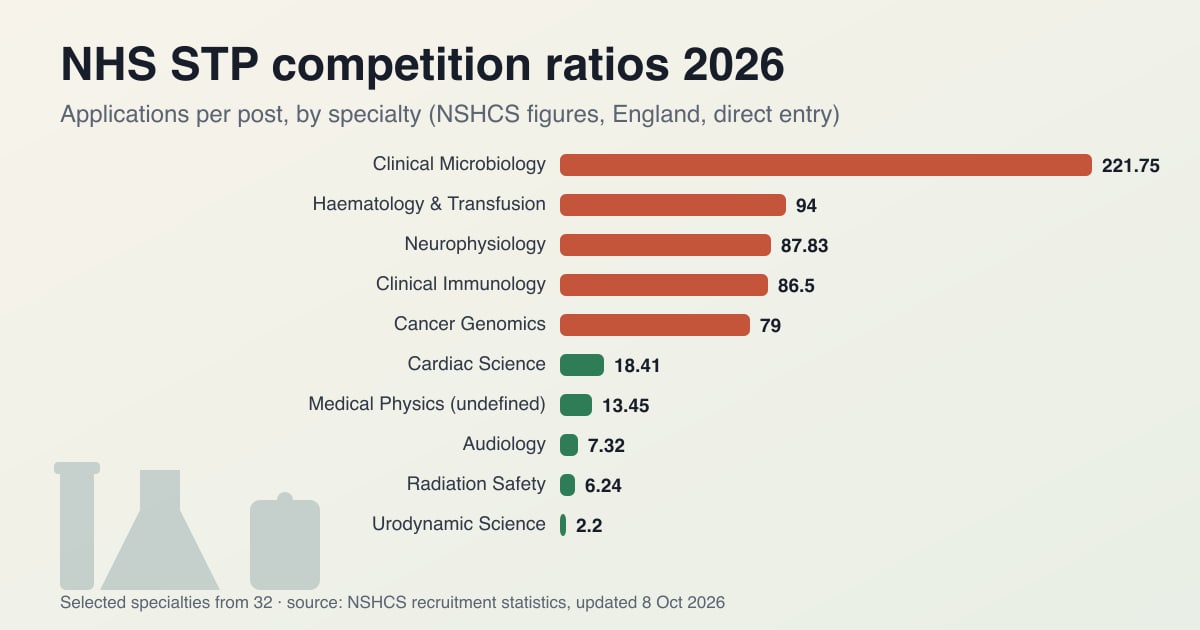
NHS STP Competition Ratios 2026 by Specialty, and How to Pick One
NSHCS’s official 2026 figures for all 32 STP specialties, ranked: 11,109 applications for 389 posts in England. Five years of trends, what happened at each stage, and how to choose.

NHS STP Salary 2027: Trainee Pay (Band 6), London Weighting and Progression
STP trainees are paid Agenda for Change Band 6: £39,959 a year from April 2026, up to £47,951 in inner London. Take-home pay, pay rises during training, and Band 7 pay after you qualify.
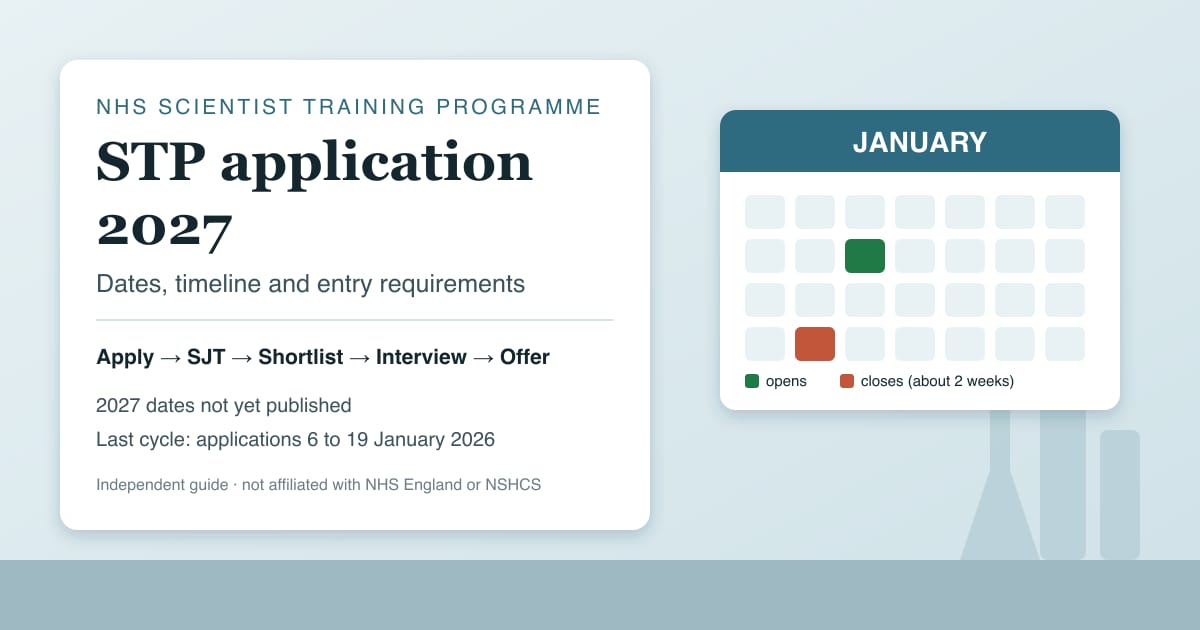
NHS STP Application 2027: Dates, Timeline and Entry Requirements
When STP applications open for 2027, the last two cycles’ official dates side by side, each stage from Oriel to SJT, interview and offer, and the degree, visa and English rules.
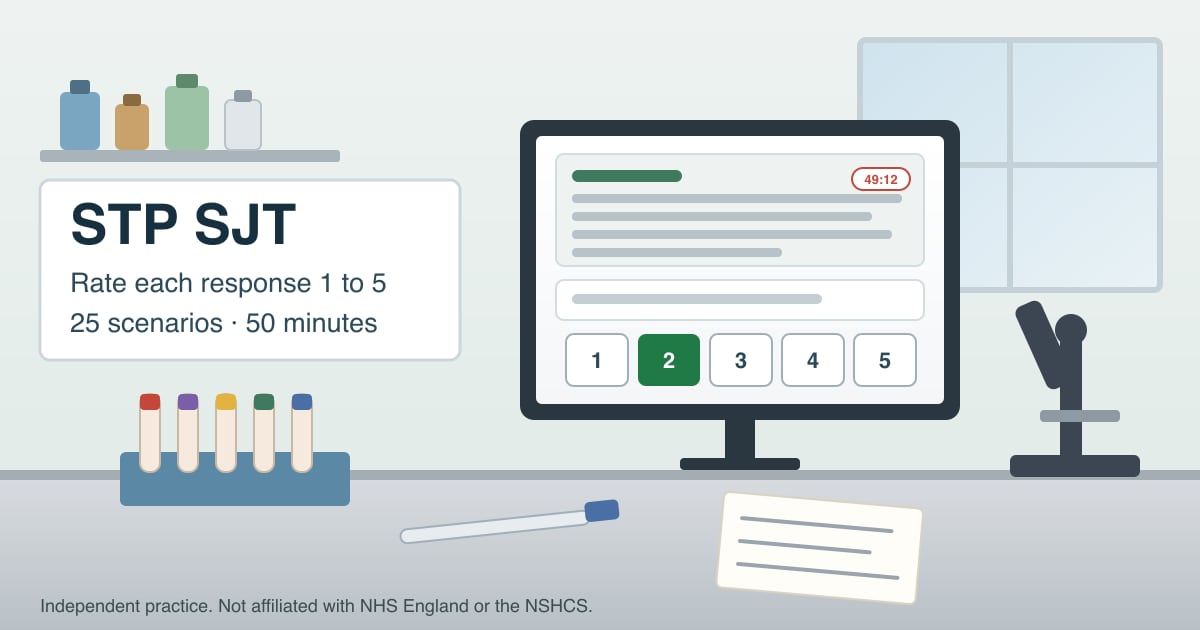
NHS STP SJT 2027: Practice Questions in the 1–5 Format, Marking, Timing
How the Scientist Training Programme situational judgement test works: 25 scenarios in 50 minutes, the 1 to 5 scale, closeness marking, the four attributes, two worked scenarios and free practice.
Leave with a plan for today.
- 21 min
Study: Situational judgement test (SJT)
- 6 min
Review what you missed. Write down the reason behind each correction.
- 3 min
Close your notes and recall the main ideas in your own words.
A personal study plan, saved only in this browser.