Checked 8 November 2026. NSHCS published interview guidance for the 2024 and 2026 rounds. On 8 November 2026 it had withdrawn the 2026 page ("no longer valid") and not yet published the 2027 one; 2027 applications are likely to open in January 2027. The format here is the 2026 round’s, from the archived official page. NSHCS says not to assume the process is the same as the year before: when the 2027 guidance appears, it overrides this page.
The NHS STP interview follows shortlisting for direct entry applicants to the Scientist Training Programme: interview scores give your rank within your specialty, and offers follow from that rank and your location choices. In the 2026 round, NSHCS described it as one competitive interview for your specialty, held on Microsoft Teams by a Trust or organisation that is taking an STP trainee, with a panel of two (at least one a scientist) and sometimes an NSHCS observer. It can last up to 50 minutes. It opens with a short, unscored chance to explain your interest in the STP and your specialty, then moves to questions on general science, specialist science, and leadership, values and behaviours, each answered in about 4 minutes. Notes are not allowed unless NSHCS has approved them in advance as a reasonable adjustment.
NSHCS’s guidance does not give the questions. It says they come from a bank of approved questions set by members of the healthcare science profession and aligned with the STP person specification. So this guide starts from that person specification: the lines NSHCS marks as assessed at interview, then 46 practice questions of our own grouped by those themes, follow-up probes, two worked answers and a 50-minute mock to run with a friend.
ProSyllabus is an independent study site. It is not affiliated with NHS England or the National School of Healthcare Science (NSHCS). Every question on this page is our own independent practice: written independently by ProSyllabus, not supplied or endorsed by NSHCS, not taken from real or past STP interviews, and not a prediction of what you will be asked.
NSHCS: 2026 interview guidance (archived 12 May 2026) and 2025 recruitment statistics.
Key facts: the STP interview (2026 round)
| Item | Detail |
|---|---|
| Who is interviewed | Direct entry applicants whose Oriel status is “interview”, or “shortlisted reserve” when a place comes up. Places depend on the number of posts and are given in shortlist rank order, together with your location preferences |
| How many interviews | One, for the specialty you applied to (NSHCS: “sometimes called national interviews”). It is competitive |
| Who hosts it | One of the NHS Trusts or organisations taking an STP trainee. It may not be one you chose: the interview assesses your suitability for the programme, not for a particular post |
| Format | Online, on Microsoft Teams. A computer, tablet or smartphone with the camera and microphone on, and a stable internet connection |
| Panel | Two trained members of the host’s staff, working in a training department, at least one of them a scientist; possibly an NSHCS observer, who does not score you |
| Length | Up to 50 minutes; the panel may finish early once the questions are done |
| Opening | A brief chance to explain your interest in the STP and your chosen specialty. NSHCS says this part is unscored |
| Question areas | General science; specialist science; leadership, values and behaviours. From a bank of approved questions aligned with the person specification |
| Answers | About 4 minutes each. Follow-up or confirmation questions are possible, and the panel may stop you if you run over |
| Rules | Photo ID held up to the camera (a birth certificate if you have no photo ID); you are alone and show the room on camera; no recording and no Google or AI; no notes unless NSHCS approved them in advance as a reasonable adjustment. Assistance ends the interview and your application |
| Scoring | Scores are ranked against all others in your specialty to give an interview rank; offers go from rank one down, matched to your location choices. The guidance does not give the marking scale |
| Feedback | Your interview score and any feedback comments, sent to everyone who attended at the end of the recruitment cycle (usually September) |
Sources: the NSHCS 2026 interview guidance and the stages of recruitment. On 8 November 2026 the live 2026 page said its content was no longer valid and had been removed, so the link opens the Internet Archive copy of the official page from 12 May 2026. NSHCS says not to assume the process is the same as the year before: check the 2027 guidance when it appears.
Where the interview sits in STP recruitment
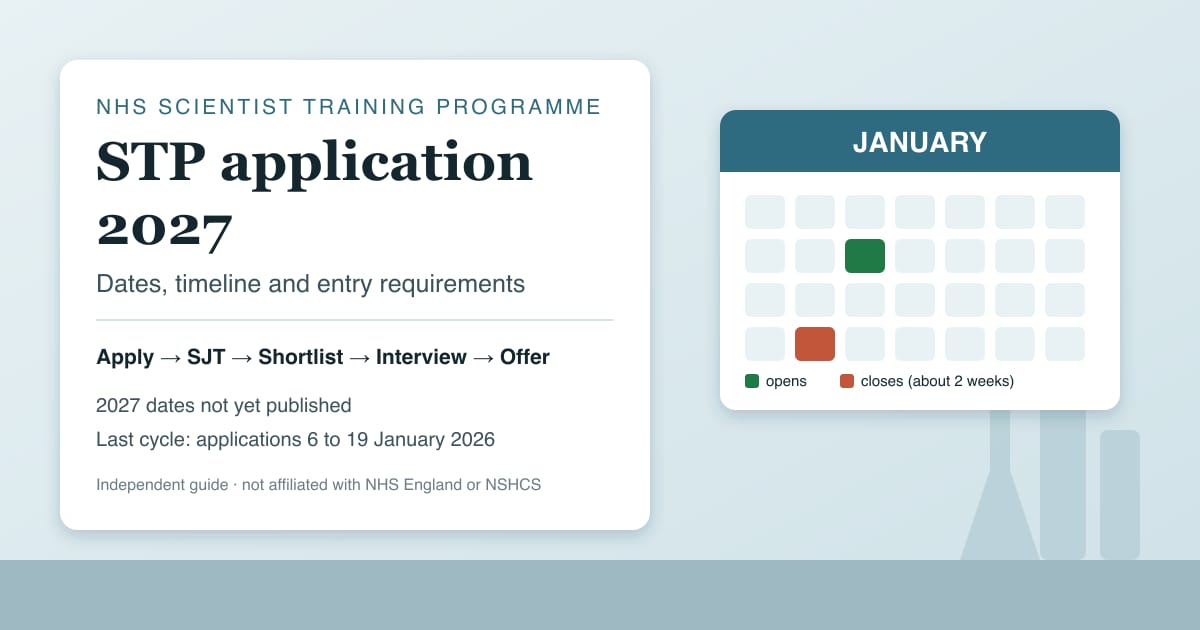
NSHCS runs direct entry recruitment nationally in stages. Applications generally open in January for a September start; on 30 July 2026 NSHCS said the 2026 round had concluded and that 2027 applications will likely open in January 2027 (the dates are in our STP application guide).
| Stage | What happens |
|---|---|
| 1. Application | An Oriel form for one specialty. For 2026, the supporting information was three questions of up to 500 words each (see our <a href="/hub/nhs-stp-application-questions" style="color:#255a45;font-weight:600">STP application questions guide</a>) |
| 2. Longlist (SJT) | Every applicant sits the situational judgement test; a cut score decides who is longlisted (see our <a href="/hub/nhs-stp-sjt" style="color:#255a45;font-weight:600">STP SJT guide</a>) |
| 3. Shortlist | Specialty panels score applications against the person specification; when needed, the SJT score breaks ties between equal shortlist scores. Shortlisted applicants rank their locations |
| 4. Interview | Places given by shortlist rank; interview scores ranked within the specialty |
| 5. Offer | Offers from interview rank one downwards, matched to location choices; the employer then completes its employment processes |
Two consequences for your preparation. First, the panel scores what you say on the day: NSHCS tells applicants not to refer to their application form or assume the panel knows what is in it. Second, the interview ranks you only against applicants in your own specialty. Prepare all three question areas: the guidance does not say how they are weighted.
Still before your 2027 application? For direct entry, the SJT comes before shortlisting and interview, and only applicants above its cut score go on to shortlisting. The free questions below are from our SJT practice test, not interview practice.
FreeTests: Professional integrity
NHS STP SJT Practice Test: free sample
Answer 4 questions against the clock, like the real exam. You then see the right answer, the reason and your time on each. About 3 minutes · free · no sign-in.
4 questions to answer
Start nowThis one is free · no sign-in needed
Your result shows how long each question took you.
How competitive the STP interview is
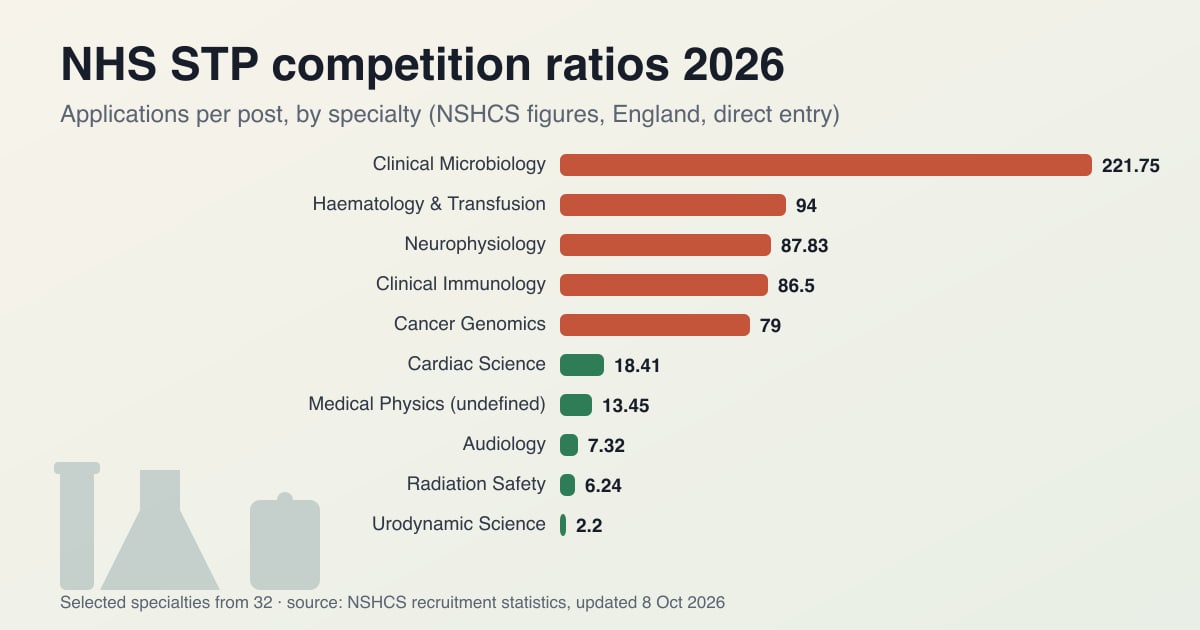
NSHCS’s 2025 recruitment statistics show about 7,860 applications, about 1,925 to 1,930 shortlisted, about 780 interviewed and about 320 to 330 offers accepted (our sums of its age-group table, which hides counts of 5 or fewer, so totals are approximate). It says the interviews were competitive, with a minimum of 2 applicants interviewed per post. Overall, about one application in ten reached interview, and the number of offers accepted was roughly two fifths of the number interviewed. These are stage totals across all specialties, not any one applicant’s chances. Ratios by specialty are in our competition ratios guide.
Do not confuse the formats
In the 2024 and 2026 guidance the STP interview was one online panel interview of up to 50 minutes, not four 10-minute stations.
The older format: NSHCS’s 2020 applicant guide described “multiple mini-interviews”: four in-person stations of 10 minutes, with four questions at each. Each station usually had two interviewers, each scoring independently from 1 to 5.
Its 2024 and 2026 guidance instead described a single interview hosted online by a recruiting organisation; neither fixes the format for 2027. The areas are similar (general science, specialist science, values and leadership), so older practice material can still help; the timing, the stations and the 1-to-5 scale are not current guidance. NSHCS also asks applicants not to assume the process matches the previous year and to avoid hearsay from forums and blogs.
What the panel is assessing: the person specification
NSHCS says the interview questions align with the STP person specification, and it tells applicants to know the person specification and job description well. The person specification has an “Assessed by” column. These are the lines it marks as assessed at interview, in our short wording; two are assessed only at interview.
| Person specification line (our summary) | Assessed by |
|---|---|
| Ability to identify problems with scientific equipment, inappropriate testing or incompatible results, investigate them, plan corrective action with senior colleagues and follow up | Interview only |
| Ability to support patients or carers, including people with acute or chronic conditions and disabilities, in a range of healthcare settings | Interview only |
| A committed, in-depth interest in scientific practice and its application to direct clinical care of patients | Application and interview |
| Designing investigations, analysing literature, and making judgements, including clinical judgements that affect patients | Application and interview |
| Understanding of quality control and quality management in a science or work-based setting | Application and interview |
| Following standard operating procedures accurately; developing and validating new techniques | Application and interview |
| Understanding the role of your specialty in healthcare and disease | Application and interview |
| Analysing complex data, images and clinical details to form advice and judgements; good IT skills | Application and interview |
| Explaining scientific and clinical work to colleagues, clinicians, managers and patients; presenting; active listening | Application and interview |
| Being self-aware and flexible enough to use evaluative or empathising listening styles to suit the listener and the situation | Application, interview and references |
| Planning and doing your own work autonomously under departmental supervision; the flexibility to learn to organise and monitor others’ workload; a demonstrable ability to lead others | Application and interview |
| Under guidance, developing interpretative skills to advise the multidisciplinary team on diagnosis and appropriate treatment | Application and interview |
| Handling patient samples, hazardous reagents and chemicals safely under health and safety rules | Application and interview |
Some lines are assessed elsewhere: working under pressure and the values of the NHS Constitution are marked “application”, and team working, attendance and personal organisation “references”. The interview guidance still lists leadership, values and behaviours as one of its three question areas, so prepare values examples anyway. Source: the NSHCS core person specification.
How to answer in 4 minutes
NSHCS asks for answers that are “clear, concise and focused”, in about 4 minutes, and warns that a panel member may intervene if you run over. Four minutes is long enough to ramble and short enough to run out before the point. The shapes below are ours, not NSHCS’s.
| Question type | Our shape |
|---|---|
| Knowledge (“Explain…”, “What is…”) | One-sentence answer first; then how it works; then where it goes wrong or what limits it; end with why it matters to patients or the service |
| Scenario (“What would you do if…”) | Safety first (patients, samples, people); then what you check; who you tell and when; what you record; what you would change so it does not happen again |
| Experience (“Tell us about a time…”) | Situation in two sentences; what you did, in “I” not “we”; the result; what you learned and how you would use it as a trainee |
| Opinion (“Should…?”, “What do you think about…?”) | Your view in one line; two reasons; the strongest counter-argument; what evidence would change your mind |
NSHCS’s own advice is to be open and honest: if you do not know an answer, tell the panel. In a knowledge question, saying what you do know, what you would need to look up and where you would look is a stronger answer than guessing.
NHS STP interview questions by theme (46 practice questions)
These are our own questions, written for this guide and grouped by the three areas in NSHCS’s guidance and the person-specification lines above. They are not from the NSHCS bank, and the real panel may ask nothing like them. Practise them out loud, on a timer, with no notes. Answer scenarios as an applicant or trainee would act: follow local procedures, stay within your competence and authority, involve the right authorised colleague, and keep examples anonymous. Do not suggest you would interpret or release results, change clinical procedures or authorise equipment on your own.
The opening (unscored, but it sets the tone)
Opening: your interest in the STP and your specialty
NSHCS: “a brief opportunity to explain your interest in the STP for the specialty you have chosen (this is un-scored)”. Aim for about a minute: brief, specific, true.
- Briefly, why the STP and why this specialty?
- What first drew you to this area of healthcare science?
- What do you expect the three years of training to involve?
Our practice questions, written for this guide; not from the NSHCS question bank.
General science and science in the NHS
General science
Covers the person specification’s interest in scientific practice and clinical care, research and literature, and the role of science in healthcare.
- How does healthcare science contribute to a patient’s care, from first symptoms to treatment?
- How does the work of a clinical scientist overlap with, and differ from, that of a research scientist in a university?
- Describe a recent scientific development you think could change NHS diagnosis, treatment or patient monitoring. What are its limits?
- How would you judge whether a published study is good enough to change practice?
- What do sensitivity and specificity mean for a diagnostic test, and why do they matter to patients?
- Should NHS laboratories use artificial intelligence to report results? What safeguards would you want?
- How would you design an experiment to test whether a new method is as good as the current one?
- Explain a scientific concept from your degree to us as if we were a patient.
- What does evidence-based practice mean to you, and where does it fall short?
- What role does healthcare science play in public health, for example in screening or infection control?
Our practice questions, written for this guide; not from the NSHCS question bank.
Quality, safety and troubleshooting
Quality, safety and getting it right
Covers quality control and quality management, following SOPs, safe handling, and the interview-only line on investigating problems with equipment, testing or results.
- What is the difference between quality control and quality assurance?
- An instrument gives a result that does not fit the clinical picture. How do you investigate?
- Why do standard operating procedures matter, and what would you do if you thought one was wrong?
- You notice a colleague skipping a safety step to save time. What do you do?
- How would you validate a new technique before it is used on patient samples or patients?
- What does accreditation mean for a clinical service, and who checks it?
- Tell us about a time you made a mistake in practical work. How did you find it and what did you change?
Our practice questions, written for this guide; not from the NSHCS question bank.
Specialist science (your specialty)
This is the area where your specialty decides the content. NSHCS says it recruits to over 30 specialties; the questions below are grouped by the kind of work, in our own grouping, so pick the group closest to yours and then write five of your own on your specialty’s core tests, techniques or equipment.
Laboratory sciences (for example blood sciences, microbiology, genomics)
Tests your specialty’s core science and its link to diagnosis and treatment.
- Talk us through what happens to a sample from the moment it arrives in the laboratory to the moment a result is reported.
- Explain how a technique central to your specialty works, and its main sources of error.
- What is the role of genomic testing in the NHS today, and what ethical questions does it raise?
- How would you explain an uncertain or inconclusive result to the clinician who requested it?
Our practice questions, written for this guide; not from the NSHCS question bank.
Physiological sciences (for example cardiac, respiratory and sleep, audiology)
Patient-facing measurement: technique, interpretation and the patient in the room.
- Walk us through a common test in your specialty, from preparing the patient to reporting.
- A patient becomes anxious and wants to stop halfway through a test. What do you do?
- What can make a physiological measurement inaccurate, and how would you spot it?
Our practice questions, written for this guide; not from the NSHCS question bank.
Physical sciences and engineering (for example medical physics, clinical engineering)
Physics or engineering applied to diagnosis, treatment and the safety of equipment.
- Explain how an imaging or treatment technology used in your specialty works, and how its safety is checked.
- How do you balance benefit and risk when a technique exposes a patient to radiation or another hazard?
- A routine equipment check is outside tolerance just before a clinic list. What do you do?
- How would you explain the risk of a procedure to a worried patient in plain numbers?
Our practice questions, written for this guide; not from the NSHCS question bank.
Data and bioinformatics
Data, software and analysis in clinical services.
- How would you validate a clinical analysis pipeline, and make its results reproducible for the same inputs, software versions and settings?
- What are the risks of using patient data for analysis, and how are they managed?
- How would you explain a statistical finding to a clinician who wants a yes or no answer?
Our practice questions, written for this guide; not from the NSHCS question bank.
Communication and supporting patients
Communication and patients
Covers explaining science to different audiences, active listening, and the interview-only line on supporting patients and carers.
- Tell us about a time you explained something complex to someone without a scientific background.
- How would you adapt how you communicate with a patient who has a learning disability, hearing loss or limited English?
- A patient asks you for their result before the clinician has seen it. What do you say? (Think about identity, privacy, local procedures, your authority and whether anything is urgent.)
- Tell us about a time you listened to someone and changed what you were going to do.
- How would you present a change to a procedure to a team that is happy with the old one?
Our practice questions, written for this guide; not from the NSHCS question bank.
Leadership, values and behaviours
Leadership, values and behaviours
The third area in NSHCS’s guidance. Covers leading and organising others, working autonomously, and NHS values.
- Tell us about a time you led a group without having formal authority.
- Which value in the NHS Constitution matters most to you as a scientist, and how have you shown it?
- Describe a time you had to manage competing deadlines. How did you decide what came first?
- A trainee in the year below asks you for help while you are under pressure yourself. What do you do?
- Tell us about feedback that was hard to hear. What did you do with it?
- What does professionalism mean for a trainee clinical scientist, and what are its limits online?
- How would you raise a concern about patient safety if a senior colleague disagreed with you?
Our practice questions, written for this guide; not from the NSHCS question bank.
Follow-up probes to practise
NSHCS says a panel member may ask follow-up or confirmation questions. These are ours: practise answering two after every question; probes test whether you can explain your reasoning, not just recite it.
| After you say… | Probe to practise |
|---|---|
| what you did | “What exactly did you do, and what did others do?” |
| a technique or concept | “What are its limitations?” or “When would it give the wrong answer?” |
| that you would escalate | “To whom, how quickly, and what would you do in the meantime?” |
| a result or success | “How do you know it worked?” |
| an opinion | “What would someone who disagrees say?” |
| that a patient was involved | “How did you protect their dignity and confidentiality?” |
| that you do not know | “How would you find out?” |
Worked answer 1: a quality control failure
A scenario question that touches three interview lines at once: quality control, troubleshooting with senior colleagues, and patient safety. The scenario is set in a laboratory. The broad sequence (contain the risk, escalate, investigate, confirm recovery, record) also helps with physiological, medical physics or engineering scenarios, but the right actions depend on the equipment, the service’s SOPs and your authority: taking equipment out of use or back into service may be for designated staff only.
Worked answer 1 · Specialist science: quality and troubleshooting
“Midway through a run of patient samples, an internal quality control result falls outside its acceptable limits. What would you do?”
Contain the risk. I would follow the laboratory’s SOP for a QC failure, stop potentially affected results from being released and alert the senior scientist responsible promptly. A result that looks normal can still be wrong, and a wrong result can lead to the wrong treatment. With their direction we would work out which tests and samples might be affected, and how urgent work could continue safely.
Investigate. Where it is safe and within my authority, I would check the QC material itself: the right lot, in date, stored and prepared correctly. I would look at the QC chart against the laboratory’s acceptance rules, earlier results, calibration and maintenance records and any recent changes. A trend or shift may point to something systematic, such as a reagent or calibration; a single outlier can have several causes. Neither pattern proves the cause on its own.
Agree the action. I would not keep repeating the QC until it passed. Corrective action, such as recalibrating or changing a reagent, would follow the SOP and my competence, and an authorised scientist would confirm that the recovery checks had been met before reporting resumed: one passing QC result would not prove it on its own.
Look back at patients’ results. The responsible scientist would decide when the problem could have started, including any trend before the last acceptable QC, which samples need retesting, and whether results already reported must be reviewed, corrected and the requesting clinicians told.
Record and learn. I would document the findings, the suspected or confirmed cause, the actions and the follow-up in the laboratory’s quality system, so that a pattern can be spotted and the SOP updated if needed.
What it shows: Interview-only person-specification skills (problem, investigation, corrective action confirmed with seniors, follow-up), knowledge of QC, and a trainee who knows the limits of their authority. It reaches the patient twice: before release and after.
The weak version: Rerunning the QC until it passes and carrying on, or changing the instrument’s settings alone to make it pass. Both skip the reasoning this example is meant to show: safety, investigation and escalation together. When patients are at risk or a step is beyond your competence, escalate at once; checks never justify a delay.
Our own invented example, written for this guide. It is not an NSHCS answer, a model answer NSHCS has approved or a prediction of what a panel will ask. Notes are not allowed in the interview unless approved as a reasonable adjustment, so learn the shape, not the words. For a scenario question, explain what you would do; for an experience question, use a genuine example of your own, never an invented one.
Worked answer 2: explaining something complex
An experience question for the communication and patient lines. Your own story will differ; what transfers is the shape: a real person, a real misunderstanding, what you did to check they understood, and knowing where your role stopped.
Worked answer 2 · Communication and supporting patients
“Tell us about a time you explained something complex to someone without a scientific background.”
Situation. In my final year I worked Saturdays as a counter assistant in a community pharmacy. A customer in her seventies came in upset: her new home blood-pressure monitor kept giving readings that were all different, and she had decided it showed something was badly wrong.
What I did first. I asked whether she felt unwell at that moment; she said no. Interpreting readings was not my role, so I asked the pharmacist, who spoke with her privately about the numbers. Afterwards the pharmacist asked me to go through the monitor with her, and with her agreement we used the pharmacy’s private consultation room.
The explanation. Using the leaflet, I explained in plain words that blood pressure changes from minute to minute, and that talking, moving or a cuff placed loosely can change a reading. We went through the steps on the leaflet together, and I asked her to show me how she would take the next reading, rather than asking “Does that make sense?”
Result. She took a reading correctly in the shop and left calmer, with the pharmacist’s advice on what to do next. When she came back a fortnight later she brought her readings written down, as the pharmacist had suggested.
What I learned. Anxiety can make information harder to take in: acknowledging her worry first made the explanation work. Asking someone to show me, not tell me, is now one way I check understanding, and I would adapt it to each patient’s needs as a trainee.
What it shows: The interview-only line on supporting patients, active listening, plain-English explanation, and a clear boundary: the pharmacist interpreted the readings, not the assistant. It ends with a lesson the applicant could use as a trainee.
The weak version: An explanation with no sign of how it was adapted, how understanding was checked or what the speaker personally did; or a version where the assistant reassures her that her readings are fine. A student, workplace or public-facing example can work just as well if it shows those things.
Our own invented example, written for this guide. It is not an NSHCS answer, a model answer NSHCS has approved or a prediction of what a panel will ask. Notes are not allowed in the interview unless approved as a reasonable adjustment, so learn the shape, not the words. For a scenario question, explain what you would do; for an experience question, use a genuine example of your own, never an invented one.
A break from interview preparation: if your SJT is still to come, try a few of our scenarios, each response rated from 1 to 5. The SJT is the stage that decides whether your application is longlisted. The free questions below are from our SJT practice test, not interview practice.
FreeTests: Professional integrity
NHS STP SJT Practice Test: free sample
Answer 4 questions against the clock, like the real exam. You then see the right answer, the reason and your time on each. About 3 minutes · free · no sign-in.
4 questions to answer
Start nowThis one is free · no sign-in needed
Your result shows how long each question took you.
A 50-minute mock interview to run with a friend
To practise the 2026 format, use a video call, with no notes, the camera on and a glass of water. Ask your friend to play both panel members and to stop you at 4 minutes. Timings and the number of questions are ours; NSHCS gives the maximum length (50 minutes) and the time per answer (about 4 minutes), not the number of questions.
| Minutes | What happens |
|---|---|
| 0 to 3 | Introductions, ID held up to the camera, a sweep of the room with the camera |
| 3 to 5 | The opening: “Briefly, why the STP and why this specialty?” (unscored in the real interview) |
| 5 to 15 | Two general science questions, each with one probe |
| 15 to 31 | Three specialist science questions on your own specialty, one of them a scenario, each with a probe |
| 31 to 43 | Two leadership, values and behaviours questions, each with two probes |
| 43 to 47 | Your questions for the panel |
| 47 to 50 | Feedback from your friend: which answers ran over, where you said “we”, where you guessed |
Change the questions for the second run so you are practising thinking, not reciting.
STP interview preparation checklist
Tick each step as you go. It combines the NSHCS guidance with our suggestions.
0 of 15 done
Ticks are saved only in this browser on this device.
The rules on the day
These are the NSHCS rules from the 2026 round. Follow them carefully: the guidance said that any assistance would stop the interview and lead to your application being rejected.
- ID: hold photo ID up to the camera: a passport, driving licence, BRP, NHS ID card or university ID card; a birth certificate if you have no photo ID.
- Alone: you confirm you are alone and will not use Google or AI, and you turn your camera around the room. NSHCS says that if you have any assistance the interview will be stopped and your application rejected.
- No notes: you may not bring or make notes during the interview, unless NSHCS has approved this in advance as a reasonable adjustment.
- No recording: you may not record the interview.
- Chat: do not use the Teams chat unless asked, for example if there are technical problems.
- Late start: you may wait in a lobby. If your interview has not begun within 10 minutes of its scheduled time, email england.hcsapplicants@nhs.net (2026 guidance).
- Technical problems: leave and rejoin if needed, and contact the host organisation using details you got beforehand; NSHCS says hosts know this happens.
NSHCS 2026 interview guidance.
NSHCS’s preparation advice in the same guidance is practical: a quiet space free from interruptions, smart office-style clothing, a glass of water (a sip gives you a moment to think), awareness of your body language, and not worrying when the panel goes silent to type notes.
Questions you could ask the panel
NSHCS says you may ask questions at the end if time allows, and that it is acceptable not to ask any. Avoid asking about something already covered. Remember the host may not be where you train, so ask about training rather than about one department. Some of ours:
- What do new STP trainees in this specialty usually find hardest in the first year?
- Across this specialty, how do trainees usually balance work-based training with the master’s degree?
- What makes a trainee stand out to their training officer?
- What advice would you give someone starting the STP?
Our suggestions.
Common mistakes
- Relying on your application form. NSHCS says not to assume the panel knows it, and not simply to repeat it: make each answer complete in itself and aimed at the question.
- Preparing only for experience questions. Two of the three areas are science, and you are ranked against others in your own specialty.
- Running past 4 minutes. Being stopped mid-answer costs you the point you were building to; lead with it.
- Guessing a fact. NSHCS advises honesty; the panel are experienced training-department staff, at least one of them a scientist.
- Leaving out the patient. The person specification ties science to clinical care throughout.
- Never escalating, or not saying when. Escalate at once when safety or your competence requires it, and say what safe checks you would do alongside.
- Saying “we” throughout. The panel needs to hear what you did.
- Preparing from old station-format advice, or from forum lists that claim to be the real questions.
After the interview: outcomes, offers and feedback
You do not get a decision at the interview. The 2026 guidance said NSHCS would publish when interviews were complete for each specialty (for the benefit of reserves), review scores once interviews in every specialty were complete, and publish when offers could be expected. Offers go out on Oriel from rank one downwards, matched to your location choices. In the 2024 round, NSHCS gave applicants 48 hours, excluding weekends, to accept or decline, with no option to hold an offer; an applicant who was unsuccessful at interview left the process for that year. Do not assume the 2024 offer rules apply in 2027.
If you declared anything in the fitness to practise questions, NSHCS says a panel considers it if you are successful at interview. Under the 2026 guidance, interview scores and any feedback comments were released automatically to everyone who attended at the end of the cycle (usually September). NSHCS warns that contacting interviewers for feedback, or reacting to feedback, will not be tolerated and could affect future applications. If you are unsuccessful, NSHCS welcomes applications in future years if you still meet the entry requirements. The STP is a 3-year salaried training post with a part-time master’s degree (NSHCS); pay is in our STP salary guide.
Reasonable adjustments: the 2026 guidance said requests go through NSHCS, not the host, with evidence provided in your application, and to email the applicants team if you are invited to interview without hearing whether yours can be made. In-service applicants (substantive NHS employees sponsored by their department who meet the programme requirements) do not go through this national interview; their employer holds a local interview against the person specification and confirms it to NSHCS (NSHCS in-service guidance).
Not sat the STP SJT yet?
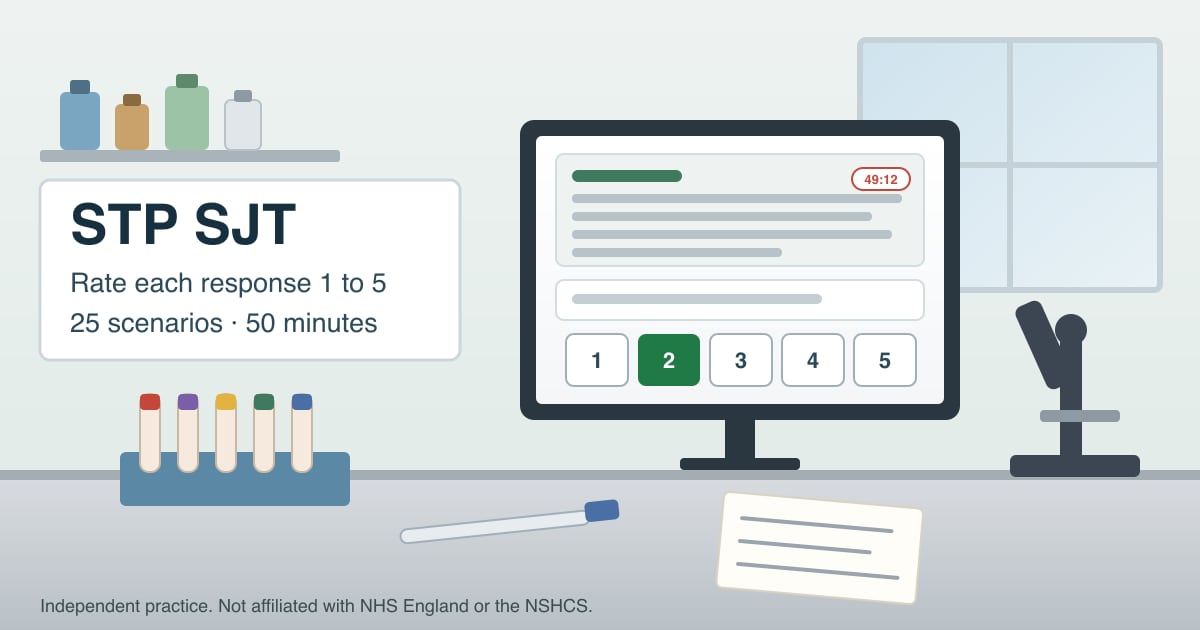
In the direct entry process NSHCS describes, applications must pass SJT longlisting (a cut score) before shortlisting and interview allocation. If your 2027 application is still ahead, the SJT comes first. Our NHS STP SJT Practice Test has full mocks of 25 original scenarios of our own, each response rated 1 to 5 and marked by closeness to our own key, with a 50-minute timer and the reason behind every rating. It does not train the interview; the interview preparation on this page is free.
See the NHS STP SJT Practice Test. Independent practice, written by us; not made or endorsed by NSHCS.
FreeTests: Professional integrity
NHS STP SJT Practice Test: free sample
Answer 4 questions against the clock, like the real exam. You then see the right answer, the reason and your time on each. About 3 minutes · free · no sign-in.
4 questions to answer
Start nowThis one is free · no sign-in needed
Your result shows how long each question took you.
Frequently asked questions
What questions are asked in the NHS STP interview?
In its 2026 guidance, NSHCS said the panel asks questions from a bank of approved questions, set by healthcare scientists and aligned with the STP person specification, on general science, specialist science, and leadership, values and behaviours, after a short unscored opening about your interest in the STP and your specialty. The guidance does not give the questions. The practice questions on this page are ours.
Is there an NHS STP interview questions and answers PDF?
NSHCS’s interview guidance describes an approved question bank but gives no questions or model answers, and lists that claim to be the real questions are unofficial. You can print this page from your browser; its 46 practice questions and two worked answers are our own.
What is the NHS STP interview process?
After shortlisting, interview places are given in shortlist rank order. In the 2026 round, a Trust or organisation taking an STP trainee interviewed each applicant once on Microsoft Teams, with a panel of two, for up to 50 minutes. Scores are ranked within the specialty, and offers go from rank one downwards, matched to location choices.
How long is the STP interview and how many questions are there?
Up to 50 minutes in the 2026 round, with about 4 minutes to answer each question. The guidance does not give the number of questions, and the panel may finish early.
Is the STP interview online or in person?
Online in recent rounds: NSHCS’s 2024 and 2026 guidance both describe interviews on an online platform (Microsoft Teams in 2026) hosted by a recruiting organisation. NSHCS’s 2020 guide described in-person stations. Check the 2027 guidance when it is published.
Who is on the STP interview panel?
In the 2026 guidance, two panel members from the hosting organisation, qualified and experienced staff working in a training department, at least one of them a scientist. An NSHCS observer may attend to check standards; the observer does not assess you.
Can I use notes in the STP interview?
Not in the 2026 round: NSHCS said you may not bring or make notes unless they are approved in advance as a reasonable adjustment, and you may not record the interview or use AI. You show your ID and the room on camera at the start.
What are medical physics or genomics STP interview questions like?
NSHCS’s guidance gives no specialty questions. It says the interview includes specialist science questions for your specialty. This page has our practice questions for physical sciences and engineering, laboratory sciences including genomics, physiological sciences and bioinformatics; add questions on your own specialty’s core techniques.
When are the NHS STP interviews in 2027?
NSHCS had not published 2027 dates on 8 November 2026; applications are likely to open in January 2027, and interviews follow the SJT and shortlisting. In the 2024 round, NSHCS told applicants from 17 May which organisation would interview them. Check NSHCS and your Oriel account for the 2027 timeline.
Do you get feedback after the STP interview?
Yes, in the 2026 guidance: everyone who attended an interview receives their interview score and any feedback comments at the end of the recruitment cycle, usually in September. NSHCS does not answer separate feedback requests.
Sources
- official — NSHCS: STP direct entry interviews, guidance for the 2026 round (on 8 November 2026 the live page said its content was no longer valid and had been removed; full text in the Internet Archive copy of 12 May 2026)
- official — NSHCS: Guidance on STP direct entry interviews, 2024 round (Internet Archive copy of 6 December 2024)
- official — NSHCS: Applying for an STP direct entry post (recruitment stages, Oriel statuses, interview rank, offers), read 8 November 2026
- official — NSHCS: Scientist Training Programme core person specification (what is assessed by application, interview and references; publication page dated 2025)
- official — NSHCS: FAQs about the STP application process (volumes, specialist panels, unofficial sources, feedback)
- official — NSHCS: STP 2025 recruitment statistics, age of direct entry applicants at each stage (stage counts; minimum 2 interviewed per post)
- official — NSHCS: STP applicants page (announcement of 30 July 2026: 2026 recruitment concluded, 2027 applications likely to open in January 2027)
- official — NSHCS: About the STP (a 3-year salaried training post with a part-time master's degree)
- official — NSHCS: Applying for an STP in-service post (local interview by the employer)
- official — NSHCS: Interviewing process for applicants to the STP 2020 (the former multiple mini-interview format; history only)
official = a document published by the conducting body. reported = a news or coaching site we could not check against an original. Where sources disagree this page says so rather than picking one.