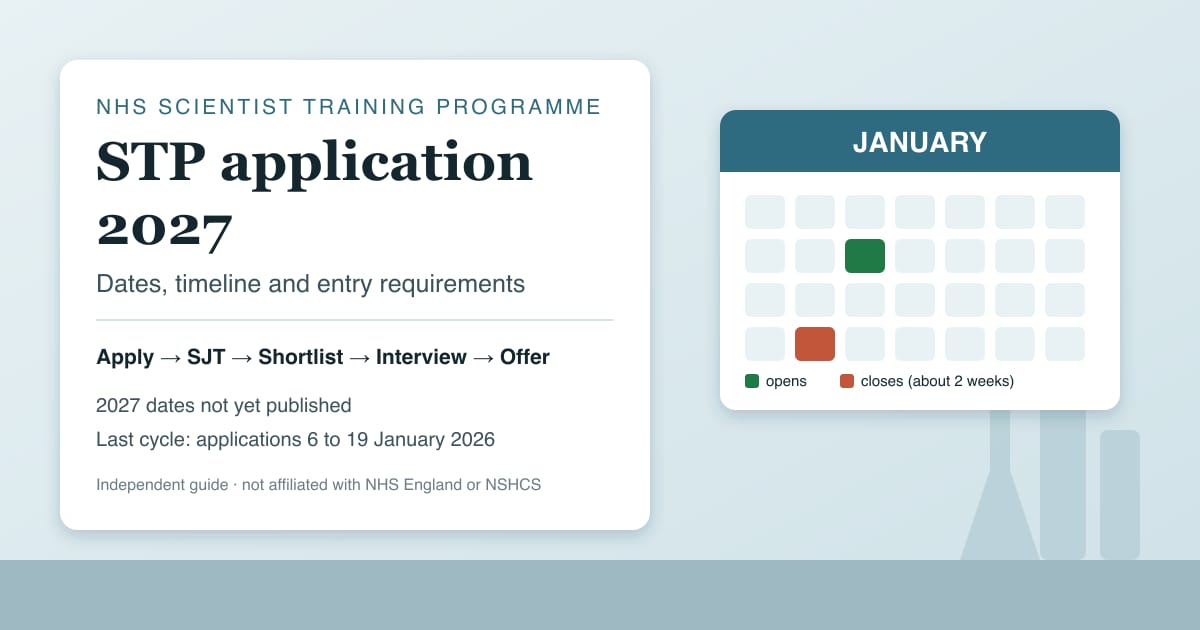
Checked 8 November 2026. Figures are NSHCS’s for STP recruitment in England in 2026 (posts starting in September 2026) and earlier years; the 2022 to 2026 competition ratio pages show “updated on 8th October 2026”. We found no 2027 posts or ratios on NSHCS’s site on 8 November 2026: posts and specialties change every year with NHS demand, so recheck when 2027 recruitment opens.
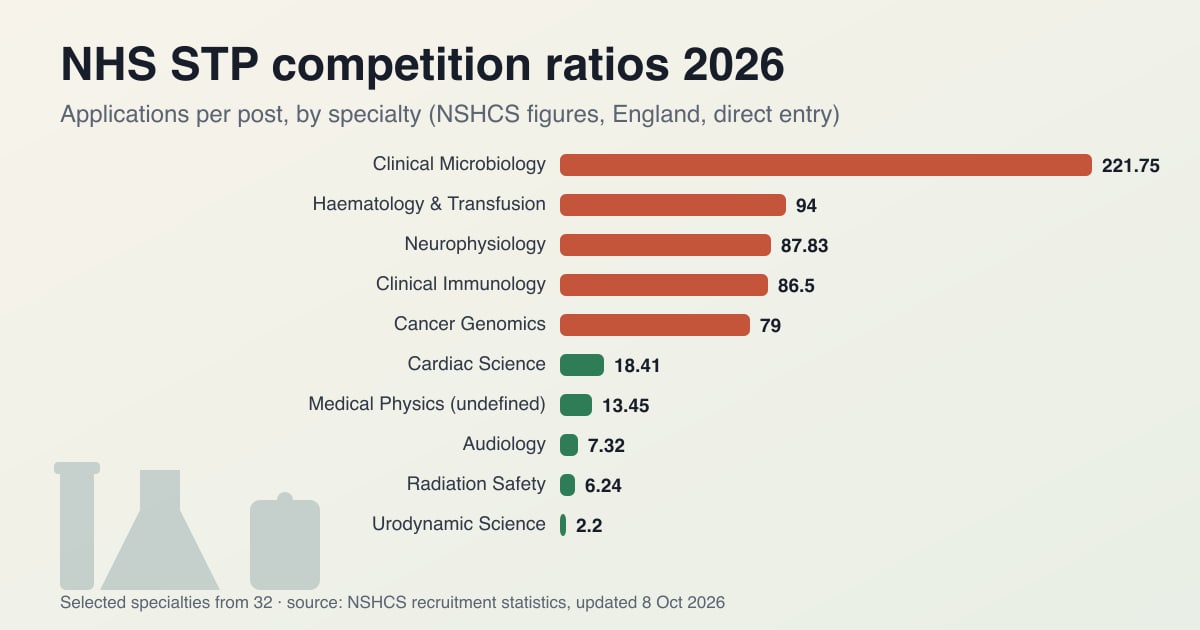
The latest NHS STP competition ratios are for 2026 recruitment: 11,109 applications for 389 direct entry posts across 32 specialties in England, about 28.6 applications per post overall (our arithmetic on NSHCS’s table). They range from 2.20 per post in Urodynamic Science to 221.75 in Clinical Microbiology, which had 887 applications for 4 posts.
Below: every specialty ranked by its official 2026 ratio, how each one has moved since 2022, what the odds look like at each stage from application to offer, and how to use the ratios (and when to ignore them) when you pick the one specialty NSHCS lets you apply for.
ProSyllabus is an independent study site, not affiliated with NHS England or the National School of Healthcare Science (NSHCS). The underlying counts and printed ratios on this page are NSHCS’s published data, with the link and the date each page was last updated; totals, groupings, rankings and percentages are our calculations and are labelled as ours.
NSHCS STP 2026 recruitment statistics: competition ratios per post for each specialty, and applicants at each stage (both last updated 8 October 2026).
NHS STP competition ratios 2026: every specialty ranked
NSHCS’s 2026 table, sorted from the most to the least competitive. The ratio is the number of applications divided by the number of direct entry posts, as NSHCS prints it. The theme is NSHCS’s own grouping of the specialties. NSHCS: 2026 competition ratios.
| Rank | Specialty | Theme | Applications | Posts | Applications per post |
|---|---|---|---|---|---|
| 1 | Clinical Microbiology | Life sciences | 887 | 4 | 221.75 |
| 2 | Haematology and Transfusion Science | Life sciences | 282 | 3 | 94 |
| 3 | Neurophysiology | Physiological sciences | 527 | 6 | 87.83 |
| 4 | Clinical Immunology | Life sciences | 346 | 4 | 86.50 |
| 5 | Cancer Genomics | Life sciences | 948 | 12 | 79 |
| 6 | Clinical Bioinformatics Genomics | Life sciences | 535 | 8 | 66.88 |
| 7 | Genomic Counselling | Life sciences | 529 | 8 | 66.13 |
| 8 | Histopathology | Life sciences | 282 | 5 | 56.40 |
| 9 | Embryology | Life sciences | 618 | 12 | 51.50 |
| 10 | Genomics | Life sciences | 780 | 16 | 48.75 |
| 11 | Clinical Biochemistry | Life sciences | 1,237 | 27 | 45.81 |
| 12 | Clinical Informatics | Physical sciences | 130 | 3 | 43.33 |
| 13 | Pharmaceutical Science | Physical sciences | 572 | 17 | 33.65 |
| 14 | Clinical Scientific Computing | Physical sciences | 162 | 7 | 23.14 |
| 15 | Histocompatibility and Immunogenetics | Life sciences | 158 | 7 | 22.57 |
| 16 | Clinical Engineering | Physical sciences | 329 | 15 | 21.93 |
| 17 | Ophthalmic and Vision Science | Physiological sciences | 39 | 2 | 19.50 |
| 18 | Critical Care Science | Physiological sciences | 93 | 5 | 18.60 |
| 19 | Cardiac Science | Physiological sciences | 1,031 | 56 | 18.41 |
| 20 | Neurophysiology: Intraoperative Neuromonitoring | Physiological sciences | 14 | 1 | 14 |
| 21 | Medical Physics – non defined | Physical sciences | 417 | 31 | 13.45 |
| 22 | Andrology | Life sciences | 49 | 4 | 12.25 |
| 23 | Respiratory and Sleep Science | Physiological sciences | 244 | 23 | 10.61 |
| 24 | Nuclear Medicine | Physical sciences | 106 | 10 | 10.60 |
| 25 | Imaging with non-ionising radiation | Physical sciences | 73 | 7 | 10.43 |
| 26 | Vascular Science | Physiological sciences | 112 | 11 | 10.18 |
| 27 | Radiotherapy Physics | Physical sciences | 222 | 26 | 8.54 |
| 28 | Reconstructive Science | Physical sciences | 22 | 3 | 7.33 |
| 29 | Audiology | Physiological sciences | 205 | 28 | 7.32 |
| 30 | Gastrointestinal Physiology | Physiological sciences | 43 | 6 | 7.17 |
| 31 | Radiation Safety and Diagnostic Radiology | Physical sciences | 106 | 17 | 6.24 |
| 32 | Urodynamic Science | Physiological sciences | 11 | 5 | 2.20 |
Three things to read alongside the table. First, the ratio is counted before the SJT: NSHCS says direct entry applications are open to anyone and “can include speculative applications, those with limited information or from individuals who do not meet the entry requirements”, so the total should not be read as a count of verified eligible candidates. Second, each person applies for one specialty only (NSHCS disqualifies anyone who sends more than one application), so in 2026 a ratio is close to the number of people per post. Third, the figures cover England only, and only direct entry posts: Scotland, Wales and Northern Ireland recruit separately, and in-service posts are not in the table. NSHCS: stages of recruitment, 2026 · NSHCS: applying for a direct entry post.
FreeTests: Professional integrity
NHS STP SJT Practice Test: free sample
Answer 4 questions against the clock, like the real exam. You then see the right answer, the reason and your time on each. About 3 minutes · free · no sign-in.
4 questions to answer
Start nowThis one is free · no sign-in needed
Your result shows how long each question took you.
The most and least competitive STP specialties
Nine of the ten highest 2026 ratios are life sciences specialties (the tenth is Neurophysiology), and all ten had 16 posts or fewer. The ten lowest are all physical or physiological sciences specialties, six of them with ten or more posts.
NSHCS 2026 competition ratios (England, direct entry). Post counts in brackets.
NSHCS 2026 competition ratios (England, direct entry). Same scale as the largest bar here, not the chart above.
Two warnings before anyone reads this as a shortcut. The least competitive specialties are not open to everyone: Reconstructive Science needs registration as a dental technician with the General Dental Council (NSHCS’s entry requirements say “current registration”; its list of relevant degrees says by the programme start date), and the five Medical Physics specialties want a degree with a high level of physics. And the biggest ratios sit on the smallest post counts: Clinical Microbiology had 16 posts in 2022 and 4 in 2026, so its ratio rose from 71.1 to 221.75 even though its applications fell, from 1,138 to 887. NSHCS: entry requirements.
Competition ratios by theme: life, physical and physiological sciences
Grouping NSHCS’s rows by theme shows the pattern behind the individual numbers. These totals and ratios are our arithmetic on NSHCS’s tables (2023 is left out, for the reason in the data notes below).
| Year | Life sciences | Physical sciences | Physiological sciences |
|---|---|---|---|
| 2022 | 5,274 for 159 posts: 33.2 | 1,149 for 117 posts: 9.8 | 1,181 for 108 posts: 10.9 |
| 2024 | 4,443 for 124 posts: 35.8 | 1,292 for 147 posts: 8.8 | 1,351 for 128 posts: 10.6 |
| 2025 | 4,848 for 92 posts: 52.7 | 1,480 for 124 posts: 11.9 | 1,545 for 104 posts: 14.9 |
| 2026 | 6,651 for 110 posts: 60.5 | 2,139 for 136 posts: 15.7 | 2,319 for 143 posts: 16.2 |
Sums of NSHCS’s specialty rows for each theme, grouped as on NSHCS’s specialties page. 2023 omitted: NSHCS’s 2023 ratios do not match its own counts.
Life sciences is where the pressure has built: applications rose from 5,274 in 2022 to 6,651 in 2026 while its posts fell from 159 to 110, so the theme went from about 33 to about 60 applications per post. Physical and physiological sciences also became more competitive, to about 16 per post each in 2026, but with more posts than life sciences. NSHCS 2022 · NSHCS 2026 · NSHCS: the specialties.
STP competition ratios 2022 to 2026, specialty by specialty
NSHCS’s printed ratio for each year, in the order of the 2026 ranking. “Not listed” means the specialty is not in that year’s table. NSHCS prints 2024 and 2025 ratios to up to one decimal (cut, not rounded: Histopathology’s 146 for 3 posts shows as 48.6) and 2026 to up to two. We keep NSHCS’s printed precision, including trailing zeros.
| 2022 | 2024 | 2025 | 2026 | Specialty | 2023 * |
|---|---|---|---|---|---|
| 71.1 | 135.0 | 145.6 | 221.75 | Clinical Microbiology | 51.5 |
| 112.6 | 37.7 | 60.5 | 94 | Haematology and Transfusion Science | 21.5 |
| 39.6 | 43.5 | 42.8 | 87.83 | Neurophysiology | 38.6 |
| 62.8 | 47.5 | 57.8 | 86.50 | Clinical Immunology | 32.5 |
| 17.8 | 32.6 | 65.6 | 79 | Cancer Genomics | 20.1 |
| 15.4 | 16.8 | 70 | 66.88 | Clinical Bioinformatics Genomics | 16.1 |
| 15.9 | 46.9 | 41.1 | 66.13 | Genomic Counselling | 25.8 |
| 65.3 | 113.0 | 48.6 | 56.40 | Histopathology | 14.1 |
| 28.0 | 56.5 | 55 | 51.50 | Embryology | 29.5 |
| 16.6 | 25.3 | 44.9 | 48.75 | Genomics | 17.2 |
| 53.2 | 32.4 | 41.3 | 45.81 | Clinical Biochemistry | 25.9 |
| 12.0 | 16.3 | 22.6 | 43.33 | Clinical Informatics | 7.0 |
| 21.2 | 12.7 | 20.2 | 33.65 | Pharmaceutical Science | 10.9 |
| 2.9 | 9.6 | 10.2 | 23.14 | Clinical Scientific Computing | 5.0 |
| 11.1 | 10.2 | 16.3 | 22.57 | Histocompatibility and Immunogenetics | 9.6 |
| 28.3 | 18.1 | 18.3 | 21.93 | Clinical Engineering | 9.3 |
| 7.0 | 5.5 | 9 | 19.50 | Ophthalmic and Vision Science | 7.0 |
| 10.5 | 6.1 | 9.3 | 18.60 | Critical Care Science | 6.7 |
| 13.2 | 15.8 | 17.8 | 18.41 | Cardiac Science | 14.1 |
| Not listed | Not listed | Not listed | 14 | Neurophysiology: Intraoperative Neuromonitoring | Not listed |
| 11.3 | 9.5 | 13.3 | 13.45 | Medical Physics – non defined | 7.0 |
| 17.5 | 6.6 | 8.6 | 12.25 | Andrology | 10.5 |
| 5.8 | 5.0 | 9.3 | 10.61 | Respiratory and Sleep Science | 6.0 |
| 4.5 | 4.8 | 8.4 | 10.60 | Nuclear Medicine | 4.0 |
| 7.0 | 7.7 | 6.2 | 10.43 | Imaging with non-ionising radiation | 5.0 |
| 4.1 | 4.0 | 7 | 10.18 | Vascular Science | 4.5 |
| 5.2 | 5.7 | 6.4 | 8.54 | Radiotherapy Physics | 4.0 |
| 7.7 | 3.3 | 5 | 7.33 | Reconstructive Science | 2.8 |
| 6.1 | 5.3 | 6.7 | 7.32 | Audiology | 3.9 |
| 8.0 | 6.3 | 12 | 7.17 | Gastrointestinal Physiology | 4.6 |
| 4.5 | 3.7 | 6.1 | 6.24 | Radiation Safety and Diagnostic Radiology | 3.2 |
| 1.0 | 2.0 | Not listed | 2.20 | Urodynamic Science | Not listed |
* These are NSHCS’s printed 2023 ratios, which are inconsistent with its own listed counts in most rows (Audiology: 78 applications and 29 posts, ratio printed as 3.9); the sources do not say which column is wrong, so we compare 2023 with nothing. The 2022 table names Clinical Microbiology “Microbiology” and Medical Physics “Medical Physics undefined”; we use the later names. Intraoperative Neuromonitoring first appears in NSHCS’s 2019 to 2026 tables in 2026, with 1 post. 2022 · 2023 · 2024 · 2025 · 2026.
How much a ratio moves often comes down to posts, not applicants: with applications held constant, a change in a small post count has a much larger proportional effect on the ratio. Examples of changing post counts, from NSHCS’s tables:
| Specialty | Posts 2022 | Posts 2023 | Posts 2024 | Posts 2025 | Posts 2026 | 2026 ratio |
|---|---|---|---|---|---|---|
| Clinical Microbiology | 16 | 15 | 5 | 5 | 4 | 221.75 |
| Clinical Bioinformatics Genomics | 17 | 19 | 16 | 5 | 8 | 66.88 |
| Genomic Counselling | 24 | 22 | 11 | 13 | 8 | 66.13 |
| Cancer Genomics | 19 | 25 | 14 | 10 | 12 | 79 |
| Neurophysiology | 7 | 14 | 7 | 9 | 6 | 87.83 |
| Histopathology | 3 | 9 | 1 | 3 | 5 | 56.40 |
Is the STP getting more competitive? The overall trend
Adding up every specialty row gives the overall picture (our arithmetic on NSHCS’s tables):
| Year | Applications | Direct entry posts | Applications per post |
|---|---|---|---|
| 2019 | 8,174 | 303 | 27.0 |
| 2020 | 5,765 | 301 | 19.2 |
| 2021 | 6,246 | 320 | 19.5 |
| 2022 | 7,604 | 384 | 19.8 |
| 2023 | 5,480 | 546 | 10.0 (see note) |
| 2024 | 7,086 | 399 | 17.8 |
| 2025 | 7,873 | 320 | 24.6 |
| 2026 | 11,109 | 389 | 28.6 |
Sums of NSHCS’s specialty rows each year (England, direct entry). 2023 left off the line: NSHCS’s 2023 printed ratios are inconsistent with its own counts.
2026 had the highest overall applications per post of any year in NSHCS’s 2019 to 2026 tables (our arithmetic): applications rose by about 41% on 2025 (from 7,873 to 11,109, our arithmetic) while posts rose from 320 to 389. Comparisons with 2019 and 2020 are not like for like: NSHCS notes that 2021 applicants were “only allowed to apply to 1 specialty” as a COVID-19 change, which suggests some people were counted in more than one specialty before then. NSHCS: 2019 to 2023 tables · NSHCS: 2021 statistics.
What happened at each stage, from application to offer
A competition ratio is only the first number. NSHCS also publishes how many applicants were left at each stage of recruitment; the table adds up its counts (our arithmetic). These published totals differ slightly from the competition tables, and NSHCS’s pages do not explain why; accepted offers can also differ from advertised posts (2025: 323 accepted against 320 posts).
| Year | Applied | Longlisted | Shortlisted | Interviewed | Offer accepted | About 1 in |
|---|---|---|---|---|---|---|
| 2026 | 11,096 | 4,939 (44.5%) | 2,165 (19.5%) | 884 (8.0%) | 382 (3.4%) | 29 |
| 2025 | 7,861 | 3,525 (44.8%) | 1,926 (24.5%) | 786 (10.0%) | 323 (4.1%) | 24 |
| 2024 | 7,093 | 3,425 (48.3%) | 1,584 (22.3%) | 778 (11.0%) | 389 (5.5%) | 18 |
| 2023 | 5,472 | 2,286 (41.8%) | 1,339 (24.5%) | 477 (8.7%) | 373 (6.8%) | 15 |
| 2022 | 7,506 | 4,516 (60.2%) | 1,163 (15.5%) | 488 (6.5%) | 369 (4.9%) | 20 |
NSHCS STP 2026 recruitment statistics, applicants at each stage (the categories in its gender table added together). Percentages are of all applications.
Our summary of NSHCS’s stages. Longlisting: every application that completes the SJT goes forward, and applications are longlisted on the SJT score alone. Shortlisting: applications that score adequately on the SJT are scored by two shortlisters, who see only the education and supporting information sections. Interview: applications are ranked and matched to interviews by rank and location choice, with at least two applicants interviewed per post. Offer: offers go from rank one downwards, matched to location. NSHCS: stages of recruitment · NSHCS: applying for a direct entry post.
So in 2026 more than half of all applications (55.5%, our arithmetic) were not longlisted, the stage decided by the SJT score, before any shortlister read them; an application without a completed SJT also stops here. NSHCS says there is no fixed percentage that passes: you compete with everyone who applied for your specialty, and the number longlisted depends on how many applied. Of those interviewed, 43% accepted an offer (382 of 884, our arithmetic). NSHCS: SJT FAQs. The test itself is covered in our STP SJT guide.
FreeTests: Professional integrity
NHS STP SJT Practice Test: free sample
Answer 4 questions against the clock, like the real exam. You then see the right answer, the reason and your time on each. About 3 minutes · free · no sign-in.
4 questions to answer
Start nowThis one is free · no sign-in needed
Your result shows how long each question took you.
How to pick an STP specialty (and how to use the ratios)
You can apply for one specialty a year and, if you are offered a post, you spend three years training in it; NSHCS also says you cannot transfer to another location once you accept. NSHCS’s own advice is that your choice “should be relevant to your choice of future career and your academic qualifications”. Check degree suitability and career interest first; use the ratios as secondary context.
| Step | What the official rules say | What it means for the ratios |
|---|---|---|
| 1. Start from your degree | A 1st or 2:1 honours or integrated master’s degree in a pure or applied science relevant to the specialty (or a relevant higher degree plus a 2:2). Medical degrees count only for life and physiological sciences | A low ratio in a specialty your degree does not fit is no help: NSHCS checks qualifications at shortlisting |
| 2. Explore the specialties NSHCS lists for your degree | NSHCS publishes non-exhaustive lists of commonly accepted degrees per specialty, with crossover between specialties; shortlisting panels judge each application | Many degrees appear in more than one theme; Biomedical Science is listed for 22 specialties (the tool below). A listed title alone does not settle eligibility |
| 3. Choose the career first | One specialty per application; you train in it for three years; no transfer of location once you accept | Shortlisters score your motivation and your understanding of the specialty’s role: a specialty picked only for its ratio is hard to write about convincingly |
| 4. Read the ratio with the post count | Specialties and posts change every year with NHS demand; posts can be added or removed during recruitment | With few posts, one post more or less changes the ratio a lot: Clinical Bioinformatics Genomics went from 16 posts and 16.8 in 2024 to 5 posts and 70 in 2025 |
| 5. Be honest about locations | Once shortlisted, you rank only the locations you would train at for the full three years; offers are matched to your location choices | Our reading: listing every location you would genuinely accept gives the matching more places to place you |
| 6. Prepare for the first cut | Every application needs a completed SJT; the score sets the longlist and, when required, breaks ties at shortlisting | Across all specialties, 55.5% of 2026 applications were not longlisted (our arithmetic) |
Two honest points from the data. If your degree fits both a life sciences specialty and a physiological one, the gap is real: in 2026 life sciences had about 60 applications per post and physiological sciences about 16 (our arithmetic). Physiological specialties such as Audiology, Vascular Science and Respiratory and Sleep Science list biology and biomedical science degrees too. But NSHCS shortlisters score your motivation for the specialty you choose, so switch only to a specialty you would actually want to work in. And if you apply and are unsuccessful, NSHCS says you can reapply next year, in a different specialty if you like, with no impact on the new application; it does not give individual feedback. NSHCS: entry requirements · NSHCS: application FAQs.
Which STP specialties does your degree fit?
Pick your degree subject to see the specialties where NSHCS lists it, ordered by the 2026 ratio; where NSHCS uses a slightly different title for that specialty, the result shows it. The lists are NSHCS’s “most commonly accepted” degrees and are not exhaustive, and a listed title alone does not settle eligibility; Urodynamic Science and Intraoperative Neuromonitoring have no list on NSHCS’s page.
Explore the STP specialties NSHCS lists for your degree, with 2026 ratios
In the table, the last column adds up every listed specialty: it describes that group of specialties, not a route you can apply to as a whole (you still pick one).
| Your degree | Specialties NSHCS lists it for | Lowest 2026 ratios among them | All of them together (our arithmetic) |
|---|---|---|---|
| Biomedical Science | 22 | Gastrointestinal Physiology (7.17); Audiology (7.32); Vascular Science (10.18) | 9,237 applications for 257 posts: 35.9 per post |
| Biology or Biological Sciences | 21 | Gastrointestinal Physiology (7.17, listed as “Biology; Biological Sciences”); Audiology (7.32, listed as “Biology; Biological Sciences”); Vascular Science (10.18, listed as “Biology”) | 9,144 applications for 252 posts: 36.3 per post |
| Biochemistry | 16 | Audiology (7.32); Andrology (12.25); Histocompatibility and Immunogenetics (22.57) | 7,720 applications for 165 posts: 46.8 per post |
| Chemistry | 4 | Clinical Scientific Computing (23.14); Pharmaceutical Science (33.65); Clinical Informatics (43.33) | 2,101 applications for 54 posts: 38.9 per post |
| Physics | 8 | Radiation Safety and Diagnostic Radiology (6.24); Radiotherapy Physics (8.54); Imaging with non-ionising radiation (10.43) | 1,545 applications for 116 posts: 13.3 per post |
| Mathematics | 8 | Radiation Safety and Diagnostic Radiology (6.24); Radiotherapy Physics (8.54); Imaging with non-ionising radiation (10.43) | 1,545 applications for 116 posts: 13.3 per post |
| Biomedical Engineering | 9 | Radiation Safety and Diagnostic Radiology (6.24); Radiotherapy Physics (8.54); Imaging with non-ionising radiation (10.43) | 2,576 applications for 172 posts: 15.0 per post |
| Mechanical Engineering | 1 | Clinical Engineering (21.93) | 329 applications for 15 posts: 21.9 per post |
| Computer Science, Data Science or Software Engineering | 2 | Clinical Scientific Computing (23.14); Clinical Informatics (43.33) | 292 applications for 10 posts: 29.2 per post |
| Genetics or Human Genetics | 6 | Andrology (12.25, listed as “Genetics”); Genomics (48.75, listed as “Genetics”); Genomic Counselling (66.13, listed as “Genetics”) | 3,728 applications for 52 posts: 71.7 per post |
| Microbiology or Medical Microbiology | 7 | Histocompatibility and Immunogenetics (22.57, listed as “Medical Microbiology”); Genomics (48.75, listed as “Microbiology”); Embryology (51.50, listed as “Microbiology”) | 4,455 applications for 67 posts: 66.5 per post |
| Pharmacology, Clinical Pharmacology or Pharmacology and Physiology | 8 | Gastrointestinal Physiology (7.17, listed as “Pharmacology and Physiology”); Audiology (7.32, listed as “Clinical Pharmacology”); Vascular Science (10.18) | 3,784 applications for 157 posts: 24.1 per post |
| Neuroscience | 7 | Audiology (7.32); Vascular Science (10.18); Respiratory and Sleep Science (10.61) | 1,419 applications for 80 posts: 17.7 per post |
| Sport or exercise science | 6 | Gastrointestinal Physiology (7.17, listed as “Sport and Exercise Science”); Audiology (7.32, listed as “Applied Sport Science”); Vascular Science (10.18, listed as “Sport and Exercise Science”) | 2,162 applications for 130 posts: 16.6 per post |
| Medicine | 7 | Audiology (7.32); Vascular Science (10.18); Respiratory and Sleep Science (10.61) | 2,506 applications for 132 posts: 19.0 per post |
| Nursing | 2 | Cardiac Science (18.41); Genomic Counselling (66.13) | 1,560 applications for 64 posts: 24.4 per post |
| Midwifery or Psychology | 1 | Genomic Counselling (66.13) | 529 applications for 8 posts: 66.1 per post |
| Dental Technology | 1 | Reconstructive Science (7.33) | 22 applications for 3 posts: 7.3 per post |
NSHCS adds specialty notes that the ratios do not show: Genomic Counselling applicants are “less likely to be shortlisted” without care or counselling experience; applicants for Medical Physics (undefined) or Clinical Engineering may be allocated to a post with a set specialty or one decided after the first year; and Reconstructive Science needs registration as a dental technician with the General Dental Council (“current registration” in the degree rules; “by the start date” in the relevant-degrees list, so ask NSHCS if your timing is close). NSHCS: entry requirements and relevant degrees.
What the ratios do not cover
| Not in the figures | Why |
|---|---|
| Scotland, Wales and Northern Ireland | Each runs its own STP recruitment; NSHCS says its data covers England only and its recruitment team has no involvement elsewhere |
| In-service posts | The tables count direct entry posts; in-service vacancies are only for NHS staff nominated by their employer |
| 2027 posts | None found on NSHCS’s site on 8 November 2026; NSHCS says applications generally open in January for a September start |
| Your own chance | The ratio counts every application, including speculative and ineligible ones; the SJT, the application form and the interview decide individual outcomes |
How we built these tables (data notes)
Every application count, post count and printed ratio is copied from NSHCS’s pages as they stood on 8 November 2026 (the 2022 to 2026 competition ratio pages each show “updated on 8th October 2026”). Totals, theme ratios, stage percentages and the “1 in” figures are our arithmetic and are labelled as ours. Four quirks in the source data: NSHCS’s 2023 printed ratios are inconsistent with its own counts and the pages do not say why; 2024 and 2025 ratios are cut to one decimal rather than rounded; the 2019 publication prints 42.4 for Clinical Bioinformatics (Genomics) although 295 applications for 17 posts is about 17.4; and “Medical Physics – non defined” is the row NSHCS’s entry requirements call Medical Physics “undefined”: a successful applicant may be allocated to a post with a set physics specialty or one decided after the first year of training.
The first cut is the same in every specialty: the SJT
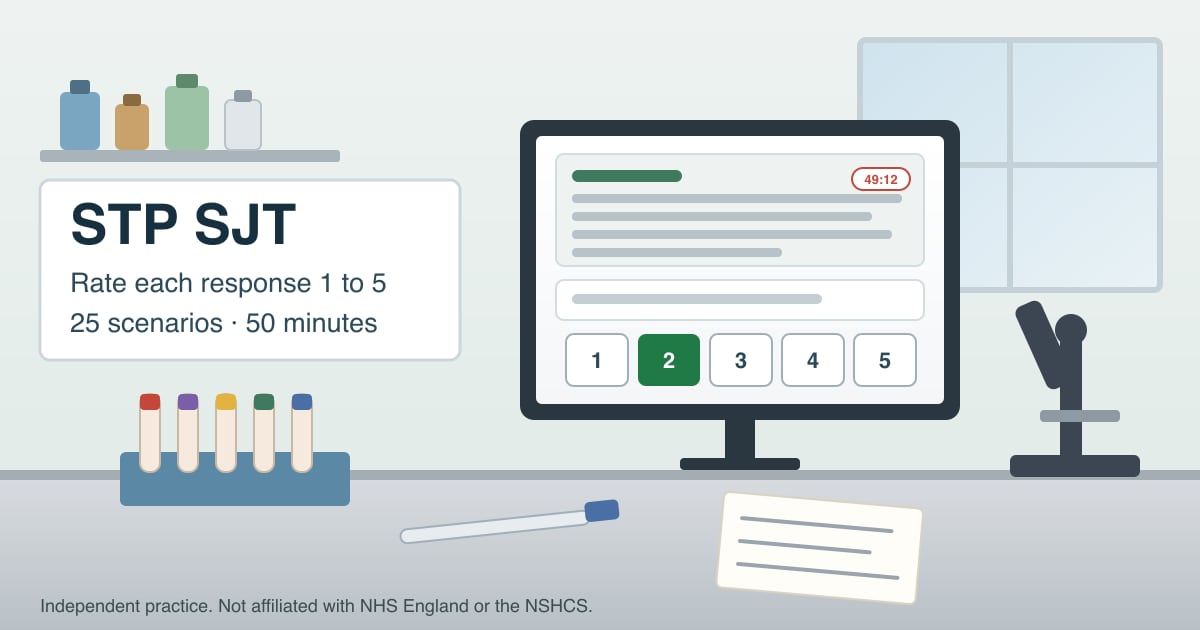
Whichever specialty you choose, your application only reaches the shortlisters if your situational judgement test score clears NSHCS’s cut score, and the SJT score is used again as a tie breaker at shortlisting. In 2026 about 45% of applications got through longlisting (our arithmetic on NSHCS’s stage counts). NSHCS describes the test as 25 scenarios in 50 minutes, each response rated from 1 = Very Appropriate to 5 = Very Inappropriate and marked by how close it is to the key, and offers a free sample test on the Pearson website: try that first. Our NHS STP SJT Practice Test adds timed practice sets in that format, marked by closeness, with every rating explained.
See the NHS STP SJT Practice Test, or read our guide to the STP SJT. Independent practice with scenarios we wrote; not made, seen or endorsed by NSHCS. Format source: NSHCS: longlisting and the SJT.
FreeTests: Professional integrity
NHS STP SJT Practice Test: free sample
Answer 4 questions against the clock, like the real exam. You then see the right answer, the reason and your time on each. About 3 minutes · free · no sign-in.
4 questions to answer
Start nowThis one is free · no sign-in needed
Your result shows how long each question took you.
Frequently asked questions
What are the NHS STP competition ratios for 2026?
Our sum of NSHCS’s 2026 specialty rows gives 11,109 applications for 389 direct entry posts in England, about 28.6 per post overall. The highest ratio was Clinical Microbiology at 221.75 per post (887 applications, 4 posts) and the lowest Urodynamic Science at 2.20 (11 applications, 5 posts).
What were the STP competition ratios in 2025?
Our sum of NSHCS’s 2025 specialty rows gives 7,873 applications for 320 posts, about 24.6 per post overall. Clinical Microbiology was highest at 145.6, followed by Clinical Bioinformatics Genomics (70), Cancer Genomics (65.6) and Haematology and Transfusion Science (60.5). Reconstructive Science was lowest at 5.
What were the STP competition ratios in 2024?
Our sum of NSHCS’s 2024 specialty rows gives 7,086 applications for 399 posts, about 17.8 per post overall. Clinical Microbiology (135.0) and Histopathology (113.0, a single post) were highest; Urodynamic Science (2.0) and Reconstructive Science (3.3) were lowest.
What were the STP competition ratios in 2023 and 2022?
Our sum of NSHCS’s 2023 specialty rows gives 5,480 applications for 546 posts, but its printed ratios are inconsistent with those counts, so use 2023 with care; Clinical Microbiology had the highest printed ratio, 51.5. In 2022 our sum gives 7,604 applications for 384 posts, about 19.8 per post, led by Haematology and Transfusion Science (112.6).
Is the NHS STP competitive?
Yes. In 2026 there were about 29 applications for every direct entry post, and 382 of 11,096 applications ended in an accepted offer, about 1 in 29 (our arithmetic on NSHCS’s stage counts). NSHCS itself calls entry to the programme extremely competitive.
What is the NHS STP success rate?
NSHCS does not publish a success rate as such, but its stage counts give one: in 2026, 44.5% of applications were longlisted after the SJT, 19.5% shortlisted, 8.0% interviewed and 3.4% ended in an accepted offer. The rate was 4.1% in 2025 and 5.5% in 2024 (all our arithmetic).
Which STP specialty is the most competitive?
In 2026 Clinical Microbiology, at 221.75 applications per post, then Haematology and Transfusion Science (94), Neurophysiology (87.83), Clinical Immunology (86.50) and Cancer Genomics (79). Clinical Microbiology had the highest printed ratio in every year from 2023 to 2026.
What is the least competitive STP specialty?
In 2026 Urodynamic Science had the lowest ratio at 2.20 per post, then Radiation Safety and Diagnostic Radiology (6.24), Gastrointestinal Physiology (7.17), Audiology (7.32) and Reconstructive Science (7.33). Each has its own entry rules: Reconstructive Science, for example, needs General Dental Council registration as a dental technician.
How many STP specialties can I apply for?
One. NSHCS allows one specialty per application, and anyone who submits more than one application for the same vacancy is withdrawn from the process. You can apply for a different specialty in a later year with no impact on the new application.
What are the STP specialties for 2027?
We found no 2027 posts on NSHCS’s site on 8 November 2026. NSHCS groups the specialties in three themes (life, physical and physiological sciences) and warns that not every specialty recruits every year. The 2026 competition table has 32 rows, and Intraoperative Neuromonitoring first appears in it.
Do the competition ratios include Wales, Scotland or in-service posts?
No. NSHCS’s data covers direct entry STP recruitment in England only. Scotland, Wales and Northern Ireland recruit separately, and in-service posts are not in the tables.
Should I avoid a specialty with a high ratio?
Not on the ratio alone. The ratio counts every application, including speculative and ineligible ones, and in a specialty with few posts, one or two posts more or less change the ratio a lot. Pick the specialty that fits your degree and the career you want, then prepare well for the SJT, the application questions and the interview.
Is this page affiliated with NHS England or NSHCS?
No. ProSyllabus is an independent study site. The figures are NSHCS’s published data, linked and dated, and our SJT practice uses scenarios we wrote ourselves.
Sources
- official — NSHCS: Application longlisting and the Situational Judgement Test (SJT) (25 scenarios, 1 to 5 scale, 50 minutes, closeness marking, sample test on Pearson; last updated 23 September 2026)
- official — NSHCS: STP 2026 recruitment statistics, competition ratios per post for each specialty (last updated 8 October 2026)
- official — NSHCS: STP 2025 recruitment statistics, competition ratios per post for each specialty (last updated 8 October 2026)
- official — NSHCS: STP 2024 recruitment statistics, competition ratios per post for each specialty (last updated 8 October 2026)
- official — NSHCS: STP 2023 recruitment statistics, competition ratios per post for each specialty (last updated 8 October 2026)
- official — NSHCS: STP 2022 recruitment statistics, competition ratios per post for each specialty (last updated 8 October 2026)
- official — NSHCS publications: competition ratios for STP direct entry posts, 2019 to 2023 (England only)
- official — NSHCS: STP 2021 recruitment statistics (2021 applicants could apply to 1 specialty only; last updated 8 October 2026)
- official — NSHCS: STP 2026 recruitment statistics, gender of direct entry applicants at each stage (stage counts and NSHCS’s description of each stage)
- official — NSHCS: STP 2025 recruitment statistics, gender of direct entry applicants at each stage
- official — NSHCS: STP 2024 recruitment statistics, gender of direct entry applicants at each stage
- official — NSHCS: STP 2023 recruitment statistics, gender of direct entry applicants at each stage
- official — NSHCS: STP 2022 recruitment statistics, gender of direct entry applicants at each stage
- official — NSHCS: Applying for an STP direct entry post (1 specialty per application, recruitment stages; last updated 3 February 2026)
- official — NSHCS: Entry requirements for direct entry applicants (degree rules and relevant degrees by specialty; last updated 23 December 2025)
- official — NSHCS: What are the STP specialties? (last updated 24 September 2026)
- official — NSHCS: Application process FAQs (last updated 10 December 2025)
- official — NSHCS: Situational judgement test FAQs (last updated 10 December 2025)
- official — NSHCS: FAQs about the STP (Scotland, Northern Ireland and Wales; last updated 16 December 2025)
official = a document published by the conducting body. reported = a news or coaching site we could not check against an original. Where sources disagree this page says so rather than picking one.