Checked 8 November 2026. No confirmed 2027 applicant application or assessment dates appeared in the NSHCS sources we checked on 8 November 2026. Every 2026 and 2025 date below is labelled as last cycle’s. The England timeline uses the archived NSHCS key-dates pages; other dates are attributed to their own sources. We will update this page when NSHCS publishes the 2027 dates; until then, check the NSHCS applicants page and Oriel before you rely on any date.
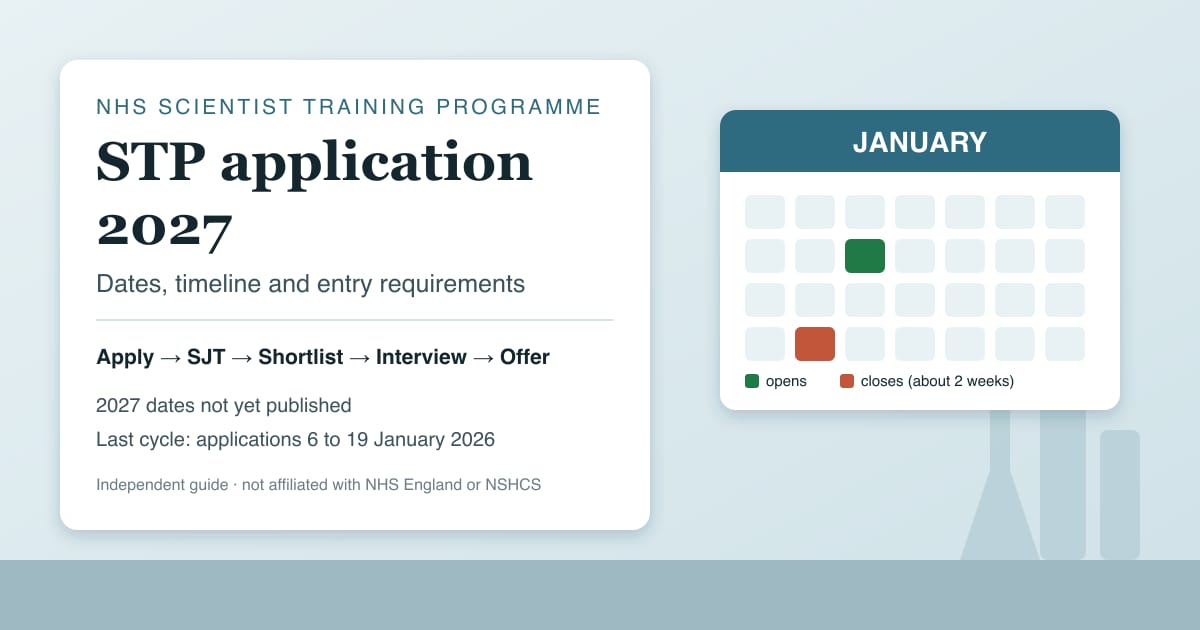
NSHCS has not yet published the NHS STP 2027 application dates. On 8 November 2026 its applicants page says 2026 recruitment has concluded and that applications for the next intake will likely open in January 2027, and the STP normally starts in September of the year you apply. Last cycle, direct entry applications opened on 6 January 2026 and closed on 19 January 2026, with the situational judgement test (SJT) from 27 to 29 January, so have your preparation done before January, then follow the confirmed opening date when NSHCS publishes it.
This page sets out what is and is not published for 2027, the official 2026 and 2025 timelines side by side, what happens at each stage from the Oriel application to the offer, and the entry requirements for UK and international applicants. ProSyllabus is an independent study site: independent practice, not affiliated with NHS England or the National School of Healthcare Science (NSHCS). Recruitment guidance below is summarised from NSHCS’s own pages (or, for Wales and Scotland, HEIW’s and NHS Education for Scotland’s), linked and dated, as read on 8 November 2026; our calculations, readings and practice material are labelled as ours.
NSHCS applicants page (30 July 2026), key-dates page for 2026 (last updated 29 April 2026) and entry requirements page (23 December 2025), read 8 November 2026.
NHS STP application 2027: key facts
| Item | Detail |
|---|---|
| Programme | Scientist Training Programme (STP): 3-year, full-time, salaried training post, normally in the NHS, leading to a Clinical Scientist career |
| Recruitment run by | The National School of Healthcare Science (NSHCS), for posts in England. Wales, Scotland and Northern Ireland recruit separately |
| 2027 applications open | Not confirmed. NSHCS: “likely” January 2027; confirmed dates will be published on its website and the vacancy on Oriel |
| Start date | Expected September 2027, not confirmed (NSHCS: applications generally open in January for trainees to start in September the same year) |
| Where you apply | Oriel, the online application portal. You can register on Oriel at any time, but can only apply once the vacancy opens |
| Which vacancy | “Healthcare Science – Direct Entry”. The in-service vacancy is only for NHS staff nominated by their employer |
| Specialties | One specialty per application, chosen in the form; the specialties on offer change every year |
| Stages | Application form → online SJT (longlisting) → shortlisting by specialty panels → location choices → interview → offer |
| Entry rule | 1st or 2:1 honours or integrated master’s in a relevant pure or applied science, or a 2:2 honours degree in any subject plus a relevant higher degree |
| Pay while training | NHS Agenda for Change Band 6, plus a fully funded part-time master’s degree |
| Applications per year | NSHCS says it regularly receives over 5,000 applications each time it recruits, across over 30 specialties |
| Help | NSHCS recruitment team: england.hcsapplicants@nhs.net (the SJT FAQ also gives england.hcsapplicants@nhs.uk) |
Sources: the NSHCS applicants page, applying for a direct entry post, entry requirements, About the STP and the application process FAQs. NSHCS asks applicants not to rely on hearsay, forums or blogs and to read its own guidance each year, because the process changes; treat this page as a dated summary with links, and check each link before you act.
NHS STP 2027 dates: what is published so far
As of 8 November 2026, no confirmed 2027 applicant application or assessment dates appear in the official sources cited here. These are the facts those pages give:
| For 2027 | Status | What the official pages say |
|---|---|---|
| Direct entry applications open | Not confirmed | NSHCS applicants page, 30 July 2026: applications for next year will likely open in January 2027; confirmed dates will be published when available |
| Application closing date and SJT window | Not confirmed | Current guidance: the SJT has its own opening and closing dates, after applications close, and published times are UK GMT |
| Specialties and number of posts | 2027 details not given in the cited sources | NHS departments could express an interest in hosting 2027/8 STP trainees until 30 October 2026; specialties change each year with demand |
| Post locations | 2027 details not given in the cited sources | In 2026, post location information was due on the NSHCS website by 1 April, before shortlist outcomes; only shortlisted applicants then choose locations |
| Wales (HEIW) | No 2027 applicant dates in the cited HEIW page | Recruited separately on NHS Jobs; the 2026 round ran 30 April to 13 May 2026 |
| Scotland (PSD Scotland, NES) | No 2027 applicant dates in the cited NES pages | Services could bid for 2027 cohort training posts from 20 July to 28 August 2026; NES says posts are generally advertised in spring |
| Start date | Expected September 2027 | NSHCS: applications open in January for trainees to start in September the same year |
Sources: NSHCS applicants page, applying for a direct entry post, NSHCS news of 22 October 2026, STP specialties, HEIW and NHS Education for Scotland. NSHCS says confirmed recruitment timelines and deadlines are published on its website, and application opening and closing dates on the vacancy (in Oriel) and its website. We will update this page when they appear.
Last cycle: the official STP 2026 and 2025 timelines
These are the last two cycles’ dates, not 2027 dates. They come from the NSHCS “Key deadline dates” pages for each year. NSHCS has since removed the timetable from the live 2026 page (it now says the content is no longer valid), so the links go to archived copies of the official pages.
| Stage | STP 2026 (last cycle) | STP 2025 |
|---|---|---|
| Direct entry applications open | Tuesday 6 January 2026, 11am | Thursday 23 January 2025, 11am |
| Applications close | Monday 19 January 2026, 4pm | Thursday 6 February 2025, 4pm |
| SJT window | Tuesday 27 January, 6am, to Thursday 29 January 2026, 11:59pm | Monday 24 February, 6am, to Wednesday 26 February 2025, 11:59pm |
| Longlist outcomes | 23 to 27 February 2026, by specialty | Friday 21 March 2025 |
| Post location information published | By 1 April 2026 | Thursday 3 April 2025, 10am |
| Shortlist outcomes | Wednesday 8 and Thursday 9 April 2026, by specialty | Tuesday 29 April 2025 |
| Location (sub-preference) choices | Friday 10 April, 11am, to Tuesday 14 April 2026, 4pm | Thursday 1 May, 11am, to Tuesday 6 May 2025, 4pm |
| Interviews | Online; most expected between Tuesday 5 May and Friday 5 June 2026 | Virtual; scheduled throughout June 2025 |
| Offers | Not on the archived copy cited here (see below) | From 10 July 2025 |
| In-service applications | Tuesday 24 February (no opening time given) to Tuesday 19 May 2026, 4pm | Wednesday 5 March 2025, 11am, to Monday 16 June 2025, 4pm |
Sources: NSHCS key deadline dates for 2026 (archived copy, page last updated 29 April 2026) and for 2025 (archived copy, last updated 3 July 2025). All times are UK GMT. Two details from the 2026 cycle are worth knowing: the December 2025 archived copy of the 2026 page gave the closing date as Friday 16 January, and the April 2026 copy gives Monday 19 January; and in spring 2026 NSHCS said it had updated the page with expected release dates for outcomes and offers, but those expected offer dates are not in the archived copy cited here. Dates do move, which is why NSHCS tells applicants to check its website regularly.
FreeTests: Professional integrity
NHS STP SJT Practice Test: free sample
Answer 4 questions against the clock, like the real exam. You then see the right answer, the reason and your time on each. About 3 minutes · free · no sign-in.
4 questions to answer
Start nowThis one is free · no sign-in needed
Your result shows how long each question took you.
Calendar days, our arithmetic from the NSHCS 2026 key-dates page (archived copy). In March 2026 NSHCS said interviews were due to finish in the second week of June. The STP starts in September, about eight months after applications open.
What the two cycles suggest (our reading, not a forecast): the application window was short both times (two weeks in 2025, just under two weeks in 2026), the SJT opened 8 days after the close in 2026 and 18 days after it in 2025, and the whole process ran to the summer. The 2027 window length is not known; plan as if it will again be about two weeks, so the work that takes time (your specialty choice, a UK ENIC statement if you have overseas qualifications, drafts of your supporting-information answers, which had three questions in 2026) should be done in December.
The stages, from application to offer
NSHCS publishes the stages with the status Oriel shows you at each one. This is the official sequence:
| Stage | What happens | Oriel status |
|---|---|---|
| 1. Application | NSHCS: “Posts available by specialty and region are published.” You complete one application on Oriel by the vacancy closing date; detailed post locations come later, before the location stage | In progress / Applied |
| 2. Longlist (SJT) | Every applicant takes the online SJT through Pearson VUE. NSHCS: “a cut score is used to longlist applications” | Longlist unsuccessful / Longlisted (the guidance also calls it “longlist fail”) |
| 3. Shortlist | Specialty panels assess applications and check qualifications against the entry requirements, then rank them by score; when required, the SJT score breaks ties where scores are the same. Shortlisted applicants choose and rank locations | Shortlist unsuccessful / Shortlisted / Shortlist reserve |
| 4. Interview | Interview places depend on the posts available and go by shortlist rank. Interview scores are ranked within the specialty | Interview / Interview complete / Interview fail |
| 5. Offer | Offers go from rank one downwards, matched to your location choices | Interview / Offer made / Offer declined / Offer accepted |
Source: the “Different stages of recruitment” section of NSHCS: Applying for an STP direct entry post. NSHCS contacts you about your application by direct message in Oriel, so check your Oriel account regularly once applications open; it may also use your email, so check junk folders too.
Stage 1: register on Oriel and apply
You can register on Oriel now, months before the vacancy opens. NSHCS gives these instructions for registering and applying:
Registering and applying on Oriel (NSHCS instructions)
- Click “Register” and choose “Register to apply to scientist training programmes”.
- Use an email address that will work until the programme starts, not a work or university address.
- Do not open Oriel in more than one tab in the same browser: saving in one tab can change data in the other.
- If you will leave a job to start the STP, Oriel needs an end date for it; for 2026 NSHCS told applicants to enter 31 August 2026, so check the 2027 guidance for the date to use.
- When the vacancy opens, search under training programme “Scientist Training Programme” and post type “Healthcare Science – Direct Entry”, not in-service.
- Choose your one specialty in the “Preferences” section by drag and drop. Use a PC or laptop: drag and drop does not work on a phone or tablet.
From NSHCS: Applying for an STP direct entry post (last updated 3 February 2026). Supported browsers listed there: Safari 12+, Chrome 77+, all versions of Edge, Firefox 68+.
The form asks for personal information, academic history, work experience, employment history and equality data, then a supporting information section. In 2026 that section had three questions, each with a 500-word maximum, answered against the STP job description and person specification; NSHCS says applications may be screened for AI-generated text and your answers must be in your own words. Shortlisters read the supporting information and education sections together, but not your employment history, so put relevant experience in your answers; and leave your name and anything else that identifies you out of them. NSHCS warns not to assume the process is the same as the year before, so treat the 2026 questions as a guide until the 2027 guidance appears. The 2026 questions, and how to answer them, are in our guide to the STP application questions. If you list voluntary work or work experience in the employment history section, mark it as non-paid.
| Rule | What NSHCS says |
|---|---|
| One application, one specialty | One application per vacancy, so one specialty in the NSHCS direct entry round; more than one application to a single vacancy means disqualification (Welsh posts are a separate process) |
| No CV, no references | CVs are not accepted. References are only requested by the employer after appointment |
| No changes after submitting | You can save and return before you submit, but not amend the form afterwards; only personal information in your Oriel account, such as your contact number, can still change |
| No late applications | Not for any reason, including technical problems. Applications do not close early when numbers are high |
| No advantage in applying early | But do not leave it to the last day: NSHCS’s before-you-begin page says typically 60% of applications arrive in the last 48 hours, and the system slows |
| Reconstructive Science | Current registration as a dental technician with the General Dental Council is part of the qualification check |
| Fitness to practise | Answer “yes” to a question such as a criminal conviction and you must submit a Fitness to Practise Declaration form; a panel considers it if you pass interview |
| False declarations | Invalidate the application and remove you from the process |
| Extra time for the SJT | 25% extra time is the only adjustment; request it on the form with evidence before you submit, and do not start the test until Oriel shows whether it was approved |
Sources: applying for a direct entry post, before you begin your application, the application process FAQs and the SJT page.
Stage 2: the SJT and longlisting
After applications close, every applicant takes the STP situational judgement test online through Pearson VUE, in a set window that in 2026 lasted three days. First-time applicants get their login by email from Pearson before the window opens (the username is not your email address); if nothing has arrived 1 working day before the window opens, check spam and use Pearson’s account recovery. If you sat the SJT in an earlier year, your old Pearson login stays the same when you apply with the same email address (the SJT page) or the same Oriel account (the FAQ); if in doubt, use Pearson’s forgotten username or password route. Before the test you must accept a non-disclosure agreement and terms of use; if you decline, your application cannot progress. NSHCS says you must score above the required threshold to be longlisted, and that a cut score is used; its guidance does not give the number. NSHCS’s SJT FAQ adds that there is no set percentage that passes: you are in competition with the other applicants to your specialty, the best scorers go through, and if a specialty has few applicants who all score well, all of them can. Miss the window and your application is removed. No confirmation email comes after the test: to check it was submitted, log out of Pearson, log back in and look for “Delivery Successful” in your exam history (NSHCS asks you to allow at least an hour for it to show before contacting support; completion does not show in Oriel). There is no negative marking, so NSHCS expects you to attempt every question, and its recruitment team is not available outside office hours, so do not leave the test to the last evening of the window.
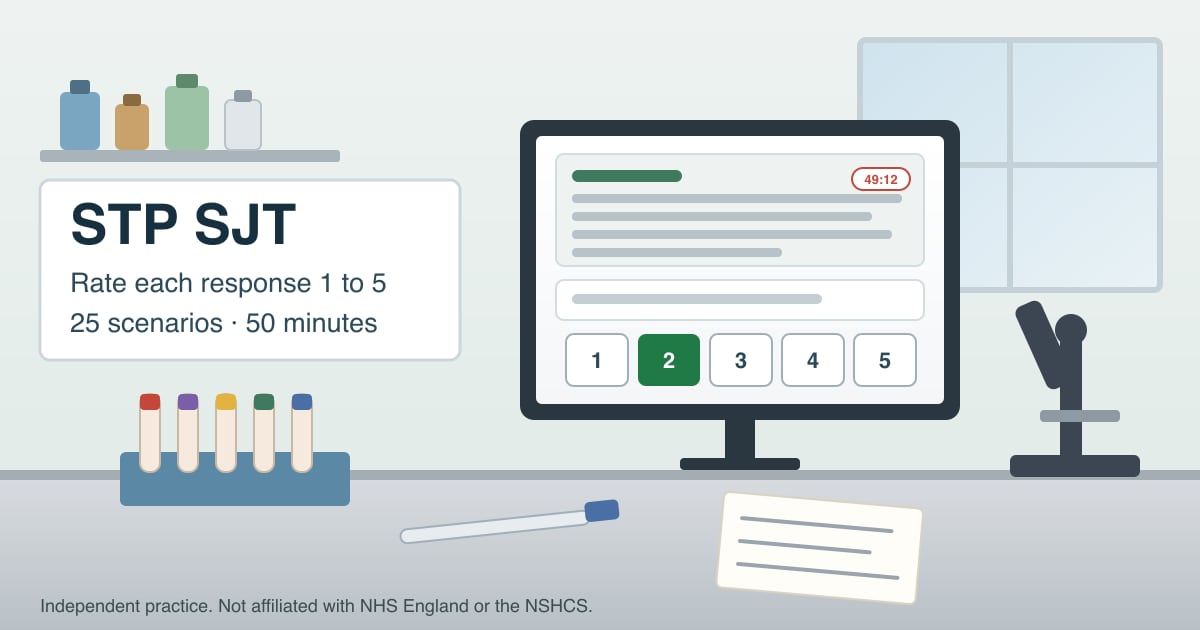
The test itself (25 scenarios in 50 minutes, each response rated 1 to 5 and marked by closeness to the key) is explained in our STP SJT guide. Sources: NSHCS SJT page and SJT FAQs.
Because the SJT came 8 days after the form closed in 2026 (18 days in 2025), the time to practise is before January, not after you submit. Our NHS STP SJT practice test uses original scenarios in the official 1 to 5 format with a 50-minute timer, and a few of its responses are free to try on this page. It is independent practice: NSHCS has not written, seen or endorsed it, and NSHCS’s own free sample test on the Pearson website should be part of your preparation too.
Stage 3: shortlisting and choosing locations
Longlisted applications go to national specialty panels, usually clinical staff who review applications on top of their day jobs. They check your qualifications against the entry requirements and score your application against the person specification; the scores decide who is invited to interview and who goes on the interview reserve list. NSHCS cannot confirm your eligibility in advance: degree relevance is judged here, at shortlisting.
If you are shortlisted, a short window opens to choose your sub-preferences: the locations and employers you would accept (in 2026, Friday 10 April to Tuesday 14 April). The rules:
Sub-preferences (NSHCS rules)
- Choose as many locations as you like, but only ones where you would train for the full 3 years: an offer is a commitment to that location, and transfers are not expected.
- Post details by specialty and employer are published before this stage (by 1 April in 2026), and posts can be added or removed as NHS needs change.
- Drag choices into the “wanted” column, tick the confirmation box and save. There is no submit button; you can edit until the deadline.
- Use a PC or laptop: drag and drop does not work on touch screens.
- The university for your master’s is set by your employer and NHS England, not by you or by location.
- NSHCS has a special circumstances policy for applicants who need to train in a particular location; evidence is uploaded on Oriel when prompted.
From NSHCS: applying for a direct entry post, application process FAQs and About the STP FAQs.
Stage 4: the interview
Interview places depend on the number of posts and are given in shortlist order. The published timetables for the last two cycles specified online or virtual interviews: the 2026 key-dates page expected most between 5 May and 5 June, and in March 2026 NSHCS said they were due to finish in the second week of June; the 2025 page scheduled them throughout June. In its announcement of 25 March 2026, NSHCS said reserves would be contacted if slots became free until Monday 1 June (after that, reserves could assume no interview, with no change to their Oriel status), and that no outcomes are released until all national interviews have finished and scores are ratified. Your interview score is ranked against everyone else interviewed in your specialty.
The person specification shows what the interview tests: it lists, for example, the ability to troubleshoot equipment and unexpected results, and to support patients with a range of conditions, as assessed at interview. Question types and model answers are in our STP interview questions guide. Sources: applying for a direct entry post, 2026 key dates, the archived 25 March 2026 announcement, core person specification.
Stage 5: offers, conditions and the September start
| Step | Detail |
|---|---|
| Offer | Made from interview rank one downwards and matched to your location choices; in 2025 offers were issued from 10 July |
| Predicted grades | NSHCS contacts you about the evidence it needs. Its FAQ says by the end of July, its guidance page by 1 August: aim for the end of July. The entry page also asks you to email your grade within 5 days of being told it |
| Higher degree you rely on | The FAQ asks for evidence that it is complete by the end of August; the entry page says any postgraduate qualification in your application must be awarded by the start. If it will not be, apply the following year |
| Other courses | NSHCS guidance says courses you are enrolled on should be completed before the start, or you cannot enrol on the STP master’s. If you still have studies outstanding, tell NSHCS after an offer; admission is then at its discretion |
| Employer checks | NSHCS passes your details to the employer, which runs pre-employment checks (including references) and issues the contract |
| University | The university contacts you to register for the MSc |
| Start | September. Deferral is only for statutory reasons such as maternity; you declare on the form that you can start that September |
| Feedback | Not given to unsuccessful applicants because of volumes; you can reapply the next year |
NHS STP entry requirements
The general degree rule applies across direct entry specialties, with extra requirements for some, below. Panels check it at shortlisting:
| Requirement | NSHCS rule |
|---|---|
| Degree class | 1st or 2:1 in an undergraduate honours degree or an integrated master’s degree |
| Degree subject | A pure or applied science relevant to the specialty you apply for |
| The 2:2 route | A 2:2 honours degree or better in any subject, plus a higher degree (for example an MSc) relevant to the specialty. You can apply while finishing that higher degree: the FAQ asks for evidence it is complete by the end of August, and it must be awarded by the start |
| Medical degrees | Accepted only for Life Sciences and Physiological Sciences specialties |
| Animal or plant science | Degrees such as zoology, marine biology or botany generally do not meet the criteria without a pure or applied science higher degree |
| Research experience | Desirable, not essential: a higher degree or equivalent evidence. Postgraduate diplomas and certificates are not accepted as that evidence |
| Reconstructive Science | Also current registration as a dental technician with the General Dental Council: the person specification says applicants “must hold current registration”, and the degree list says it must be in place by the start date |
| Final-year students | Can apply on a predicted 1st or 2:1; if the final result does not meet the entry requirements, the offer can be withdrawn (a predicted 1st that becomes a 2:1 is fine) |
| Work experience | Not essential for direct entry; add any, including voluntary work, to your application |
| Age, driving | No age limit. No driving licence needed, but you must be willing to travel for the programme |
Sources: NSHCS entry requirements, entry requirements FAQs and the core person specification. Because degrees vary so much, NSHCS publishes only examples of commonly accepted degrees, not a definitive list, and its recruitment team cannot confirm in advance whether your degree is eligible.
| Theme | Commonly accepted degrees (NSHCS examples, not exhaustive) |
|---|---|
| Life Sciences | Biochemistry, Biology, Biomedical Science, Genetics, Microbiology, Pharmacology, Forensic Science, Medical Sciences (varies by specialty) |
| Physical Sciences (medical physics) | A degree with a high level of physics meeting most Institute of Physics requirements: Physics, Mathematics and Physics, Engineering Physics, Natural Sciences. Medical Physics (undefined) and Clinical Engineering trainees may be placed in a post whose specialty is fixed, or decided after year one |
| Clinical Engineering | An engineering degree meeting most Engineering Council requirements: Biomedical Engineering, Mechanical Engineering, Electronics and Communication Engineering, Materials Science and Engineering |
| Clinical Informatics and Clinical Scientific Computing (Physical Sciences) | Computer Science, Data Science, Mathematics/Statistics, Software Engineering, Medical Informatics, Physics |
| Physiological Sciences | Physiology, Biomedical Science, Sport and Exercise Science, Neuroscience, Medicine; Audiology, Optometry for their specialties |
| Genomic Counselling | Life science degrees and also Nursing, Midwifery, Psychology. NSHCS says care or counselling experience is extremely advantageous and candidates are less likely to be shortlisted without it; without a genetics module, show a grounding in genetics |
International applicants: visa, UK ENIC and English
NSHCS welcomes international applicants who meet the entry criteria, with these extra steps:
| Item | Detail |
|---|---|
| Right to work and study | Needed for all 3 years and in place before you start. Where possible, establish it before applying |
| Visa sponsorship | NSHCS does not sponsor visas. If you are offered a post, the employing trust handles sponsorship (Health and Care Worker or Skilled Worker visa), provided you meet the rules, including the minimum 70 points; check current Home Office guidance |
| Current UK visa | Graduate visa holders must switch to a Health and Care Worker or Skilled Worker visa if appointed. Other statuses that already give the right to work and study (for example some dependant visas) need no change. NSHCS says a Tier 2 visa does not transfer to a new employer, so a new one is needed |
| ATAS certificate | May be needed; apply as soon as the university confirms, and be ready to fast-track it |
| Overseas qualifications | A UK ENIC Statement of Comparability; transcripts or other documents cannot replace it. For an undergraduate qualification, it must confirm at least a UK “Bachelor Science (Honours) degree”: “Bachelor (Ordinary) degree” or “Bachelor Degree” is not the level required. Add the equivalent grade to the Oriel form. Get the statement before applications open and upload it; if it arrives after you submit, email it to england.hcsapplicants@nhs.net as soon as possible, before the deadline NSHCS gives you (its guidance says before shortlisting) |
| English | If English is not your primary language, or you do not hold an undergraduate or postgraduate qualification taught and assessed in English, you may need IELTS Academic or General: 7.0 overall, no element below 6.5, UKVI or non-UKVI versions, taken at a test centre, no more than 2 years old. Asked for at offer stage, before you start; a valid one can be uploaded with your application. The university may set its own English requirement |
| SJT from abroad | Pearson VUE cannot deliver the SJT to residents of, or IP addresses in, OFAC-sanctioned areas (Belarus, Cuba, Iran, North Korea, Russia, Syria, and the Donetsk/Luhansk and Sevastopol/Crimea regions of Ukraine); the application then cannot proceed |
| Costs | NSHCS does not pay maintenance or relocation costs |
Sources: NSHCS: Additional information for non-UK applicants (23 September 2026) and FAQs for international applicants. Deadlines are in UK GMT, so allow for your time zone. The UK ENIC statement has its own processing time and fee: start it in good time before January.
Wherever you apply from, the SJT follows soon after the form closes (8 days later in 2026), in the same format for everyone (25 scenarios with 4 to 8 responses each, in 50 minutes, or 25% longer with approved extra time): you judge what a trainee scientist should do, each response rated on its own from 1 = Very Appropriate to 5 = Very Inappropriate, and ratings can repeat. A few free practice responses from our NHS STP SJT practice test (independent practice, not made or endorsed by NSHCS):
FreeTests: Professional integrity
NHS STP SJT Practice Test: free sample
Answer 4 questions against the clock, like the real exam. You then see the right answer, the reason and your time on each. About 3 minutes · free · no sign-in.
4 questions to answer
Start nowThis one is free · no sign-in needed
Your result shows how long each question took you.
Direct entry or in-service?
| Route | Who it is for | How it works |
|---|---|---|
| Direct entry | Anyone meeting the degree rule, including current NHS staff (who resign their post to start) | You apply to one specialty and choose locations; you are employed in a supernumerary training post for 3 years |
| In-service | Existing NHS staff in a recognised scientific specialty, nominated by their employer and meeting the qualification requirements (the person specification lets some in-service applicants meet further requirements instead of the degree rule) | Your employer gives you an in-service code and you need training arrangements agreed with your current employer; like every STP trainee, you are released from other duties for the whole programme. In 2026 this window ran from 24 February to 19 May |
Source: NSHCS: Difference between direct entry and in-service. If you work in the NHS without an employer nomination, you apply through direct entry.
Choosing your specialty
NSHCS groups the STP into Life Sciences (12 specialties on its list, from Andrology to Histopathology), Physical Sciences (Clinical Engineering, Clinical Informatics, Clinical Scientific Computing, Medical Physics in four strands, Pharmaceutical Science, Reconstructive Science) and Physiological Sciences (10, from Audiology to Vascular Science). Not every specialty recruits every year, so check which ones are open when the 2027 vacancy goes live. You can apply to only one, and applying to a different one in a later year has no effect on that application.
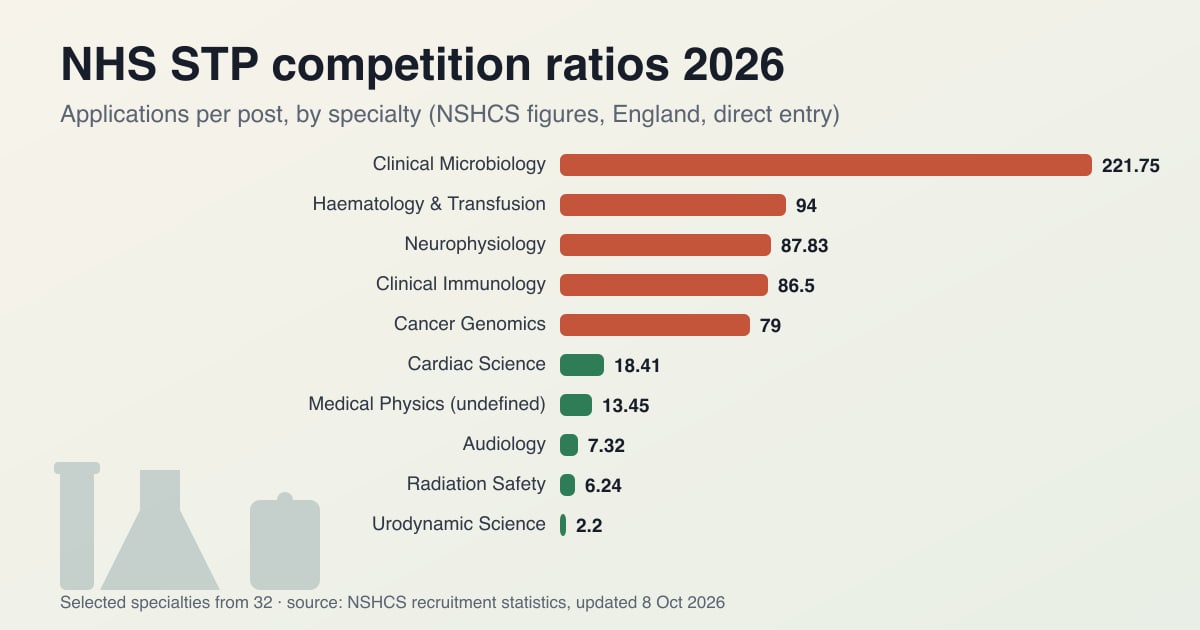
Competition varies a lot between specialties. NSHCS publishes recruitment statistics for each year from 2021 to 2026; our competition ratios guide turns them into a readable table. Sources: STP specialties, application process FAQs.
Scotland, Wales and Northern Ireland
NSHCS runs STP recruitment for England. The other UK nations run their own recruitment, with different portals and dates; in Wales, HEIW says the programme itself is still run by NSHCS:
| Nation | Who recruits | Last cycle |
|---|---|---|
| Wales | Health Education and Improvement Wales (HEIW), with NHS Wales employers | 2026-29 posts opened on 30 April 2026 on NHS Jobs (via Trac) and closed at midnight on 13 May 2026: 32 posts in 14 adverts. Band 6, fees funded, and trainees can apply for a bursary of up to £2,000 for additional training needs; HEIW lifted the limit on how many Welsh posts you can apply for. HEIW asks for a first or 2:1 in a pure or applied science, or a relevant MSc or PhD |
| Scotland | Individual NHS Scotland boards, with posts commissioned by PSD Scotland Healthcare Science (NHS Education for Scotland) | About 20 supernumerary Clinical Scientist trainees a year, on the STP or, where no STP is commissioned in Scotland for a discipline, an equivalent master’s-level programme. Services bid for posts each year (for the 2027 cohort, 20 July to 28 August 2026) and posts are generally advertised in spring on the NHS Scotland jobs site |
| Northern Ireland | Its own health authorities (NSHCS is not involved in this recruitment) | The cited NSHCS FAQ gives no Northern Ireland portal or timetable |
Sources: NSHCS FAQs about the STP, NSHCS: STP in NHS Wales, HEIW news of 30 April 2026, NHS Education for Scotland and its 2027 cohort news. Our post count adds up HEIW’s list of adverts. Wales and Scotland adverts are separate from the NSHCS Oriel process, so you can watch for them as well.
What you sign up for: the three years
The STP combines a salaried training job with a funded master’s and workplace learning. NSHCS says you are employed for 3 years, normally in an NHS department, at Agenda for Change Band 6, while you complete a fully funded part-time master’s, workplace training recorded in an e-portfolio, and a final assessment. Successful trainees can then apply to the Health and Care Professions Council (HCPC) for registration as a Clinical Scientist. The pay figures are in our STP salary guide.
| Point | What NSHCS says |
|---|---|
| Full-time and in person | No part-time STP. You are expected at the workplace in person throughout, and at the university unless it offers or approves remote attendance; flexible working is only discussed with the employer after you accept, at its discretion |
| Travel | You may spend weeks at other training centres, and you travel to the university, which you do not choose |
| Training support | £2,137 per trainee each year, mainly for travel and accommodation for the academic part (other educational uses can be agreed), included in the employer’s education contract: discuss access with your employer and agree its use with your training officer. It cannot currently pay for elective or Individual Professional Development modules, or IT equipment |
| Supernumerary | You are released from other duties and supervised throughout; trainees should not be taken out of training for routine service or on-call sessions |
| After the STP | No guaranteed job for direct entry trainees (in-service trainees’ employment continues as normal), and no tie-in to the NHS. You cannot skip the STP master’s even if you already hold one |
Mistakes and risks to avoid
Rules that end an application (NSHCS)
- Submitting late: late applications are never accepted, for any reason. Leaving it to the last hours risks a slow system.
- Applying to two specialties in the NSHCS round, or twice to one vacancy: you are disqualified.
- Missing the SJT window: applications without a completed SJT are removed.
- A false declaration: it invalidates the application.
- No evidence of your grade or higher degree by the deadline, or a result that does not meet the entry rule: NSHCS says the offered place will be withdrawn (a predicted 1st that becomes a 2:1 is fine).
From the NSHCS pages listed in the sources below.
Risks to avoid (our advice from NSHCS guidance)
- Choosing the in-service vacancy without an employer nomination: direct entry applicants cannot apply for it.
- Planning to take the SJT on a phone or tablet: mobile devices are not supported.
- Not checking Oriel messages and junk email, and missing the short location-choice window.
- Ranking a location you would not live in for 3 years: an accepted offer is a commitment to it.
- Leaving the UK ENIC statement until applications open: it has its own processing time and fee.
Drawn from the NSHCS pages listed in the sources below. Welsh and Scottish posts are separate processes.
Get ready before STP 2027 applications open
NSHCS says the 2027 vacancy will likely open in January 2027, and last time the form was open for about 13 days. Tick these off in December so the window is for submitting, not starting.
0 of 13 done
Ticks are saved only in this browser on this device.
Next in this series
After this page, read the series in the order you will need it: our guide to the STP application questions for the supporting-information answers (three questions in 2026), then our STP SJT guide for the test that follows the form, then our STP interview questions guide for the interview (scheduled for May to June last cycle; 2027 dates not confirmed). For the bigger choices, our competition ratios guide and our STP salary guide cover competition and pay.
Applications must pass SJT longlisting before any specialty panel scores them, and the test came 8 days after the form closed in 2026. Try a few practice responses in the 1 to 5 format below. Independent practice, written by us; not made or endorsed by NSHCS.
FreeTests: Professional integrity
NHS STP SJT Practice Test: free sample
Answer 4 questions against the clock, like the real exam. You then see the right answer, the reason and your time on each. About 3 minutes · free · no sign-in.
4 questions to answer
Start nowThis one is free · no sign-in needed
Your result shows how long each question took you.
Frequently asked questions
When do NHS STP applications open for 2027?
NSHCS has not confirmed the date. In an announcement of 30 July 2026, still on its applicants page on 8 November 2026, it said 2026 recruitment had concluded and applications for next year would likely open in January 2027, with confirmed dates published when available. Last cycle, direct entry applications opened on Tuesday 6 January 2026 at 11am.
What is the NHS STP application deadline for 2027?
Not published yet. For comparison, the 2026 closing date was Monday 19 January 2026 at 4pm (a December 2025 archived copy said Friday 16 January) and the 2025 closing date was Thursday 6 February 2025 at 4pm. Late applications are not accepted for any reason.
What were the NHS STP 2026 key dates?
From the NSHCS 2026 key-dates page: applications 6 to 19 January 2026; SJT 27 to 29 January; longlist outcomes 23 to 27 February; post locations by 1 April; shortlist outcomes 8 and 9 April; location choices 10 to 14 April; online interviews, most expected between 5 May and 5 June 2026. In-service applications ran from 24 February to 19 May 2026.
What is the NHS STP application process?
You apply on Oriel to one specialty, then take the online situational judgement test. A cut score on the SJT decides who is longlisted. Specialty panels then score and rank applications against the person specification, shortlisted applicants choose locations, interviews are held, and offers go from the top of each specialty’s interview ranking, matched to location choices.
What are the NHS STP entry requirements?
A 1st or 2:1 in an undergraduate honours or integrated master’s degree in a pure or applied science relevant to your specialty, or a 2:2 honours degree in any subject plus a relevant higher degree such as an MSc. Medical degrees count only for Life and Physiological Sciences specialties, and Reconstructive Science also needs General Dental Council registration as a dental technician.
Can I apply for the STP with a 2:2?
Only with a higher degree, such as an MSc, that is relevant to the specialty: then a 2:2 honours degree or better in any subject is accepted. You can apply while finishing that higher degree, but NSHCS needs evidence it is complete by the end of August. NSHCS also says postgraduate diplomas and certificates are not accepted as evidence of research experience, so do not rely on one as your higher degree.
Can I apply in my final year of university?
Yes. You give your predicted result, which must be a 1st or 2:1. If you are offered a place, you must give NSHCS evidence of your final result by the end of July (its FAQ; its guidance page says 1 August) to start in September. Email NSHCS your grade within 5 days of your university telling you it. If the result does not meet the entry requirements, the offer can be withdrawn. No letter about predicted grades is needed when you apply.
Can international students apply for the NHS STP?
Yes, if you meet the entry criteria. You need the right to work and study in the UK for all 3 years, a UK ENIC Statement of Comparability for any international qualifications (for an undergraduate degree it must confirm at least a UK “Bachelor Science (Honours) degree”), and, if English is not your primary language or you hold no degree taught and assessed in English, possibly IELTS of 7.0 or above with no element below 6.5. NSHCS does not sponsor visas; the employer arranges sponsorship after an offer, and graduate visa holders must switch.
When does the STP start?
In September of the year you apply: NSHCS says applications generally open in January for a September start, so September 2027 is expected for the 2027 round, though no 2027 date is confirmed yet. You declare on the form that you are available to start that September, and deferrals are only considered for statutory reasons such as maternity.
How do I log in to Oriel for the STP?
Register on the Oriel website with the option “Register to apply to scientist training programmes”, using a personal email address. You can register at any time but can only apply when the 2027 vacancy opens. Apply to the “Healthcare Science – Direct Entry” vacancy, not in-service, and use a PC or laptop.
Is there an NHS STP in Scotland?
Yes, but NSHCS does not recruit for it. NHS Scotland boards recruit about 20 supernumerary Clinical Scientist trainees a year (STP, or an equivalent master’s-level programme where no STP is commissioned), with posts commissioned by PSD Scotland Healthcare Science at NHS Education for Scotland. Posts are generally advertised in spring on the NHS Scotland jobs site; services bid for 2027 cohort posts in July and August 2026.
How do I apply for the STP in Wales?
Through HEIW, on NHS Jobs, not through Oriel. In 2026, 32 Welsh posts opened on 30 April and closed at midnight on 13 May 2026. Welsh trainees get a Band 6 salary and funded fees, and can apply for a bursary of up to £2,000. The HEIW page we cite gives no 2027 dates.
How many people apply for the STP?
NSHCS says it regularly receives over 5,000 applications each time it recruits, across over 30 specialties. It publishes recruitment statistics by specialty for each year from 2021 to 2026, and competition differs a lot between specialties.
Does applying early help my STP application?
No. NSHCS says there is no advantage to applying early, but it advises against the last day: its guidance says typically 60% of applications are submitted in the last 48 hours (its FAQ says most), which slows the system, and late applications are never accepted.
Can I get feedback or reapply if I am unsuccessful?
NSHCS does not give individual feedback because of the number of applications. You can reapply the next year if you meet the entry requirements, and can choose a different specialty without any effect on the new application.
What happens after the STP SJT?
Scoring is done after the test window closes and you do not see a score; to confirm your test was submitted, check for “Delivery Successful” in your Pearson exam history. Your Oriel status changes to longlisted or longlist unsuccessful; in 2026 longlist outcomes came out from 23 to 27 February, about four weeks after the SJT.
More in this series
Sources
- official — NSHCS: STP applicants (announcement 30 July 2026: 2026 recruitment concluded, 2027 applications likely to open in January 2027)
- official — NSHCS: Key deadline dates for applications to the STP 2026 (archived copy of the official page, last updated 29 April 2026; the live page now says the content was removed)
- official — NSHCS: Key deadline dates for applications to the STP 2025 (archived copy of the official page, last updated 3 July 2025)
- official — NSHCS: Applying for an STP direct entry post (stages, Oriel statuses, registration, deadlines, supporting information), last updated 3 February 2026
- official — NSHCS: Before you begin your STP application (late applications, last 48 hours, 1 August results, references), last updated 23 December 2025
- official — NSHCS: Entry requirements for direct entry applicants (degree classes, relevant degrees, research experience), last updated 23 December 2025
- official — NSHCS: Scientist Training Programme core person specification (PDF)
- official — NSHCS: Additional information for non-UK applicants (right to work, visas, ATAS, UK ENIC, IELTS, sanctioned countries), last updated 23 September 2026
- official — NSHCS: Application longlisting and the Situational Judgement Test (SJT), last updated 23 September 2026
- official — NSHCS: Difference between direct entry and in-service STP vacancies, last updated 12 March 2026
- official — NSHCS: What are the STP specialties?, last updated 24 September 2026
- official — NSHCS: About the STP (3 years, Band 6, funded master’s, in-person, HCPC), last updated 15 June 2026
- official — NSHCS: FAQs about the STP application process, last updated 10 December 2025
- official — NSHCS: FAQs about STP entry requirements, last updated 10 December 2025
- official — NSHCS: FAQs about entry requirements for international applicants, last updated 12 January 2026
- official — NSHCS: FAQs about the Scientist Training Programme (Scotland, Northern Ireland, Wales, pay, travel, no job guarantee), last updated 16 December 2025
- official — NSHCS: FAQs about the situational judgement test, last updated 10 December 2025
- official — NSHCS: Scientist Training Programme recruitment statistics (2021 to 2026)
- official — NSHCS news, 2 September 2026: update on the STP educational training support funding (£2,137 per trainee a year)
- official — NSHCS news, 22 October 2026: expressions of interest in hosting 2027/8 STP trainees (portals open until 30 October 2026)
- official — NSHCS: Scientist Training Programme in NHS Wales, last updated 31 October 2025
- official — HEIW news, 30 April 2026: applications for STP posts in Wales for 2026-29 are open (closing 13 May 2026)
- official — NHS Education for Scotland (PSD Scotland Healthcare Science): Clinical Scientist pre-registration training, last updated 7 April 2026
- official — NHS Education for Scotland news, 7 July 2026: Clinical Scientist training expressions of interest for the 2027 cohort
official = a document published by the conducting body. reported = a news or coaching site we could not check against an original. Where sources disagree this page says so rather than picking one.