Natural Vegetation and Wildlife
Chapter 5: Geography - Complete Study Guide | NCERT Class 9 Notes & Questions 2025
Comprehensive Chapter Summary - Natural Vegetation and Wildlife Class 9 NCERT
Overview
- Chapter Purpose: Explores variations in trees, bushes, grasses, birds around schools/parks, highlighting India's vast bio-forms. India as one of 12 mega biodiversity countries, with 47,000 plant species (10th world, 4th Asia), 15,000 flowering (6% world total), non-flowering like ferns/algae/fungi, 90,000 animals, rich fish variety. Natural vegetation: Plant community grown naturally without human aid, undisturbed long time (virgin vegetation). Cultivated crops/fruits/orchards part of vegetation but not natural. Endemic/indigenous: Purely Indian; exotic: From outside. Flora: Plants of region/period; fauna: Animals. Figure 5.1: Tropical Evergreen Forest. Key Insight: Biodiversity essential; conservation needed if plants/animals disappear—humans can't survive without. Reprint 2025-26 updates focus on threats like endangerment.
- Types of Vegetation: Major types (Figure 5.4): Tropical Evergreen, Deciduous, Thorn Forests/Scrubs, Montane, Mangrove. Factors: Rainfall, altitude, temperature influence distribution.
- Expanded Relevance 2025: Climate change impacts forests/wildlife; conservation via biosphere reserves. Update: Endangered species lists.
- Exam Tip: Distinguish forest types by rainfall/altitude; use Figure 5.4 for maps; know flora/fauna examples.
- Broader Implications: Vegetation/wildlife support ecosystems, medicines, economy; threats from hunting/pollution/habitat loss.
Tropical Evergreen Forests
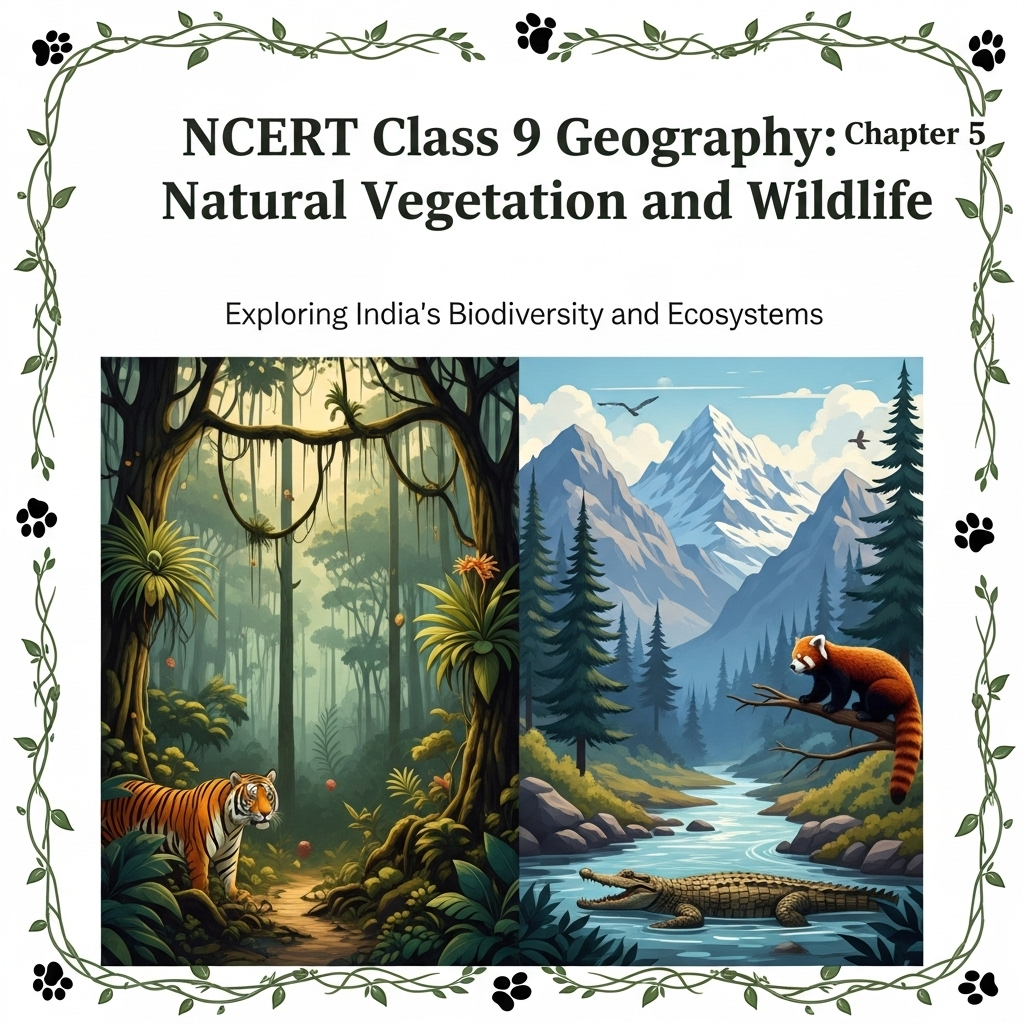
- Characteristics: Restricted heavy rainfall (>200 cm, short dry season) in Western Ghats, Lakshadweep/Andaman-Nicobar islands, upper Assam/Tamil Nadu coast. Trees up to 60m, luxuriant multi-layered (trees/shrubs/creepers); no definite leaf-shedding, green year-round. Commercially: Ebony, mahogany, rosewood, rubber, cinchona. Animals: Elephant, monkey, lemur, deer, one-horned rhino (Assam/WB), birds, bats, sloth, scorpions, snails. Figure 5.1: Structure.
Tropical Deciduous Forests
- Characteristics: Most widespread (monsoon forests), rainfall 200-70 cm, shed leaves 6-8 weeks dry summer. Subdivided: Moist (200-100 cm, eastern: NE states, Himalayan foothills, Jharkhand, W Odisha/Chhattisgarh, E Western Ghats slopes; dominant: Teak, bamboos, sal, shisham, sandalwood, khair, kusum, arjun, mulberry); Dry (100-70 cm, Peninsular plateau rainier parts, Bihar/UP plains; teak, sal, peepal, neem; open stretches for cultivation/grazing). Animals: Lion, tiger, pig, deer, elephant, birds, lizards, snakes, tortoises. Figure 5.2: Tropical Deciduous Forest.
The Thorn Forests and Scrubs
- Characteristics: <70 cm rainfall, NW India (Gujarat, Rajasthan, MP, Chhattisgarh, UP, Haryana); thorny trees/bushes, scattered, long roots for moisture, succulent stems, small thick leaves minimize evaporation; acacias, palms, euphorbias, cacti. Animals: Rats, mice, rabbits, fox, wolf, tiger, lion, wild ass, horses, camels. Figure 5.3: Thorn Forests and Scrubs.
Montane Forests
- Characteristics: Mountainous, temperature decreases with altitude, succession tropical to tundra. Wet temperate (1000-2000m: Evergreen broad-leaf oaks/chestnuts); Temperate (1500-3000m: Coniferous pine, deodar, silver fir, spruce, cedar; S Himalayan slopes, high altitude S/NE India); Temperate grasslands higher; Alpine (>3600m: Silver fir, junipers, pines, birches; stunted near snow-line, merge shrubs/scrubs to Alpine grasslands for grazing by nomads like Gujjars/Bakarwals); Tundra: Mosses/lichens. Animals: Kashmir stag, spotted deer, wild sheep, jack rabbit, Tibetan antelope, yak, snow leopard, squirrels, shaggy horn wild ibex, bear, red panda, sheep/goats thick hair. Figure 5.5: Montane Forests.
Mangrove Forests
- Characteristics: Tidal coasts with mud/silt; dense mangroves, roots submerged; deltas Ganga, Mahanadi, Krishna, Godavari, Kaveri; sundari (durable timber), palm, coconut, keora, agar. Animals: Royal Bengal tiger, turtles, crocodiles, gharials, snakes. Figure 5.6: Mangrove Forests.
Wildlife
- Overview: India rich fauna: 90,000 species, 2000 birds (13% world), 2546 fish (12%), 5-8% amphibians/reptiles/mammals. Elephants (hot wet forests Assam/Karnataka/Kerala), one-horned rhinos (swampy Assam/WB), wild ass/camels (arid Rann Kachchh/Thar), Indian bison, nilgai, chousingha, gazelle, deer, monkeys. Only country with tigers/lions: Lions Gir (Gujarat), tigers MP/Sundarbans/Himalayas. Leopards prey animals. Rivers/lakes/coasts: Turtles, crocodiles, gharials (unique). Birds: Peacocks, pheasants, ducks, parakeets, cranes, pigeons. Himalayas: Yak, shaggy horn wild ox, Tibetan antelope, bharal, wild sheep, kiang, ibex, bear, snow-leopard, red panda. Figure 5.7: Wildlife Reserves. Wildlife Protection Act 1972. Role: Pollination, biological control; every species essential ecosystem.
- Medicinal Plants: India known herbs/spices ancient; 2000 Ayurveda plants, 500 regular use. Red List: 352 medicinal, 52 critically threatened, 49 endangered. Examples: Sarpagandha (blood pressure), Jamun (diabetes), Arjun (earache/blood pressure), Babool (eye sores/tonic), Neem (antibiotic/antibacterial), Tulsi (cough/cold), Kachnar (asthma/ulcers/digestive). Activity: Identify local medicinal plants.
Conservation and Threats
- Threats: 1300 plants endangered, 20 extinct; animals endangered/extinct from hunting, pollution, alien species, reckless cutting for cultivation/habitation. Newspaper clippings: Endangered tigers/rhinos/vultures. Activity: Find clippings, government steps, personal contribution.
- Measures: 18 biosphere reserves (e.g., Sundarbans, Nilgiri in world network); financial/technical aid botanical gardens (1992); Project Tiger/Rhino/Great Indian Bustard; 106 National Parks, 573 Wildlife Sanctuaries, Zoological gardens. Realize ecosystem importance; stop indiscriminate destruction. Figure 5.7: Reserves.
Migratory Birds
- Details: Wetlands attract migrants like Siberian Crane in winter. Rann Kachchh: Flamingos build nests salty mud, raise young. Rich natural heritage.
SEO Note: Why This Guide?
Top-ranked for 'Natural Vegetation and Wildlife Class 9 notes 2025'—free, with 60 Q&A from PDF, quizzes. Integrates biodiversity insights.
Key Themes
- Biodiversity Variations: Rainfall/altitude based.
- Details: Flora/fauna examples, maps (Figure 5.4). Activity: Why some states more forest cover?
- Conservation Links: Biospheres/projects for sustainability.
- Critical Thinking: Why biodiversity necessary? Impacts if lost.
Cases for Exams
Use Figure 5.4 for vegetation identification; discuss medicinal plants; analyze conservation objectives.
Exercises Summary
- Focus: Expanded to 60 Q&A from PDF: 20 short (2M), 20 medium (4M), 20 long (8M) based on NCERT exercises + similar.
- Project Idea: Poem/paragraph on wildlife; street play tree plantation; plant tree on birthday.