Checked 6 November 2026. The Board of Examiners is moving certificates to online exams and, for underground certificates, to a 3-stage examination process in 2027. Checklists and fees change: this page follows what RSHQ published when we checked on 6 November 2026. Always read the current checklist before you apply.
In a Queensland underground coal mine, the underground mine manager must hold a first class certificate of competency for an underground mine and the practising certificate that goes with it (Coal Mining Safety and Health Act 1999, s 60(5)). That certificate is what most people mean by the "mine manager certificate of competency". The Board of Examiners grants it after checking your experience and qualifications, then examining you: a legislation (law) exam first, then an oral exam.
This guide covers the first class certificate for underground coal only: the experience the Board asks for and how it counts your hours, the qualifications and endorsements, the law exam and the oral, the step-by-step process and what the certificate lets you do. It ends with a short comparison with the new surface mine manager's certificate for open-cut coal mines. For the law itself, see our Queensland coal mining law exam guide and our Regulation 2017 summary.
This is a plain-English study guide, not legal advice. The Board of Examiners decides eligibility, and its current checklist, the Act and the Regulation are what apply. ProSyllabus is an independent study site, not part of Resources Safety and Health Queensland (RSHQ) or the Board of Examiners.
RSHQ First Class Mine Manager (Coal, UG) work history template; RSHQ Examinations (updated 28 Oct 2026); RSHQ Certificates of competency (last updated 29 Oct 2026). Checked 6 Nov 2026.
Who needs a first class certificate
Section 60 of the Act applies to every underground coal mine. The site senior executive (SSE) must appoint an underground mine manager to control and manage the mine (s 60(2)), and the coal mine operator or SSE "must not appoint a person as an underground mine manager unless the person has" a first class certificate of competency for an underground mine and the practising certificate the Board requires for it (s 60(5)). The SSE can be appointed underground mine manager, but only by the coal mine operator (s 60(3)).
The same certificate matters in four other places:
- Technical directions. Nobody may give the underground mine manager a direction about a technical matter at the mine unless they hold a first class certificate of competency for an underground coal mine (s 60(6)). Nobody may give a direction that may adversely affect safety and health (s 60(7)).
- The roles below the manager. A first class certificate is also accepted, with the practising certificate, for the person who controls underground activities when the manager is not at the mine (s 60(8)) and for an ERZ controller (s 60(9)), alongside the second class and deputy's certificates.
- Shotfiring. Shotfiring operations underground must be directly supervised and controlled by a holder of a first class, second class or deputy's certificate (Regulation s 210).
- Open-cut examiners. RSHQ's competency list accepts a first class certificate for underground coal mines, from 17 June 2022, in place of the atmospheric monitoring unit RIIENV301E for the open-cut examiner position.
Two more appointment rules sit in s 60: a person can be underground mine manager for more than 1 mine at the same time only with the chief inspector's written approval (s 60(13)), and the coal mine operator must make sure that an SSE appointing the manager appoints an employee of the operator, an associated entity of it, or an entity that employs or engages 80% or more of the coal mine workers at the mine (s 60(14)). If the manager is temporarily absent, the person who appointed them must appoint someone to act in the role, and if the office is vacant they may (s 60A). The operator must make sure the acting manager meets the same competency requirement, and that an acting appointment lasts no more than 12 weeks from the day the vacancy or absence began, unless the acting manager is an employee of the operator, an associated entity, or an entity that employs or engages 80% or more of the mine's workers (s 60A(4) to (6)).
Source: Coal Mining Safety and Health Act 1999 ss 60 and 60A (current as at 1 July 2026); Regulation s 210 (current as at 1 September 2026); RSHQ coal mining competencies, rows 3 and 6 (updated 26 May 2026).
The first class certificate is not an SSE notice. To be SSE of an underground mine you need a site senior executive notice and its practising certificate (s 54(4)), which is a separate Board qualification with its own checklist: see our SSE notice guide. Every other statutory role at a coal mine (supervisor, ventilation officer, electrical and mechanical engineering managers, and others) has its own requirements, which we cover in a separate guide.
The experience the Board asks for
The Board's work history template for the first class certificate says the minimum is at least five years' practical underground coal mining experience, of a standard acceptable to the Board, in an underground coal mine. It then lists what that experience should include:
| Block | Minimum | What the Board lists |
|---|---|---|
| Winning coal at the face | 2 years | At least 6 months in a gateroad development panel; at least 6 months in a mains development or bord and pillar development panel; at least 12 months in a longwall extraction panel |
| Supporting the winning of coal | 1 year | Recommended: gas drainage, secondary support, mine transport and supply systems, mine ventilation systems |
| Leadership in the safety and health management system | 2 years | Recommended: leading incident investigations; leading critical parts of sealing part of a mine, including preparing and analysing gas samples; leading underground shotfiring; leading the use of polymeric chemicals for strata support; leading the set-up or upkeep of a panel's gas monitoring system; leading the review of a SOP or PHMP; helping set design criteria for panel development and second workings and monitoring them through a permit to mine system; a level 1 emergency exercise or an IMT formed for a real event |
| Senior supervision | 3 years | In a senior supervisory role, including at least 1 year in the role responsible for controlling and managing underground activities when the manager is not at the mine (the s 60(8) role) |
Source: RSHQ First Class Mine Manager (Coal, underground) work history template, section 8, and the 1st class checklist, read 6 Nov 2026. The template does not say whether these blocks overlap; the checklist lists the first three. If your history does not fit neatly, ask the Board of Examiners Secretary before you apply.
The template also lists the systems your work summary should show you have established, implemented, applied and monitored, in three groups: coal mining (including at least 3 years directly supervising mining in one or more of bord and pillar, place changing, longwall, punch mining, tunnel access mining, outburst, spontaneous combustion, gas drainage or inrush), hazard monitoring and the safety and health management system (ventilation, gas, strata, spontaneous combustion, emergency preparedness and incident investigation, inrush), and support systems (risk management, transport and other systems). The Board says job titles alone are not acceptable evidence: give specific examples, the equipment, the dates and where in the mine.
How the Board counts your hours
This is where most people's questions about "hours" come from. The template allows two ways to claim:
- Calendar time. You can claim the five years as calendar time if you work at least an even time roster (for example 7 on, 7 off) and you do not claim any gap of more than 2 weeks.
- Hours. Or you can claim by hours worked in a role. The Board treats a week of experience as a 5-day, 8-hour, 40-hour week. Its own example: a roster that averages 50 hours a week for 20 weeks is 1,000 hours, which you claim as 25 weeks (1,000 ÷ 40).
By our arithmetic, five years of 52 weeks at 40 hours is 10,400 hours. That figure is not in the template; it is just the Board's 40-hour week applied to the five years. Each entry in the template asks for the dates, roster type, hours per shift and number of shifts completed, and the underground mine manager who was appointed at the operation at the time must sign it. If you cannot get a signature from a past employer, you can give a statutory declaration instead.
If your mine has no longwall or place change mining, the template says you can make a written submission to the Board explaining how you have gained exposure, such as visits to other operations or a fixed secondment, and contact the Board for guidance.
RSHQ Board of Examiners checklists and templates for each certificate or notice, read 6 Nov 2026. Each has its own required mix of experience; only the total is shown here.
Qualifications, certificates and endorsements
The 1st class underground mine manager (Coal) checklist asks for all of the following, with every qualification verified by a Justice of the Peace or a Commissioner of Declarations:
| Item | What the checklist says |
|---|---|
| Management qualification | Statement of attainment for RII60320 Advanced Diploma of Underground Coal Mining Management, or a relevant tertiary qualification the Board accepts |
| Risk management unit | RIIRIS601 Establish and maintain risk management systems |
| Emergency courses | A certificate of attendance for an emergency response course, and one for the Queensland Mines Rescue Service Mine Emergency Management Systems course |
| Gas | Certificate of Proficiency in Mine Gases and Gas testing |
| First aid and CPR | Current statements of attainment for HLTAID011 (first aid) and HLTAID009 (CPR) |
| Your record | Your CV and the work history template |
| Endorsement | An endorsement of your readiness to apply and sit the examinations from the underground mine manager and the site senior executive |
| Statutory declaration | A Queensland statutory declaration if you cannot get the signatures for your work history |
Source: RSHQ Board of Examiners, Application checklist, 1st class underground mine manager (Coal), read 6 Nov 2026. RSHQ's competency list also asks a working underground mine manager to hold RIIRIS601E (or an equivalent, MINE7033 or GMIRM) with the certificate.
If you hold a qualification the checklist does not name, RSHQ's legislation-sections fact sheet says you need a statement from an Australian university, Engineers Australia or an Australian registered training organisation (RTO) that it is equivalent, for the Board to review.
Step by step through the Board of Examiners
- 1. Check the current checklist. RSHQ says every application must meet the education and experience criteria in effect at the time, and a written exam you passed for an earlier application does not count for a new one.
- 2. Build your work history. Fill in the template with specific examples, dates, rosters and shifts, signed by the underground mine manager for each period.
- 3. Get the endorsement. The underground mine manager and the SSE endorse your readiness to apply and sit the exams.
- 4. Apply in the RSHQ Portal. All applications go through the RSHQ Portal, after an identity check to "standard" strength. The fee is in Schedule 8, Part 1 of the Regulation: 44.95 fee units for a first class certificate, which RSHQ's 2026-27 fact sheet gives as $50.93 excluding GST.
- 5. The Board assesses your eligibility. If you are approved to go on, you are told to sit the legislation exam.
- 6. Sit the law exam. You must pass it before you can sit the oral.
- 7. Sit the oral exam. RSHQ describes it as an oral panel interview.
- 8. Receive the certificate and register for a practising certificate. Since 10 June 2025, holders working in statutory positions must be registered in the Board's Practising Certificate Scheme and hold a current practising certificate.
There is a deadline: RSHQ says you must complete both the application and the examination process within 3 years of submitting your application, or you have to apply again. Written exams are held monthly in Brisbane, Dysart, Mackay, Moranbah and Rockhampton (and Townsville and Mount Isa depending on availability), and you can ask to sit at a courthouse, library, school or similar government office with an external supervisor. We do not quote dates: RSHQ publishes the 2026 and 2027 written examination schedules on its Examinations page.
Source: RSHQ Certificates of competency (last updated 29 Oct 2026) and Examinations (updated 28 Oct 2026); Regulation schedule 8, part 1; RSHQ fees fact sheet 2026-27; Business Queensland Board of Examiners page (last updated 9 Oct 2026).
The law exam
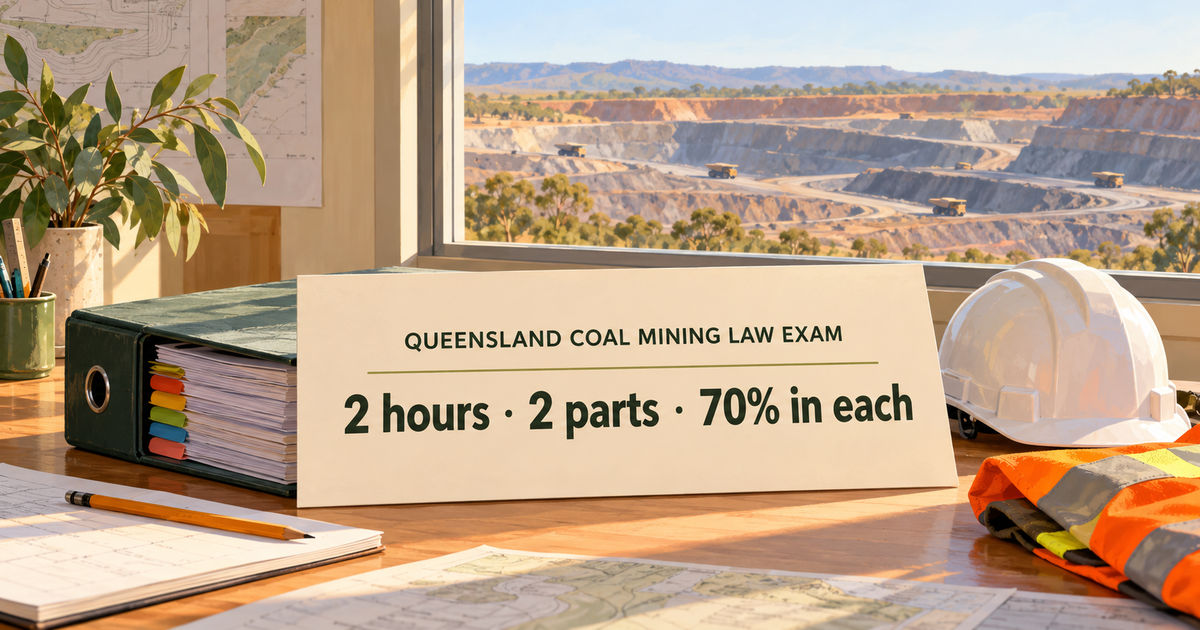
RSHQ says the coal mining exam is a 2-hour, 2-part, closed book exam on the Coal Mining Safety and Health Act 1999 and the Coal Mining Safety and Health Regulation 2017, and the pass mark is 70% for each part. Questions may be short answer or multiple choice depending on the competency, and cover the legislation relevant to the position as well as general health and safety topics. Format, the resit rules and what to read are in our law exam guide; this section is about what a first class candidate should expect.
RSHQ has not published a section list for the first class coal exam (its legislation-sections fact sheet covers only the new manager certificates). The underground mine manager is named in dozens of Regulation sections, so for this certificate expect the whole of the underground side of the law. A few examples of duties the Act and the Regulation put on the manager by name:
| Topic | Duty on the underground mine manager | Where |
|---|---|---|
| Appointments | Appoint the person in charge when the manager is not at the mine, ERZ controllers, and the electrical and mechanical engineering managers | Act s 60(8) to (11) |
| Gas detectors | Make sure each person appointed under s 60(8) or (9) has a portable gas detector | Regulation s 228 |
| Diesel plant in an ERZ1 | Make sure an engine powering plant in an ERZ1 has been assessed by its manufacturer as safe to use there, having regard to the recognised standard | Regulation s 261 |
| Hot work | Authorise hot work outside a permanent underground workshop, record it, and notify an inspector within 7 days after it is finished | Regulation ss 263, 264 |
| Sealing | Do not seal the mine or part of it (except in an emergency) until notice is given and the inspector has acknowledged it in writing, then seal it that way | Regulation ss 326, 327 |
| Shotfiring | Make sure shotfiring is directly supervised and controlled by a first class, second class or deputy's certificate holder | Regulation s 210 |
Source: CMSH Act s 60 and CMSH Regulation 2017 (current as at 1 September 2026), sections named. For the recognised standards behind s 261 and others, see our recognised standards guide.
RSHQ says underground certificates of competency will move to a 3-stage examination process in 2027, and that it will tell industry the exam structure as each phase starts. (The late 2026 or early 2027 date RSHQ gives for first class mine managers is for mineral mines and quarries, MMQ, not coal.) For the new surface manager certificates the 3 stages are an online law exam, an online written technical exam and an oral; RSHQ's guide to the managers' technical exam describes it as closed book and online, with 5 long-answer technical questions in 100 minutes, set at AQF level 6, about 300 words each. If you apply around the change, ask the Board of Examiners Secretary which process your application will follow.
The oral exam
You can sit the oral only after you pass the law exam. RSHQ describes it as an oral panel interview; it does not publish the questions or a marking guide, so we do not guess at them. What RSHQ does publish is what happens if you do not pass, and it is stricter than for the written exam:
| Oral attempt | What happens next |
|---|---|
| 1st unsuccessful, result between 30% and 70% | Wait at least 6 months from receiving the result letter, and send a report of the actions you have taken to fix the gaps named in the letter (topics, dates, mentors or coaches), endorsed by the SSE and the underground mine manager |
| 1st unsuccessful, 30% or less; or 2nd unsuccessful | An endorsed report of the actions you have taken; the Board decides whether you can be assessed again; a 12-month waiting period from the date of notification of the result letter |
| 3rd unsuccessful | A show cause request from the Board, which decides whether you can go on and may set conditions; at least 12 months before you reapply |
Source: RSHQ Examinations, oral exam resit conditions (updated 28 Oct 2026).
Three preparation habits we suggest, given that the panel is set up to test whether you can manage an underground mine. Know your own mine's principal hazard management plans and how they meet the law, because the work history template already asks you to show you have led parts of them. Be able to explain the legal duty behind a decision, not just the practice: who holds it, and which section says so. And ask your SSE and manager for mock panels, since their endorsement is part of the application and, after a failed oral, of the resit report.
Two worked questions
These two are our own, written from the current Act. They are not Board of Examiners questions.
Question 1: who can be appointed
- An underground coal mine needs a new underground mine manager. The preferred candidate holds a second class certificate of competency and a current practising certificate, and has been undermanager at the mine for 4 years. Can the SSE appoint them as underground mine manager?
- Answer: no. Under s 60(5) of the Act, the coal mine operator or SSE must not appoint a person as underground mine manager unless they hold a first class certificate of competency for an underground mine and the practising certificate for it. A second class certificate is accepted for the s 60(8) and (9) roles, not for the manager.
CMSH Act 1999 s 60(5), (8) and (9).
Question 2: a technical direction
- A company manager who does not hold a first class certificate tells the underground mine manager to change the ventilation layout of a panel. Is the direction allowed?
- Answer: no. Section 60(6) says a person must not give the underground mine manager a direction about a technical matter at the mine unless they hold a first class certificate of competency for an underground coal mine (maximum penalty 200 penalty units). Separately, s 60(7) bars anyone from giving a direction that may adversely affect safety and health at the mine.
CMSH Act 1999 s 60(6) and (7).
Try a few exam-style questions free
These questions play in our practice player: press Start, answer them, and the result page explains each answer with the section it comes from. They are our own practice questions on the Act and the Regulation.
FreeTests: CMSH Act · CMSH Regulation
QLD Coal Mining Law Exam Practice: free sample
Answer 4 questions against the clock, like the real exam. You then see the right answer, the reason and your time on each. About 5 minutes · free · no sign-in.
4 questions to answer
Start nowThis one is free · no sign-in needed
Your result shows how long each question took you.
Open-cut coal: the surface mine manager's certificate
Open-cut coal mines now have their own manager's certificate. Under s 58A of the Act, the SSE of a surface mine must appoint a surface mine manager to control and manage the mine, who must hold a surface mine manager's certificate of competency and its practising certificate. RSHQ says this certificate was introduced in June 2025, that from 1 June 2026 every applicant goes through the full process (online law exam, online written technical exam and oral), and that from June 2030 sites must appoint people who hold it.
| First class (underground coal) | Surface mine manager (coal) | |
|---|---|---|
| Who must hold it | The underground mine manager (Act s 60(5)) | The surface mine manager (Act s 58A(5)); RSHQ: mandatory for sites from June 2030 |
| Minimum experience | 5 years' practical underground coal experience, in the blocks above | 5 years in mining, at least 2 in coal mining operations and at least 2 supervising coal mine workers in key operations at a surface coal mine, a coal handling preparation plant or a technical services office |
| Main qualification | RII60320 Advanced Diploma of Underground Coal Mining Management, or an accepted tertiary qualification | RII60720 Advanced Diploma of Surface Coal Mining Management, or a tertiary qualification plus RIIRIS601, RIIGOV601, RIIERR601 and RIIWHS601 |
| Other evidence | Emergency, mines rescue, gas and first aid certificates; endorsement by the UMM and SSE | A portfolio (risk assessment, workplace inspection, PHMP review, communications, training plan, SOP or work instruction, investigation or ICAM), a Queensland statutory declaration witnessed by an appropriate officer and, if employed at a coal mine, SSE endorsements |
| Exams | Law exam, then oral (3-stage process from 2027) | Online law exam, then online technical exam and in-person oral |
| Fee (Schedule 8, Part 1) | 44.95 fee units ($50.93 ex GST, 2026-27) | 44.95 fee units ($50.93 ex GST, 2026-27) |
Source: CMSH Act ss 58A and 60; RSHQ Surface Mine Manager checklist and 1st class checklist (read 6 Nov 2026); RSHQ Certificates of competency, key dates for new certificates (last updated 29 Oct 2026); fees fact sheet 2026-27. The open-cut examiner is a different, lower certificate: see our open-cut examiner guide.
Coming from another state or New Zealand
If you already hold an equivalent certificate of competency from another Australian or New Zealand jurisdiction, RSHQ says you can apply for mutual recognition, for the certificates listed in the fees fact sheet. There are two pathways: sit the Queensland law exam to show you know the Queensland Act and Regulation, or, if you have a job lined up at a Queensland site, give a signed statement from that site's SSE confirming they have assessed your knowledge of the Queensland legislation. You send certified copies of your current registration documents (and your practising certificate if you apply from New South Wales or New Zealand), and the Board then decides whether further assessment, such as a law exam and an oral panel interview, is needed.
Source: RSHQ Mutual recognition of competency (updated 17 Dec 2025).
Common mistakes
- Thinking a second class certificate (undermanager) is enough to manage the mine. It covers the s 60(8) and (9) roles; the manager needs a first class certificate (s 60(5)).
- Treating the first class certificate as an SSE notice. Running an underground mine as SSE needs an SSE notice (s 54(4)), which is a separate application.
- Listing job titles. The Board says job titles alone are not acceptable evidence; each period needs specific work, dates, roster and shifts, and a manager's signature.
- Claiming calendar time with long gaps. Gaps of more than 2 weeks are not claimed, and calendar time needs at least an even time roster; otherwise claim by hours at 40 a week.
- Letting the 3 years run out. The application and all exams must be finished within 3 years of applying, and a written exam passed for an earlier application does not carry over.
- Forgetting the practising certificate. The certificate of competency alone does not let you act in the role: s 60(5) needs the practising certificate as well.
Get the law exam out of the way first
The oral comes only after you pass the Board of Examiners law exam: closed book, on the Act and the Regulation, 2 hours, 2 parts, with 70% needed in each part (RSHQ). For a first class candidate, much of it is the law you already work under as a deputy or undermanager, asked precisely.
See the Queensland coal mining law exam practice test: our own questions on the Act and the Regulation, each answer explained with the section it comes from. Independent practice; not made or endorsed by RSHQ or the Board of Examiners.
Frequently asked questions
What are the requirements for a mine manager certificate of competency in Queensland?
For underground coal, the first class certificate. The Board of Examiners asks for at least five years' practical underground coal mining experience (including 2 years winning coal at the face, 1 year in support operations, 2 years in a leadership role in the safety and health management system and 3 years in a senior supervisory role, with at least 1 year in the s 60(8) role), RII60320 Advanced Diploma of Underground Coal Mining Management or an accepted tertiary qualification, RIIRIS601, emergency, mines rescue, gas and first aid certificates, and endorsement by the underground mine manager and SSE. You then pass a law exam and an oral.
How many hours of experience do I need for a first class certificate?
The Board asks for five years. You can claim them as calendar time if you work at least an even time roster and do not claim gaps of more than 2 weeks, or by hours, counting 40 hours as one week. By our arithmetic, five years of 40-hour weeks is 10,400 hours; that number is not in the Board's template.
What is the pass mark for the law exam?
RSHQ says the coal mining exam is a 2-hour, 2-part, closed book exam on the Coal Mining Safety and Health Act 1999 and Regulation 2017, with a pass mark of 70% for each part. You must pass it before you can sit the oral.
What is the oral exam?
RSHQ describes it as an oral panel interview, taken after you pass the law exam. It does not publish the questions. If you fail it, you wait at least 6 months (with an endorsed report) after a first attempt between 30% and 70%, and 12 months after a result of 30% or less or a second failure.
How much does it cost to apply?
Schedule 8, Part 1 of the Coal Mining Safety and Health Regulation 2017 sets the application fee for a first class certificate at 44.95 fee units. RSHQ's fees fact sheet for 2026-27 gives this as $50.93 excluding GST.
How long does the process take?
RSHQ does not publish a typical time. It says you must complete both the application and the examination process within 3 years of submitting your application, or apply again. Written exams run monthly.
Can I be underground mine manager with a second class certificate?
No. Section 60(5) of the Act requires a first class certificate of competency for an underground mine and its practising certificate. A second class certificate is accepted for the person in charge when the manager is away (s 60(8)) and for ERZ controllers (s 60(9)).
Is there a mine manager certificate for open-cut coal mines?
Yes, the surface mine manager's certificate of competency, introduced in June 2025 (Act s 58A). It asks for 5 years in mining with at least 2 in coal and 2 supervising, RII60720 or a tertiary qualification with four set units, and a portfolio, then online law and technical exams and an oral. RSHQ says sites must appoint holders from June 2030.
Is this page legal advice?
No. It is a study guide. The Board of Examiners decides eligibility, and its current checklist, the Act and the Regulation are what apply.
Sources
- official — RSHQ: Certificates of competency (checklists, how to apply, transition to online and 3-stage exams), last updated 29 Oct 2026
- official — RSHQ Board of Examiners: Application checklist, 1st class underground mine manager (Coal) (DOCX), read 6 Nov 2026
- official — RSHQ Board of Examiners: First Class Mine Manager (Coal, underground) work history template, section 8 (minimum experience, hours rule), read 6 Nov 2026
- official — RSHQ Board of Examiners: Application checklist, Surface Mine Manager (SMM) (DOCX), read 6 Nov 2026
- official — RSHQ: Examinations (coal law exam: 2 hours, 2 parts, closed book, 70% each part; written and oral resit rules), updated 28 Oct 2026
- official — RSHQ: Mutual recognition of competency (law exam or SSE endorsement pathway), updated 17 Dec 2025
- official — RSHQ: Coal mining competencies (recognised competencies for statutory positions; row 3, underground mine manager), updated 26 May 2026
- official — RSHQ: Fees for Board of Examiners applications fact sheet 2026-27 (PDF)
- official — Business Queensland: Board of Examiners (role, members, Practising Certificate Scheme), last updated 9 Oct 2026
- official — Coal Mining Safety and Health Act 1999 (Qld), current as at 1 July 2026, ss 54, 58A, 60 and 60A (checked 6 Nov 2026)
- official — Coal Mining Safety and Health Regulation 2017 (Qld), current as at 1 September 2026, ss 210, 228, 261, 263, 264, 326, 327, chapter 4A and schedule 8 (checked 6 Nov 2026)
official = a document published by the conducting body. reported = a news or coaching site we could not check against an original. Where sources disagree this page says so rather than picking one.