Checked 25 September 2026. From the MAH-B. Design CET 2026 brochure and the CET Cell's 2026 syllabus and marking scheme; the same three-part pattern was used in 2025. The 2027 brochure is not out yet.
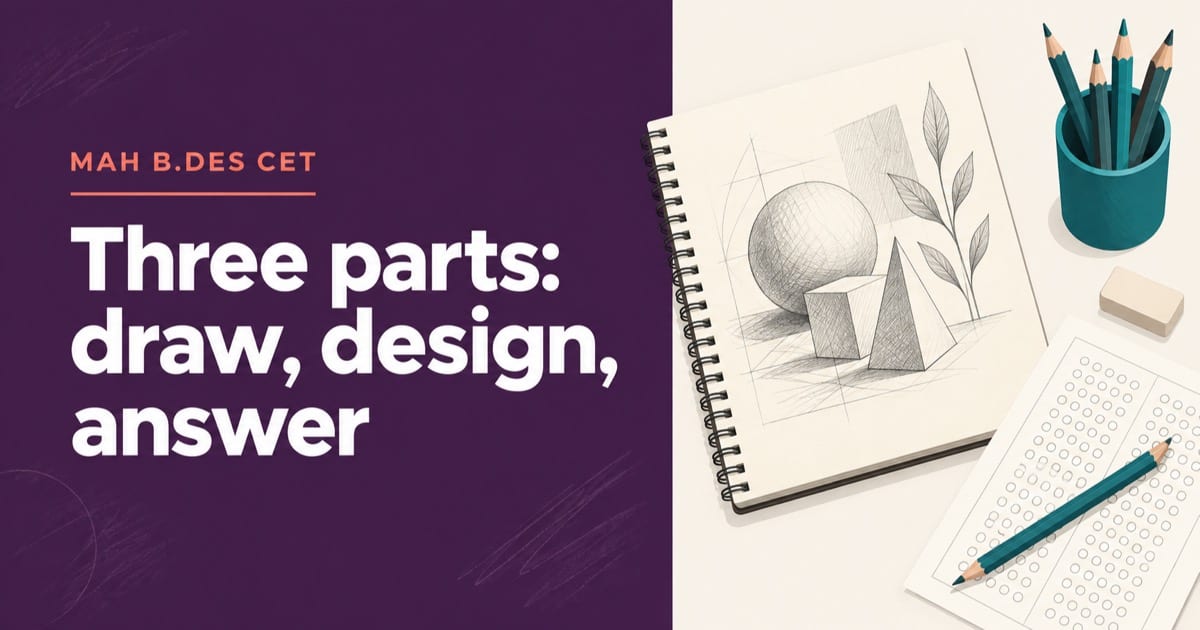
MAH-B. Design CET is the State Common Entrance Test Cell, Maharashtra's test for the four-year Bachelor of Design at the state's CAP institutes. Since 2025 it has been a single sitting in three parts: a 40-mark drawing task, a 60-mark design problem, and 60 multiple-choice questions for 100 marks — 200 marks in 2 hours 45 minutes of test time. It is taken on paper, not on a computer, and there is no negative marking. Half the marks are for what you draw, so preparing only for the MCQs gives away half the paper. This guide sets out the pattern from the CET Cell's own documents.
MAH-B. Design CET 2026 brochure and syllabus.
The three parts
| Part | What you do | Questions | Marks | Time |
|---|---|---|---|---|
| A — Visualisation and illustration | Sketch a situation described in a paragraph (people, objects, an event) with pencil sketching and shading | 1 | 40 | 45 min |
| Break | — | — | — | 15 min |
| B — Design thinking and problem solving | Read a problem situation, sketch a solution, render it in colour and annotate it | 1 | 60 | 60 min |
| Break | — | — | — | 30 min |
| C — MCQs | 60 objective questions answered on an OMR sheet — the section table lists all four sections as MCQs | 60 | 100 | 60 min |
From the CET Cell's 2026 syllabus and marking scheme and the 2026 brochure. All parts are compulsory and there is no choice of question. The syllabus overview row for Part C mentions "multiple-choice objective type questions, Numerical answer type questions", while its section table lists every section as MCQs and the brochure describes OMR answers; the 2027 notification will settle the format.
CET Cell syllabus and marking scheme, 2026.
Part C in detail
2026 syllabus; identical in the syllabus the CET Cell uploaded in November 2024 for 2025-26.
| Section | Official topics |
|---|---|
| General knowledge / awareness | General knowledge, basics of computers, current affairs |
| Art & design fundamentals | Elements and principles of design, perception of form, aesthetic sensitivity, colour theory and schemes, basic art history, Indian culture, dance forms, classical music, arts and crafts, tribal art forms and their states, Egyptian, Roman, Mughal and Harappan cultures |
| Science–technology | Basics of physics, geometry and mathematics; everyday mechanical and scientific concepts; knowledge of materials |
| Analytical and logical reasoning | Recognising patterns, analysing data, sequences and relationships between shapes and images |
Two things follow from the marks. Art and design fundamentals is the biggest MCQ block — 40 marks, as much as science and reasoning combined and twice GK. And there is no English section: the paper is set in English, but English grammar and comprehension are not tested as such. An hour for 60 questions is a minute each, with nothing lost for a wrong answer, so every question should be answered.
Pacing Part C: 60 questions in 60 minutes
| Section | Suggested time | Why |
|---|---|---|
| Art & design fundamentals (20 × 2) | 22 minutes | Worth 40% of the MCQ marks; recognition questions go fast, colour and composition ones need a moment |
| Analytical and logical reasoning (10 × 2) | 14 minutes | Shape sequences and patterns take the longest per question |
| Science–technology (10 × 2) | 12 minutes | Short calculations and everyday-physics questions |
| General knowledge (20 × 1) | 8 minutes | You know it or you do not; do not dwell |
| Check the OMR sheet | 4 minutes | The sheet is scanned by machine with no manual checking |
Our suggestion. Because there is no negative marking, fill every bubble before time is called — an unanswered question can only score zero.
How the drawing parts are marked
The syllabus says Part A "will be evaluated for observation skills, creative/imaginative presentation, composition of drawing, for right proportions, good line quality, perspective, and shading." Part B asks you to "understand the given situation, use their earlier experience & observations", then "draw a proportionate sketch by highlighting essential elements/new features in the idea", colour it "with appropriate colour scheme", and write a short annotation. In plain terms: Part A rewards looking and drawing well, Part B rewards an idea that solves the stated problem and is explained clearly. A beautiful render of a weak idea will lose marks in B; a clever idea drawn out of proportion will lose them in A.
What to bring (brochure, Annexure I)
- Your own colours, brushes, pencils, eraser, scale, palette and a cotton rag — the CET Cell does not supply drawing material.
- Colour pencils, markers or sketch pens for Part B rendering.
- A blue or black pen for the OMR sheet in Part C.
- The admit card and a valid photo ID.
Offline, English, no scribe
| Rule | What the CET Cell says |
|---|---|
| Mode | Offline, at selected centres; drawing sheets for A and B, OMR answer sheet for C, scanned by machine with no manual checking |
| Medium | English only, all parts |
| Negative marking | None |
| Scribe | Not available for MAH-B. Design CET 2026 |
| Centre | Chosen at registration; cannot be changed once allotted |
| Sessions | One date, one sitting in 2025 and 2026; no normalisation document for B.Design was published |
From the 2026 brochure (sections 3, 5 and 7) and the syllabus. One CET Cell registration notice of 22 January 2026 called the tests "Online"; the brochure, syllabus and final-extension notice all say offline.
Where other pages get this wrong
MAH B.Des CET has been a three-part, 62-question, 200-mark paper since the 2025 cycle, taken offline in 2 h 45 min of test time.
Commonly published instead: "Exam duration 3 hours 45 minutes", "Part C is 90 minutes", or the old pattern of 70 MCQs plus two sketching questions in 3 hours.
The 2026 brochure and syllabus give 45 + 60 + 60 minutes of test time with two breaks. The "90 minutes" is a leftover line in the 2025 brochure that contradicts its own timetable, and the 70 + 2 pattern belongs to 2024.
The exam day in 2026
| Time (5 Apr 2026) | What happens |
|---|---|
| 10:30 | Reporting for Parts A and B |
| 11:00–11:45 | Part A — illustration |
| 11:45–12:00 | Break |
| 12:00–1:00 | Part B — design problem |
| 1:30 | Reporting for Part C |
| 2:00–3:00 | Part C — 60 MCQs |
From the 2026 brochure and the CET Cell's final dates notice. In 2025 Part C ran 1:30–2:30. The result notices mention no answer key: the CET Cell releases a score card, then shows images of your drawing sheets in your login with a paid objection window (₹1,000 per objection in 2025 and 2026).
Estimate your score
MAH B.Des CET score estimator
Enter a realistic estimate for the two drawing parts and how many MCQs you would get right in each Part C section. The estimator adds up the 200 and compares it with where each college's first round closed in 2026.
Marks per question from the 2026 syllabus: GK 1 mark, the other three MCQ sections 2 marks each; no negative marking. Closing scores are Round I, Maharashtra State Level seats, from the CET Cell's 2026-27 cut-off list — G = General (open to all), L = Ladies. With more than 350 CAP seats still vacant after Round IV in 2026, later rounds and institute-level admissions went further down the merit list; a new year's closing score will differ.
The college figures are Round I closing scores for 2026; the cut-off guide has both years and every category.
Practise it, don't just read it
Part C is where steady practice pays fastest — the art and design section alone is 40 marks.
The ProSyllabus MAH B.Des CET library has quizzes for Design Awareness and General Knowledge, Principles of Design and Art History, Visual and Spatial Reasoning and Logical and Analytical Reasoning — the Part C ground. The first one is free.
What is the exam pattern of MAH B.Des CET?
Three parts: A, a 40-mark illustration task in 45 minutes; B, a 60-mark design problem in 60 minutes; C, 60 MCQs for 100 marks in 60 minutes. 200 marks in all, offline, no negative marking.
Is there negative marking in MAH B.Des CET?
No. The brochure and syllabus both say there is no negative marking.
Is MAH B.Des CET online or offline?
Offline — drawing sheets for Parts A and B and an OMR sheet for Part C, at selected centres.
What is the syllabus of MAH B.Des CET Part C?
General knowledge and current affairs (20 marks), art and design fundamentals (40), science and technology (20) and analytical and logical reasoning (20).
Is English tested in MAH B.Des CET?
The paper is in English, but there is no English language section in the official syllabus.
How long is the MAH B.Des CET exam?
2 hours 45 minutes of test time — 45, 60 and 60 minutes — with breaks of 15 and 30 minutes.
Do I need to bring my own colours for MAH B.Des CET?
Yes. Candidates bring their own colours, brushes, pencils, eraser, scale and other drawing material.
Is there an answer key for MAH B.Des CET?
None was published in 2025 or 2026. The CET Cell releases a score card, shows images of your drawing sheets in your login and takes objections at ₹1,000 each.
Are there official mock tests for MAH B.Des CET?
No. The CET Cell's mock-test list for 2025-26 covers other CETs but not B.Design.
Sources
- official — CET Cell — Information Brochure, MAH-B. Design CET 2026 (updated 16 Mar 2026)
- official — CET Cell — syllabus and marking scheme, technical CETs 2026
- official — CET Cell — syllabus and marking scheme uploaded Nov 2024 (A.Y. 2025-26)
- official — CET Cell — Information Brochure, MAH-B. Design CET 2025
- official — CET Cell — Information Brochure, MAH-B. Design CET 2024 (old pattern)
- official — CET Cell — technical education CET 2026 final dates (16 Mar 2026)
- official — CET Cell — B.Design CET 2026 registration notice (22 Jan 2026)
- official — CET Cell — B.Design CET 2026 final extension notice (24 Feb 2026)
- official — CET Cell — B.Design CET 2026 result notice (11 Jun 2026)
- official — CET Cell — B.Design CET 2025 result notice (9 Jun 2025)
- official — CET Cell — mock-test links A.Y. 2025-26 (no B.Design mock)
- official — B.Design CAP 2026-27 — cut-off list, Maharashtra seats, Round I
- reported — Careers360 — MAH B.Design CET (reported; see corrections)
official = a document published by the conducting body. reported = a news or coaching site we could not check against an original. Where sources disagree this page says so rather than picking one.