
Checked 11 November 2026. From the official Fast Stream Assessment Centre guide on Civil Service Careers and the GOV.UK Fast Stream recruitment data and annual reports, read on 11 November 2026. Scoring and selection rules can change between campaigns; check your own invitation.
Three short answers, from the official pages we read on 11 November 2026. Pass mark: none is given for the Fast Stream Assessment Centre (FSAC) for 2027 entry. Pass rate: we found no FSAC pass rate in the official sources listed at the end of this guide. Scoring: three exercises, each marked independently by a different assessor, against a set standard rather than against the other candidates; the score scale, any weighting and how exercise scores combine are not stated. Below: the official wording, what older official reports said about pass marks, the whole-process success rates GOV.UK does publish, and what two official freedom of information replies add.
Civil Service Careers, FSAC guide (read 11 November 2026); GOV.UK, Fast Stream recruitment data 2026, Table 1.
Where other pages get this wrong
Is there a fixed FSAC pass mark or pass rate? The official pages give neither.
Commonly published instead: a percentage you must reach at FSAC, or a share of candidates who pass it.
The official FSAC guide for 2027 entry gives no figure for either. The GOV.UK recruitment data counts applications and the number recommended for appointment for the whole process, with no table for the assessment centre stage. Two official freedom of information replies add some historical counts, not an FSAC pass rate (below). If you see an FSAC pass mark or pass rate elsewhere, check its source and campaign year: the official sources reviewed here give no figure for 2027 entry.
Fast Stream assessment centre scoring: how FSAC is marked
| Official wording or close summary (FSAC guide, 2027 entry) | What it means for you |
|---|---|
| “We will measure your potential against our set criteria.” | There are criteria, published below as the 4D framework. The guide does not say how they become a mark. |
| “Your performance in each exercise is marked independently and by different assessors.” | Three exercises, each marked independently by a different assessor. |
| “Each exercise is marked by a different assessor, meaning no single person makes a final decision on your application.” | No one assessor decides your result. |
| “you’re all assessed against a set standard.” | You are not marked against the other candidates. The guide says so in the same sentence. |
| Summary: the assessors will not see your application form or previous scores, or know your educational or employment history. | Your assessors judge only what they see in the exercise. Whether earlier scores count anywhere in the final decision is not stated. |
| Summary: it is normal to find some exercises harder than others; they are designed so you can perform well in one area even if you find another challenging. | Finding one exercise harder is normal. The guide does not say whether a stronger exercise can offset a weaker one. |
Lines in quotation marks are quoted; lines starting “Summary” are close summaries. All are from the About, “What is assessed and how to prepare” and “The assessments” pages of the official FSAC guide, read on 11 November 2026.
What each exercise is marked on
| Exercise | Format (official) | Marked on (official) |
|---|---|---|
| <a href="/hub/fast-stream-written-exercise" style="color:#255a45;font-weight:600">Written Exercise</a> | 55 minutes: review an information pack, complete 4 written tasks in a Word template | The 4D framework: Think, Relate, Adapt, Strive (official Written Exercise page) |
| <a href="/hub/fast-stream-oral-briefing-exercise" style="color:#255a45;font-weight:600">Oral Briefing Exercise</a> | 45 minutes to prepare, a 10-minute briefing to a director played by the assessor, 15 minutes of questions | Think, Relate, Adapt, Strive (official Oral Briefing Exercise page) |
| <a href="/hub/fast-stream-interview-questions" style="color:#255a45;font-weight:600">Personal Development Conversation</a> | A 30-minute, one-to-one structured discussion with an assessor | Three dimensions: Relate, Adapt, Strive |
The four dimensions as the official guide defines them: Think is how you gather, process and analyse information; Relate is your interpersonal skills and emotional intelligence; Adapt is your flexibility and learning agility; Strive is your drive and values. The guide adds that assessors are not looking for perfection but for potential as a future leader in the Civil Service.
Published and not published, at a glance
| Question | Official answer (2027 entry) |
|---|---|
| Is there an FSAC pass mark? | Not given. The guide refers to set criteria and a set standard, with no figure. |
| What is the score scale for each exercise? | Not described. |
| Are the three exercises weighted equally? | Not stated. |
| Can a strong exercise make up for a weak one? | Not stated. The guide does not explain how exercise scores combine. |
| Am I compared with the other candidates? | No. You are assessed against a set standard, not against each other. |
| What share of candidates pass FSAC? | Not published. Freedom of information replies give historical counts of FSB invitations for three schemes and of FSAC invitations for 2018 (below). |
| Is the standard the same for every scheme? | Not stated. |
| Will I get feedback on my scores? | Yes. A performance report, successful or not, gives feedback on your scores on each exercise. Whether it shows numbers is not stated. |
The stage before FSAC has its own page: our online tests pass mark guide covers what is published about scoring the earlier online tests.
From FSAC to a decision
| Step | What the official guide says |
|---|---|
| Performance report | Everyone receives one, successful or not, on the Fast Stream homepage: feedback on your scores on each exercise, what a high-performing response looks like, and development tips. Save or screenshot it: it will be removed at the end of May 2027, and you cannot request it after that. |
| Policy or Digital schemes | The FSAC is the final part of your selection process. |
| Other schemes | If you are successful at FSAC for a scheme with one, you attend a Final Selection Board (FSB), a specialist assessment for that scheme. Our <a href="/hub/fast-stream-final-selection-board" style="color:#255a45;font-weight:600">Final Selection Board guide</a> covers it. |
| Successful at the end of selection | The onboarding team sends your formal job offer and information about pre-employment checks and how you will be placed into your first post. |
When results arrive, and how long they take, is covered in our assessment centre dates and results guide. The FSAC guide does not give a number of days.
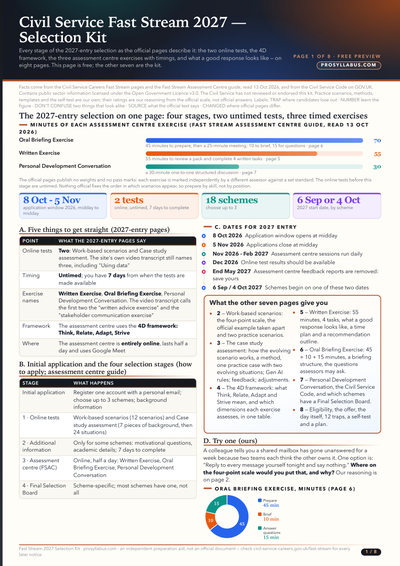
- Written Exercise: 55 minutes, 4 tasks
- Oral Briefing: 45 minutes to prepare, 10 to brief, 15 of questions
- Personal Development Conversation: 30 minutes
- One report with a practice score out of 12 on our own scale
- What held your score back, quoted from your own words where a quote fits
- A plan to your assessment-centre date, up to 120 days ahead
What older official reports said about the FSAC pass mark
Two older Fast Stream annual reports on GOV.UK say more about pass marks than any page for 2027 entry. They describe earlier campaigns with a different process (a separate online e-Tray stage, and in 2017 and 2018 an FSAC made up of a leadership exercise, an analysis exercise and a group exercise), so read them as history, not as this year’s rules.
| Report | What it said | Stated for 2027? |
|---|---|---|
| Annual report 2015 (published January 2017) | Pass marks were finalised gradually, to keep places for high-scoring candidates seen late in the year (the report does not say which stages this covered, and says other ways were being explored for 2017). Candidates who achieved the pass mark at the assessment centre had reached the required standard, and were guaranteed a place in the Corporate Fast Stream if they had listed it as a preference. Candidates were ranked in order of merit on a final mark awarded at the assessment centre. | No |
| Annual report 2017-2018 (published December 2018) | “we gradually finalise pass marks to ensure that we still have places remaining at the end of the recruitment year for high scoring candidates who we see late in the schedule.” | No |
| Annual report 2017-2018 | A Direct Appointment Scheme offered candidates who were narrowly unsuccessful at FSAC a mainstream post at EO or HEO grade if one became available: 378 EO and 110 HEO posts for 2017 entry, 587 EO and 539 HEO in 2018. | No |
What this adds up to: the 2015 report mentions an FSAC pass mark and a final FSAC mark. The 2017-2018 passage mentions pass marks being gradually finalised, without naming the stage. Neither report gives a figure, and neither says anything about 2027 entry, whose guide gives no pass-mark figure; it refers to set criteria and a set standard.
FSAC pass rate: what the official statistics show
The GOV.UK Fast Stream recruitment data for 2024, 2025 and 2026 gives vacancies, applications and the number of people recommended for appointment, scheme by scheme, and a success rate. None of the three publications has a table for a single selection stage, so they cannot tell you how many candidates passed FSAC.
| Recruitment data | Vacancies | Applications (first preference) | Recommended for appointment | Success rate (official) |
|---|---|---|---|---|
| 2024 | 915 | 44,362 | 986 | 2.2% |
| 2025 | 676 | 72,691 | 754 | 1.0% |
| 2026 | 654 | 69,046 | 703 | 1.0% |
Recommended for appointment ÷ applications by first preference. GOV.UK, Fast Stream recruitment data 2024, 2025 and 2026, Table 1. Not an FSAC pass rate.
Two cautions. First, these rates cover the whole selection process, including the online tests and a Final Selection Board where the scheme has one, so they are not the share of candidates who pass FSAC. Second, the number recommended can exceed vacancies (986 against 915 in 2024); the table rows we read do not explain why. For whole-process success rates by scheme, see our success rates by scheme.
What the freedom of information replies show
Two official Cabinet Office replies to freedom of information requests, published on the WhatDoTheyKnow site, add historical counts. Neither gives an FSAC pass rate.
Candidates invited to the Final Selection Board for three schemes, 2019 to 2024
Numbers are FSB invitations. The percentage in parentheses is the share of that scheme’s first-preference applicants. These are not FSAC pass rates: that denominator includes applicants who were unsuccessful at earlier stages or withdrew.
| Campaign | Diplomatic and Development | Diplomatic and Development Economics | Government Economic Service |
|---|---|---|---|
| 2019 | 108 (0.8%) | 25 (3.6%) | 347 (52.0%) |
| 2020 | 107 (0.7%) | 58 (7.6%) | 445 (26.3%) |
| 2021 | 68 (0.5%) | 58 (7.0%) | 147 (10.5%) |
| 2022 | 86 (0.8%) | 52 (8.2%) | 214 (21.4%) |
| 2023 | 108 (1.6%) | 68 (15.2%) | 245 (38.3%) |
| 2024 | 77 (0.8%) | 47 (9.0%) | 164 (20.4%) |
Cabinet Office reply FOI2025/00795, 13 February 2025. Its footnote says candidates who passed the assessment centre for the scheme and did not subsequently withdraw would be eligible to take part in the Final Selection Board. The same reply described the Government Policy and Generalist schemes as never having had a Final Selection Board, with FSAC as the final assessment stage; the current guide names Policy and Digital as the schemes for which FSAC is the final part of selection.
The table gives FSB invitation counts for these schemes. Those candidates had passed FSAC and not withdrawn, but the figures are not a count of everyone who passed FSAC, and the reply does not say how many sat FSAC for each scheme, so no pass rate can be worked out. The same reply also gives pass rates for the Final Selection Board itself, covered in our Final Selection Board guide.
One year with an FSAC invitation count: the 2018 campaign
| Figure | Number | Source |
|---|---|---|
| Candidates invited to the assessment centre, 2018 (2017/18) campaign | 5,032 | Cabinet Office reply FOI327430, 6 February 2019. It says data before 2018 is not held. |
| Recommended for appointment, Fast Stream recruitment 2018, all schemes | 1,411 | GOV.UK, Fast Stream annual report 2017-2018, Table 11 |
Do not divide 1,411 by 5,032: that would not give an FSAC pass rate. The invitation count does not say how many attended, some schemes used a further selection stage after FSAC, and the FSAC of 2018 had different exercises from the one described for 2027 entry.
- Written Exercise: 55 minutes, 4 tasks
- Oral Briefing: 45 minutes to prepare, 10 to brief, 15 of questions
- Personal Development Conversation: 30 minutes
- One report with a practice score out of 12 on our own scale
- What held your score back, quoted from your own words where a quote fits
- A plan to your assessment-centre date, up to 120 days ahead
Worked example: how one answer maps to the dimensions
The guide gives no numerical pass mark, so for preparation the useful question is what an assessor can give credit for. The official guide says assessors can only credit what you say and do in the moment. Here is one invented Personal Development Conversation answer read against the three dimensions that exercise is marked on.
Worked example · Personal Development Conversation
Practice question: “Tell me about a time you changed how you did something after getting feedback.”
Answer (invented): “In my second year I ran the society’s newsletter. After two issues our treasurer told me, kindly but clearly, that the issues were too long and members stopped reading after the first page. I was a bit defensive at first, so I asked her to show me where she stopped reading. Then I checked the email statistics: about a third of people opened it, and almost nobody clicked anything past the first story. I cut each issue to five short items with the dates at the top, and asked two first-years to read a draft before it went out. Opens rose to just over half by the end of the term. What I took from it is that I now ask for feedback before something goes out, not after, and I still do that with my coursework.”
| Dimension (official name) | Evidence in this answer (our reading) | What would make it stronger (our reading) |
|---|---|---|
| Relate | Admits being defensive, then asks the treasurer to show the problem; brings in first-year readers | A line on how the treasurer reacted, or how the change was agreed with the committee |
| Adapt | Changes the format after feedback and checks the result with figures | Saying what was tried and dropped along the way |
| Strive | Keeps going after a knock and carries the habit into other work | Why the newsletter mattered to members, beyond the opening rate |
An invented answer written by ProSyllabus. The three dimensions are the ones the official guide names for this exercise; the reading of the answer is ours, not an official marking, and no score or band is implied.
What this means for how you prepare
Our advice, built on the official lines above
- Prepare for all three exercises. Each is marked independently by a different assessor, and nothing published says a weak exercise can be offset by stronger performance elsewhere.
- Ignore the other candidates. Your exercises are assessed against a set standard, not against the other candidates. The guide does not explain how final decisions are made.
- Make the evidence visible. The guide says assessors can only give credit for what you say and do in that moment. Aim at the dimensions each exercise is marked on.
- Do not let one exercise shake you. The guide says it is normal to find some exercises harder than others.
- Save the performance report. It is your official feedback on each exercise, and it is removed at the end of May 2027. Our FSAC guide covers the day itself.
Practice timings and order for each exercise are in the FSAC guide and the three exercise guides.
No published pass mark? Prepare for all three exercises
Fast Stream Assessment Centre Mock Day
- The Written Exercise, the Oral Briefing and the Personal Development Conversation, back to back, with the official timings
- One practice report with feedback on each exercise
Independent practice, not affiliated with the Civil Service Fast Stream or the Cabinet Office. A practice report is not an FSAC score and does not predict one.
What we could not find
Not published on any official page we read on 11 November 2026
- An FSAC pass mark, or how one is set, for 2027 entry.
- The score scale used for each exercise or each dimension.
- How exercise scores are combined, or whether they are weighted.
- The share of candidates who pass FSAC, overall or for any scheme, in any year.
- Whether the standard differs by scheme.
- Whether a narrowly unsuccessful candidate is offered anything, as the Direct Appointment Scheme did in 2017 and 2018.
Quoted text is from Civil Service Careers and GOV.UK, which publish under the Open Government Licence v3.0. This guide is independent and is not written or endorsed by the Civil Service.
Frequently asked questions
Frequently asked questions
What is the pass mark for the Fast Stream Assessment Centre?
No figure is given on the official pages we read. The FSAC guide for 2027 entry says you are measured against set criteria and assessed against a set standard.
What is the Fast Stream Assessment Centre pass rate?
We found no FSAC pass rate in the official sources listed on this page. The GOV.UK recruitment data gives a success rate for the whole process: 1.0% of first-preference applications ended in a recommendation in the 2026 data, 1.0% in 2025 and 2.2% in 2024. A Cabinet Office freedom of information reply gives Final Selection Board invitations for three schemes from 2019 to 2024, but not how many sat FSAC.
How many people are invited to the Fast Stream Assessment Centre?
The only official figure we found is 5,032 candidates for the 2018 (2017/18) campaign, from a Cabinet Office freedom of information reply of February 2019. We found no invitation count for 2027 entry in the official sources.
How is the Fast Stream Assessment Centre scored?
Each of the three exercises is marked independently by a different assessor, against a set standard. The Written Exercise and the Oral Briefing are marked on Think, Relate, Adapt and Strive, and the Personal Development Conversation on Relate, Adapt and Strive. The score scale and how exercise scores combine are not stated.
Am I competing against the other candidates at FSAC?
No. The official guide says you are not competing with the other candidates and that you are all assessed against a set standard.
Can I do badly in one FSAC exercise and still pass?
The guide does not say. It says it is normal to find some exercises harder than others, but it does not explain how exercise scores are combined or whether one can offset another.
Do I get feedback on my FSAC scores?
Yes. You receive a performance report whether you are successful or not, with feedback on your scores on each exercise, a description of a high-performing response and development tips. Whether it shows numbers is not stated. Save it: it is removed at the end of May 2027 and cannot be requested after that.
Do my online test scores count at FSAC?
The guide says the assessors will not see your application form or previous scores. Whether earlier scores count in the final decision is not stated.
Is FSAC the last stage?
For the Policy and Digital schemes, yes. For the schemes named on the official page as having one, candidates successful at FSAC go on to a Final Selection Board.
Sources
- official — FSAC guide: About the Fast Stream Assessment Centre (set criteria; each exercise marked independently by different assessors)
- official — FSAC guide: What is assessed and how to prepare (4D framework, fair assessment, a set standard)
- official — FSAC guide: The assessments (three independent exercises, each marked by a different assessor)
- official — FSAC guide: Written Exercise (55 minutes, 4 written tasks, marked on Think, Relate, Adapt, Strive)
- official — FSAC guide: Oral Briefing Exercise (45 + 10 + 15 minutes, marked on Think, Relate, Adapt, Strive)
- official — FSAC guide: Personal Development Conversation (assessed on Relate, Adapt and Strive)
- official — FSAC guide: After the Fast Stream Assessment Centre (performance report, Final Selection Boards, offers)
- official — GOV.UK: Civil Service Fast Stream recruitment data 2026 (Table 1)
- official — GOV.UK: Civil Service Fast Stream recruitment data 2025 (Table 1)
- official — GOV.UK: Civil Service Fast Stream recruitment data 2024 (Table 1)
- official — Cabinet Office reply to a freedom of information request, FOI2025/00795, 13 February 2025: Final Selection Board statistics 2019 to 2024 (published on WhatDoTheyKnow)
- official — Cabinet Office reply to a freedom of information request, FOI327430, 6 February 2019: candidates invited to the assessment centre (published on WhatDoTheyKnow)
- official — GOV.UK: Civil Service Fast Stream annual report 2015 (published January 2017), section on how candidates are assessed
- official — GOV.UK: Civil Service Fast Stream annual report 2017-2018 (published December 2018), "How we assess"
official = a document published by the conducting body. reported = a news or coaching site we could not check against an original. Where sources disagree this page says so rather than picking one.
What to read next