Guides & contents
ProSyllabus JournalCBSE Class 9 Annual Assessment

Complete Solutions and Summary of Constitutional Design – NCERT Class 9, Civics, Chapter 2 – Summary, Questions, Answers, Extra Questions

Detailed summary and explanation of Chapter 2 'Constitutional Design' covering the need for a constitution, making of the Indian constitution, foundational values and philosophy, key makers and debates, with question answers and extra questions based on NCERT Class IX Civics.

Updated 1 year agoNCERT · Class IX · Civics · Summary · Extra Questions · Constitution · Constitutional Design · Democracy · India · Chapter 2
#Constitution#Democracy#Indian Constitution#Constituent Assembly#Fundamental Rights#Duties#Preamble#Social Justice#Secularism#Representation#India#Political Philosophy#NCERT#Class 9#Civics#Chapter 2#Answers#Extra Questions
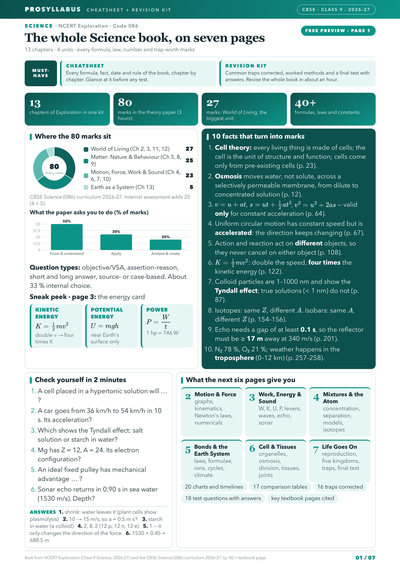
Revision kit13 chapters, 20 charts, 16 traps corrected
  • Marks booster + cheatsheet: key concepts in 2 lines each
  • 16 exam traps, listed
  • 27 marks: Unit I, cells to reproduction
  • 25 marks: Unit II, mixtures to bonding
  • 23 marks: Unit III, motion to sound
  • Formula cards for every law and number
Page 1 free about 8 min read, Full kit about 55 min read
₹59
Read page 1 freeabout 8 minView details
Complete Solutions and Summary of Constitutional Design – NCERT Class 9, Civics, Chapter 2 – Summary, Questions, Answers, Extra Questions
Constitutional Design - Complete Study Guide

Constitutional Design

Chapter 2: Democratic Politics - Complete Study Guide

Comprehensive Chapter Summary

Overview

  • Core Concept of Constitution in Democracy: In democracies, rulers are bound by basic rules called the constitution, the supreme law that outlines citizens' rights, government powers, and functioning; prevents arbitrary rule.
  • Key Questions Addressed: Why need a constitution? How drawn up? Who designs it? What values shape democratic constitutions? Can changes be made later? These questions are explored through real-world examples.
  • Focus on South Africa and India: Recent SA example of post-apartheid design; India's process post-independence; both highlight transformation from oppression to democratic framework fostering citizen and government conduct.
  • Broader Relevance: Constitutions generate trust, specify governance, limit powers, express societal aspirations; essential for diverse societies to coordinate and build inclusive nations.
  • Expanded Insight: Unlike monarchies or dictatorships, democratic constitutions are written, agreed upon by representatives, and amendable to adapt to changing conditions without losing core values.

Learning Tip

Visualize constitution as society's "social contract": A binding agreement like a family rulebook, ensuring fairness and preventing conflicts, inspired by Enlightenment thinkers but adapted locally.

2.1 Democratic Constitution in South Africa

  • Historical Context of Apartheid: Unique racial discrimination system (1948-1989) imposed by white European settlers (17th-18th centuries); divided people by skin color—Blacks (75% natives, oppressed), Coloureds (mixed), Indians (migrants), Whites (rulers treating non-whites as inferiors without votes).
  • Oppressive Features: Segregation in all spheres—living areas (Blacks needed permits for white zones), transport (separate trains/buses), public facilities (hotels, schools, beaches with "whites only" signs like Durban 1953), churches, associations (Blacks barred from protesting).
  • Struggle Against Apartheid: Began 1950s with protests, marches, strikes led by African National Congress (ANC)—umbrella for workers' unions, Communist Party; joined by sensitive whites; international denunciation as racist, but regime responded with detention, torture, killings of thousands.
  • Nelson Mandela's Iconic Role: ANC leader, tried for treason (Rivonia Trial 1964), sentenced to life on Robben Island (27 years); speech: Fought white/black domination for "democratic free society... prepared to die"; symbolized non-violent yet firm resistance.
  • Towards Transition: Increased struggles forced policy shift—repealed discriminatory laws, lifted bans; Mandela freed 1990 after 28 years; midnight April 26, 1994, new multi-racial flag unfurled, ending apartheid via first democratic elections.
  • Negotiated Constitution: Oppressors (former regime) and oppressed (ANC) sat together for 2 years of debate; forgave past atrocities; built "rainbow nation" on equality, democratic values, social justice, human rights; 1996 Constitution—one of world's finest, granting extensive rights (e.g., equality for all races/genders).
  • Mandela's Vision Expanded: "Historical enemies negotiated peaceful transition... belief in goodness cornerstone of democracy"; preamble heals divisions, honors sufferers, builds open society; inspires global democrats—from pariah state to model.
  • Key Lesson: Inclusive process excluded no one as "demon"; everyone part of solution despite past; contrasts revenge, fostering unity.

Apartheid's Lasting Symbols Expanded

Signs like Durban beach ("reserved for white race group") emblematic of era's tension; hypothetical revenge by black majority post-1994 would perpetuate cycle—chapter asks: What if? Answer: Undermines trust; SA chose forgiveness for sustainable democracy.

2.2 Why Do We Need a Constitution?

  • SA as Illustrative Example: Oppressed (Blacks) and oppressors (Whites) to live as equals post-apartheid; fears on both sides—Blacks wanted majority rule (one person one vote), social/economic rights; Whites sought privilege/property protection.
  • Compromise Dynamics: Long negotiations led to agreement—Whites accepted majority rule/basic rights for poor/workers; Blacks agreed no absolute rule (e.g., no arbitrary property seizure); not easy, required trust-building.
  • Role of Written Rules: Only way to implement/guarantee compromise—written "rules of game" all abide by; lays future ruler selection, elected powers/limits, citizen rights; supreme, not easily changeable by winners.
  • Four Key Functions Detailed:
    • Trust and Coordination: Essential for diverse groups (e.g., SA's racial divides) to live together; prevents breakdown in suspicion-heavy societies.
    • Government Constitution: Specifies formation (e.g., elections), decision powers (who does what), ensuring accountable rule.
    • Limits on Power: Defines what governments cannot do; protects citizen rights (e.g., equality, no discrimination).
    • Aspirational Expression: Outlines vision for good society (e.g., justice, liberty); guides laws/actions.
  • Universality: Not unique to SA/countries—needed worldwide for differences; applies to associations (clubs, cooperatives) requiring democratic rules like non-discriminatory membership.
  • Democratic Practice: All democracies have written constitutions (e.g., US post-1776 Independence, France post-Revolution); non-democracies may have but ignore them; constitutions enable evolution from subjects to citizens.
  • Expanded Critique: Without constitution, trust fragile (e.g., SA's revenge risk); written form ensures enforcement, unlike oral promises; activity: Analyze local club rules for democratic alignment (e.g., equal voting?).

Real-World Application Expanded

SA's 1996 Constitution: Preamble invokes past injustices, future unity ("May God protect our people"); most extensive rights globally, including socio-economic; model for conflict resolution—e.g., influenced post-apartheid reconciliation commissions.

2.3 Making of the Indian Constitution

  • Challenging Circumstances: Unlike SA, India emerged from colonial subjugation to citizenship amid partition trauma (10 lakh killed in religious violence); princely states' merger uncertain (join India/Pakistan or independent?); future insecure with princely integration challenges.
  • Pre-Existing Consensus Advantage: Freedom struggle not just anti-foreign but rejuvenative—transformed society/politics; sharp differences on post-independence path, but basics agreed (e.g., democracy, equality) from 1928 Motilal Nehru Report (universal franchise, freedom/equality, minority rights) and 1931 Karachi Resolution.
  • Colonial Institutional Legacy: British voting to few led to weak legislatures; 1937 Provincial elections/Ministries (not fully democratic) provided experience for own institutions; adopted details from 1935 Government of India Act (e.g., federal structure).
  • Global Inspirations Adapted: French Revolution (ideals of liberty/equality), British parliamentary practice, US Bill of Rights, Russian socialist equality; leaders questioned suitability for India—not blind imitation, but selective learning on own terms.
  • Constituent Assembly Composition: Elected July 1946 by Provincial Legislatures (fair regional representation); 299 members post-partition (Dec 1946 first meeting); Congress-dominated but diverse (languages, castes, classes, religions, occupations, non-Congress members like communists).
  • Deliberative Process: Systematic/open/consensual—basic principles first; Drafting Committee (Dr. Ambedkar chair) prepared draft; clause-by-clause discussion (114 days over 3 years, 2000+ amendments); all documents/debates recorded (12 volumes 'Constituent Assembly Debates') for interpretation.
  • Adoption and Legitimacy: Adopted Nov 26, 1949; effective Jan 26, 1950 (Republic Day); broad consensus (no major group questions legitimacy today); represented people indirectly via legislatures—composition similar even under universal franchise; unusual achievement vs. rewrites elsewhere.
  • Key Makers Profiles Expanded: Rajendra Prasad (President, Champaran satyagraha); H.C. Mookerjee (Vice-Chair, educationist); Jaipal Singh (Adivasi leader, hockey captain); Vallabhbhai Patel (Home Minister, princely integration); Abul Kalam Azad (Education Minister, anti-separatist); T.T. Krishnamachari (Drafting, Finance Minister); diverse ideologies (socialists, communists, Gandhian).
  • Activity Expansion: Research state member (e.g., G. Durgabai Deshmukh—women's activist); highlights inclusivity.

Partition's Trauma Detailed

Activity: Elders' memories—fears of violence/disintegration, hopes for unity/equality; 10 lakh deaths, Gandhi's assassination underscored need for strong constitution; princely mergers (e.g., Patel's role) crucial for territorial integrity.

2.4 Guiding Values of the Indian Constitution

  • Philosophy from Leaders' Visions: Gandhi (1931 Young India): Release from thralldom; poorest have voice; no high/low classes, untouchability, intoxicants; women equal rights; perfect harmony.
  • Ambedkar's Caution: Key drafter, anti-caste revolutionary; concluding speech: Jan 26, 1950 enters "life of contradictions"—political equality (one man one vote) vs. social/economic inequality; warned prolonged denial perils democracy; urged removal for sustainability.
  • Nehru's Aspirational Pledge: Tryst with Destiny (Aug 15, 1947 midnight): Redeem pledge substantially; awake to freedom; dedicate to service ending poverty/ignorance/disease/inequality; "greatest man" (Gandhi) to wipe every tear—work unending till no suffering.
  • Common Idea in Quotes: Equality/justice for all, ending divisions; differences: Gandhi—harmony/no curses; Ambedkar—structural warnings; Nehru—future striving/service.
  • Preamble as Soul: Short statement of values guiding all articles; "poem on democracy"; examines laws/actions; inspired by US model, most modern constitutions have one.
  • Key Words Point-Wise Explanation:
    • We, the People: Enacted by representatives, not king/external; sovereignty from citizens.
    • Sovereign: Supreme internal/external decisions; no dictation.
    • Socialist (added 1976): Socially generated wealth shared equally; regulate land/industry to reduce inequalities.
    • Secular (added 1976): Freedom for any religion; no official, equal respect all beliefs/practices.
    • Democratic: Equal political rights; elect/hold rulers accountable; rule-based government.
    • Republic: Elected head, not hereditary.
    • Justice (Social/Economic/Political): End caste/religion/gender discrimination; reduce inequalities; welfare for disadvantaged.
    • Liberty (Thought/Expression/Belief): No unreasonable restrictions on thinking/expressing/following beliefs/actions.
    • Equality (Status/Opportunity): All equal before law; end traditional inequalities; ensure equal opportunities.
    • Fraternity: Family-like behavior; dignity/unity/integrity of nation; no inferiority treatment.
  • Preambles Comparison Expanded: Common—people as source, justice/liberty; Differences: US—future union/defense; SA—past healing/diversity/God invocation; India—aspirations for socialist/secular society, no God reference; SA uniquely past-focused.
  • Institutional Design: Embodies values into arrangements (ruler selection, power limits, rights); long/detailed, amendable (e.g., 42nd 1976); legal language complex, but chapters cover key aspects; not static/sacred—updates for aspirations/changes.

Values in Action Expanded

Conduct book (1912) on women as "fragile/destined for male protection"—contradicts equality/liberty/fraternity; Constitution (Article 14-15) ensures non-discrimination, women's emancipation (e.g., Deshmukh's role); amendment debates (e.g., women's reservation) test ongoing relevance.

Exercises Summary Expanded

  • Core Themes Tested: False statements on consensus/amendments; SA conflict; unnecessary provisions; leader matching; Nehru speech analysis; value matching; Constitution Day; democracy factors; critiques; true/false on authority/institutions.
  • Learning Outcomes: Understand why constitutions bind, SA/India processes, Preamble philosophy; apply to current events (e.g., amendments).
CBSE Class 9 kits

Revision kit13 chapters, 20 charts, 16 traps corrected
  • Marks booster + cheatsheet: key concepts in 2 lines each
  • 16 exam traps, listed
  • 27 marks: Unit I, cells to reproduction
  • 25 marks: Unit II, mixtures to bonding
  • 23 marks: Unit III, motion to sound
  • Formula cards for every law and number
Page 1 free about 8 min read, Full kit about 55 min read
₹59
Read page 1 freeabout 8 minView details
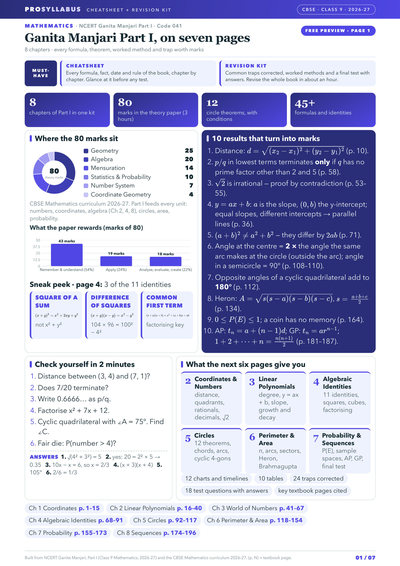
Revision kit11 identities + 12 circle theorems, Class 9
  • Marks booster + cheatsheet: key concepts in 2 lines each, common traps
  • 25 marks: Circles, in Unit IV Geometry
  • 20 marks: linear polynomials, Unit II Algebra
  • Ch 7: probability and its traps
  • 14 marks: Mensuration, Heron and Brahmagupta
  • 8 chapters of worked numericals
Page 1 free about 8 min read, Full kit about 55 min read
₹59
Read page 1 freeabout 8 minView details
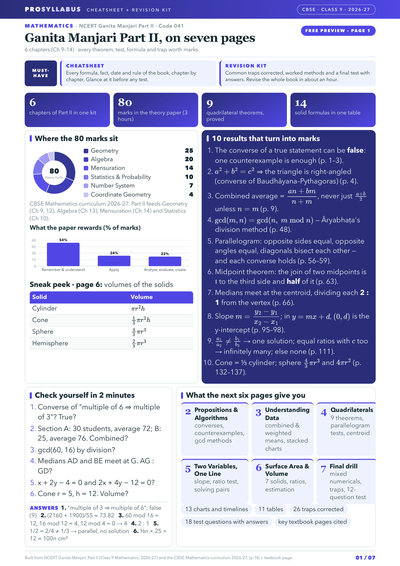
Revision kit9 quadrilateral theorems + all 7 solids
  • Marks booster + cheatsheet: key concepts in 2 lines each, common traps
  • 25 marks: Quadrilaterals, Unit IV Geometry
  • 20 marks: linear equations in two variables
  • Common traps that cost marks, listed
  • 14 marks: surface area and volume
  • 10 marks: combined and weighted averages
Page 1 free about 8 min read, Full kit about 55 min read
₹59
Read page 1 freeabout 8 minView details
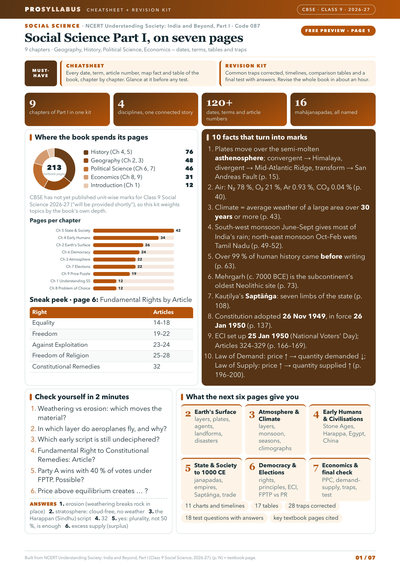
Revision kit9 chapters: Geography to Economics, dated
  • Marks booster + cheatsheet: key concepts in 2 lines each, common traps
  • Timelines from early humans to 1000 CE
  • Article numbers for democracy and elections
  • Common traps that cost marks, listed
  • Comparison tables built from the book
  • Plate tectonics and landforms, Ch 1–2
Page 1 free about 8 min read, Full kit about 55 min read
₹59
Read page 1 freeabout 8 minView details
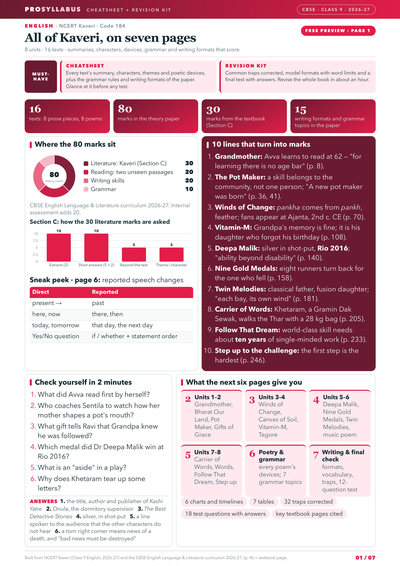
Revision kitAll 16 Kaveri texts + 8 poems in one table
  • Marks booster + cheatsheet: key concepts in 2 lines each, common traps
  • 20 marks: Section B writing formats
  • 10 marks: the 7 grammar topics of the paper
  • Common traps that cost marks, listed
  • 8 units: summaries and characters of each
  • Idioms and expressions in one place
Page 1 free about 8 min read, Full kit about 55 min read
₹59
Read page 1 freeabout 8 minView details
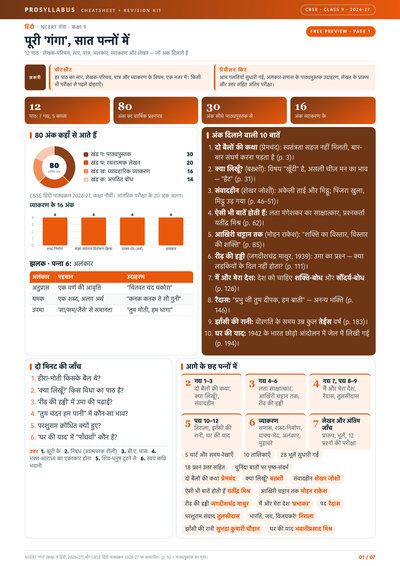
Revision kitAll 12 गंगा lessons, with अलंकार examples
  • Marks booster + cheatsheet: key concepts in 2 lines each
  • 20 अंक: खंड घ रचनात्मक लेखन formats
  • समास and उपसर्ग-प्रत्यय rules in one place
  • अर्थ के आधार पर वाक्य-भेद, with मुहावरे
  • लेखक-परिचय, सार and पात्र for each पाठ
  • 12 भूलें students make
Page 1 free about 8 min read, Full kit about 55 min read
₹59
Read page 1 freeabout 8 minView details

Get alerts for CBSE Class 9 Annual Assessment

Dates, results and cutoffs, by email when they are announced. Free.

Google, Apple, or a code to your phone or email. It is saved to your account.

This chapter is part of the CBSE Class 9 Annual Assessment Board ExaminationExplore every chapter — summary, notes, extra questions & MCQ quizzes

Topic tests for CBSE Class 9 Annual Assessment

Short tests, one topic at a time, with every answer explained.

Double-checked questions Real exam pattern 1 free test every month, then ₹9 per test

#1

Cell: The Building Block of Life

Start here
Science 10 Qs · ~10 min

Instant score, answer review and weak-topic diagnosis

#2

The Pot Maker

English 10 Qs · ~10 min

Instant score, answer review and weak-topic diagnosis

#3

Journey Inside the Atom

Science 10 Qs · ~10 min

Instant score, answer review and weak-topic diagnosis

#4

Describing Motion Around Us

Science 10 Qs · ~10 min

Instant score, answer review and weak-topic diagnosis

#5

Tissues in Action

Science 10 Qs · ~10 min

Instant score, answer review and weak-topic diagnosis

#6

Physical Education and Well-being

Physical Education 10 Qs · ~10 min

Instant score, answer review and weak-topic diagnosis

#7

दो बैलों की कथा

Hindi 10 Qs · ~10 min

Instant score, answer review and weak-topic diagnosis

#8

How I Taught My Grandmother to Read

English 10 Qs · ~10 min

Instant score, answer review and weak-topic diagnosis

#9

The World of Numbers

Maths 10 Qs · ~10 min

Instant score, answer review and weak-topic diagnosis

#10

How Forces Affect Motion

Science 10 Qs · ~10 min

Instant score, answer review and weak-topic diagnosis

#11

आखिरी चट्टान तक

Hindi 10 Qs · ~10 min

Instant score, answer review and weak-topic diagnosis

#12

Science and Sports

Physical Education 10 Qs · ~10 min

Instant score, answer review and weak-topic diagnosis

#13

Vitamin-M

English 10 Qs · ~10 min

Instant score, answer review and weak-topic diagnosis

#14

Exploring Mixtures and their Separation

Science 10 Qs · ~10 min

Instant score, answer review and weak-topic diagnosis

#15

संवादहीन

Hindi 10 Qs · ~10 min

Instant score, answer review and weak-topic diagnosis

#16

Exploring Algebraic Identities

Maths 10 Qs · ~10 min

Instant score, answer review and weak-topic diagnosis

#17

Introduction to Linear Polynomials

Maths 10 Qs · ~10 min

Instant score, answer review and weak-topic diagnosis

#18

निर्मल जीत सिंह सेखों

Hindi 10 Qs · ~10 min

Instant score, answer review and weak-topic diagnosis

#19

रैदास के पद

Hindi 10 Qs · ~10 min

Instant score, answer review and weak-topic diagnosis

#20

Winds of Change

English 10 Qs · ~10 min

Instant score, answer review and weak-topic diagnosis

#21

Measuring Space: Perimeter and Area

Maths 10 Qs · ~10 min

Instant score, answer review and weak-topic diagnosis

#22

Reproduction: How Life Continues

Science 10 Qs · ~10 min

Instant score, answer review and weak-topic diagnosis

#23

घर की याद

Hindi 10 Qs · ~10 min

Instant score, answer review and weak-topic diagnosis

#24

भारति, जय, विजयकरे!

Hindi 10 Qs · ~10 min

Instant score, answer review and weak-topic diagnosis

#25

राम-लक्ष्मण-परशुराम संवाद

Hindi 10 Qs · ~10 min

Instant score, answer review and weak-topic diagnosis

#26

क्या लिखूँ?

Hindi 10 Qs · ~10 min

Instant score, answer review and weak-topic diagnosis

#27

Olympism

Physical Education 10 Qs · ~10 min

Instant score, answer review and weak-topic diagnosis

#28

Follow That Dream

English 10 Qs · ~10 min

Instant score, answer review and weak-topic diagnosis

#29

The Mathematics of Maybe: Introduction to Probability

Maths 10 Qs · ~10 min

Instant score, answer review and weak-topic diagnosis

#30

Orienting Yourself: The Use of Coordinates

Maths 10 Qs · ~10 min

Instant score, answer review and weak-topic diagnosis

#31

Atomic Foundations of Matter

Science 10 Qs · ~10 min

Instant score, answer review and weak-topic diagnosis

#32

Entering the World of Secondary Science

Science 10 Qs · ~10 min

Instant score, answer review and weak-topic diagnosis

#33

तब याद तुम्हारी आती है

Hindi 10 Qs · ~10 min

Instant score, answer review and weak-topic diagnosis

#34

झाँसी की रानी

Hindi 10 Qs · ~10 min

Instant score, answer review and weak-topic diagnosis

#35

मैं और मेरा देश

Hindi 10 Qs · ~10 min

Instant score, answer review and weak-topic diagnosis

#36

रीढ़ की हड्डी

Hindi 10 Qs · ~10 min

Instant score, answer review and weak-topic diagnosis

#37

ऐसी भी बातें होती हैं (लता मंगेशकर से साक्षात्कार)

Hindi 10 Qs · ~10 min

Instant score, answer review and weak-topic diagnosis

#38

Yoga for Holistic Health and Personal Excellence

Physical Education 10 Qs · ~10 min

Instant score, answer review and weak-topic diagnosis

#39

Sports

Physical Education 10 Qs · ~10 min

Instant score, answer review and weak-topic diagnosis

#40

Sports for All

Physical Education 10 Qs · ~10 min

Instant score, answer review and weak-topic diagnosis

#41

Carrier of Words

English 10 Qs · ~10 min

Instant score, answer review and weak-topic diagnosis

#42

Twin Melodies

English 10 Qs · ~10 min

Instant score, answer review and weak-topic diagnosis

#43

The World of Limitless Possibilities

English 10 Qs · ~10 min

Instant score, answer review and weak-topic diagnosis

#44

Predicting What Comes Next: Exploring Sequences and Progressions

Maths 10 Qs · ~10 min

Instant score, answer review and weak-topic diagnosis

#45

I'm Up and Down, and Round and Round

Maths 10 Qs · ~10 min

Instant score, answer review and weak-topic diagnosis

#46

Earth as a System: Energy, Matter, and Life

Science 10 Qs · ~10 min

Instant score, answer review and weak-topic diagnosis

#47

Patterns in Life: Diversity and Classification

Science 10 Qs · ~10 min

Instant score, answer review and weak-topic diagnosis

#48

Sound Waves: Characteristics and Applications

Science 10 Qs · ~10 min

Instant score, answer review and weak-topic diagnosis

#49

Work, Energy, and Simple Machines

Science 10 Qs · ~10 min

Instant score, answer review and weak-topic diagnosis

#50

Fundamental Rights and Duties Fundamentals | CBSE Class 9 Annual Assessment

10 Qs · ~10 min

Instant score, answer review and weak-topic diagnosis

#51

Motion Along a Straight Line Fundamentals | CBSE Class 9 Annual Assessment

10 Qs · ~10 min

Instant score, answer review and weak-topic diagnosis

#52

Number Systems and Operations Fundamentals — Free CBSE Class 9 Annual Assessment Quiz

10 Qs · ~10 min

Instant score, answer review and weak-topic diagnosis

More on CBSE Class 9 Annual Assessment20 guides

Kathmandu - NCERT Class 9, Chapter 8 - Summary, Questions, Answers, Extra QuestionsComplete Solutions and Summary of Atoms and Molecules – NCERT Class 9, Science, Chapter 3 – Summary, Questions, Answers, Extra QuestionsComplete Solutions and Summary of Socialism in Europe and the Russian Revolution – NCERT Class 9, History, Chapter 2 – Summary, Questions, Answers, Extra QuestionsComplete Solutions and Summary of The Fundamental Unit of Life – NCERT Class 9, Science, Chapter 5 – Summary, Questions, Answers, Extra QuestionsComplete Solutions and Summary of Introduction to Euclid's Geometry – NCERT Class 9, Mathematics, Chapter 5 – Summary, Questions, Answers, Extra QuestionsComplete Solutions and Summary of India - Size and Location – NCERT Class 9, Geography, Chapter 1 – Summary, Questions, Answers, Extra QuestionsComplete Solutions and Summary of Number Systems – NCERT Class 9, Mathematics, Chapter 1 – Summary, Questions, Answers, Extra QuestionsComplete Solutions and Summary of Circles – NCERT Class 9, Mathematics, Chapter 9 – Summary, Questions, Answers, Extra QuestionsComplete Solutions and Summary of Introduction to Mathematical Modelling – NCERT Class 9, Mathematics, Appendix 2 – Summary, Questions, Answers, Extra QuestionsComplete Solutions and Summary of Heron's Formula – NCERT Class 9, Mathematics, Chapter 10 – Summary, Questions, Answers, Extra QuestionsComplete Solutions and Summary of Is Matter Around Us Pure – NCERT Class 9, Science, Chapter 2 – Summary, Questions, Answers, Extra QuestionsComplete Solutions and Summary of Statistics – NCERT Class 9, Mathematics, Chapter 12 – Summary, Questions, Answers, Extra QuestionsComplete Solutions and Summary of Triangles – NCERT Class 9, Mathematics, Chapter 7 – Summary, Questions, Answers, Extra QuestionsComplete Solutions and Summary of Sound – NCERT Class 9, Science, Chapter 11 – Summary, Questions, Answers, Extra QuestionsComplete Solutions and Summary of Structure of the Atom – NCERT Class 9, Science, Chapter 4 – Summary, Questions, Answers, Extra QuestionsComplete Solutions and Summary of Improvement in Food Resources – NCERT Class 9, Science, Chapter 12 – Summary, Questions, Answers, Extra QuestionsComplete Solutions and Summary of Proofs in Mathematics – NCERT Class 9, Mathematics, Appendix 1 – Summary, Questions, Answers, Extra QuestionsComplete Solutions and Summary of Matter in Our Surroundings – NCERT Class 9, Science, Chapter 1 – Summary, Questions, Answers, Extra QuestionsComplete Solutions and Summary of Gravitation – NCERT Class 9, Science, Chapter 9 – Summary, Questions, Answers, Extra QuestionsComplete Solutions and Summary of Polynomials – NCERT Class 9, Mathematics, Chapter 2 – Summary, Questions, Answers, Extra Questions
Notebook backup + AISave your notes. Revise with AI.Learn more →

Discussion

No discussions yet.

Share this article

Page 1 free about 8 min read, Full kit about 55 min read
Page 1 freeabout 8 min

View details