Checked 14 October 2026. From the GOV.UK guidance pages for the Civil Service Judgement Test (last updated 24 May 2024), Civil Service online tests (27 January 2026) and reasonable adjustments for online tests (28 January 2026), read on 14 October 2026. Pass marks are set per job and are not published; test guidance can change without notice.
People search for the Civil Service Judgement Test pass mark expecting a number: a percentage, or a score out of something. The official guidance does not give one, and that is not an oversight. This guide sets out exactly what GOV.UK says about how the Civil Service Judgement Test (CSJT) is scored, the two different thresholds a candidate meets, who decides each of them and when, and which parts of the scoring are simply not published. Every statement below is taken from the official pages listed at the foot, read on 14 October 2026. Where we have added our own arithmetic or our own reading, it is labelled as ours.
The short answer
No pass mark for the Civil Service Judgement Test is published. Your score is a percentile against other applicants, and the recruiter sets the pass mark for each job after the test deadline.
GOV.UK describes a “minimum required standard” for each job level, then says the recruiter “will look at all applicant scores to decide what the job’s pass mark will be” and “may decide to raise the pass mark for the job”. It gives no figure for either. We found no official page that does, so this guide prints none.
GOV.UK, Preparing for the Civil Service Judgement Test (last updated 24 May 2024), read 14 October 2026.
The test in one table
Before the scoring makes sense you need the shape of the test. Everything in this table is from the GOV.UK guidance page for the Civil Service Judgement Test, except the row on the answer options for part 1, which comes from the official practice test.
| Feature | What the official page says |
|---|---|
| Official name | Civil Service Judgement Test (CSJT); the online-tests page shortens it to “Judgement Test” |
| Type of test | An online situational judgement test |
| What it measures | Judgement and decision-making regarding specific Civil Service Behaviours selected as important for the job |
| Part 1 | Self-assessment of your typical behaviour and preferences at work; 15% of the overall CSJT score |
| Part 1 answer options | The page does not list them. The official practice test shows a seven-point agree/disagree scale, from Completely Disagree to Completely Agree |
| Part 2 | Workplace scenarios, each with possible actions that you rate for effectiveness |
| Scenarios | Three scenarios for each behaviour; each scenario asks you to rate four actions |
| Rating scale | Counterproductive, Ineffective, Fairly Effective, Effective |
| Format | Scenarios for three of the behaviours are short videos, the others are text; a job may show only video, only text, or a mix |
| Time limit | None. Most people take two to four minutes a scenario; allow at least an hour |
| Where it is taken | Online, from an invitation; relaunched from your application centre in Civil Service Jobs |
| Result | A score shown as a percentile, with automatically generated feedback |
| Pass mark | No figure published. A minimum standard applies for the job level, and the recruiter decides each job's pass mark after the deadline |
The official name is the Civil Service Judgement Test. GOV.UK describes it as “an online situational judgement test”, which is why candidates also search for it as the Civil Service situational judgement test. It is one of the commonly used Civil Service online tests: the GOV.UK online-tests page (updated 27 January 2026) lists 8, while the Civil Service Careers page on assessments and interviews still says “There are 7 commonly used tests”. Both list the Civil Service Judgement Test. The job advert says whether a vacancy uses it.
How the score is produced
The guidance has one sentence on how the score is made: “The number and difficulty of test questions is used to produce your score, which is compared to a representative group of applicants who have also taken the test.” The general online-tests page puts it this way: “Your test score is calculated from your responses, which we compare with the results of a peer group who took the same test - this creates a percentile.”
Two things follow from those sentences. First, the result you see is relative. It places you against other people, not against a fixed number of right answers. Second, difficulty is part of the calculation, so two candidates who see different scenarios (the page says you only see scenarios relevant to the job level you applied for) are not simply being counted on answers matched.
What the pages do not explain is the mechanics underneath: how each of your ratings is compared with the intended rating, whether a rating one step away from the intended one earns partial credit, or how difficulty is weighted. None of that is published. Any website that tells you a near miss is worth half a mark, or that a wrong rating loses marks, is describing something the Civil Service has not put on an official page we could find.
The 15% that is not a scenario
The test has two parts, and the first is easy to overlook. In the words of the guidance: “In the first part, you will be asked about your typical behaviour and preferences at work. You must rate how ambitious, motivated and flexible you are in the workplace.” It then states the weighting: “This section is self-assessment, and makes up 15% of your overall CSJT score.”
Our arithmetic: if the self-assessment is 15% of the overall score, the rest of the test accounts for the other 85%. The page does not print the figure 85, and it does not say how that share is divided between behaviours or scenarios. It does add a warning that matters more than the weighting: “You should answer the questions honestly, as you may be asked about them at interview.”
The four ratings you are scored on
In the second part you read or watch a workplace scenario and give an effectiveness rating to each action. These are the four options and their official descriptions, word for word.
| Rating | Official description (GOV.UK) |
|---|---|
| Counterproductive | An unacceptable action that would make the situation worse. |
| Ineffective | A poor action that would not help the situation. |
| Fairly Effective | A useful action that would be of some help to the situation. |
| Effective | A good action that would help to resolve the situation. |
The guidance is explicit that the ratings are not a ranking exercise: “When reviewing an action, look at it independently from the others. Do not assume that only one action is either effective or ineffective - you can rate more than one action the same.” So a scenario can have two actions that deserve the same rating, and you are not required to use each rating once.
The two thresholds: the minimum standard and the job’s pass mark
This is the part most pages blur. The official text describes two separate hurdles, decided at two different times.
| Step | What the official guidance says | Who decides |
|---|---|---|
| 1. You finish the test | You receive your score and automatically generated feedback in your application centre in Civil Service Jobs | Automatic |
| 2. Minimum standard for the job level | “If you pass the test at the minimum required standard for that job level, you will receive a message informing you.” | Set for the job level; the figure is not published |
| 3a. Further tests, if the job uses them | “where any additional tests are needed, you will be sent an invitation to complete them” | The job advert says which tests apply |
| 3b. The job’s pass mark | “after the test deadline, the recruiter will look at all applicant scores to decide what the job’s pass mark will be. They will consider the impact on protected groups, and the number of invitations to the next stage.” | The recruiter, after the deadline |
| 4. A raised pass mark | “The recruiter may decide to raise the pass mark for the job - if so, you will be informed, and you will be told if you have passed or failed at the raised standard.” | The recruiter |
| 5. No guarantee | “Meeting the minimum test requirements for a job level is no guarantee of an invite to continue the selection process.” | The recruiter |
Read together, those lines mean a candidate can be told they met the minimum standard on the day they finish and still be told, after the deadline, that they did not reach the pass mark set for that particular job. That is not a contradiction. The first message is about the level of the job; the second is about one vacancy and the field of applicants it attracted.
The online-tests page describes the first hurdle as a percentile: “Meeting the minimum required percentile is no guarantee of an invitation to continue the selection process.” So the minimum standard is a percentile figure, but the page does not say what it is for any grade.
What the recruiter weighs when setting a job’s pass mark
The guidance names two things: “the impact on protected groups, and the number of invitations to the next stage”. Our reading of that sentence: a vacancy with many applicants and few interview places can end up with a higher pass mark than the same grade of job with fewer applicants, because the number of people the recruiter can take forward is one of the two stated inputs. That is our inference from the wording, not a rule the page spells out, and the page gives no example figures.
How many scenarios, and how long
The page does not give a total number of scenarios. It gives a rule: “There are three scenarios for each behaviour, and each scenario asks you to rate four actions.” It also says the test measures “specific Civil Service Behaviours, which have been selected as important for success in your chosen job”, without saying how many behaviours a test covers. On timing it says: “The test is not timed, however most people take between two and four minutes to answer one scenario,” and later, “While the test is not timed, we recommend allowing at least an hour to complete it.”
How long is my test? A scenario and time estimate
The official page gives two building blocks: three scenarios for each behaviour, with four actions to rate in each, and two to four minutes a scenario for most people. It does not say how many behaviours your test covers. Enter the number of behaviours your invitation or job advert lists and this does the multiplication. The arithmetic is ours, not an official test length.
The estimate covers the scenarios only. The self-assessment section and the practice questions at the start are extra, and the official advice is to allow at least an hour.
The same arithmetic as a table, for readers on a page where the calculator does not load. The first column is the number of behaviours; there are nine Civil Service Behaviours in total, but nine is not a stated test length.
| Behaviours assessed | Scenarios (3 each) | Actions to rate (4 each) | Time on scenarios at 2 to 4 minutes each |
|---|---|---|---|
| 1 | 3 | 12 | 6 to 12 minutes |
| 2 | 6 | 24 | 12 to 24 minutes |
| 3 | 9 | 36 | 18 to 36 minutes |
| 4 | 12 | 48 | 24 to 48 minutes |
| 5 | 15 | 60 | 30 to 60 minutes |
| 6 | 18 | 72 | 36 to 72 minutes |
| 7 | 21 | 84 | 42 to 84 minutes |
| 8 | 24 | 96 | 48 to 96 minutes |
| 9 | 27 | 108 | 54 to 108 minutes |
This table is our multiplication of the two official figures. It leaves out the self-assessment section and the practice questions, which is one reason the official advice of at least an hour is the safer plan.
If you do not pass, and if you do
For a candidate below the minimum standard the guidance has one line: “If you do not pass at the minimum required standard for a job level, you can retake the test during any future applications.” There is no waiting period on the page, and no limit on the number of future applications.
For a candidate who passes, note one further check. The page says: “Your test answers should be your own; you must not ask for input from anyone. Hiring managers may require candidates invited to interview to retake the test under supervised conditions. You will learn whether you need to do this if you are invited to interview.” A score obtained with help is therefore a score you may be asked to repeat in front of someone.
What the CSJT page does not have is a section on banked scores. The pages for the Verbal and Numerical tests and for the Styles Assessment each have one; the CSJT page does not, so it does not say whether a pass carries over to a later application. The detail is in our guide to what a CSJT score means.
What we could not find
Not on any official page we read
- A pass mark, a minimum percentile or a “good score” for any grade, department or job.
- How individual ratings are marked: whether a rating one step from the intended one earns anything, and whether a wrong rating is penalised.
- How “difficulty” enters the score.
- The total number of scenarios in a test, or how many behaviours a given job's test covers.
- How the 85% of the score outside the self-assessment is divided.
- The size or make-up of the comparison group, and how often it is refreshed.
- A fee. No official page we read mentions a charge for the test, and none uses the word “free” about it either.
- Whether a CSJT pass is banked for later applications.
Pages read on 14 October 2026: the GOV.UK guidance for the CSJT, Civil Service online tests, reasonable adjustments for online tests, using the Civil Service Jobs website, and Civil Service Careers on assessments and interviews. Test-preparation websites quote percentile figures as pass marks. We found none of them on an official page, so we have left them out rather than repeat them.
What to do with this
Because the pass mark depends on the field, the only part you control is your own score. Three things help, all from official material. Learn the four rating descriptions exactly as written. Read the Civil Service Behaviours for the grade you are applying at, because the scenarios are chosen for that job level. And take the unscored official CSJT Practice Test so the layout is familiar. Our tips guide works through each of these from the official wording, and our eight original practice scenarios let you practise the rating scale on teaching exercises of our own (they are not official questions).
Frequently asked questions
Frequently asked questions
What is the pass mark for the Civil Service Judgement Test?
No pass mark is published. GOV.UK says there is a minimum required standard for each job level, and that after the test deadline the recruiter looks at all applicant scores to decide the job's pass mark, and may raise it. No official page gives a figure for either.
How is the Civil Service Judgement Test scored?
GOV.UK says the number and difficulty of test questions is used to produce your score, which is compared to a representative group of applicants who have also taken the test. The result is shown as a percentile. A self-assessment section makes up 15% of the overall score.
Is the CSJT score a percentage of correct answers?
No. It is a percentile. The official example is that a percentile of 44 means you scored better than 44% of the comparison group. It is not 44% of answers correct.
Can I pass the minimum standard and still be rejected?
Yes. GOV.UK says meeting the minimum test requirements for a job level is no guarantee of an invite to continue the selection process. The recruiter can set a higher pass mark for the job after the deadline.
How many questions are in the Civil Service Judgement Test?
The guidance gives no total. It says there are three scenarios for each behaviour and four actions to rate in each scenario, plus a self-assessment section and practice questions at the start. It does not say how many behaviours a test covers.
Is the Civil Service Judgement Test timed?
No. GOV.UK says the test is not timed, that most people take two to four minutes to answer one scenario, and that you should allow at least an hour.
Can I retake the Civil Service Judgement Test if I fail?
GOV.UK says that if you do not pass at the minimum required standard for a job level, you can retake the test during any future applications.
More in this series
- What a CSJT score means
- CSJT tips from the behaviours
- Seeing the Big Picture: examples by grade
- Changing and Improving: examples by grade
- Making Effective Decisions: examples by grade
- Leadership: examples by grade
- Communicating and Influencing: examples by grade
- Working Together: examples by grade
- Developing Self and Others: examples by grade
- Managing a Quality Service: examples by grade
- Delivering at Pace: examples by grade
- CSJT questions and answers, worked
- Free CSJT practice: what exists
- Civil Service Judgement Test: 8 original practice scenarios
- Fast Stream online tests: a different test with a different scale
- Fast Stream vs direct entry and the other routes
Sources
- official — GOV.UK: Preparing for the Civil Service Judgement Test (last updated 24 May 2024)
- official — GOV.UK: Civil Service online tests (last updated 27 January 2026)
- official — GOV.UK: Reasonable adjustments for online tests, a candidate guide (last updated 28 January 2026)
- official — GOV.UK: Using the Civil Service Jobs website as a candidate (last updated 27 January 2026)
- official — Civil Service Careers: Assessments and interviews
- official — GOV.UK: Preparing for the Civil Service Verbal and Numerical tests (last updated 14 May 2025)
- official — GOV.UK: Preparing for the Civil Service Styles Assessment (published 27 January 2026)
- official — Civil Service: official CSJT Practice Test (unscored)
official = a document published by the conducting body. reported = a news or coaching site we could not check against an original. Where sources disagree this page says so rather than picking one.
Ready for more? 12 further scenarios, rated the way the real test asks
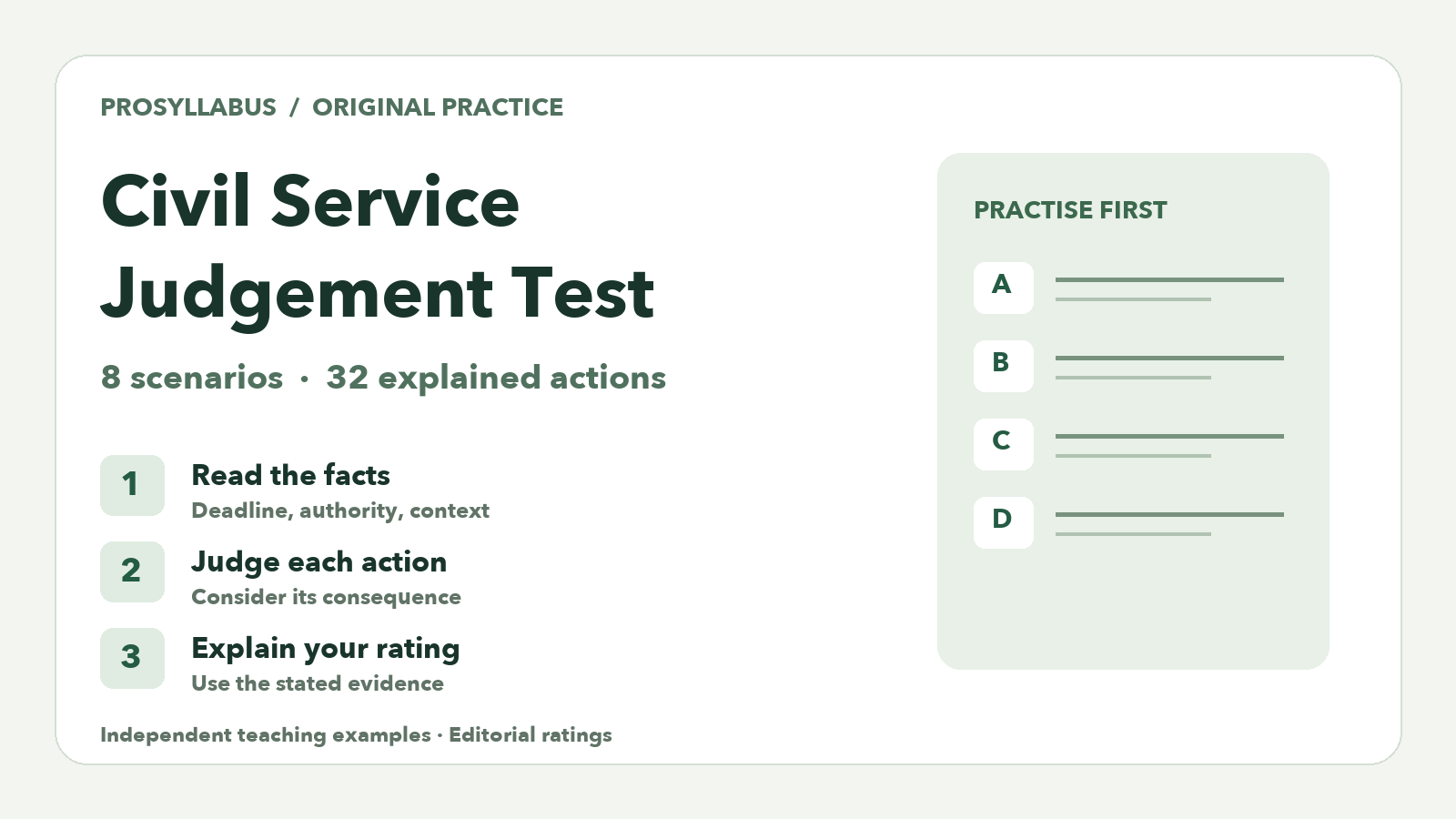
Original workplace scenarios at the level of the roles that use this test. Rate each action Counterproductive, Ineffective, Fairly Effective or Effective, then see the reason behind every rating. Start with the free one below.
- 12scenarios
- 48actions to rate
- 4behaviours
- 48ratings explained
Every rating comes with its reason, written against the scale definitions on GOV.UK and the Civil Service Code.
FreeTests: Managing a Quality Service
A mailbox nobody owns
Read the situation, then rate each of the 4 actions from Counterproductive to Effective. You then see the right rating and the reason for each. About 3 minutes · free · no sign-in.
A mailbox nobody owns
You are an administrative officer in a pensions enquiry team. Four of you answer a shared mailbox, and nobody has been given the job of sorting it. This morning it holds 140 unanswered emails. The oldest is 12 working days old, and the team's published standard is a reply within 10 working days. Your team leader, Asha, is on a training course until tomorrow but is reading her messages.
Opens when you unlock all
- The third transfer · Managing a Quality Service
- Two forms, one set of details · Managing a Quality Service
- Sixty applications by Friday · Delivering at Pace
- Two jobs, one afternoon · Delivering at Pace
- The system is down · Delivering at Pace
- Handed over at the last minute · Working Together
- One case in five arrives incomplete · Working Together
- The new starter who works from home · Working Together
- Explaining a refusal · Communicating and Influencing
- The guidance nobody absorbed · Communicating and Influencing
- An out-of-date figure in the room · Communicating and Influencing
- 11 more scenarios with 44 actions to rate on the test's own four-point scale
- 4 behaviours, three scenarios each, the way the real test is built
- The reason behind every rating, so you learn the scale and not the answers
- Your rating pattern: whether you mark too generously or too harshly, and what to fix
- Untimed, like the real test. Work through it in one sitting or several
Independent practice material. Not written or endorsed by the Civil Service. The real test shows only scenarios for your job level, may use video, and opens with a self-assessment section worth 15% of the score that has no right answers to practise. Results are a percentile against other applicants, and no answer key is published.