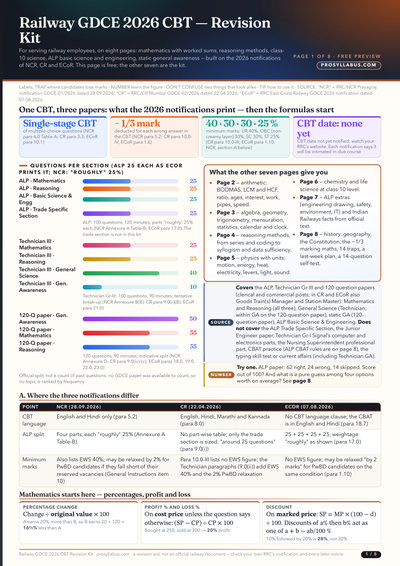

Checked 16 October 2026. Section weights from the 2026 GDCE notifications of NCR, CR and ECoR; the plan itself is ours. No 2026 GDCE CBT date has been notified by these RRCs; Western Railway’s Train Manager CBT under its 2023 notification is on 17, 24 and 29 October 2026.
A GDCE candidate is not a full-time aspirant. You are working shifts, sometimes nights, and studying in the gaps. The good news is that the GDCE syllabus is the familiar one — NCR’s notification says it follows RRB direct recruitment, except ALP — and the standard papers are short: 90 or 120 minutes (more for candidates using a scribe). The hard part is that no CBT date has been notified by NCR, CR or ECoR for their 2026 GDCE; each says the date will be intimated in due course (NCR para 5.1, CR para 8.0, ECoR para 10.1). So this plan is built backwards from a date you choose, and it gives each section time in proportion to its official weight in your paper.
Indicative weights from NCR Annexures A–D; CR para 9.0; ECoR paras 17–23. Hours are our plan.
Where other pages get this wrong
Your GDCE trade or technical section is a quarter of the ALP paper and two-thirds of the JE paper — but it is not in the Technician Gr-III paper at all.
Commonly published instead: Plans that give every GDCE candidate the same mix, or tell Technician Gr-III candidates to revise their ITI trade.
Technician Gr-III is Mathematics 25, Reasoning 25, General Science 40 and General Awareness 10 (NCR Annexure B(B), CR 9.0(ii)(B), ECoR 21.0). ALP’s fourth part is the Trade Specific Section of about 25 questions (NCR Annexure A). JE gives 100 of 150 questions to Technical Abilities for your exam group (NCR Annexure C). Spend your hours where your own paper puts the marks. One inconsistency: NCR para 1.0 item 15 says Technician candidates name an ITI trade and get questions from it, which its Annexure B table does not show — ask RRC/NCR if unsure.
Hours by section at 10 hours a week for six weeks
Our split for six weeks at 10 hours a week: 60 hours, of which 10 are kept for full mocks in the last week and the other 50 are split in proportion to each paper’s indicative question shares. This is the same rule the planner above uses.
| Paper | Section study hours (50, plus 10 h mocks) |
|---|---|
| ALP (100 Q) | Mathematics 12.5 · Reasoning 12.5 · Basic Science & Engineering 12.5 · Trade section 12.5 |
| Technician Gr-III (100 Q) | Mathematics 12.5 · Reasoning 12.5 · General Science 20 · General Awareness 5 |
| Technician Gr-I S&T (100 Q) | General Awareness 5 · Reasoning 7.5 · Computers 10 · Mathematics 10 · Basic Science & Engineering 17.5 |
| Junior Engineer (150 Q) | General Awareness 5 · Physics & Chemistry 5 · Computers 3.4 · Environment 3.3 · Technical Abilities 33.3 |
| 120-question paper (GTM, SM, CCTC, clerks) | General Awareness 20.8 · Mathematics 14.6 · Reasoning 14.6 |
Proportional split only. If you are already strong in a section, move hours out of it; the official shares tell you what the paper rewards, not what you personally need.
The six-week plan
| Week | Focus | Output |
|---|---|---|
| 1 | Read your own RRC’s notification end to end. Take one full timed mock cold. Mark every section where you lost more than a third of the marks. | A list of your three weakest topics |
| 2 | Mathematics foundations: percentages, ratio, profit and loss, interest, time and work, time and distance. Reasoning: series, coding, analogies, directions. | One topic quiz a day, timed |
| 3 | Your paper’s big section: ALP Basic Science & Engineering and trade; Technician Gr-III General Science; Technician Gr-I Basic Science & Engineering; JE Technical Abilities; GTM/SM/clerks General Awareness. | Short notes, one page per topic |
| 4 | Mathematics second half: mensuration, geometry, trigonometry, statistics, algebra. Reasoning: syllogism, Venn diagrams, data sufficiency, statement-based questions. | Second full timed mock |
| 5 | Back to your big section, then the small ones: computers, environment, general awareness as your paper needs. | Error log: every wrong answer, why |
| 6 | Full timed mocks only, with the −1/3 rule applied. Revise from your notes and error log, not new books. | A fixed skip rule you trust |
For a four-week run, merge weeks 2 and 4 into one maths-and-reasoning week and weeks 3 and 5 into one big-section week. Keep week 1 and the last week as they are: the first mock tells you where to spend time, and the last week of mocks is what makes the −1/3 rule automatic.
A week that fits round shifts
Most railway employees cannot promise the same hours every day. A rhythm that survives rosters is better than an ambitious timetable that collapses in the first night shift.
About ten hours a week, three kinds of session
- Four sessions of 60–75 minutes on working days (4 to 5 hours): one topic, a 15-minute timed quiz, then check every wrong answer. Short enough to do after a shift.
- One long session (3–4 hours) on your rest day: the big section of your paper, or a full mock from week 4 onwards.
- Ten minutes a day of general awareness or formulas (about 1 hour 10 minutes a week): on the commute or between duties — the 120-question paper gives General Awareness an indicative 50 questions. Together that is roughly 8 to 10 hours a week.
- After a night shift, do reasoning or revision, not new maths: it is the part least hurt by tiredness.
- Track hours honestly. If you missed a week, re-run the planner with the hours you actually have rather than doubling up.
Section-by-section priorities
Mathematics and Reasoning: every paper except JE
These two sections appear in ALP, both Technician papers and the 120-question paper, and General Arithmetic and Reasoning appear in the Nursing Superintendent paper. They are also where speed is learnt: the 120-question paper allows 45 seconds a question on average. Practise them timed from the first week. The JE paper is the exception — it has no separate Mathematics or Reasoning section.
ALP: Basic Science & Engineering and the trade
Basic Science & Engineering includes engineering drawing (projections, views, instruments, lines, symbols), units and measurement, work, power and energy, heat, basic electricity, levers and simple machines, occupational safety and health, environment education and IT literacy. The trade section asks around 25 questions on the common DGT topics of the ALP trades combined (syllabus on www.dgt.gov.in). Your daily work may cover parts of your trade well and others not at all; read the DGT syllabus to find the gaps.
Technician Gr-III: class 10 science
General Science is an indicative 40 questions of Physics, Chemistry and Life Sciences at class 10 level. This is often the section employees last studied many years ago, so give it the hours its weight deserves and revise from a class 10 textbook rather than a guidebook.
JE: your exam group’s technical syllabus
Technical Abilities is an indicative 100 of the 150 questions, from the exam group your diploma or degree maps to: Civil, Mechanical, Electrical or Electronics and Allied. ECoR printed the Civil syllabus in its notification and added the mapping table and the other three groups by addendum of 14.09.2026; its JE table also prints 150 marks for those 100 questions, which looks like a misprint (NCR and CR give 100). NCR and CR say the JE paper gives a virtual calculator on screen (ECoR does not mention one), so practise numerical questions with an on-screen calculator.
GTM, Station Master and clerks: General Awareness is the biggest section
General Awareness is an indicative 50 of the 120 questions. Its list runs from current events and sports to polity, history, geography, the economy, science up to class 10, computers, transport systems in India, government programmes and public-sector organisations. Split it: static topics (history, polity, geography, science) in long sessions, current affairs in daily ten-minute reads. Station Master candidates must also clear a CBAT afterwards, which RDSO’s website explains.
The paperwork that can stop a prepared candidate
Exam-day requirements in the 2026 notifications
- Download the e-call letter from your RRC’s website; nothing is posted. For its 2023 Train Manager CBT, for example, Western Railway said the call-letter link would open seven days before the exam.
- NCR: bring your railway identity card and a sparing letter with your photo, signed and stamped by your supervisor or controlling officer, who must also attest the photo (13.4). CR and ECoR: bring a relieving letter, the e-call letter and a valid photo ID (CR 15.4, ECoR 14.4). Arrange it early: NCR says the departmental procedures for sparing candidates and issuing passes may be followed at all stages (16.0(iii)).
- Bring the same colour photograph you uploaded; your signature must match the one in the application, in running hand.
- No calculator, phone, watch, pen, wallet, belt or shoes inside the hall.
- There is no second chance: no supplementary CBT for absentees, and requests to change the date, shift or centre are not entertained (the RRC itself may reschedule).
ProSyllabus is an independent study site, not part of Indian Railways or any Railway Recruitment Cell. Your own RRC’s notification, every corrigendum or notice it issues later, and the Railway Board rules they apply are the authority.
The only GDCE CBT schedule we found in an official notice is Western Railway’s: the Train Manager CBT under its notification 01/2023 is scheduled for 17, 24 and 29 October 2026 (notice of 10.09.2026). Employees transferred out of Western Railway are not eligible to sit it. For NCR, CR and ECoR 2026, watch the RRC website — the notifications say the dates will be published there.
Practise it, don't just read it
For every paper except JE, weeks 2 and 4 of the plan are Mathematics and Reasoning (JE candidates spend them on their general and technical sections). One timed topic quiz a day is the smallest habit that moves your score.
The ProSyllabus Railway GDCE library has topic quizzes on Mathematics and on General Intelligence and Reasoning, which appear (Mathematics sometimes as Arithmetic) in every 2026 GDCE paper of NCR, CR and ECoR except Junior Engineer. The first quiz is free.
Frequently asked questions
How many weeks do I need to prepare for GDCE?
Four to six weeks at 8–12 hours a week gives 32 to 72 hours. Whether that covers your syllabus depends on your paper and your starting point; the JE technical syllabus and any section you last studied long ago need more.
When is the GDCE 2026 exam?
NCR, CR and ECoR have not notified CBT dates; each says they will be intimated in due course on its website.
Which section should I prepare first for GDCE ALP?
All four parts are roughly equal at 25 questions each, so start with whichever your first mock shows is weakest — often Basic Science & Engineering or the trade section.
Do I need to study my trade for GDCE Technician Grade III?
The detailed Technician Gr-III tables show no trade section: Mathematics, Reasoning, General Science and General Awareness. NCR para 1.0 item 15 conflicts with this by linking Technician questions to the chosen ITI trade, so NCR candidates should ask RRC/NCR.
How should I prepare General Awareness for GDCE Goods Train Manager?
It is an indicative 50 of 120 questions. Revise static topics in longer sessions and read current affairs daily in short slots.
Can I prepare for GDCE while working night shifts?
Yes. Use short weekday sessions for one topic and a timed quiz, keep long sessions for rest days, and do reasoning or revision after a night shift rather than new topics.
Do I need a sparing letter for the GDCE CBT?
NCR asks for your railway identity card and a sparing letter with your photo, signed and stamped by your supervisor. CR and ECoR ask for a relieving letter, the e-call letter and a valid photo ID.
Is a calculator allowed for GDCE JE?
No physical calculator. NCR and CR say a virtual calculator appears on screen in the JE paper; ECoR does not mention one.
How many mocks should I take before GDCE?
At least one at the start to find your weak sections, and full timed mocks through the last week, scored with the −1/3 rule.
What if I miss the GDCE CBT?
There is no supplementary exam for absentees under any circumstances, and requests to change the date or shift are not entertained.
Sources
- official — RRC/NCR Prayagraj — GDCE Notification No. RRC/NCR/GDCE-01/2026 (28.09.2026)
- official — RRC/CR Mumbai — GDCE Notification No. RRC/CR/GDCE-02/2026 (22.04.2026)
- official — RRC East Coast Railway — GDCE 2026 Notification No. ECoR/Pers/RRC-GDCE/2026 (07.08.2026), incl. Annexure F (RRB normalisation notice, 09.02.2026)
- official — RRC East Coast Railway — Addendum: JE syllabus and extension of closing date (14.09.2026)
- official — RRC Western Railway — CBT dates for Train Manager, GDCE 01/2023 (10.09.2026)
official = a document published by the conducting body. reported = a news or coaching site we could not check against an original. Where sources disagree this page says so rather than picking one.


