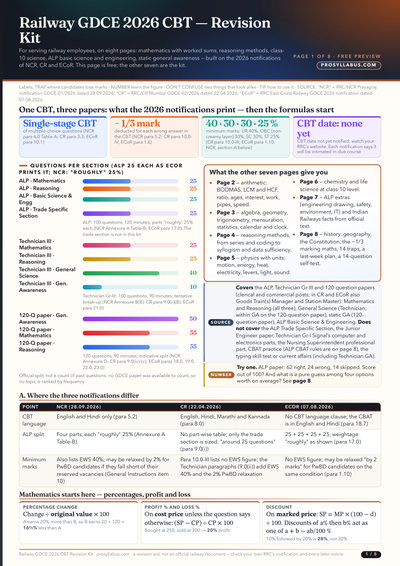

Checked 16 October 2026. Rules from the 2026 GDCE notifications of NCR, CR and ECoR, including ECoR Annexure F (RRB normalisation notice of 09.02.2026). All score arithmetic on this page is ours. None of the three notifications publishes a cut-off, so none is shown.
All three 2026 GDCE notifications impose the same penalty: one-third of the marks allotted for each question is deducted for each wrong answer in the CBT, for every category of post (NCR para 5.2, ECoR para 1.6; CR para 10.0-IV words it as “1/3 mark”). NCR and CR give each question one mark — ECoR’s JE table is the one inconsistent entry — so a wrong answer costs exactly one-third of a mark, about 0.33, and a blank costs nothing. This guide turns that rule into numbers you can use in a mock, shows the minimum marks each community must reach, and explains two adjustments that may apply after the exam: normalisation when a paper runs in several shifts, and a merit index where several exam groups compete for one post, as in JE.
Where other pages get this wrong
The GDCE minimum percentage is a floor for being placed in merit, not a pass mark that wins a post.
Commonly published instead: Pages that call 40% the GDCE “cut-off” or say that clearing it means selection.
NCR’s merit index is computed only for candidates whose marks are “equal or above the community qualifying marks” (para 8.0), and candidates are then called for document verification in merit order, only as many as there are vacancies (General Instructions item 19). ALP and Station Master candidates must also clear the CBAT. None of the NCR, CR or ECoR notifications publishes a cut-off; any cut-off figure you see is not from them.
The rule in numbers
Our arithmetic, for a 100-question paper such as ALP or Technician. Score = right − wrong ÷ 3. The last column shows what the same attempt would score with no negative marking, to show what the wrong answers cost.
| Right | Wrong | Blank | Score | Without the −1/3 rule |
|---|---|---|---|---|
| 60 | 0 | 40 | 60.00 | 60 |
| 60 | 15 | 25 | 55.00 | 60 |
| 62 | 24 | 14 | 54.00 | 62 |
| 65 | 30 | 5 | 55.00 | 65 |
| 50 | 30 | 20 | 40.00 | 50 |
| 45 | 15 | 40 | 40.00 | 45 |
| 40 | 0 | 60 | 40.00 | 40 |
Three wrong answers cancel one right answer. Look at rows 2 and 4: five more right answers bought with fifteen more wrong ones leave the score exactly where it was. Rows 5, 6 and 7 all land on 40 — the UR minimum on a 100-mark paper — from very different attempts.
Minimum marks for each paper, in raw terms
The notifications give the minimum as a percentage: UR 40, EWS 40 (NCR and CR’s Technician paragraphs), OBC-NCL 30, SC 30, ST 25. Our conversion to marks for each paper length:
| Community | 100-question paper (ALP, Technician, Nursing Supdt) | 120-question paper (GTM, SM, CCTC, clerks) | 150-question paper (JE, NCR and CR) |
|---|---|---|---|
| UR (40%); NCR, and CR’s Technician rules, also print EWS 40% | 40 | 48 | 60 |
| OBC-NCL (30%) | 30 | 36 | 45 |
| SC (30%) | 30 | 36 | 45 |
| ST (25%) | 25 | 30 | 37.5 |
Percentages from NCR General Instructions item 10, CR para 10.0-III and ECoR para 1.10; the marks are our arithmetic. They may be relaxed for PwBD candidates — “by 2%” in NCR generally and in CR’s Technician paragraphs, “by 2 marks” in ECoR — only if there are not enough PwBD candidates for the vacancies reserved for them. Where a paper runs in more than one shift, ECoR Annexure F (item 9) says the minimum is checked on normalised marks.
Should you guess? The expected value of one answer
NCR’s ALP paper (Annexure A, Table-B) and CR’s Nursing Superintendent paper (para 9.0(vi)) state four options with one correct answer; the other papers are described as multiple choice. For a four-option question you cannot solve, the average result of answering depends on how many options you can rule out first. Our arithmetic, per question:
| Options you can rule out | Chance the answer is right | Average marks from answering | Verdict |
|---|---|---|---|
| None — pure guess among 4 | 1 in 4 | 1/4 − 3/4 × 1/3 = 0 | No gain on average; leave it unless time is up and you are working to a plan |
| One — guess among 3 | 1 in 3 | 1/3 − 2/3 × 1/3 = +0.11 | Small gain on average |
| Two — guess between 2 | 1 in 2 | 1/2 − 1/2 × 1/3 = +0.33 | Clear gain on average |
“Average” means over many such questions: on any single guess you either gain 1 or lose 0.33. One sensible rule is to answer when you can genuinely eliminate an option, skip a blind guess, and keep a count of how many skips you are carrying so you know your floor.
Our arithmetic from the −1/3 rule with four options per question.
Time per question, paper by paper
| Paper | Questions | Minutes | Average time a question |
|---|---|---|---|
| ALP | 100 | 120 | 72 seconds |
| Technician Gr-I / Gr-III | 100 | 90 | 54 seconds |
| Junior Engineer | 150 | 120 | 48 seconds |
| GTM / SM / CCTC / clerk-typist | 120 | 90 | 45 seconds |
| Nursing Superintendent (CR) | 100 | 90 | 54 seconds |
Durations from NCR Annexures A–D, CR para 9.0 and ECoR paras 17–23; the seconds are our arithmetic. The 120-question paper allows the least time per question.
Normalisation: when your raw marks are not the final marks
If a CBT runs in several shifts, a hard shift and an easy shift cannot be compared on raw marks. ECoR attaches the RRB’s normalisation notice of 09.02.2026 as Annexure F, and NCR and CR describe the same use of normalised marks for multi-session papers (NCR para 8.0, CR “Normalisation of the marks”). The method, in short:
How the RRB normalisation method works (ECoR Annexure F)
- Percentile in your own shift: the number of candidates in your shift with a raw score equal to or below yours, divided by everyone who appeared in that shift, × 100. The topper of every shift gets 100.
- Percentiles are calculated to five decimal places to reduce ties.
- Base shift: the shift with the highest mean, provided its attendance is at least 70% of the average shift (ties: highest individual marks, then highest attendance).
- Normalised marks: your percentile is located in the base shift and the matching marks are read off directly; otherwise they are interpolated between the neighbouring base-shift percentiles, or extrapolated by the item 9(b) formula if your percentile is below the base shift’s lowest.
- The minimum-percentage check uses these normalised marks.
A single-session paper uses raw marks as they are.
The merit index (JE and other mixed-group posts)
Where candidates from different exam groups compete for one post, NCR and CR compute a merit index: Merit Index = Sq + (St − Sq) × (M − Mq) ÷ (Mt − Mq). M is your marks (raw for one session, normalised for several). Mq is the qualifying mark for the general category, printed as 40. Mt is the mean of the top 0.1% or the top 10 candidates in the paper, whichever is larger. Sq is fixed at 350 and St at 900. A combined merit list is then made in descending order of merit index, and posts are allotted on it. Note that Mq is printed as 40 even for the 150-question JE paper, whose UR minimum works out to 60: we read 40 as the formula constant the notifications print, and you should ask your RRC if it matters to you.
A worked example with made-up numbers (our arithmetic): if M = 80, Mq = 40 and the top candidates in your paper averaged Mt = 120, then Merit Index = 350 + 550 × 40 ÷ 80 = 625. A candidate in another exam group with the same 80, whose top candidates averaged a lower Mt = 100, gets 350 + 550 × 40 ÷ 60 = 716.67. The index measures you against your own paper’s toppers.
Equal CBT marks — and, under Annexure F, equal percentile scores — are resolved by age (older first), then alphabetical order of the name (NCR item 18, CR 10.0-VI, ECoR 1.11 and Annexure F item 7).
ALP and Station Master: the CBT is only part of the merit
For ALP the final merit gives 50% weightage to CBT marks and 50% to the CBAT score; for Station Master it is 70% CBT and 30% CBAT. In both, every CBAT test battery must be cleared with a T-score of at least 42, with no relaxation for any community, and the CBAT has no negative marking. Eight times the vacancies in each community are shortlisted for the CBAT on CBT marks; for ALP the notifications add that everyone tied at the cut-off is also called. So for these posts a strong CBT score is what gets you into the CBAT; it is not, on its own, a seat.
Practise it, don't just read it
Use a timed quiz to find your own error rate. Every wrong answer costs one-third of a mark against leaving it blank; your attempted answers only go negative overall if more than three in four are wrong, but each wrong one still costs you.
The ProSyllabus Railway GDCE library has topic quizzes on Mathematics and on General Intelligence and Reasoning, which appear (Mathematics sometimes as Arithmetic) in every 2026 GDCE paper of NCR, CR and ECoR except Junior Engineer. The first quiz is free.
Frequently asked questions
How much is deducted for a wrong answer in GDCE?
One-third of the marks for that question. With one mark a question, a wrong answer costs exactly one-third of a mark, about 0.33; an unanswered question costs nothing.
Is there negative marking in the GDCE CBAT?
No. The computer-based aptitude test for ALP and Station Master has no negative marking.
What are the GDCE qualifying marks out of 100?
Our arithmetic from the notified percentages: UR 40, OBC-NCL 30, SC 30, ST 25 on a 100-question paper.
What are the GDCE qualifying marks for the 120-question paper?
Our arithmetic: UR 48, OBC-NCL and SC 36, ST 30.
Should I guess in the GDCE CBT?
On a four-option question, a blind guess gains nothing on average under the −1/3 rule. Ruling out one option makes it +0.11 on average; ruling out two makes it +0.33.
Will my GDCE marks be normalised?
Only if your paper is held in more than one shift. Then raw marks become percentile scores within each shift, which are used for merit; normalised marks read off the base shift are used to check the minimum percentage.
What is the GDCE merit index?
350 + 550 × (M − 40) ÷ (Mt − 40), where M is your marks and Mt the mean of the top 0.1% or top 10. It is used to merge candidates from different exam groups.
What is the GDCE cut-off?
None of the NCR, CR or ECoR 2026 notifications publishes a cut-off. The notified percentages are minimums; selection depends on merit against the number of vacancies.
How are ties broken in GDCE?
For equal marks, the older candidate ranks higher; if the date of birth is the same, alphabetical order of the name.
How many questions can I get wrong and still reach 40 in GDCE?
It depends on how many you get right: score = right − wrong ÷ 3. With 45 right you can afford 15 wrong; with 50 right, 30 wrong (our arithmetic).
Sources
- official — RRC/NCR Prayagraj — GDCE Notification No. RRC/NCR/GDCE-01/2026 (28.09.2026)
- official — RRC/CR Mumbai — GDCE Notification No. RRC/CR/GDCE-02/2026 (22.04.2026)
- official — RRC East Coast Railway — GDCE 2026 Notification No. ECoR/Pers/RRC-GDCE/2026 (07.08.2026), incl. Annexure F (RRB normalisation notice, 09.02.2026)
official = a document published by the conducting body. reported = a news or coaching site we could not check against an original. Where sources disagree this page says so rather than picking one.


