
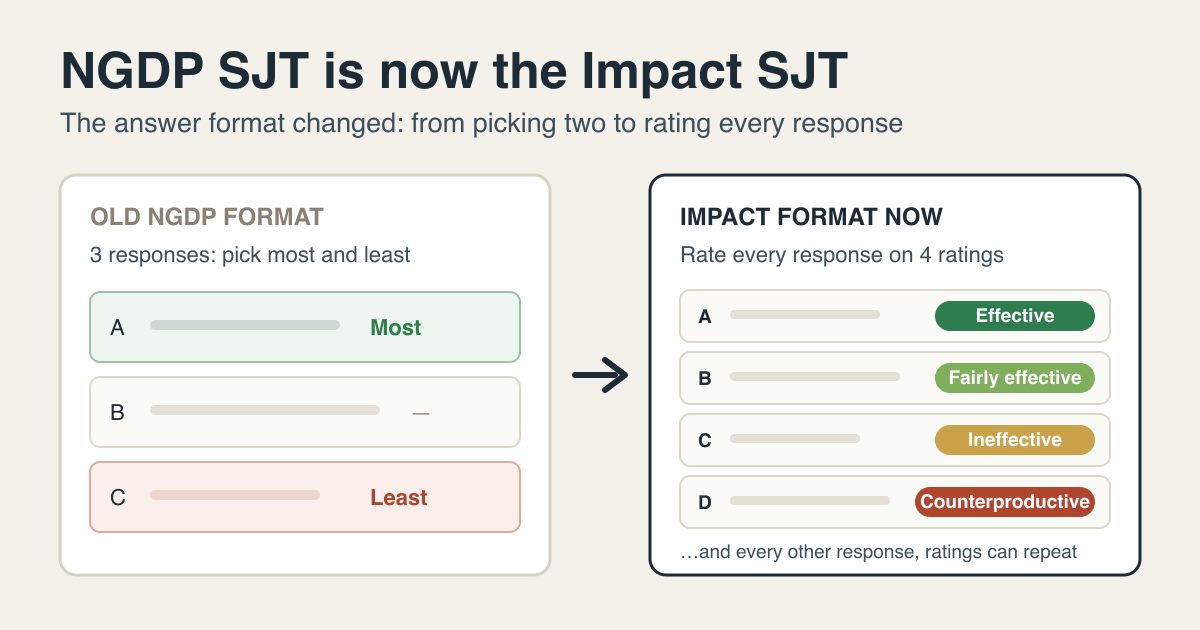
Checked 10 November 2026. Checked on 10 November 2026 against the LGA pages listed at the end. The LGA pages do not agree on the answer format: the Cohort 29 application page and the LGA practice questions ask you to rate every response, while the LGA timeline page describes three responses and picking the most and least appropriate. We follow the application page and the practice questions; on the day, follow the instructions on screen.
The NGDP is now Impact. The LGA says Impact: The Local Government Graduate Programme is the new name, launched in June 2024, for the programme previously known as the National Graduate Development Programme (NGDP), which ran for over 20 years. The LGA adds that the programme's content and structure stayed the same (LGA FAQs); that statement is about the programme, not the test instructions. So if you are searching for the NGDP situational judgement test, the test you will take is the Impact SJT at Stage 1.
The published descriptions of the answer format differ. The LGA's 2019 NGDP sample questions gave three responses per scenario, and the LGA timeline page still describes picking the most and least appropriate of three (2019 NGDP sample PDF, timeline page). The Cohort 29 application page asks you to read each scenario and give an effectiveness rating for each response (application page), and the LGA's own practice questions use four ratings: Effective, Fairly effective, Ineffective and Counterproductive (LGA practice questions). This page sets the two formats side by side, works one short example of each, and explains what the difference means for how you practise.
Before you start (Stage 1 is open from 7 October 2026 to 12.00 midday on Wednesday 6 January 2027)
- Try the LGA's two official practice questions: every response has a rating and the LGA's reason.
- Rate every response. Ratings can repeat.
- To separate Ineffective from Counterproductive, ask whether the action would make things worse.
- Read the LGA's key skills and behaviours alongside its practice questions.
LGA Cohort 29 application page, timeline page and practice questions, read 10 November 2026.
NGDP samples and current Impact instructions side by side
| Item | Old NGDP format | Impact format now |
|---|---|---|
| Name | National Graduate Development Programme (NGDP) | Impact: The Local Government Graduate Programme (new name since June 2024, LGA FAQs) |
| Responses per scenario | 3 (the 2019 LGA sample questionnaire, and the LGA timeline page today) | Several: the application page says "multiple ways of responding"; the two LGA practice questions have 6 and 5 |
| What you do | The 2019 samples give Correct, OK and Poor answers; the current timeline page says to pick the most and least appropriate | Give every response an effectiveness rating |
| The scale | No rating scale: the 2019 samples label the answers Correct, OK and Poor | Effective, Fairly effective, Ineffective, Counterproductive |
| Can two responses get the same answer? | No: the 2019 samples give the three options different labels | Yes: in LGA practice question 1, three of the six responses are Effective |
| What the LGA explains | The 2019 sample labels each option Correct, OK or Poor | A rationale for every response |
| Other test details | Not stated in the 2019 samples | Both current LGA pages: 24 scenarios, untimed, breaks after answering a question, finish before the deadline. The timeline page adds that each key skill and behaviour is measured three times |
The LGA's timeline page and its application page describe the format differently, as the note at the top explains. We follow the application page and the practice questions. On the day, read the instructions in the test and follow what the screen asks.
FreeTests: Effective Communication
Questions at the recycling stall: free sample
Read the situation, then rate each of its 5 responses, as the real test asks. The first 3 of 43 scenarios are free.
3 scenarios free▶ Start nowThis one is free · no sign-in neededUntimed, like the real test- 43 council scenarios
- Rate every response, as the real test asks
- All 8 key skills
- A reason for every rating
- Your score per key skill
- Untimed; pause any time
The three-response format: most and least appropriate
The LGA timeline page describes choosing the most and least appropriate of three responses. In that format you only find the two ends; the middle option is never judged on its own. Here is our example of that format. We wrote it; it is not an LGA question.
Three-response example (written by us, not an LGA item)
- You are a graduate trainee in a council's waste services team. A resident emails you, angry that their bin has been missed three weeks running, and copies in their local councillor. Collections are run by a different team.
- A: Reply to the resident and the councillor, apologise, say you have passed the complaint to the collections team and give a date when you will update them.
- B: Forward the email to the collections manager and leave them to reply.
- C: Reply to the councillor only, explaining that bin collections are not your team's responsibility.
- Our key: most appropriate A, least appropriate C. A owns the contact, routes the problem to the team that can fix it and tells the resident what happens next. C ignores the resident, who raised the complaint, and pushes the problem away. B is in the middle: it reaches the right team, but gives the resident no acknowledgement or update date and leaves all follow-up to the collections manager.
Our scenario and our key. It does not represent any real NGDP or Impact question.
The new Impact format: rate every response
In the current format each response gets its own rating, and the same rating can be used more than once. The LGA practice questions define the four ratings (its second question spells the last one "Counter-productive"; we use the first question's "Counterproductive"). The middle column paraphrases the LGA definitions; the right-hand column is our reading.
| Rating | LGA definition (paraphrased) | Our reading |
|---|---|---|
| Effective | A highly appropriate response that would be useful in addressing the situation | Useful and appropriate here. It does not have to solve every part of the problem |
| Fairly effective | An appropriate response that would be somewhat useful, though there may be better options | Appropriate and somewhat useful. Often partial, late, or leaves someone out; judge it on its own |
| Ineffective | A poor response that would not be useful in addressing the situation | Not useful: often a harmless action that misses the point |
| Counterproductive | A very poor response that would make the situation worse | Makes things worse: for example it hides a problem or inflames a conflict |
The LGA's own rationales draw the line between the bottom two ratings the same way. In its first practice question, going over your line manager's head is rated Ineffective "rather than counterproductive" because it does not necessarily cause direct harm (LGA practice questions). Here is one example in the new format, again written by us.
New-format example (written by us, not an LGA item)
- You are a graduate trainee in a council's planning policy team. You are summarising responses to a public consultation for a committee report, due to your manager on Thursday. On Tuesday you find that about 40 responses sent by post were never added to the spreadsheet you were given.
- A: Tell your manager today, with an estimate of how long the postal responses will take to add, and ask whether the Thursday deadline should move. Our rating: Effective. You flag the gap straight away and give your manager what they need to decide how to finish the work and handle the deadline.
- B: Tell your manager today that some postal responses are missing, but give no estimate of the extra work and no suggestion for finishing it. Our rating: Fairly effective. Flagging the problem early helps, but your manager gets little to plan with.
- C: Ask a colleague whether the summary should use Arial or Calibri, and say nothing about the missing responses for now. Our rating: Ineffective. It does not help with the missing responses or the plan for Thursday.
- D: Leave the postal responses out, since most people replied online, and say nothing. Our rating: Counterproductive. The committee would decide on an incomplete picture, and residents who wrote in would be ignored.
- E: Ask the team that logs the post to send you the missing responses, and plan to tell your manager on Thursday only if you are still behind. Our rating: Fairly effective. Getting the responses is useful, but waiting until Thursday to flag any risk to the deadline gives your manager less time to plan.
Our scenario and our ratings. It does not represent any real Impact question.
Two responses share a rating here, which the format allows. Notice also what selecting only most and least would have hidden: under most-and-least you would only have found A and D. The new format also asks you to place B, C and E, not only the best and worst. B raises the problem without helping to plan the work; E takes a useful step but delays telling your manager about any risk to the deadline.
FreeTests: Effective Communication
Questions at the recycling stall: free sample
Read the situation, then rate each of its 5 responses, as the real test asks. The first 3 of 43 scenarios are free.
3 scenarios free▶ Start nowThis one is free · no sign-in neededUntimed, like the real testOur count of the LGA's ratings on its page "Impact – practice situational judgement test questions" (question 1: six responses; question 2: five), read 10 November 2026. Two questions are a small sample: it shows that ratings repeat, not how the real test is balanced.
What the change means for your practice
Practising for the rating format (our advice)
- Judge every response on its own. You are no longer ranking three options against each other. Ask of each one: would this help, and would it make anything worse?
- Do not force a spread. Ratings can repeat. The LGA's first practice question has three Effective responses, two Fairly effective and one Ineffective, and no Counterproductive at all.
- Check the boundaries between ratings. Judge how appropriate and useful each action would be here. A useful action does not have to solve every part of the problem to be Effective. For Counterproductive, be able to say how the action would make matters worse.
- Use old NGDP questions carefully. Their Correct, OK and Poor answers can help you compare stronger and weaker actions. To make them fit the new format, rate all three options on the four ratings before you look at the answers. Do not convert "correct", "OK" and "poor" straight into ratings: the LGA gives no conversion between the two systems, and in the rating format two options can share a rating.
- Practise rating every response. The LGA's two practice questions have six and five responses. Rate whole scenarios, then compare each of your ratings with the rating and reason given for that same response, and note whether you tend to rate too harshly or too kindly.
- Start with the LGA's two practice questions. The LGA publishes two official practice questions in the rating format, with a reason for every response's rating. An older LGA PDF of NGDP sample questions uses the three-option format.
Timing, and how it is scored
Timing and the deadline (LGA application page and timeline page)
- Untimed. The application page says around an hour on average and suggests one sitting with at least 1 to 2 hours to spare. The timeline page says 30 to 45 minutes on average and suggests at least an hour.
- Breaks. You can take a break after answering a question, before the next one, and log back in to finish before the deadline.
- Order. The SJT comes after your application questions, and you must complete it before you can submit.
- Deadline. Stage 1 closes at 12.00 midday on Wednesday 6 January 2027.
- One application. You can only apply to one Impact programme a year.
- Finance Stream. Applicants also take a numeracy test.
From the Cohort 29 application page and the timeline page, read 10 November 2026.
The LGA pages we read on 10 November 2026 do not say how the ratings are scored, and give no pass mark. Our practice set uses its own rule, labelled as ours, not the LGA's: the full mark for our correct rating, a part mark for a rating one step away, and nothing further away. That rule rewards getting close, so think about which side of the scale a response sits on before you choose between its two neighbours.
More Impact guides
The Impact SJT in full, with the format, how to approach the ratings and the deadline: Impact Graduate Scheme situational judgement test.
The key skills and behaviours the test measures, each three times: Impact Graduate Scheme key skills.
What comes after the SJT, starting with the video interview for applicants who pass: Impact Graduate Scheme application process.
Practise in the current format
Our Impact SJT practice set uses the rating format: council scenarios, five or six responses each, every response rated from Effective to Counterproductive, with a reason for every rating, a score for each key skill, and whether you tend to rate too harshly or too kindly. The first three scenarios are free. Independent practice. Not affiliated with the Local Government Association: the LGA did not write our scenarios and does not endorse them.
FreeTests: Effective Communication
Questions at the recycling stall: free sample
Read the situation, then rate each of its 5 responses, as the real test asks. The first 3 of 43 scenarios are free.
3 scenarios free▶ Start nowThis one is free · no sign-in neededUntimed, like the real testFrequently asked questions
Is NGDP the same as Impact?
Yes. The LGA says Impact: The Local Government Graduate Programme is the new name, launched in June 2024, for the programme previously known as the National Graduate Development Programme (NGDP). It ran under that name for over 20 years, and the LGA says the content and structure of the programme stayed the same.
Is the NGDP situational judgement test still most and least appropriate?
The Cohort 29 application page asks you to give an effectiveness rating for each response option, and the LGA practice questions use four ratings: Effective, Fairly effective, Ineffective and Counterproductive. The LGA timeline page still describes three responses and picking the most and least appropriate, so follow the instructions shown in the test itself.
How many questions are in the NGDP SJT?
The Impact SJT has 24 scenarios, and the LGA says each of its key skills and behaviours is measured three times across the test. In the LGA's two practice questions each scenario has five or six responses to rate.
Is the Impact SJT timed?
No. The application page says it takes around an hour on average and suggests one sitting with 1 to 2 hours to spare. The timeline page says 30 to 45 minutes on average. You can take a break after answering a question and finish before the deadline, 12.00 midday on Wednesday 6 January 2027.
Can I give the same rating to more than one response?
Yes. In the LGA's first practice question, three of the six responses are rated Effective. Rate each response on its own and do not try to use every rating.
What is the pass mark for the NGDP SJT?
The LGA pages we read on 10 November 2026 do not publish a pass mark or the scoring rule. The timeline page says that if you pass the SJT you are invited to the video interview.
Are old NGDP practice questions still useful?
Partly. Their Correct, OK and Poor answers can help you compare stronger and weaker actions. But they only key three options, and the current test asks you to rate every response on four ratings, including the ones in the middle. Rate all the options yourself before you look at any old key.
Where are the official NGDP SJT practice questions?
The LGA publishes two Impact practice questions, each with a rating and a rationale for every response, on its page "Impact – practice situational judgement test questions". An older LGA PDF of NGDP sample questions uses the three-option format.
Are your practice scenarios real Impact SJT questions?
No. Our scenarios are our own, written to the LGA's description of the format, and our ratings are our judgement. ProSyllabus is independent and not affiliated with the Local Government Association.
More in this series
Sources
- official — LGA: Impact: The Local Government Graduate Programme FAQs (the rebrand from NGDP), read 10 November 2026
- official — LGA: Graduate Management Trainee on Impact, Cohort 29 application page (SJT instructions, closing date), read 10 November 2026
- official — LGA: Impact: The Local Government Graduate Programme timeline (Stage 1 dates, SJT length), read 10 November 2026
- official — LGA: Impact practice situational judgement test questions (two questions with ratings and rationales), read 10 November 2026
- official — LGA: ngdp Situational Judgement Questionnaire: Sample Questions (PDF, 2019, the old three-option format), read 10 November 2026
official = a document published by the conducting body. reported = a news or coaching site we could not check against an original. Where sources disagree this page says so rather than picking one.


