
Checked 10 November 2026. Skill names from the LGA Impact application page, definitions checked against the Cohort 29 vacancy page; the test facts from the LGA Impact timeline and the vacancy page; all read 10 November 2026 for Cohort 29 (Stage 1 closes 6 January 2027, 12pm). The LGA has reworded the skills before (its older NGDP page uses different names), so check the application page before you apply.
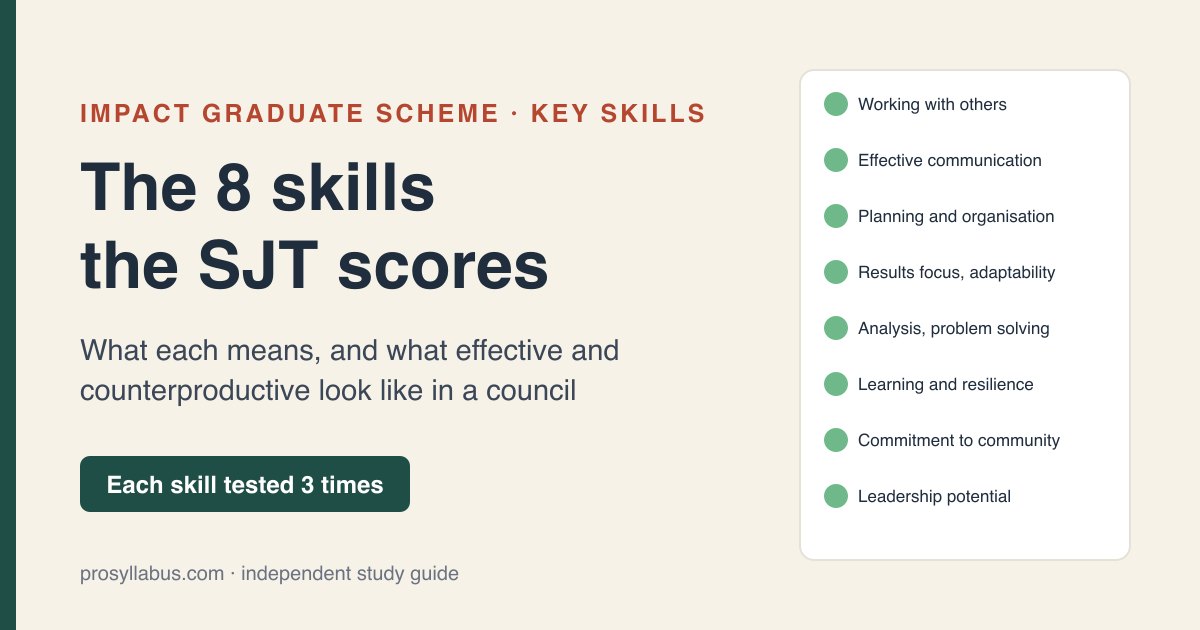
The Impact graduate scheme (formerly the NGDP) assesses you on 8 key skills and behaviours: working with others; effective communication; planning and organisation; results focus and adaptability; analysis and problem solving; motivation for learning and personal resilience; commitment to local government and the wider community; and leadership potential. Those are the names on the LGA's Impact application page today. The situational judgement test (SJT) at Stage 1 has 24 scenarios and, in the LGA's words, measures "each of our key skills and behaviours three times over the test". The video interview and the assessment centre come back to the same skills later.
Two things make this page different. First, the LGA has reworded the skills: an older NGDP page that still ranks in search uses "persuasive communication" and "drive for results", and some prep guides still use those names. Second, for each skill we show what an Effective and a Counterproductive response look like in a council. The Cohort 29 vacancy page says you will "provide an effectiveness rating for each of the provided response options", and the LGA's practice questions use four ratings, from Effective to Counterproductive. Independent practice. Not affiliated with the Local Government Association.
Local Government Association, Impact application page, timeline and Cohort 29 vacancy page, read 10 November 2026.
FreeTests: Effective Communication
Questions at the recycling stall: free sample
Read the situation, then rate each of its 5 responses, as the real test asks. The first 3 of 43 scenarios are free.
3 scenarios free▶ Start nowThis one is free · no sign-in neededUntimed, like the real testThe 8 Impact key skills and behaviours at a glance
The LGA says the skills are "not conditional on your prior work or life experience": they show what working in a council is like, so you can draw on study, a part-time job or volunteering. Here they are in one line each, in our words.
| # | Key skill (LGA name) | In one line (our paraphrase) |
|---|---|---|
| 1 | Working with others | Collaborate across different teams, respect people's differences, ask, and accept challenge. |
| 2 | Effective communication | Say it clearly for this audience, listen back, and weigh opinions against evidence. |
| 3 | Planning and organisation | Run your own workload, balance several demands, and use a method to prioritise. |
| 4 | Results focus and adaptability | Own the outcome, change course when facts change, think about consequences, and stay positive. |
| 5 | Analysis and problem solving | Read numbers and words accurately, link sources, find the trend, and conclude from evidence. |
| 6 | Motivation for learning and personal resilience | Seek out learning, formal and informal, and stay resilient, including through self-care and boundaries. |
| 7 | Commitment to local government and the wider community | Care about residents, aim for real impact, and understand the political and economic context. |
| 8 | Leadership potential | Lead by example, work on your own, take ownership, and support the people around you. |
What changed from the NGDP skills and behaviours
The programme was the National Graduate Development Programme (NGDP) before it became Impact. The older LGA skills page is still online, and its wording differs from the current application page. Two skills were renamed and the definitions of the others were rewritten. Phrases such as "influence" and "challenge the status quo" appear in the older definitions, so check which list a guide is using.
| Older NGDP name | Current Impact name | What shifted (our reading of the two LGA pages) |
|---|---|---|
| Working with others | Working with others | Same name. Both versions are about collaborating with people who differ from you. The old one named political sensitivity, emotional intelligence and managing expectations; the current one names respect for different backgrounds and needs, asking questions and being open to challenge. |
| Persuasive communication | Effective communication | Renamed. Both versions include active listening and suiting the audience. The old one centred on persuading and influencing with confidence; the current one makes clarity, purpose and backing opinions with evidence more explicit. |
| Planning and organisation | Planning and organisation | Same name. Both versions are about managing your time and priorities. The old one also stressed seeing things through and adjusting to change; the current one stresses being proactive, handling several projects at once and using tools and techniques to prioritise. |
| Drive for results | Results focus and adaptability | Renamed. Both versions are about taking responsibility for results. The old one stressed initiative, tenacity and challenging the status quo; the current one adds adapting when priorities or information change, thinking through consequences and staying positive after setbacks. |
| Analysis and problem solving | Analysis and problem solving | Same name. Both versions are about interpreting information from several sources to reach conclusions. The current one names numerical and non-numerical data, evidence-based conclusions and spotting trends by linking sources. |
| Motivation for learning and personal resilience | Motivation for learning and personal resilience | Same name. Both versions pair seeking out learning with resilience. The current one adds managing conflicting priorities, self-care and setting boundaries. |
| Commitment to local government and the wider community | Commitment to local government and the wider community | Same name. Both versions ask for an understanding of the local government context and a commitment to meaningful impact for the community. The current one makes enthusiasm and the wider political and economic landscape more explicit. |
| Leadership potential | Leadership potential | Same name. Both versions include leading by example, taking responsibility and supporting others. The old one also stressed taking charge, challenging the status quo and motivating others; the current one makes working independently and owning tasks explicit. |
The pattern, in our reading: much carries over, but the current wording puts less weight on persuading and taking charge, and more on clarity, adapting to new information, owning your own work and looking after yourself. Neither the old nor the current skills page says how responses are rated, so use the current definitions as your yardstick. For how the answer format changed from NGDP to Impact, see NGDP situational judgement test practice (now the Impact SJT).
How the SJT measures each skill three times
The LGA timeline says the SJT's 24 scenarios measure each key skill three times. The LGA's two practice questions are each headed with one key skill. The LGA pages we read do not publish a pass mark, how ratings are scored or whether you get a score per skill. The current answer format, including why two LGA pages describe it differently, and the timing are in the Impact situational judgement test guide.
| Asks or listens | Mentions priorities | Adapts to change | Takes ownership | Uses evidence | Self-care and boundaries | Wider context | |
|---|---|---|---|---|---|---|---|
| Working with others | named | ||||||
| Effective communication | named | named | |||||
| Planning and organisation | named | ||||||
| Results focus and adaptability | named | named | named | ||||
| Analysis and problem solving | named | ||||||
| Motivation for learning and personal resilience | named | named | |||||
| Commitment to local government and the wider community | named | ||||||
| Leadership potential | named |
"Named" = in our reading, the current LGA definition of that skill states the theme directly (for example, "asks questions", "self-care and boundary setting"). A blank cell does not mean the theme is irrelevant to the skill.
Local Government Association, Impact application page, Key skills and behaviours, read 10 November 2026.
Two things stand out. Several definitions address priorities, so a response that only means "work harder" can fall short on more than one skill. And evidence appears in both communication and analysis, so a response that states something unchecked can fail either. The examples under each skill below are our own, set in invented council situations. Later stages are covered in Impact application process, stages and dates.
1. Working with others
What the LGA says it means (our paraphrase): working well with diverse teams, showing sensitivity and respect for differences in people's backgrounds, needs and points of view, asking questions, and staying "open to challenge" to reach solutions that benefit everyone involved.
Effective, in a council
- A colleague from the planning team objects to your draft. You ask what worries them, change the part they are right about and explain the part you kept.
- Before a joint meeting with a community group, you check who needs an interpreter or step-free access instead of assuming.
Counterproductive, in a council
- Going over a colleague's head to your manager the first time they disagree with you.
- Leaving a quieter team member's idea out of the summary because it was not yours or your manager's.
The close call: doing the work yourself to avoid friction looks helpful, but it leaves the disagreement unsolved: that tends to read as fairly effective or ineffective, not effective.
2. Effective communication
What the LGA says it means (our paraphrase): getting information across clearly and with a purpose, in speech and in writing, adjusting the approach to the audience, listening to make sure you have understood, and weighing opinion against evidence.
Effective, in a council
- Rewriting a technical note on bin collection changes into plain English for residents, then asking a colleague outside the team to read it first.
- Summarising back what an upset caller has told you before you explain what happens next.
Counterproductive, in a council
- Answering a councillor's question in a meeting with a figure you guessed, without saying it is a guess.
- Telling residents something you have not checked, because it sounds reassuring.
The close call: a clear explanation that still helps, but never checks what the other person needs, can fall a step short of effective. If it misses their real need, it may not help at all.
3. Planning and organisation
What the LGA says it means (our paraphrase): managing your own workload proactively, efficiently and effectively when demands pile up, being comfortable with several projects at once and using strategies, tools and techniques to decide what comes first.
Effective, in a council
- Two managers give you work due on the same day. You list both deadlines, ask them which matters more, and agree a new date for the other.
- Breaking a consultation report into dated steps on a shared tracker so the team can see where it stands.
Counterproductive, in a council
- Saying yes to every request and missing a statutory deadline without warning anyone.
- Quietly dropping a task you find dull and hoping nobody notices.
The close call: working late to fit everything in gets the job done but does nothing about the clash. In our reading it falls short of effective, and the resilience skill below says why.
4. Results focus and adaptability
What the LGA says it means (our paraphrase): taking responsibility for getting things done and meeting expectations, being flexible enough to change approach when priorities shift or new information arrives, considering what your decisions will lead to, and staying positive when things go wrong.
Effective, in a council
- A community event loses its venue a week before. You find two options, set out the cost and access of each, and ask your manager to choose.
- New data shows your project's target group has moved; you flag it and propose a revised plan instead of carrying on.
Counterproductive, in a council
- Pushing on with the original plan after the facts changed, because it was agreed.
- Blaming a partner organisation in front of residents when a deadline slips.
The close call: pressing ahead to hit the date can look like drive, but the current wording asks you to adapt to new information and consider implications. In our reading, speed alone is unlikely to be the best response.
FreeTests: Effective Communication
Questions at the recycling stall: free sample
Read the situation, then rate each of its 5 responses, as the real test asks. The first 3 of 43 scenarios are free.
3 scenarios free▶ Start nowThis one is free · no sign-in neededUntimed, like the real test5. Analysis and problem solving
What the LGA says it means (our paraphrase): reading information from different sources accurately, numbers and text alike, to understand a problem and reach conclusions based on evidence, and linking those sources to spot the key trends.
Effective, in a council
- Checking the complaints figures against what residents actually wrote before you say what is driving a rise.
- Noticing that two reports use different date ranges and saying so, instead of comparing them as if they matched.
Counterproductive, in a council
- Presenting a colleague's guess about a cause as a finding.
- Leaving out the figures that do not fit your recommendation.
The close call: a careful analysis of one source, with the gap stated honestly, is sound work, but in our reading it sits one step below the answer that links both sources. Worked item 1 below shows this.
6. Motivation for learning and personal resilience
What the LGA says it means (our paraphrase): actively looking for chances to learn and develop, formal or informal, valuing self-improvement, and having the resilience to handle competing priorities while recognising that self-care and boundary setting matter.
Effective, in a council
- Asking to shadow a colleague in the finance team to understand how a budget is set before you write about one.
- Telling your manager early that your workload is not sustainable and suggesting what could move.
Counterproductive, in a council
- Arguing with your placement supervisor in a team meeting about their feedback, then ignoring it on your next task.
- Working every evening for weeks without telling anyone, until you have to step back from the project at short notice.
The close call: pushing through without raising the problem shows grit, but the current wording names self-care and boundary setting. When you rate a "just work harder" response, check whether it recognises workload limits and raises problems early. The LGA's first sample question is headed with this skill.
7. Commitment to local government and the wider community
What the LGA says it means (our paraphrase): being enthusiastic about serving the needs and interests of the local community and making a meaningful difference through the work, and understanding how the wider political and economic picture affects local initiatives and how your actions can help.
Effective, in a council
- At a consultation drop-in, recording a sceptical resident's concern exactly and telling them how responses reach councillors.
- Reading the council's budget papers before proposing a project, so the idea fits what can be funded.
Counterproductive, in a council
- While staffing a council consultation stall, telling a resident which way you hope councillors will vote.
- Treating a residents' meeting as a box to tick and leaving before the questions.
The close call: pointing someone to the right online form is useful, but it misses the chance to listen and record their view now. Worked item 2 below shows the gap.
8. Leadership potential
What the LGA says it means (our paraphrase): understanding that you lead by example through your own work ethic and values, being comfortable working independently and owning tasks, and still supporting and giving a lead to others.
Effective, in a council
- Owning a mistake in your part of a joint report and fixing it before your manager has to ask.
- Offering a new trainee your notes and an hour of your time in their first week.
Counterproductive, in a council
- Taking over a project from a struggling colleague without telling them or your manager.
- Cutting corners on a task because "nobody checks this part".
The close call: taking charge of a group is not, on its own, what the current wording asks for. In our reading, steady ownership and support for others fit the wording better than a show of authority. The LGA's second sample question is headed with this skill.
Two worked items: rating responses by skill
Two short items of our own, each aimed at one skill, rated on the four labels the LGA practice questions use (Effective, Fairly effective, Ineffective, Counterproductive). They are illustrations of the skills above, not LGA questions and not from the practice set. Ratings and reasons are our reading.
Worked item 1: analysis and problem solving (our illustration)
You are a graduate trainee in a council's housing team. Your manager wants a one-page note for tomorrow's meeting on why complaints about repairs rose this quarter. You have the complaints log, with figures by month and repair type, and a folder of tenants' emails.
- Count complaints by repair type and month, read a sample of emails behind the biggest category, and note where the two sources disagree. Effective: it links numerical and written evidence and is honest about the limits.
- Base the note on the complaints log alone, with a line saying the emails have not been reviewed yet. Fairly effective: accurate and transparent, but it misses half the evidence the skill asks you to connect.
- Forward the log and the emails to your manager so they can draw their own conclusions. Ineffective: nothing is lost, but no analysis is done and the request is not met.
- Write that the new repairs contractor is to blame, as several colleagues have said, without checking the data. Counterproductive: an untested claim presented as a finding could mislead a decision about a contract.
Original ProSyllabus example. The first two differ by one step: both are honest, only one links the sources.
Worked item 2: commitment to local government and the wider community (our illustration)
You are helping at a council drop-in session on a proposed parking scheme. A resident tells you the council never listens and the consultation is a formality.
- Listen, record their specific concern on the response form, and explain how responses are reported to councillors and when the decision is due. Effective: it serves the resident, strengthens the consultation and stays neutral.
- Give them the leaflet with the online consultation link so they can respond in their own time. Fairly effective: a real route to be heard, but it misses the chance to hear them now.
- Tell them you are only a trainee and cannot comment on how decisions are made. Ineffective: it leaves the concern unanswered and neither explains the process nor finds someone who can.
- Tell them quietly that you think the decision has already been made, to be honest with them. Counterproductive: presenting an unsupported suspicion as inside knowledge could discourage people from taking part and undermine confidence in the consultation.
Original ProSyllabus example. Ineffective here means it does not help; counterproductive means it makes things worse, matching the LGA's descriptions of the two labels.
The 19 scenarios in our practice set follow the same idea: up to 3 per key skill, set in councils, every response rated on the four labels, with a reason for each rating and a score for each of the 8 skills at the end (our scoring, not the LGA's). See the Impact SJT practice set.
Skills that are easy to confuse
Some responses could fit two skills. Thinking about which skills a situation draws on can help you judge the responses. The LGA's sample questions name a skill; the Cohort 29 instructions do not say whether the live scenarios do. Our reading of the current definitions:
| Easy to confuse | How to tell them apart (our reading) |
|---|---|
| Effective communication vs working with others | Communication is about the message: clarity, audience, listening back, evidence. Working with others is about the relationship: respect, asking questions, being open to challenge. |
| Planning and organisation vs results focus and adaptability | Planning is about managing your own workload and priorities. Results focus is about owning the outcome and changing course when the facts change. |
| Results focus and adaptability vs leadership potential | Results focus is getting this thing done well. Leadership potential is how you work: by example, independently, owning tasks and supporting others. |
| Motivation for learning and resilience vs planning and organisation | Both can involve a heavy workload. Resilience is about learning, coping and setting boundaries; planning is about the method you use to fit the work in. |
| Commitment to local government vs effective communication | A resident-facing scenario can test either. Commitment is about serving the community and understanding the political context; communication is about getting the message across. |
How to prepare for the key skills
- Learn the current wording, not the old one. Read the eight definitions on the LGA application page. The LGA FAQs say the selection process is designed to measure candidates against them.
- Read how councils work. The LGA's own tips: read up on what councils do and the issues they face, look at your local council's website and read local news. Commitment to local government is one of the eight skills, and knowing the context helps with the others.
- Try the LGA's two practice questions. They cover two of the eight skills (resilience and leadership potential) and show the four ratings with a reason for each.
- Practise rating every response. The Cohort 29 vacancy page says you rate each response option. For every response ask: does it help, help somewhat, fail to help, or make things worse? Those match the LGA's four labels.
- Check your lean. If you keep rating "work harder" or "push on" responses as effective, re-read the resilience and adaptability definitions: they name boundaries and adapting to new information.
- Collect one example per skill from study, work or volunteering. You will want them again for the video interview, whose three questions relate to the key skills.
FreeTests: Effective Communication
Questions at the recycling stall: free sample
Read the situation, then rate each of its 5 responses, as the real test asks. The first 3 of 43 scenarios are free.
3 scenarios free▶ Start nowThis one is free · no sign-in neededUntimed, like the real testFrequently asked questions
What are the Impact graduate scheme key skills and behaviours?
Eight, in the LGA's current wording: working with others; effective communication; planning and organisation; results focus and adaptability; analysis and problem solving; motivation for learning and personal resilience; commitment to local government and the wider community; and leadership potential.
How many times is each key skill measured in the Impact SJT?
Three times. The LGA timeline says the situational judgement test has 24 scenarios and measures each of the key skills and behaviours three times over the test.
Are the NGDP key skills the same as the Impact ones?
Not quite. The older NGDP page lists persuasive communication and drive for results; the current Impact page has effective communication and results focus and adaptability, and the other definitions were rewritten too. Use the current application page.
What is the situational judgement test for the Impact graduate scheme?
It is the Stage 1 online test, and it is built on the 8 key skills: the LGA says its 24 scenarios measure each skill three times. Our Impact SJT guide covers the format, timing and ratings in detail.
Do I need council experience to show the key skills?
No. The LGA says the key skills and behaviours are not conditional on your prior work or life experience. Examples from study, part-time work or volunteering can show them.
Are the key skills used after the SJT?
Yes. The LGA says the three video interview questions relate to the key skills and behaviours, and that candidates are assessed against them across the assessment centre exercises.
Is there a pass mark or a score for each skill?
The LGA pages we read do not publish a pass mark, how ratings are scored or whether candidates get a score per skill. Any per-skill score from a practice tool, including ours, is that tool's own scoring.
What do Effective and Counterproductive mean in the Impact SJT?
They are the top and bottom of the four ratings the LGA practice questions use. The LGA describes Effective as a highly appropriate response that would be useful, Fairly effective as appropriate and somewhat useful, Ineffective as poor and not useful, and Counterproductive as very poor, a response that would worsen the situation.
Sources
- official — Local Government Association: Impact, the Local Government Graduate Programme application (Key skills and behaviours, Practice tests, Hints and tips), read 10 November 2026
- official — Local Government Association: Impact, the Local Government Graduate Programme timeline, read 10 November 2026
- official — Local Government Association: Impact, practice situational judgement test questions, read 10 November 2026
- official — Local Government Association: Skills and behaviours (the earlier NGDP wording, still online), read 10 November 2026
- official — Local Government Association: Impact, the Local Government Graduate Programme FAQs, read 10 November 2026
official = a document published by the conducting body. reported = a news or coaching site we could not check against an original. Where sources disagree this page says so rather than picking one.


