
Checked 10 November 2026. Checked on 10 November 2026 against the LGA pages listed at the end. The LGA pages differ on format and timing. The Cohort 29 application page asks you to rate every response and expects about an hour. The timeline page still describes picking the most and least appropriate of three responses, and 30 to 45 minutes. We follow the application page and the LGA practice questions; on the day, follow the instructions on screen.
The Impact situational judgement test (SJT) is the Stage 1 assessment of Impact: The Local Government Graduate Programme, the LGA's graduate scheme formerly called the NGDP. Finance Stream applicants also take a numeracy test. The SJT appears after the application questions, and you must finish it before you can submit your application (Cohort 29 application page). Stage 1 is open until 12.00 midday on Wednesday 6 January 2027.
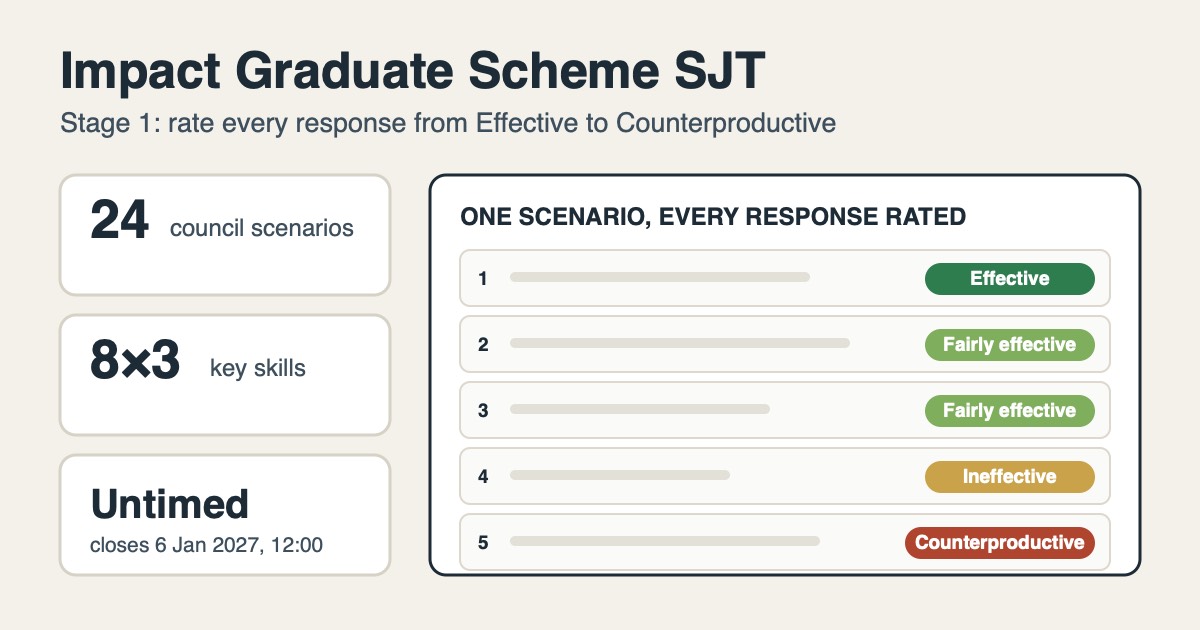
The test shows you 24 workplace scenarios set in a council. For each scenario you read the situation and then give every response its own rating: Effective, Fairly effective, Ineffective or Counterproductive. This guide covers what the test measures, how each rating works, a way to approach every response, and two worked responses. The practice boxes on this page let you try three full scenarios in the same format.
LGA Cohort 29 application page and timeline page, read 10 November 2026.
FreeTests: Effective Communication
Questions at the recycling stall: free sample
Read the situation, then rate each of its 5 responses, as the real test asks. The first 3 of 43 scenarios are free.
3 scenarios free▶ Start nowThis one is free · no sign-in neededUntimed, like the real testWhat the Impact SJT measures
The LGA says the test measures each of its eight key skills and behaviours three times across the 24 scenarios (timeline page). The LGA says the test was developed with council managers and graduates on the programme (LGA application page), and that no prior knowledge or experience is necessary (Cohort 29 vacancy page). The eight skills, as the LGA names them:
| Key skill | What a strong response tends to show (our guidance) |
|---|---|
| Working with Others | Works with people across teams, respects different views, stays open to challenge |
| Effective Communication | Explains clearly for the audience, listens, backs opinions with evidence |
| Planning and Organisation | Puts competing tasks in a sensible order and keeps your own workload under control |
| Results Focused and Adaptability | Gets things done and changes approach when priorities change |
| Analysis and Problem Solving | Reads figures and information accurately and concludes only what they support |
| Motivation for Learning and Personal Resilience | Seeks feedback and learning, copes with setbacks, sets healthy limits |
| Commitment to Local Government and the Wider Community | Keeps residents and the community at the centre of the decision |
| Leadership Potential | Leads by example, takes ownership, supports others |
Each of these is covered in depth, with what an Effective and a Counterproductive response look like in a council, in Impact Graduate Scheme key skills.
The four ratings, and the line between each pair
The LGA defines the four ratings on its practice questions page (LGA practice questions). In plain words: an Effective response is highly appropriate and useful; a Fairly effective one is appropriate and somewhat useful, though there may be better options; an Ineffective one is poor and would not help; a Counterproductive one is very poor and would make the situation worse.
| Rating | What the LGA definition says (paraphrased) | Typical signs in a council scenario (our guidance) |
|---|---|---|
| Effective | Highly appropriate and useful in addressing the situation | Deals with the main issue in good time, by the person who should act, and keeps residents or colleagues informed |
| Fairly effective | Appropriate and somewhat useful, though there may be better options | An appropriate step that is somewhat useful, where a better option may exist. Judge any delay, partial action or referral in context |
| Ineffective | Poor and would not be useful in addressing the situation | A poor step that would not help address the situation; it may look busy but achieve nothing useful here |
| Counterproductive | Very poor and would make the situation worse | Makes things worse: for example it misleads a resident, causes a fixed deadline to be missed, blames a colleague in front of others, or hides an error |
Where people slip (our advice)
- Effective or Fairly effective? Judge how appropriate and useful the response is in these circumstances. If it helps but a clearly better step is left undone (a person, the main issue or a deadline not dealt with), it is usually Fairly effective.
- Fairly effective or Ineffective? Ask whether it moves the situation on at all. A harmless step that does not touch the problem in this scenario (tidying a file, a kind gesture unrelated to the issue) is Ineffective.
- Ineffective or Counterproductive? Among responses that would not help, ask what goes wrong if you do it. If it would make the situation worse (a missed contract deadline, a resident misled, a colleague blamed in public), it is Counterproductive. If it simply does not help, it is Ineffective.
- Ratings repeat. Two or three responses can share a rating, and a rating need not appear at all. In the LGA's first practice question three of the six responses are Effective. Judge each response alone; never force a spread.
- 43 council scenarios
- Rate every response, as the real test asks
- All 8 key skills
- A reason for every rating
- Your score per key skill
- Untimed; pause any time
How to approach each scenario
A method for every scenario (our advice)
- 1. Find the real problem. Before reading the responses, say in one line what the main issue is and who is affected: a resident, a colleague, a deadline, a budget.
- 2. Note the fixed facts. Deadlines that cannot move, what you have been asked to do, and what you already know (a fixed deadline, a contract date, who can approve a decision) often decide the rating.
- 3. Rate each response alone, against the problem, not against the other responses. Then check each response you rated Effective: is it highly appropriate and useful here?
- 4. Check every response you rated Counterproductive. Be able to say what it makes worse. If you cannot, it is probably Ineffective.
- 5. Think as a trainee in a council. Honest with residents, fair to colleagues, sensible with public money, and ready to take ownership without taking over.
Two worked responses
One short scenario we wrote, with two of its responses rated and explained. It is not an LGA item, and it is not one of our practice set's scenarios.
Worked example (written by us)
- You are a graduate trainee in a council's Communities team. A resident group has asked to use the community hall free of charge for a weekend fundraiser. Your line manager, who is the team manager, is away until Thursday but reading email. The booking rules say only the team manager can waive the hall fee, and the group needs an answer by Friday to print its posters.
- Response: Tell the group it can have the hall free, since the event is for a good cause. Our rating: Counterproductive. You would be promising something only the team manager can approve. If the waiver is refused, the group will have planned around free use of the hall and face a charge it did not expect, and trust in the council suffers.
- Response: Email your line manager with the request and the Friday deadline, and tell the group you have asked and will pass on the answer as soon as you have it. Our rating: Effective. It sends the request to the person authorised to decide, in time, and keeps the group informed so they can plan.
Our scenario and our ratings, written to the LGA's definitions. It does not represent any real Impact question.
Notice what decided both ratings: one fixed fact in the scenario (only the team manager can waive the fee) and one deadline (Friday). Details like these often decide a rating, which is why reading the situation carefully matters more than spotting the "nicest" response.
FreeTests: Effective Communication
Questions at the recycling stall: free sample
Read the situation, then rate each of its 5 responses, as the real test asks. The first 3 of 43 scenarios are free.
3 scenarios free▶ Start nowThis one is free · no sign-in neededUntimed, like the real testTiming, breaks and the deadline
What the LGA says (Cohort 29 application page and timeline page)
- Untimed. The application page says around an hour on average and suggests one sitting with 1 to 2 hours to spare. The timeline page says 30 to 45 minutes. Plan for the longer figure.
- Breaks. You can take a break after answering a question, before the next one, and log back in to finish before the deadline.
- Order. The SJT comes after the application questions; you must complete it before you can submit.
- Deadline. Stage 1 runs from 7 October 2026 to 12.00 midday on Wednesday 6 January 2027. Starting close to the deadline leaves little time to sort out problems.
- Finance Stream. Applicants to the Finance Stream take a numeracy test as well as the SJT.
From the Cohort 29 application page and the timeline page, read 10 November 2026.
How scoring works: the real test and our practice set
The LGA pages we read on 10 November 2026 do not publish the scoring rule or a pass mark, and they do not say how many applicants pass. The timeline page says that if you pass the SJT you are invited to a video interview. Our practice set uses its own rule, labelled as ours: one mark for matching our rating, half a mark for a rating one step away, and no marks for two or more steps away. It also shows a score for each key skill and whether you tend to rate too harshly or too kindly.
This is the rule our practice set uses so that near misses still count for something. The LGA pages we read on 10 November 2026 do not publish how the real test is scored.
FreeTests: Effective Communication
Questions at the recycling stall: free sample
Read the situation, then rate each of its 5 responses, as the real test asks. The first 3 of 43 scenarios are free.
3 scenarios free▶ Start nowThis one is free · no sign-in neededUntimed, like the real testOther Impact guides
The most-and-least format the timeline page still describes, set against today's rating format, with one worked example each: NGDP situational judgement test practice.
The eight key skills in depth: Impact Graduate Scheme key skills.
What comes after the SJT, from the video interview to council interviews: Impact Graduate Scheme application process.
Practise in the current format
Our Impact SJT practice set has 19 original council scenarios covering all eight key skills. Each has five or six responses to rate from Effective to Counterproductive, and every rating comes with its reason. It is untimed, shows your time on each scenario and lets you pause. The first three scenarios are free. Independent practice. Not affiliated with the Local Government Association: the LGA did not write our scenarios and does not endorse them.
FreeTests: Effective Communication
Questions at the recycling stall: free sample
Read the situation, then rate each of its 5 responses, as the real test asks. The first 3 of 43 scenarios are free.
3 scenarios free▶ Start nowThis one is free · no sign-in neededUntimed, like the real testFrequently asked questions
What is the Impact graduate scheme situational judgement test?
It is the online test at Stage 1 of Impact: The Local Government Graduate Programme. You read 24 workplace scenarios set in a council and give every response an effectiveness rating. The LGA says it measures each of its eight key skills and behaviours three times.
How many questions are in the Impact SJT?
24 scenarios. Each scenario has several responses to rate; the LGA's two practice questions have six and five.
Is the Impact SJT timed?
No. The Cohort 29 application page says it takes around an hour on average; the timeline page says 30 to 45 minutes. You can take a break after answering a question and log back in until 12.00 midday on 6 January 2027.
Where can I find Impact SJT questions with answers?
The LGA publishes two practice questions with a rating and a reason for every response, on its page "Impact – practice situational judgement test questions".
Is there an Impact SJT PDF?
The LGA's practice questions for the current rating format are on its web page "Impact – practice situational judgement test questions".
Can two responses get the same rating?
Yes. Ratings can repeat, and a rating need not be used at all. In the LGA's first practice question three of the six responses are rated Effective.
What is the pass mark for the Impact SJT?
The LGA does not publish a pass mark or its scoring rule on the pages we read on 10 November 2026. Applicants who pass are invited to the video interview.
Is the Impact SJT still most and least appropriate?
The Cohort 29 application page asks you to rate every response, and the LGA practice questions use four ratings. The timeline page still describes picking the most and least appropriate of three. Follow the instructions shown in the test; the differences are set out in our NGDP SJT guide.
Are your practice scenarios real Impact questions?
No. Our scenarios are original and set in fictional councils, and our ratings are our reading of the LGA's definitions. We at ProSyllabus are independent and not affiliated with the Local Government Association.
More in this series
Sources
- official — LGA: Graduate Management Trainee on Impact, Cohort 29 application page (SJT instructions, key skills, closing date), read 10 November 2026
- official — LGA: Impact: The Local Government Graduate Programme timeline (Stage 1 dates, three measures per key skill), read 10 November 2026
- official — LGA: Impact practice situational judgement test questions (the four ratings and their definitions), read 10 November 2026
- official — LGA: Impact application page (key skills and behaviours, practice tests, hints and tips), read 10 November 2026
official = a document published by the conducting body. reported = a news or coaching site we could not check against an original. Where sources disagree this page says so rather than picking one.


