
Checked 5 October 2026. The official GATE 2027 GA PDF and question-paper pattern are the authority. Our paper coding and study method are editorial analyses, not an official topic forecast.
The GATE 2027 General Aptitude syllabus is common to every test paper and worth 15 of 100 marks. You can read the entire one-page IIT Madras syllabus PDF in minutes. The harder job is deciding which method to use when a question mixes a short passage, a chart, a set of conditions, or a folded shape. This guide turns the official four syllabus areas into a practical revision system, with original worked examples and a transparent audit of 30 archived paper files. It is a free, complete study guide; the optional revision kit comes after the methods.
The first three figures are GATE 2027 official pattern/syllabus figures. The last is our 2022–26 sample count, including repeated stems.
The official 2027 GA syllabus, in one table
| Area | Official coverage | First useful operation |
|---|---|---|
| Verbal Aptitude | Basic English grammar; vocabulary, idioms and phrases; reading and comprehension; narrative sequencing | Identify the exact sentence or passage evidence before selecting a word or order. |
| Quantitative Aptitude | Data interpretation using graphs, 2D/3D plots, maps and tables; ratios, percentages, powers, exponents, logarithms, permutations, combinations, series, mensuration, geometry, statistics and probability | Write units and a base value; estimate before calculating. |
| Analytical Aptitude | Deduction, induction, analogy and numerical reasoning | Translate each condition into a short, testable statement. |
| Spatial Aptitude | Transformation of shapes (translation, rotation, scaling, mirroring); assembling and grouping; paper folding and cutting; 2D/3D patterns | Track orientation, faces or fold layers before comparing options. |
This table paraphrases the official GA PDF rather than replacing it. The source does not assign marks to each of the four areas. A site that prints a fixed verbal-versus-quantitative split for GATE 2027 is adding its own forecast. Our study plan below responds to your errors, not an invented official weightage.
Pattern and marking: make each attempt decision deliberately
| Question type | Correct | Wrong | Review rule |
|---|---|---|---|
| MCQ: one correct option | 1 or 2 marks | −1/3 for a 1-mark MCQ; −2/3 for a 2-mark MCQ | Eliminate options, then decide whether evidence supports an attempt. |
| MSQ: one or more correct options | Full stated marks only if the complete set is right | 0; no negative marking and no partial credit | Test every option independently; one missed true option loses the item. |
| NAT: numerical answer | Full stated marks when in accepted range | 0; no negative marking | Estimate, enter the requested format and recheck units. |
The official question-paper pattern gives 10 GA questions for 15 marks, within a 100-mark, three-hour paper. Because GATE uses one- and two-mark questions, this implies five one-mark and five two-mark GA questions. That arithmetic is our inference from the published pattern, not a separate promise about order or topic placement. The remaining 85 marks are subject-paper marks; in some papers Engineering Mathematics is a named component inside those 85. GA is the shared 15-mark portion, not Engineering Mathematics, XH Reasoning and Comprehension, or XL Chemistry.
What we actually checked in five years of official papers
We reviewed the GA portions of six official paper codes—AR, CS, EC, EE, ME and XL—across 2022–2026. That is 30 paper files and ten GA question positions in each, or 300 question occurrences. We hashed question stems to flag repeats: 270 distinct stems remained. A repeated stem across paper files is not a new independent question. This is a deliberately limited cross-paper sample, not all GATE papers, and the labels below are our method labels rather than official syllabus subtopics.
| Sample slice | Paper codes | GA occurrences |
|---|---|---|
| 2022 | AR, CS, EC, EE, ME, XL | 60 |
| 2023 | AR, CS, EC, EE, ME, XL | 60 |
| 2024 | AR, CS, EC, EE, ME, XL | 60 |
| 2025 | AR, CS, EC, EE, ME, XL | 60 |
| 2026 | AR, CS, EC, EE, ME, XL | 60 |
| Total | 30 files; 270 distinct hashed stems | 300 |
These are seven exact labels from a more granular coding ledger, not a complete partition of 300 questions and not predicted 2027 marks. Narrow labels and repeated stems limit any frequency interpretation.
The responsible use of this audit is to collect methods: reading evidence, relation mapping, diagramming, conditional logic and basic computation recur across paper codes. A frequency list cannot tell you which ten questions GATE 2027 will set. Use the official 2022–26 archive to retest those methods on unfamiliar questions. Read the answer key for the exact paper you attempted; do not use a different session or branch key by mistake.
Four original worked examples: learn an operation, not an answer
1. Verbal: move from a claim to passage evidence
Suppose a passage says, “The new bus route reduced the average commute for survey respondents, but its effect on the city-wide population was not measured.” A question asks which conclusion follows. “Every resident saved time” does not follow: the passage only measured respondents. “The respondents’ average commute decreased” follows exactly. The operation is to separate the sample from the wider population and reject a conclusion with a larger scope than the evidence. On a grammar item, use the same discipline: read the whole sentence and check subject–verb agreement, time reference and meaning before choosing the familiar-looking word.
| Given statement | Supported conclusion | Unsupported leap | Error code |
|---|---|---|---|
| Measured respondents had a shorter average commute | The sample average fell | All residents benefited | Scope expansion |
2. Quantitative: keep the base visible
A practice chart shows 80 units in one year and 100 in the next. The increase is 20 units; percentage increase is 20 ÷ 80 × 100 = 25%, because the original 80 is the base. If it then falls from 100 back to 80, the percentage fall is 20 ÷ 100 × 100 = 20%. Equal absolute changes do not produce equal percentages. In a dense plot, first read axis labels and units, then copy the two values, then choose the denominator. Estimating “about a quarter” before arithmetic is a useful error check.
| Move | Absolute change | Base | Percentage change |
|---|---|---|---|
| 80 → 100 | +20 | 80 | +25% |
| 100 → 80 | −20 | 100 | −20% |
3. Analytical: test a statement against all constraints
Three talks, A, B and C, occupy slots 1–3. A occurs before B; C is not first. Try A–C–B: A is before B and C is not first, so it is valid. Try C–A–B: C is first, so it fails immediately. Try A–B–C: both rules also hold. Thus the clues do not determine a unique order. The operation is to distinguish “one valid arrangement” from “the only arrangement.” In an MCQ, reject a choice that assumes uniqueness unless another clue proves it.
| Order | A before B | C not first | Decision |
|---|---|---|---|
| A–C–B | Yes | Yes | Valid |
| C–A–B | Yes | No | Invalid |
| A–B–C | Yes | Yes | Valid |
4. Spatial: mirror, then rotate only if requested
Imagine an L with its vertical stroke on the left and its foot pointing right. Reflect it across a vertical mirror line. The vertical stroke moves to the right and the foot points left; it remains at the bottom. Rotating the original L by 180 degrees would put its foot at the top, so that is a different transformation. For paper folding, count how many layers a cut passes through and unfold one crease at a time. A quick sketch is faster than trying to hold every position mentally.
A compact companion for the 15-mark section
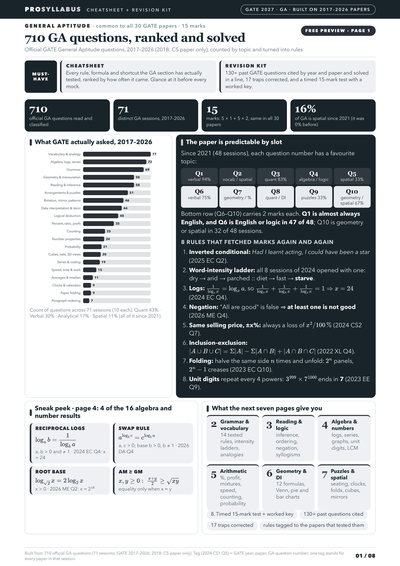
Use the four free worked cases above first. If a compact, seven-page method reference would help you revisit them, preview the kit’s actual first page.
The GATE 2027 General Aptitude Visual Revision Kit is a separate seven-page PDF: 26 method cards, 16 worked checks and one original ten-question checkpoint with answers. Its first page is free to preview. It covers the common GA section, not the remaining 85 marks of your branch paper.
Preview the GA revision kit →Turn one mock into the next review session
After one official GA set, mark every answer as correct and confident, correct but guessed, wrong through method choice, wrong through calculation, or wrong through reading. Put guessed correct items into the review pile: a lucky score hides a repeatable weakness. The four-area labels below are for scheduling, not an official score report. If an item could be both quantitative and analytical, assign it to the method that actually failed in your attempt.
| Mistake observed | Method family | Repair on paper | Unseen retest |
|---|---|---|---|
| Read “of” as “more than” in a graph | Quantitative | Circle the base and unit before computing. | One new percentage chart |
| Chose a conclusion beyond the passage | Verbal | Underline evidence and mark the claim’s scope. | One new short passage |
| Ignored one seating condition | Analytical | Write each constraint as a check box. | One new three-condition set |
| Rotated a mirrored figure | Spatial | Draw the mirror axis and mark a distinctive corner. | One new asymmetric shape |
| Worked input | Formula | One possible rounded allocation | Caution |
|---|---|---|---|
| Verbal 2, Quantitative 3, Analytical 1, Spatial 1 errors | 3 minutes each + 18 minutes in proportion to the seven errors | Verbal 8, Quantitative 11, Analytical 6, Spatial 5 minutes | The tool resolves rounding deterministically; this is a study suggestion, not exam timing. |
Do not spend a 30-minute review merely rereading all ten solutions. Re-solve a wrong item from a blank page, name the first operation you missed, then try a new question that needs the same operation. Keep a one-line error log: “selected denominator 100 instead of 80,” not “weak in aptitude.” Over two or three papers, the log tells you where to put your next hour. A fixed daily chapter timetable cannot see this evidence.
A practical four-pass cycle with official papers
| Pass | Task | Evidence of progress |
|---|---|---|
| 1. Map | Read the official one-page syllabus; put each unfamiliar phrase in one of the four areas. | You can explain the operation behind it. |
| 2. Solve | Attempt ten GA positions from one official paper under a reasonable time cap; keep the branch paper separate. | Record answer, confidence and time. |
| 3. Diagnose | Check the matching official answer key; classify each miss by operation, not just topic. | One specific correction and one fresh retest per miss. |
| 4. Space | Revisit the error after two days and again after a week using a different problem. | The same method works without the original answer in view. |
Start with an official paper from a branch you intend to write, then use another branch for fresh GA exposure: the syllabus is shared. A paper’s subject questions and answer key conventions remain paper-specific. Do not equate a ten-question GA practice result with a predicted GATE score or rank. The official marking rule applies, but actual difficulty, field performance and the remaining 85 marks are unknown in a ten-question drill.
Choose the next resource for the problem you actually have
If you need the official wording, use the IIT Madras GA syllabus PDF. If you need unfamiliar questions, use the official papers and answer keys. If you want a compact memory aid for the four method families after you have practised them, the optional seven-page GA revision kit offers a free first-page preview. The kit is a separate purchase and does not include a branch-specific 85-mark course, a quiz subscription or a membership.
Is General Aptitude compulsory in GATE 2027?
Yes. The GATE 2027 official exam-papers-and-syllabus page says General Aptitude is common to all 30 papers and carries 15 marks.
How many questions and marks are in GATE General Aptitude?
The official pattern gives 10 questions and 15 marks. With one- and two-mark items, that implies five of each.
What are the four areas of the GATE 2027 GA syllabus?
Verbal Aptitude, Quantitative Aptitude, Analytical Aptitude and Spatial Aptitude, as listed in the official one-page GA PDF.
Does GATE publish the marks split among GA topics?
No fixed 2027 split among the four GA syllabus areas is supplied in the official syllabus or pattern. Past-paper counts are historical observations, not a future blueprint.
Is there negative marking in GA?
Wrong MCQs lose one third of their marks: 1/3 for a one-mark item or 2/3 for a two-mark item. MSQ and NAT questions have no negative marking. MSQs have no partial credit.
Are General Aptitude and Engineering Mathematics the same?
No. General Aptitude is the 15-mark section shared by all GATE papers. Engineering Mathematics, where named, belongs within a paper’s other 85 marks.
Can I use GA questions from a different GATE branch?
Yes for practice of the common GA syllabus. Check the exact year and paper answer key; do not treat branch-specific subject questions as GA.
Does the ProSyllabus GA revision kit include my full branch syllabus?
No. The seven-page PDF covers the shared GA section, with 26 method cards, 16 worked checks and an original ten-question checkpoint. It has a free first-page preview and is a separate purchase.
More in this series
- GATE CS topic-wise weightage, counted from six official sets
- GATE CS previous year papers with official answer keys
- GATE CS qualifying marks, score vs rank, with calculator
- GATE CS 2027 syllabus changes, section by section
- PSU recruitment through GATE CS 2027, from the notices
- GATE DA vs GATE CS: which paper to write
- GATE CS rank predictor
- GATE CS expected cut-off for top IITs
- GATE CS notice board: official updates
- GATE CS exam analysis
- GATE Computer Science complete guide
Sources
- official — GATE 2027: official General Aptitude syllabus PDF, IIT Madras
- official — GATE 2027: exam papers and syllabus (GA common to all papers), IIT Madras
- official — GATE 2027: question-paper pattern and marking, IIT Madras
- official — GATE 2027: official previous paper and answer-key archive, IIT Madras
official = a document published by the conducting body. reported = a news or coaching site we could not check against an original. Where sources disagree this page says so rather than picking one.


