
Checked 8 November 2026. Figures for the 2027 cohort (programme starts 12 July 2027). Frontline says the bursary amount can change each year and depends on Department for Education funding; salaries in years two and three are set by each local authority. The DfE salary statistics are the first of their kind (official statistics in development) and describe September 2025.
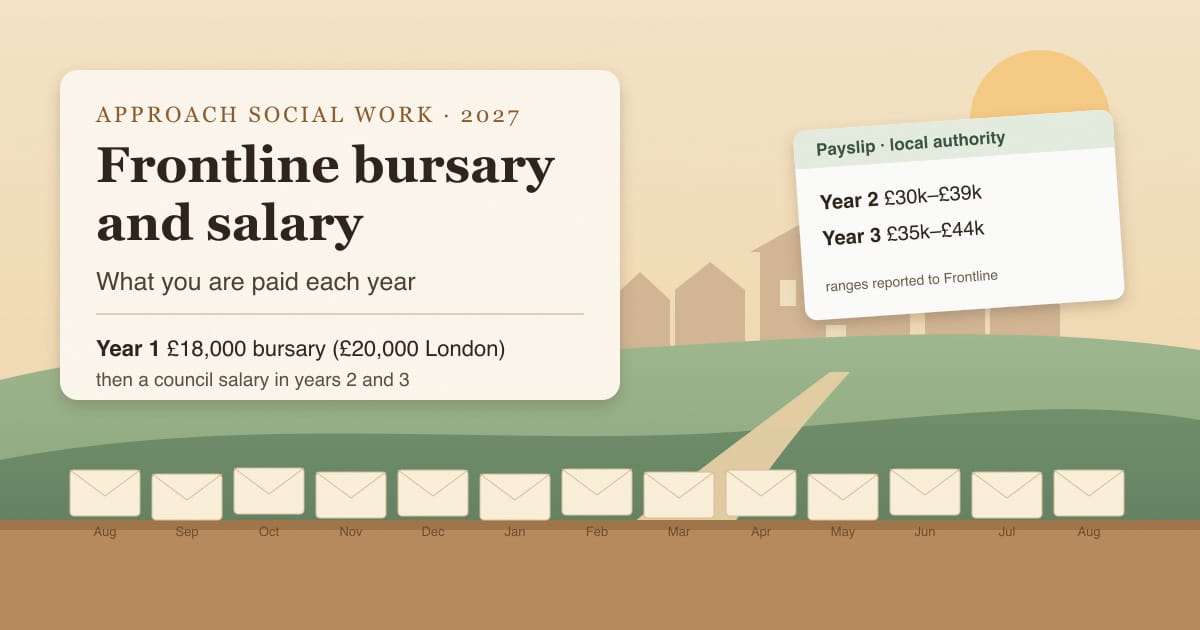
The Frontline bursary on Approach Social Work is £18,000 for year one, or £20,000 if you are placed in London. It is tax free and does not have to be repaid. From year two you are employed by your local authority on a newly qualified social worker salary: participants reported £30,000 to £39,000 in year two (median £35,000) and £35,000 to £44,000 in year three (median £40,000).
This page sets out what you are paid in each year of the programme, how the year-one bursary is paid, what it does and does not cover, the gap between the last bursary payment and the first salary, and what social workers earn later, using the Department for Education’s own salary statistics. Every figure comes from Frontline or the DfE.
ProSyllabus is an independent study site, not affiliated with Frontline or Approach Social Work. Every pay figure on this page is taken from Frontline or the Department for Education, with the link and the date we read it, and our own calculations are labelled; check the current figures on Frontline’s site before you commit.
Frontline: Pay, progression and financial support, and the Approach Social Work programme page (read 8 Nov 2026).
Frontline bursary vs salary: what you are paid each year
The whole programme in one table, for the cohort that starts on 12 July 2027. The year-one bursary is a total for the year; the salaries are annual, before tax. All figures are Frontline’s; the last two rows are the typical later roles Frontline describes.
| Stage | What you are paid | Who pays | Tax and National Insurance | Source |
|---|---|---|---|---|
| Year 1 (July 2027 to August 2028) | Bursary of £18,000 in total outside London, £20,000 in London, paid in 13 monthly instalments | Frontline (funded by the Department for Education) | None: Frontline compares it to the take-home pay of a £20,600 annual salary (£23,500 in London) | Frontline pay page and bursary policy |
| Year 2 (from September 2028) | £30,000 to £39,000 a year (median £35,000) as a newly qualified social worker | Your local authority, as its employee | Taxed as a normal salary | Frontline, reported by participants in 2024 and 2025 |
| Year 3 | £35,000 to £44,000 a year (median £40,000) | Your local authority | Taxed as a normal salary | Frontline, reported by participants in 2024 and 2025 |
| Senior practitioner (typically 3 years after qualifying) | £40,000 to £50,000, depending on experience and location | Your employer | Taxed | Frontline pay page |
| Team manager (usually 5 years after qualifying) | Up to £55,000, depending on experience and location | Your employer | Taxed | Frontline pay page |
Two points the table does not show. First, your tuition is free: Frontline pays for the postgraduate diploma and the master’s degree, and says social work master’s fees typically cost £9,000 a year. Second, the year-two and year-three figures are what past participants reported earning, not a promise: your salary is set by your local authority and is the same as other social workers there who qualified through other routes. Frontline: Pay, progression and financial support · Frontline: programme page.
Bursary: Frontline’s published amounts for the 2027 cohort. Years 2 and 3: salaries participants reported to Frontline in 2024 and 2025. DfE rows: Children’s social work workforce 2025, median base salary of full-time child and family social workers at 30 September 2025 (data set 6, rounded to £100). The bursary is tax free; the salaries are before tax.
Year 1: the Frontline bursary in detail
In year one you are a student, not an employee. Frontline’s bursary policy is explicit that the bursary “is not a salary and does not include benefits”: you are a student trainee of Lancaster University placed in a local authority team, and the bursary is a contribution to your living and travel costs. The rules that matter, from Frontline’s pay page and its 2026-27 bursary policy:
| Rule | What Frontline says |
|---|---|
| Amount | £18,000 for placements outside London, £20,000 for London local authorities (Frontline uses the London Councils website to guide its London weighting decisions) |
| Tax | Not subject to income tax or National Insurance; Frontline’s policy adds that HMRC’s treatment is open to review and could change |
| Repayable? | No, it is non-repayable (a payment wrongly received after you have officially left must be returned, below) |
| Legal basis | Section 46 of the Children and Social Work Act 2017; a grant under regulation 68(7) of the Universal Credit Regulations 2013 |
| How it is paid | 13 equal monthly instalments, in advance, on the first working day of each month, straight into your bank account |
| First and last payment | From August 2027 to August 2028 for the 2027 cohort |
| Student finance | Paid instead of a maintenance loan: you cannot also take a Student Finance England loan in year one |
| Moving local authority | Your bursary may change to match the new location (London or not) |
| Holiday | Up to 25 days in year one, approved by your consultant social worker; Frontline’s policy says the days are “not paid and are not a benefit of the bursary”, and unused days are not paid out |
To keep receiving it you must be fully registered with Lancaster University, stay enrolled and actively participating, submit all assignments and meet the attendance and engagement requirements, follow Frontline’s and your local authority’s procedures and regulations, and give Frontline any evidence it reasonably asks for about your health, character and criminal convictions. Frontline Bursary and Financial Policy 2026-27 · Help centre.
FreeTests: Verbal reasoning · Relationships and communication
Approach Social Work Online Test Practice: free sample
Answer 4 questions against the clock, like the real exam. You then see the right answer, the reason and your time on each. About 8 minutes · free · no sign-in.
4 questions to answer▶ Start nowThis one is free · no sign-in neededYour result shows how long each question took you.How much is the Frontline bursary per month?
Frontline’s policy says the bursary is paid in 13 equal monthly instalments. Dividing its totals by 13 (our arithmetic):
| Placement | Total bursary for year one | Each of the 13 payments |
|---|---|---|
| Outside London | £18,000 | about £1,385 (£1,384.62) |
| London | £20,000 | about £1,538 (£1,538.46) |
Year one includes the five-week Readiness for Practice stage, which opens the programme on 12 July 2027, and your first year of placement; the bursary for it is paid in 13 instalments from August 2027 to August 2028. Payments land on the first working day of each month, and 1 August 2027 is a Sunday, so the first payment should arrive on Monday 2 August 2027. Because each instalment is paid in advance, it is meant to cover the month ahead. Note the start: the programme begins on 12 July 2027 but the first payment comes in August, so budget for your costs in those first three weeks (Frontline’s bursary advance and grant scheme, below, exists for this stage, with very limited funds).
Frontline also compares the whole bursary with a salary: because it is not taxed, £18,000 is roughly the take-home pay of someone earning £20,600 a year (£23,500 in London for the £20,000 bursary). The bursary is paid over 13 months, so this is Frontline’s comparison of totals, not of monthly income.
- 3 practice tests of 20 questions
- Verbal reasoning: True / False / Cannot say and comprehension
- Social-work SJT scenarios: most and least likely responses
- Every answer explained
- Your result by area
The gap between the last bursary payment and your first salary
Your last bursary payment arrives in August 2028. Your first salary payment as a local authority employee usually arrives between 15 and 30 September 2028, depending on your local authority. So the August payment has to stretch for about six to nine weeks (45 to 60 days from 1 August).
Frontline tells participants to prepare for “this longer than usual gap between payments”, and its bursary policy (section 2.1.6) says that failing to plan for it is not grounds for a loan or grant from Lancaster University’s support funds. Plan how you will cover your costs until the first salary; setting money aside during year one may help. Frontline: Pay, progression and financial support · Bursary and Financial Policy 2026-27.
What the bursary has to cover, and what Frontline pays for
The bursary is a contribution to living and travel costs. Frontline says it is likely you will need other money as well, and asks applicants to be sure they can cover year one from the bursary plus their own funds before they apply. What is paid for, and what is not:
| Cost | Who pays | Notes |
|---|---|---|
| Tuition: postgraduate diploma and master’s degree | Frontline, in full | Frontline says social work master’s fees typically cost £9,000 a year |
| First DBS check | Frontline | Replacing a lost or damaged certificate is at your cost |
| Travel to Readiness for Practice, residential and teaching days | You | Frontline covers accommodation and food for the three-day residential |
| Home visits and visits to families during placement | Usually your local authority | Each local authority reimburses in its own way |
| GP fee for the health form | You | Some GP surgeries charge for completing it |
| Overseas police checks, replacement qualification certificates | You | Frontline does not contribute |
| Specific learning difficulty (SpLD) assessment, if you choose one | Frontline pays £160; you pay the rest | Frontline can pay upfront and take the rest back through bursary deductions |
Outside London there is one more cost: Frontline says driving and access to a car are key requirements for all its local authority partners outside London. You need a full UK driving licence (manual or automatic) when you apply and access to a car by the start of the placement in September (Frontline works case by case with people who are medically exempt). Pay page · Help centre.
Universal Credit, childcare, council tax and student loans
The bursary interacts with benefits and other support. Frontline cannot advise on individual cases, but it publishes these points:
| Topic | What happens |
|---|---|
| Universal Credit | Most participants no longer receive it once the bursary starts; Frontline says the bursary is more than Universal Credit would pay, with some exceptions for people with additional needs |
| 30 hours funded childcare | Most participants are no longer eligible; Frontline says it is extremely unlikely you will qualify for in-work support such as funded childcare in year one |
| Council tax | As a full-time Lancaster University student you may get an exemption or discount, depending on your household |
| Existing student loans | The bursary does not count as income for student loan repayments; you may need to send the Student Loans Company evidence of your means of support |
| A postgraduate loan you already took out | You still get the full bursary |
| Disabled Students’ Allowance | You can apply through Student Finance England in year one; it is needs-based and not repaid |
| Years two and three | You are an employee, so normal rules apply; Access to Work may help with a disability or health condition |
If you have children, work out the change in your childcare costs and household income before you apply. Frontline help centre: effect on other benefits.
If the bursary is not enough: hardship funds and advances
Frontline describes the extra help as limited and discretionary, so treat it as a safety net rather than part of your budget:
- Frontline participant hardship fund. For people holding a conditional offer and year-one participants. It is aimed at groups more likely to face hardship, including people with dependants, single parents, career changers with existing financial commitments, people from low-income families, disabled people, care leavers, people who are homeless or in transitional housing, and people from racialised minority groups. Details normally come out in mid-April, before the programme starts. Frontline says there is no guarantee of the outcome.
- Bursary advance and grant scheme. Helps with costs during the Readiness for Practice stage, for a very limited number of participants. Frontline asks you to consider that an advance means reduced payments for the rest of the year.
- Lancaster University’s Opportunity and Access Fund and emergency loan. For significant, unexpected changes in your finances. Frontline says participants are less likely to qualify, because they get a bursary and pay no fees.
- Lancaster’s Student Assistance Programme. Debt management support and legal information, available to participants.
Frontline: Pay, progression and financial support, and Bursary and Financial Policy 2026-27, section 2.1.
Do you have to pay the bursary back?
No. Frontline describes the bursary as non-repayable. Its 2026-27 policy does set out what happens when your circumstances change:
| Situation | What happens to the bursary |
|---|---|
| You leave the programme | Payments stop. Because payments are made in advance, one can be wrongly received after you have officially left; Frontline requires that payment back and will discuss an arrangement if repaying is hard |
| You stop attending all taught and practice-based elements with no explanation | Frontline reserves the right to discontinue and revoke the bursary, under its attendance and engagement policy |
| You intercalate (pause) for illness or personal reasons | No bursary during the pause; payments restart when you return to placement |
| You need an extension to finish year one | No extra bursary: the total period is 13 months |
| Maternity, paternity or adoption leave that stops you completing year one within the academic year you joined | Payments stop when the leave starts and recommence under the policy if you return in the next available academic year |
| You defer before starting | Nothing is paid while deferred; you then receive pro-rata payments on the same terms as the rest of that cohort in your local authority |
| You are suspended pending an investigation | You stay eligible from the first day of suspension until the matter is concluded; whether payment continues depends on the outcome |
Frontline Bursary and Financial Policy 2026-27, sections 2.2, 2.5 and 2.8.
Years 2 and 3: your salary as a newly qualified social worker
After you pass year one, you receive a postgraduate diploma, register with Social Work England and start work as an employee of your local authority. There is no bursary in years two and three. Instead, Frontline says, you are paid a newly qualified social worker salary in year two and a social worker salary in year three, set by the local authority and the same as colleagues who qualified through other routes.
| Year | Role | Reported salary range | Median reported |
|---|---|---|---|
| Year 2 | Newly qualified social worker | £30,000 to £39,000 | £35,000 |
| Year 3 | Social worker | £35,000 to £44,000 | £40,000 |
These are the salaries participants reported to Frontline in 2024 and 2025. Frontline adds that pay varies between the local authorities where it places participants and that London authorities may offer more. In both years you keep studying towards the master’s degree, and you follow the national two-year Early Career Development Programme, which the DfE says replaces the Assessed and Supported Year in Employment from autumn 2027. Annual leave in these years follows your local authority’s policy. Frontline pay page · DfE: Early Career Development Programme.
What social workers earn by region: the DfE figures
Frontline’s ranges come from its own participants. For the wider picture, the Department for Education published, for the first time in March 2026, the base salaries of England’s full-time child and family social workers in local authorities, as at 30 September 2025. Medians, rounded to the nearest £100:
| Region | All full-time child and family social workers | Under 2 years’ time in service | Case holders |
|---|---|---|---|
| England | £47,200 | £42,800 | £41,800 |
| London | £52,600 | £48,000 | £47,500 |
| Inner London | £53,300 | £49,200 | £48,600 |
| Outer London | £52,200 | £47,000 | £47,000 |
| South East | £47,200 | £42,200 | £41,800 |
| East of England | £47,100 | £40,700 | £40,700 |
| West Midlands | £48,200 | £41,800 | £39,900 |
| East Midlands | £44,800 | £41,800 | £41,800 |
| South West | £46,100 | £41,300 | £40,800 |
| North West | £46,100 | £40,800 | £40,800 |
| North East | £45,100 | £40,800 | £41,800 |
| Yorkshire and The Humber | £46,100 | £39,200 | £39,900 |
Read these with care. The DfE labels them official statistics in development, collected for the first time; they are base salaries before allowances, for full-time staff only, and exclude agency workers. The DfE’s “Less than 2 years” time-in-service band is its own grouping and is not limited to newly qualified social workers, and the DfE and Frontline figures describe different groups at different times. For what a Frontline participant is likely to earn in year two, Frontline’s own figures are the better guide. The DfE figures are a snapshot, in September 2025, of the full-time, non-agency workforce with recorded base salaries: London’s overall median was about £5,400 higher than England’s, though that is a difference between two workforces, not an allowance you would receive (the DfE notes that regional weighting may already be included in base salary, for example in London). DfE: Children’s social work workforce 2025.
After the programme: senior practitioner, team manager and beyond
Frontline describes two common next steps after the programme:
| Role | When (Frontline) | Salary (Frontline) |
|---|---|---|
| Senior practitioner | Typically three years after qualifying (one year after the programme) | £40,000 to £50,000, depending on experience and location |
| Team manager | Usually five years after qualifying; head of service comes later | Up to £55,000, depending on experience and location |
Separately, the DfE publishes national medians by its own role categories. Local authorities use their own job titles, so these are reference points, not a match for Frontline’s roles:
| DfE role category | National median (September 2025) |
|---|---|
| Case holder | £41,800 |
| Qualified without cases | £48,200 |
| Senior practitioner | £49,000 |
| First line manager | £56,400 |
| Middle manager | £66,500 |
| Senior manager | £84,400 |
These are national medians for full-time, non-agency staff with recorded base salaries in each DfE role category, at every level of experience and including London. Across that workforce in September 2025, the median was £42,800 for staff with under two years’ time in service, £45,100 for two to under five years and £50,300 for five to under ten years: a snapshot of different people, not the path of one career. People searching for a Frontline consultant social worker salary will not find one in Frontline’s pay pages or bursary policy. In year one you are placed in a practice hub of typically five participants and receive management, training and supervision from a consultant social worker; Frontline does not give their pay. Frontline: progression in social work · DfE data set 6.
Frontline vs Step Up to Social Work: the money compared
Another fully funded fast-track into children’s social work in England is the DfE’s Step Up to Social Work. The money compares like this:
| Item | Approach Social Work (Frontline) | Step Up to Social Work (DfE) |
|---|---|---|
| Training bursary | £18,000, or £20,000 in London | £21,995, the same everywhere |
| Period the bursary covers | 13 months (about £1,385 a month, or £1,538 in London) | A 14-month full-time programme (about £1,571 a month if spread evenly; our arithmetic) |
| Tax | Tax free | Tax free |
| Repayable | No | No |
| Amount depends on | Location: London or outside London | Not means tested, and does not vary by location |
| Tuition | Covered | Covered |
| Qualification | Postgraduate diploma after year one, then a master’s by the end of year three | Postgraduate diploma (PGDip, level 7) in social work |
| When you can apply | Applications for the 2027 cohort opened on 28 September 2026 | Every two years; applications for the 2026 programme have closed |
| Experience needed | Not among Frontline’s eligibility criteria (and work experience cannot replace its academic requirements) | 6 months’ full-time (or equivalent) direct experience, paid or voluntary, of working with vulnerable children, young people or families, carers or vulnerable adults |
Spread over its 14 months, Step Up’s bursary is close to Approach’s London rate and above its rate elsewhere. But it is a different route with a different timetable: GOV.UK says Step Up applications are currently closed, while Frontline’s 2027 applications opened on 28 September 2026. GOV.UK: Step up to social work · Frontline help centre · Frontline eligibility.
FreeTests: Verbal reasoning · Relationships and communication
Approach Social Work Online Test Practice: free sample
Answer 4 questions against the clock, like the real exam. You then see the right answer, the reason and your time on each. About 8 minutes · free · no sign-in.
4 questions to answer▶ Start nowThis one is free · no sign-in neededYour result shows how long each question took you.Is Frontline worth it financially?
That depends on your situation, but the official figures make the trade clear. In year one you take a tax-free £18,000 or £20,000, which Frontline compares to the take-home pay of a £20,600 or £23,500 salary, while paying no tuition on a qualification whose fees Frontline puts at about £9,000 a year. From year two you are on a qualified social worker’s salary, which participants reported at a median of £35,000 and then £40,000, and the DfE puts the national median for all full-time child and family social workers at £47,200.
The costs to weigh are the ones this page lists: a year-one bursary well below the year-two salaries, travel, possibly a car, the loss of Universal Credit or funded childcare for some families, and the payment gap in September 2028. If those work for you, the financial case is that you qualify without tuition debt and are on a salary from your second year.
A money checklist before you accept a place
How to get the bursary: the application
The bursary comes with a place on the programme, so the first step is the application. Frontline’s stages are registration, an application form with two competency-based questions, an online test, a half-day virtual assessment centre, and pre-employment checks. Applications for the 2027 cohort opened on 28 September 2026 and locations close as they fill, so Frontline recommends finishing each stage as soon as you are ready. Frontline: application process.
The online test arrives once you submit your application form and must be completed within 7 days. Our guide to the Approach Social Work online test covers it in full; the free practice questions on this page play in the same test player.
Before any bursary: Frontline’s online test
To reach the programme, and the pay on this page, you first have to pass Frontline’s online test: Frontline reviews your application form only after a successful result. It combines verbal reasoning with social-work scenarios; Frontline’s own video says you pick the responses you are most and least likely to choose. Our Approach Social Work Online Test Practice gives you three full practice tests in that format, with every answer explained and a result by area.
See the Approach Social Work Online Test Practice, or read our guide to the online test. Independent practice, written by us; not made or endorsed by Frontline.
FreeTests: Verbal reasoning · Relationships and communication
Approach Social Work Online Test Practice: free sample
Answer 4 questions against the clock, like the real exam. You then see the right answer, the reason and your time on each. About 8 minutes · free · no sign-in.
4 questions to answer▶ Start nowThis one is free · no sign-in neededYour result shows how long each question took you.Frequently asked questions
How much is the Frontline bursary?
For the 2027 cohort of Approach Social Work, £18,000 for year one, or £20,000 if you are placed in a London local authority. It is tax free and non-repayable.
How much is the Frontline bursary per month?
Frontline pays it in 13 equal monthly instalments from August 2027 to August 2028, which works out at about £1,385 a month outside London and about £1,538 in London.
Is the Frontline bursary taxed?
No. Frontline says it is not subject to income tax or National Insurance, so £18,000 is roughly the take-home pay of a £20,600 salary (£23,500 in London for the £20,000 bursary). Frontline notes that HMRC’s treatment could change.
Do you get paid on Frontline?
In year one you receive a bursary, not a salary: you are a student, not an employee. In years two and three you are employed by your local authority and paid a social worker’s salary.
What is the Frontline social work salary after year one?
Participants reported £30,000 to £39,000 in year two (median £35,000) and £35,000 to £44,000 in year three (median £40,000), depending on the local authority and location.
Is the Approach Social Work salary higher in London?
The year-one bursary is £20,000 in London instead of £18,000, and Frontline says London local authorities may offer higher salaries. DfE figures put the London median for all full-time child and family social workers at £52,600, against £47,200 for England.
Do I have to pay back the Frontline bursary?
No, it is non-repayable. The exception in Frontline’s policy is a payment made in advance after you have already left the programme, which must be returned.
Does the Frontline bursary affect Universal Credit or childcare?
It may affect both. Frontline says most participants no longer receive Universal Credit once they have the bursary and/or are no longer eligible for 30 hours of funded childcare.
Can I get a student loan as well as the bursary?
No maintenance loan: the bursary is paid instead of one, and you cannot take a Student Finance England loan in year one. The bursary does not count as income for repaying any student loan you already have.
What is the Frontline consultant social worker salary?
Frontline’s pay pages and bursary policy do not give one. In year one the consultant social worker provides management, training and supervision to your practice hub of typically five participants.
What is the starting salary for a social worker in England?
Frontline participants reported £30,000 to £39,000 (median £35,000) in their first year as newly qualified social workers. For comparison, the DfE’s median base salary for all full-time case-holding child and family social workers, at every level of experience, was £41,800 in September 2025.
Is there a bursary for social work apart from Frontline?
Yes. The DfE’s Step Up to Social Work pays a tax-free bursary of £21,995, the same everywhere, but it recruits every two years and needs six months’ relevant experience.
Is ProSyllabus part of Frontline?
No. ProSyllabus is an independent study site, not affiliated with Frontline or Approach Social Work. The pay figures here are taken from Frontline and the DfE, with links.
More in this series
- Approach Social Work online test 2027: free verbal reasoning and SJT practice
- Approach Social Work: the Frontline programme explained
- Approach Social Work application form: the competencies with STAR examples
- Frontline assessment centre: the written exercise, role play and interview
- Frontline interview questions and how to prepare
Sources
- official — Frontline: Approach Social Work, Pay, progression and financial support (bursary, years 2 and 3 salary, progression, costs; read 8 Nov 2026)
- official — Frontline: Approach Social Work programme page (pay and progression, with median salaries reported by participants in 2024 and 2025; read 8 Nov 2026)
- official — Frontline: Approach Social Work help centre (financial support, holiday, student loans, benefits, programme dates; read 8 Nov 2026)
- official — Frontline: Bursary and Financial Policy 2026-27 (PDF, version 2026.01, reviewed January 2026)
- official — Department for Education: Children’s social work workforce, reporting year 2025 (published 19 March 2026; base salary at 30 September 2025, official statistics in development)
- official — GOV.UK (Department for Education): Step up to social work (funding; page updated 2 July 2025)
- official — Department for Education: Support for social workers, national professional development offer (early career development programme)
- official — Frontline: Approach Social Work eligibility (read 8 Nov 2026)
- official — Frontline: Approach Social Work application process (read 8 Nov 2026)
- official — Frontline (official YouTube channel): How to succeed in your Approach Social Work online test (7 Oct 2026)
official = a document published by the conducting body. reported = a news or coaching site we could not check against an original. Where sources disagree this page says so rather than picking one.


