
Checked 8 November 2026. Frontline’s wording for the 2027 cohort of Approach Social Work (Frontline says assessment centres run from October; for this cohort we read that as October 2026). Exercises can vary between recruitment cycles, and Frontline sends invited applicants their details; always follow your own invitation.
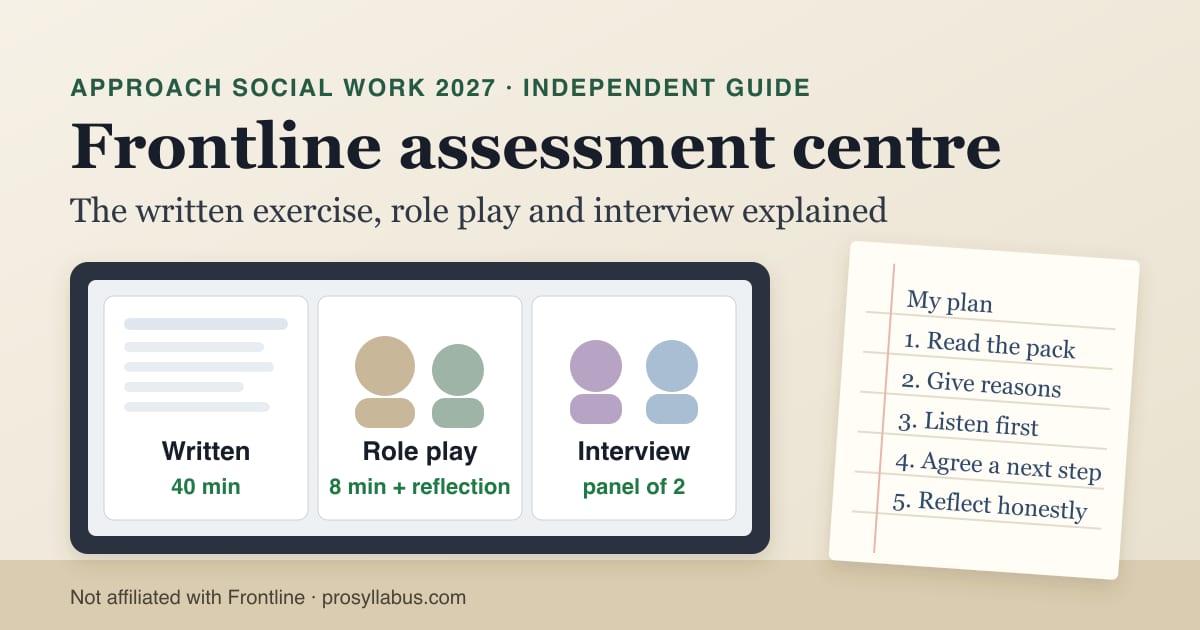
The Frontline assessment centre is stage 4 of the 5 in Frontline’s application process overview for Approach Social Work (the programme’s new name; it used to be the Frontline programme). It is a half-day, virtual event run on a video call, with three activities: a written exercise of 40 minutes about two families, a role play: an 8-minute conversation with a family member, plus reflection (Frontline mentions it both part way through and after the conversation), and a competency-based interview with a social worker and a person with care experience.
This guide sets out what Frontline itself says about each activity, how you are assessed, how to prepare, and two original practice items: a sample role-play brief and a written-exercise prompt, each with a marking guide. Interview questions have their own page, our Frontline interview questions guide.
ProSyllabus is an independent study site. It is not part of Frontline or Approach Social Work. The sample role play and written exercise on this page are our own, written for practice: independent practice, not affiliated with Frontline, and not made, endorsed or checked by it.
Frontline: application process page and assessment centre tips.
Key facts: the Frontline assessment centre
| Item | Detail |
|---|---|
| Programme | Approach Social Work (formerly the Frontline programme), Frontline’s three-year route into children’s social work |
| Stage | Stage 4 of 5 in Frontline’s application process overview (step 5 of 6 on its applicant page, which lists screening and document upload separately); before pre-employment checks |
| Format | Virtual, half a day, on a video conferencing platform |
| Activities | A written exercise, a role play, and a competency-based interview with a social worker and a person with care experience; Frontline lists no group exercise, though you meet other candidates during the day |
| Written exercise | 40 minutes in total; you play an Approach social worker new to a team supporting two families; more case details arrive on the day |
| Role play | An 8-minute conversation with a family member as a newly qualified social worker; Frontline’s tips mention a reflection with an assessor part way through and a reflection session after the conversation |
| Before the day | An information pack one to three days before; Frontline suggests allowing about an hour to digest it |
| How you are assessed | Against Frontline’s competencies; a different assessor watches each activity, and each competency is assessed in several activities |
| Dates | From October; Frontline’s applicant page says until April, its help centre says usually until May (see below) |
| Outcome | Within 10 working days of your assessment centre date |
How you get invited, and when it runs
You are considered for an assessment centre only after you pass the online test, your application is screened, and you upload your eligibility documents. Frontline’s applicant page says that to have the chance of an invitation you must upload all the required eligibility documents and complete its career experience form. Its help centre says these include your degree certificate and right to work documents, and in some cases your GCSE English Language certificate or an accepted equivalent, and that letters from institutions and photocopies are not accepted as evidence of qualification; a final-year student can still go ahead as long as they can confirm they will receive proof of results before the programme starts, by a date Frontline communicates, and then provide official proof once the final classification is out. Invitations go out on a rolling basis, depending on location and on the needs of Frontline’s local authority partners.
Two Frontline pages give slightly different end months. The applicant page says assessment centres run from October through to April; the help centre says they usually run from October until May. The end months differ, but the advice is the same: move through the earlier stages quickly. The help centre adds that dates are released frequently, that you should book the earliest date you can, and that Frontline may cancel upcoming assessment centres once it has recruited the candidates it needs. If you are invited, you follow the instructions in your invitation to book a date. Applicants page · Help centre.
| Step | What Frontline says |
|---|---|
| Pass the online test | Within 7 days of the invite; you receive the result, and if successful your application is reviewed |
| Screening | A social work trained screener reviews your two 350-word competency answers, without access to your personal details or work experience |
| Upload documents | Degree certificate, right to work documents and in some cases GCSE English; plus your career experience form |
| Invitation and booking | Rolling invitations by location and partner need; book the earliest date you can |
| Information pack | Sent one to three days before; allow about an hour to read it |
| The assessment centre | Half a day online; written exercise, role play, interview |
| Outcome | Within 10 working days; if successful, a conditional offer and pre-employment checks |
FreeTests: Assessment centre role play
Try one role-play moment: what would you say first?
A short practice brief of our own: a parent who feels judged opens the door. Type what you would say in your first minute, then see what your answer showed and a model response. One free try.
1 role-play moment · type your first minute▶ Start nowThis one is free · no sign-in neededWho assesses you, and how
Frontline says you are assessed by trained assessors: social workers (its applicant page says some have completed one of Frontline’s programmes) and people with experience of the care system. Its help centre adds that throughout the day assessors are also looking for evidence of your professional conduct and time management, so our practical suggestion is to join on time with your camera, microphone and connection checked beforehand.
The most useful sentence on Frontline’s tips page is about how you are assessed: a different assessor observes each activity, and each competency is assessed in more than one activity. Frontline’s own conclusion is that one weak activity does not end your day, because you can still show the competency elsewhere. The practical conclusion is to treat each activity as a fresh start.
These are Frontline’s five competency groups, with where each is most visible on the day. The mapping is our reading of Frontline’s activity descriptions, not a published marking scheme:
| Competency | Where it shows most (our reading) |
|---|---|
| Values, motivation and interests | Interview: why social work, why Approach, a realistic picture of the job |
| Relationships and communication | Role play (rapport, calm under challenge); written exercise (clear, respectful, non-judgemental writing) |
| Analysis and judgement | Written exercise (patterns, risks, missing information, a reasoned decision); role play (asking the right questions) |
| Self-awareness, reflection and resilience | Role play reflection (honest strengths and weaknesses, then adapting); interview |
| Leading with professionalism | All day: time management, follow-through, challenging unfairness respectfully |
Read the full descriptions on Frontline’s competencies page. Frontline repeats the point on its tips page more than once: know how you will show the competencies before you arrive.
Before the day: the information pack
Frontline sends an information pack between three days and one day before your assessment centre and suggests allowing around an hour to digest it. It contains instructions for the interview and role play and the case information for the written exercise (Frontline’s written-exercise tips speak of the case information sent three days before). It does not contain everything: more details for the written exercise are given on the day, the role-play case information is read during the briefing time on the day, and more comes during the conversation itself. You are welcome to make notes.
Frontline also expects you to have researched Approach and the role of a children’s social worker. It suggests attending one of its events or watching a recording, reading its stories page, or taking its interactive quiz, “Is social work right for you?”. If you have a question about the day, its applicant pages offer lunchtime and evening drop-in sessions with a member of the recruitment team. For the technical side, its tips page links video conferencing guidance and a short video (the video still uses the old name, the Frontline programme).
The written exercise
Frontline describes the task like this: you take on the role of an Approach social worker who has recently joined a new team to support two families. You must show that you can identify, gather and interpret key information, problem solve, and write clearly and persuasively. Frontline says it wants to see how you interpret the information provided and gather additional evidence, and how you set out your rationale in writing.
| Frontline’s advice | What it means in practice |
|---|---|
| 40 minutes in total | Reading and writing share one clock |
| Recommends starting to write with at least 30 minutes left | Spend no more than about 10 minutes on the on-the-day material before you write |
| Read the case information sent before the day | Frontline’s tips speak of it arriving three days before; know both families well, so the 10 minutes on the day go on the new details |
| Your own thinking, not regurgitated information | Make judgements and support each one with evidence from the materials |
| Consider tone and style | Write as if the person concerned will read it; no judgemental language or assumptions |
| Check the answer at the end | Leave a few minutes for spelling, grammar and sense |
Frontline sets 40 minutes in total and recommends starting to write with at least 30 minutes left; the split between writing and checking is our suggestion.
Frontline adds a point that is easy to miss under time pressure: it wants your judgements, supported by evidence in the materials. A response that retells both case files in order shows reading, not analysis. Extra time for the written exercise is one of the reasonable adjustments Frontline lists for applicants with a disability (see below).
- 3 timed written exercises (40 minutes)
- 3 role-play scenarios, typed at three moments
- 12 interview questions with model answers
- Feedback on every answer
- Written practice only, no video
Worked item 1: a sample written-exercise prompt and marking guide
The prompt below is our own, written to match the shape Frontline describes (a new Approach social worker, two families, a pack before the day, new details on the day). It is not a Frontline exercise, and the real one may ask a different question. Read the case information first, as you would before the day. Then start a 40-minute timer, read the new information and the question, and write your answer before reading the marking guide. The 400-word limit is ours; Frontline’s pages give no word limit.
Sample written exercise (ours): two families, one day
Your role. You are an Approach social worker who joined the Northfield children’s team this week. Your team manager has asked you to support two families.
Case information (sent before the day). Family A: Mia (7) lives with her mother, Ms Carter. The school has recorded 11 absences this term, mostly on Mondays, and says Mia has twice arrived without breakfast. Ms Carter has told the school she works night shifts at a care home. Family B: Jay (14) lives with his father, Mr Hollis, and his younger brother. A youth worker says Jay has been seen out late with older teenagers and once had a new phone he would not explain. Mr Hollis has not returned two calls from the school.
New information (given on the day). A message from Mia’s school: Mia told a teaching assistant this morning that she “looks after herself” when her mum is at work. A message from Jay’s youth worker: Jay did not attend the club this week, which is unusual.
The question. Write a note of up to 400 words to your team manager. Explain what needs to happen today for each family, which family you would visit first and why, what further information you need and from whom, and what you will do next for the other family. You may ask colleagues for help.
Our own fictional case, written for practice. Any resemblance to real people is coincidental.
Marking guide (ours): what a strong answer does
Our marking guide looks at reasoning, urgency and proposed actions rather than one fixed visiting order. Mia’s comment needs prompt clarification of her safety and care arrangements, and Jay’s whereabouts and safety also need prompt checking. Prioritising Mia is reasonable on this information; another order can be justified only with sound reasoning and timely action for both children. A strong note:
- Makes a clear, provisional decision early and treats urgency properly: raises both concerns with the manager now, explains which child it would prioritise and why, arranges parallel checks or colleague support where needed, and says what new information would change the plan. Any immediate danger means immediate protective action through the proper safeguarding route, not waiting for a routine visit.
- Separates reports, hypotheses and unanswered questions. “The school reports that Mia said she looks after herself when her mum is at work; this needs clarifying” is evidence; “Ms Carter is neglectful” is an assumption the material does not support. It considers other explanations as well as risks.
- Spots patterns and gaps: Monday absences and reported night work (are they connected? the note checks rather than assumes); no information on who else lives with Mia or who cares for her when her mother works; no explanation yet for Jay’s phone or his missed club; nothing yet about his younger brother.
- Names sources for the missing information, including the children themselves: Mia and Jay, Ms Carter, Mr Hollis, the school, the youth worker and the team’s records. It notes strengths and support networks, explains what information is needed and why, and keeps contact with other relatives and any information sharing relevant, necessary and proportionate, with the manager’s guidance where needed.
- Does not drop the second family. Jay’s pattern (older peers, an unexplained phone, a change in routine) can be a sign of exploitation risk, without being proof of it. A strong note plans prompt checks on where Jay is and whether he is safe, seeks his own account, contacts his father and the youth worker, thinks about his younger brother, and discusses urgency with the manager now rather than waiting for things to worsen.
- Recognises the limits of a new worker’s role: discusses the decision with the manager, and says when a concern would need escalating.
- Writes respectfully: neutral language about both parents, short paragraphs, a clear structure, and spelling, grammar and meaning checked at the end.
Weak answers retell both files without a decision, label a parent, ignore the on-the-day information, or run out of time before the next steps.
Our marking guide, mapped to Frontline’s competencies (analysis and judgement, communication, professionalism). Not Frontline’s scoring.
A model opening, to show the register: “I would like to discuss both children’s safety with you now. The school reports that Mia said she ‘looks after herself’ while her mother is at work, and Ms Carter has told the school she works nights. This raises a concern that Mia may be left unsupervised, but we do not yet know when this happens or who else cares for her. I propose prompt checks of Mia’s safety and care arrangements today, alongside checks on where Jay is and whether he is safe, with a colleague’s help if needed. I would like us to agree the visiting order and any protective action now, and review the plan as information comes in.” It is factual, keeps reports as reports, treats a possible risk as today’s work for both children, and says what is not yet known.
Try a role-play moment free
Before the role play section, try one moment of practice: a short role-play brief of our own, in which a parent who feels judged opens the door. Type what you would say in your first minute, then see what your answer showed and a model response. It is our own practice item, not a Frontline exercise, and you get one free try. If you have not yet sat Frontline’s online test, that stage is explained in our online test guide.
FreeTests: Assessment centre role play
Try one role-play moment: what would you say first?
A short practice brief of our own: a parent who feels judged opens the door. Type what you would say in your first minute, then see what your answer showed and a model response. One free try.
1 role-play moment · type your first minute▶ Start nowThis one is free · no sign-in neededThe role play
Frontline’s description: acting as a newly qualified social worker, you hold an 8-minute conversation with a family member, followed by a reflection session to evaluate the conversation and consider what you would do differently. The same tips also say you will reflect on your performance with an assessor part way through the exercise, and that Frontline wants to see how well you adapt your approach after reflecting. The page does not set out the exact order, so follow the briefing on the day. Expect reflection; if the conversation resumes afterwards, use it to adapt your approach.
What Frontline says it is looking for: how you interact with others, how you handle challenge, and how you guide the conversation to positive outcomes. It suggests you look at the competencies and think which ones the role play might assess. Its practical advice:
| Frontline’s advice | Why it matters |
|---|---|
| Read the case information during the briefing time | Know the objectives well; notes are allowed, but your attention belongs on the conversation |
| New information is introduced during the activity | A script breaks the moment the family member says something unexpected |
| Do not prepare a scripted response | The exercise tests how you listen, adapt and respond |
| Meet the brief’s objectives while being conscious of feelings | Both the task and the relationship count |
| Expect emotion; the family member may not want to talk | Building rapport with a reluctant person is the skill |
| Be honest in the reflection | Name what went well and what you would change, then adapt |
Eight minutes is short. Our suggested shape, not Frontline’s: about a minute to introduce yourself and say honestly why you are there; most of the time listening, with open questions to understand and focused questions where you need to check the child’s care or safety; a moment to respond to whatever new information comes up (and, if there is a reflection part way through, to use it to adjust); and the last minute to explain the next step honestly and check how the person feels about it.
Worked item 2: a sample role-play brief and marking guide
Our own brief, in the shape Frontline describes. Ask a friend to play the parent using the hidden notes, and time 8 minutes of conversation, pausing the timer for any practice reflection. Frontline’s tips mention a reflection part way through the exercise and a reflection session after the conversation, so practise both: stop once part way through to reflect, carry on and adapt, and review at the end. This structure is our practice suggestion.
Sample role-play brief (ours): a first visit
Your role. You are a newly qualified social worker. You are visiting Mr Daniel Reece, father of Sam (9), at home for the first time.
Background. Sam’s school has contacted children’s services: Sam has been falling asleep in class, has missed several days, and told his teacher that “Dad is sad all the time”. Sam’s mother died two years ago. Mr Reece knows the school made contact; he agreed to this visit by phone but sounded unhappy about it.
Your objectives. Explain your role and the school’s concerns honestly; hear Mr Reece’s point of view; explore how Sam’s daily care, wellbeing and safety are affected; and discuss a proportionate next step, including hearing from Sam himself.
Notes for the person playing Mr Reece (do not show the candidate). Start guarded: “I don’t know why the school couldn’t just ring me.” Soften if the social worker is respectful and explains the purpose clearly; become more defensive if they sound accusing. After about 3 minutes, say: “I lost my job last month. I’m not sleeping either, if you must know.” If asked kindly, admit you have not told anyone. Agree beforehand on simple answers about where Sam is and who looks after him (for example, Sam is at school today and you get him up and take him there yourself). Respond well to respectful explanations and offers of support; you may stay unhappy about the visit, and that alone does not mean the candidate did badly.
Our own fictional brief, written for practice; not a Frontline role play.
Marking guide (ours): features of a strong conversation
- A clear, honest opening: who you are, why the school’s concern led to the visit, what happens next. Not vague, not alarming.
- Calm under challenge. Acknowledges “I can hear this visit feels unwelcome” instead of arguing or over-apologising.
- Open questions and listening: “How have mornings been for you and Sam?” to understand the family’s experience, with focused questions where needed to check Sam’s care; reflects back what was said.
- Responds to the new information (job loss, poor sleep): shows empathy, keeps Sam at the centre (“How do you think Sam is finding things?”), and does not drop the purpose of the visit.
- Professional boundaries: explains confidentiality and its safeguarding limits; avoids promises such as “the case will be closed after today”; offers empathy and support without diagnosing Mr Reece.
- A proportionate next step, agreed where possible: for example arrangements to see and hear from Sam, support through his school, and help with the family’s practical difficulties, including encouraging Mr Reece to speak to his GP about his sleep and mood. Checks understanding and explores any disagreement; explains the worker’s role and what happens next, and seeks the manager’s guidance where needed. If an immediate safety concern emerges, responds promptly through the proper safeguarding route.
In the reflection, a strong candidate names one thing that worked (“acknowledging his frustration early helped him talk”), one thing to change and why (“I asked two questions at once, so he answered neither”), and then tries the change if the conversation resumes, or explains what they would do next time if the reflection comes at the end. Saying “it went perfectly” is a weaker reflection than an honest one.
Our marking guide, mapped to Frontline’s competencies (relationships and communication; self-awareness, reflection and resilience; analysis and judgement). Not Frontline’s scoring.
Useful phrases to have in your head, not a script: “Can I explain why I’m here, and then hear how things are from your side?” · “It sounds like a lot has changed for you both.” · “What would help most right now?” · “Before I go, can we agree what happens next?”
The interview
Frontline describes a panel interview with a social worker and a person with care experience (its application process page calls them a care-experienced young person). They ask about your experiences and why you want to be a social worker. It is competency-based, so questions are linked to the competencies and ask about your past experience.
Frontline gives three pieces of advice: prepare examples of when you have shown each competency; do not script your answers, because the panel is looking at how naturally you communicate and scripted answers are hard to adapt to follow-up prompts; and you may find the STAR method (Situation, Task, Action, Result) useful to structure your answers. Frontline’s help centre also says you do not need specific experience to apply, and that your examples can come from work, voluntary or life experience; choose ones that show your own actions and what you learnt. Practice questions and model STAR answers are in our Frontline interview questions guide and our competencies guide with STAR examples.
Reasonable adjustments
Frontline says a team member can discuss assessment centre adjustments with applicants who disclose a need, exploring what can reasonably be provided. Examples it lists from past applicants include extra time for tasks such as the written exercise, adjustments to tasks such as a BSL interpreter or a scribe, and dyslexia-friendly resources. You do not have to disclose a disability, but Frontline strongly recommends doing so as early as possible (for example on your application form) so it can arrange adjustments in time. Help centre: reasonable adjustments.
A preparation plan for the assessment centre
Our suggestion, from the online test result to the day, built around the pack arriving up to three days before:
| When | What to do |
|---|---|
| After the online test | Upload your eligibility documents and the career experience form promptly: Frontline needs them before it can invite you. If you need adjustments and have not raised them yet, contact the recruitment team now |
| As soon as you are invited | Book the earliest date you can; check your camera, microphone and connection against Frontline’s video conferencing guidance; confirm any agreed adjustments |
| Before the pack arrives | Reread the five competencies; prepare 6 to 8 real examples for the interview; practise one role play and one 40-minute written exercise |
| When the pack arrives (1 to 3 days before) | Spend about an hour on the pack: read the interview and role-play instructions; for the written exercise, list each family’s risks, strengths and gaps (the role-play case information comes in the briefing time on the day) |
| The day before | Light review only; prepare a quiet room, water, paper and a pen; plan to join early |
| On the day | Watch the clock in the written exercise; listen first in the role play; answer the interview naturally; treat each activity as a fresh start |
A checklist for the assessment centre
Common mistakes
- Reading for 20 minutes in the written exercise. Frontline says start writing with at least 30 minutes left.
- Summarising the case files instead of making a judgement supported by evidence.
- Judgemental words about a parent (“neglectful”, “uncooperative”) that the material does not support.
- A scripted role play that ignores the new information the family member gives you.
- Leaving the role play with no clear next step, or promising an outcome you cannot guarantee (such as secrecy or the case closing).
- A vague, defensive or “perfect” reflection. Frontline wants honest strengths and weaknesses, and to see you adapt where the exercise lets you.
- Scripted interview answers, or “we” instead of what you did.
- Letting one weak activity affect the next. Each competency is assessed more than once, by different assessors.
After the assessment centre
Frontline says you will hear the outcome within 10 working days of your assessment centre date. If you are successful, you receive a conditional offer once your qualifications and right to work are verified, and you then read and sign a conditional offer letter to confirm you want a place in the 2027 cohort. Frontline lists four conditions: eligibility requirements (such as references and verified documents), suitability requirements (such as a self-declaration form, a DBS check and health checks), Frontline being able to place you with a suitable local authority, and two days of shadowing in your allocated local authority. Until every condition is met you cannot start the programme or fully register with its university partner, Lancaster University. Frontline says it is only able to provide feedback to applicants who reach the assessment centre stage. Frontline does not offer deferred places at the point of application; after an offer, deferral is considered only in extreme extenuating circumstances. You can apply only once in each recruitment cycle, so if you are unsuccessful you wait until applications open again the following autumn. For pay, locations and eligibility, see our Approach Social Work programme guide and our Approach Social Work page.
Not sat the online test yet?
You reach the assessment centre only after passing Frontline’s online test. Our Approach Social Work Online Test Practice has three practice tests of 20 questions: verbal reasoning passages and social-work scenarios asked as most likely and least likely, every answer explained, and a result by competency area. We organise the feedback around Frontline’s published competency groups; the questions and results are our own and do not predict Frontline outcomes.
See the Approach Social Work Online Test Practice. Independent practice, written by us; not made or endorsed by Frontline.
FreeTests: Assessment centre role play
Try one role-play moment: what would you say first?
A short practice brief of our own: a parent who feels judged opens the door. Type what you would say in your first minute, then see what your answer showed and a model response. One free try.
1 role-play moment · type your first minute▶ Start nowThis one is free · no sign-in neededFrequently asked questions
What happens at the Frontline assessment centre?
Frontline’s assessment centre for Approach Social Work is a half-day virtual event with three activities: a 40-minute written exercise about two families, an 8-minute role play with a family member plus reflection, and a competency-based interview with a social worker and a person with care experience.
When are Frontline assessment centres for 2026 and 2027?
For the 2027 cohort, our reading is that assessment centres start in October 2026: Frontline says they run from October, and its applicant page gives April as the end month; its help centre says they usually run until May. These are indicative: Frontline may cancel remaining assessment centres once it has recruited enough candidates. Follow your invitation and book the earliest date you can.
What is the Frontline assessment centre role play?
Frontline says you act as a newly qualified social worker in an 8-minute conversation with a family member. Its tips mention a reflection with an assessor part way through the exercise and a reflection session after the conversation, where you say what went well and what you would do differently. New information comes up during the conversation, so Frontline advises against scripting it.
What is the Frontline written exercise?
You take the role of an Approach social worker who has just joined a team supporting two families. You get case information before the day and more details on the day, and have 40 minutes in total; Frontline recommends starting to write with at least 30 minutes left.
What questions are asked in the Frontline assessment centre interview?
Frontline says the interview is competency-based: a social worker and a person with care experience ask about your past experiences and why you want to be a social worker. Prepare examples for each competency, use STAR if it helps, and do not script your answers.
What are the best Frontline assessment centre tips?
From Frontline’s own tips: spend about an hour on the information pack, research the role of a children’s social worker, know the competencies, manage your time in the written exercise, listen and adapt in the role play, reflect honestly, and do not script the role play or the interview. Frontline also runs lunchtime and evening drop-in sessions for applicants’ questions.
Can I find past Frontline assessment centre questions?
The official pages checked for this guide describe the activities but include no past exercises, and we cannot verify whether accounts found elsewhere are authentic or current. Use Frontline’s guidance and the information pack you receive, and practise with original exercises such as the two on this page.
How is the Frontline assessment centre marked?
Against Frontline’s competencies. A different assessor observes each activity and each competency is assessed in more than one activity, so Frontline encourages you to keep going after an activity you felt went badly: you may still show the competencies elsewhere. Frontline’s pages give no pass mark or scoring scheme.
When do I hear back after the Frontline assessment centre?
Within 10 working days of your assessment centre date, Frontline says. Successful applicants receive a conditional offer, subject to pre-employment checks.
Can I get adjustments at the assessment centre?
Frontline can discuss reasonable adjustments with applicants who disclose a need, exploring what can reasonably be provided. Examples it lists include extra time for the written exercise, a BSL interpreter or a scribe, and dyslexia-friendly resources. Raise your needs as early as you can.
Is this page from Frontline?
No. ProSyllabus is independent and not affiliated with Frontline. The facts come from Frontline’s published pages, linked in the sources; the sample role play and written exercise are our own.
More in this series
Sources
- official — Frontline: Approach Social Work applicants, Assessment centre tips (the three activities, timings, before the day; read 8 Nov 2026)
- official — Frontline: Approach Social Work applicants (assessment centre dates, invitations, assessors, outcome)
- official — Frontline: Approach Social Work help centre (assessment centre booking, assessors, outcome, feedback, reasonable adjustments)
- official — Frontline: Approach Social Work, Application process (virtual, half day, three activities)
- official — Frontline: Approach Social Work competencies (full descriptions)
- official — Frontline: Is social work right for you? (Frontline’s free quiz)
official = a document published by the conducting body. reported = a news or coaching site we could not check against an original. Where sources disagree this page says so rather than picking one.


