
Checked 8 November 2026. Frontline’s competencies and application form questions for the 2027 cohort (applications opened 28 September 2026, rolling until locations fill). Frontline’s website and its 2025.01 admissions policy list the competencies differently; always answer the questions exactly as they appear in your own form.
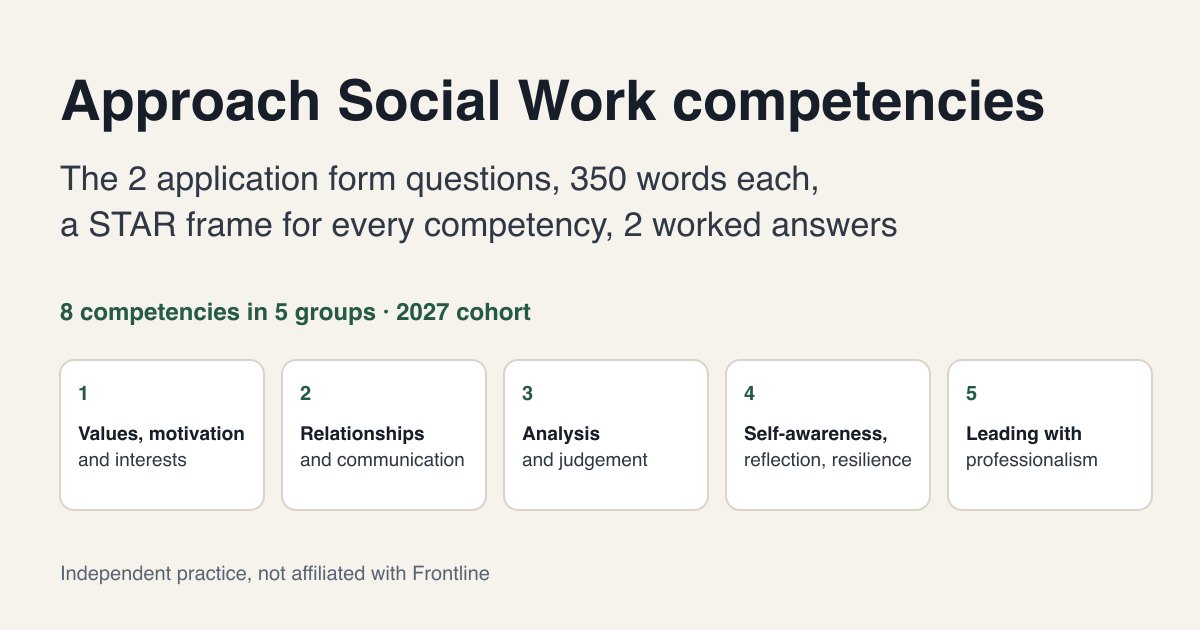
The Approach Social Work competencies are the eight qualities Frontline assesses at every stage of its application, grouped under five headings: values, motivation and interests; relationships and communication; analysis and judgement; self-awareness, reflection and resilience; and leading with professionalism. The application form tests two of them directly, with two questions of up to 350 words each: one on your values, motivation and interests, and one on leadership.
This guide lists every competency under Frontline’s own name, sets out both form questions and what each must cover, gives an original STAR frame for each of the eight competencies, and gives two complete worked example answers, one for each question, with a note on what every paragraph proves. Frontline’s own model answers are written for a fictional finance job at Frontline; the two below answer the actual Approach Social Work questions.
ProSyllabus is independent practice, not affiliated with Frontline or Approach Social Work. The STAR frames and the two example answers on this page are our own, written for fictional applicants; Frontline has not made, checked or endorsed them.
Frontline: competencies page and applicants page, read 8 Nov 2026.
Key facts: competencies and the application form
| Item | Detail |
|---|---|
| Programme | Approach Social Work (formerly the Frontline programme): Frontline’s fully funded three-year route into children’s social work in England, for the 2027 cohort |
| Competencies | 8 competencies in 5 groups, assessed at every stage: application form, online test and assessment centre |
| Also assessed | Time management and professional conduct, throughout the process |
| Form questions | 2 competency-based questions: Values, motivation and interests; Leadership |
| Word limit | 350 words for each answer; Frontline encourages you to use most of it |
| Who reads it | A screener trained in social work, who sees only your two answers: not your name, personal details or work history |
| When it is read | Only after a successful online test result. The test invite follows the form, and you have 7 days from receiving it |
| Scoring | Each stage has a score threshold based on previous seasons; the official pages we read give no thresholds or marking scheme |
| Your own work | Frontline can withdraw an application at any stage if answers were copied or written with AI software |
| Official pages | thefrontline.org.uk: Competencies, Approach Social Work applicants, Recruitment and admissions policy |
The 8 competencies, under Frontline’s names
These are the five groups and eight competencies exactly as Frontline names them on its competencies page for the 2027 cohort. The right-hand column is our short summary of what Frontline says each one means; read the full wording on Frontline’s competencies page before you write anything, as Frontline itself asks.
| Group | Competency | What it means (our summary) |
|---|---|---|
| Values, motivation and interests | Values, motivation and interests | A realistic, researched view of children’s social care; wanting to help children and families with fairness and dignity; curiosity about people and systems and a belief that they can change; commitment to learning, academic study and personal development |
| Relationships and communication | Empathy with professional boundaries | Respecting people’s perspectives and feelings; compassion without judgement or loss of objectivity; understanding why boundaries matter and keeping them |
| Relationships and communication | Clear, respectful and adaptive communication | Clear, respectful speaking and writing; adapting tone and style to the person and situation; staying calm, non-judgemental and purposeful when challenged |
| Analysis and judgement | Analytical thinking and curiosity | Seeking information and asking clarifying questions before deciding; spotting patterns, inconsistencies, risks and gaps; curiosity about context and other explanations |
| Analysis and judgement | Judgement and decision making under uncertainty and pressure | Timely, appropriate decisions when things are ambiguous or pressured; knowing the limits of your knowledge; balancing risks and escalating concerns |
| Self-awareness, reflection and resilience | Self‑awareness and reflexivity | Seeing how your experiences, identity and values shape how you see others; noticing your impact, bias and blind spots; changing after new information or feedback |
| Self-awareness, reflection and resilience | Emotional resilience and seeking help | A realistic view of the emotional pressure of social work; managing your emotions and persevering; asking for help rather than struggling alone |
| Leading with professionalism | Leadership | Respecting people’s time, following through on commitments and taking accountability; respectfully challenging assumptions, bias and unfairness; promoting fairness, safety and dignity; collaborating and influencing others |
On top of the eight, Frontline’s “What we’re looking for” page says it looks for evidence of how you manage your time and of your professional conduct throughout the process: quickly grasping complex tasks or concepts, planning ahead to meet deadlines, and professionalism in how you present, communicate and relate to others. In practice that starts with the form: submitted on time, checked, and answering the question asked (What we’re looking for).
Old list or new? Why other pages show different competencies
If you have seen a list of seven Frontline competencies elsewhere, it matches an older, shorter list. Frontline’s recruitment and admissions policy (version 2025.01, applicable from August 2025) lists seven: motivation, self-awareness, resilience, effective communication, empathy and relationships, analysis and adaptability, and leadership. Its website now uses the five groups and eight competencies above, and the policy itself points to the website for the details. Prepare against the website version. If you read advice written for the seven, this is the closest match in the current list (our approximate comparison; the older names were broader, so some spread across several current competencies):
| Older name (policy 2025.01) | Closest current competency (our comparison) |
|---|---|
| Motivation | Values, motivation and interests |
| Empathy and relationships | Empathy with professional boundaries |
| Effective communication | Clear, respectful and adaptive communication |
| Analysis and adaptability | Analytical thinking and curiosity; Judgement and decision making under uncertainty and pressure |
| Self-awareness | Self‑awareness and reflexivity |
| Resilience | Emotional resilience and seeking help |
| Leadership | Leadership (under Leading with professionalism) |
Two things the current wording names explicitly, and the seven short names do not, are worth writing towards: professional boundaries (empathy alone is not the whole competency) and seeking help (resilience includes asking for support). The PCF (Professional Capabilities Framework) is the profession-owned framework for social work education and development in England, published by BASW; Frontline’s policy says its competencies map directly to it and that applicants must meet its domains at entry level to be offered a place (recruitment and admissions policy, BASW PCF).
FreeTests: Verbal reasoning · Relationships and communication
Approach Social Work Online Test Practice: free sample
Answer 4 questions against the clock, like the real exam. You then see the right answer, the reason and your time on each. About 8 minutes · free · no sign-in.
4 questions to answer▶ Start nowThis one is free · no sign-in neededYour result shows how long each question took you.The two application form questions
Frontline sets out both questions on its applicants page, the page you reach after registering. In our words, each question and the three things Frontline says your answer should include:
| Question | What you are asked | Your answer should include |
|---|---|---|
| 1. Values, motivation and interests (350 words) | What has motivated you to apply for Approach Social Work | (a) why you want to be a child and family social worker; (b) why Approach Social Work is the right route into social work for you; (c) how societal issues, such as inequality, have influenced your decision |
| 2. Leadership (350 words) | A time you showed leadership by taking action or speaking up to improve a situation. Frontline frames it around social workers taking responsibility, working well with others and speaking up for children and families | (a) what you did; (b) what impact it had; (c) how it could translate to advocating for children and families as a social worker |
Four rules from Frontline shape how you write them (Approach Social Work applicants page):
- Your answers are read on their own. The screener sees only your two answers, not your work experience section, so any experience you rely on must be in the answer itself.
- The screening is blind. If you pass the online test, a screener trained in social work reads your answers without your personal details or work experience, to avoid bias.
- Use the word count. Frontline encourages you to make the most of the 350 words to answer fully. Write in a document first, check spelling and grammar, ask someone to read it, then paste it in.
- Tailor it. Answer the questions asked, and do not paste an answer from another application. For the leadership question, Frontline suggests STAR and asks you to write “I”, not “we”.
Frontline’s policy adds one more: everything you submit must be your own, not copied from another person and not created with AI software, and Frontline can withdraw an application at any stage if it finds otherwise. The examples on this page show structure. Copying them, or having a tool write yours, puts your application at risk.
How to plan answer 1: values, motivation and interests
This question is not a STAR question; it asks why, not what happened. Frontline’s guidance is to think about why social work and Approach Social Work are right for you, backed by experience (work, personal or voluntary) or values, and its commentary on its model answers says the “why this organisation” part can often be overlooked. One frame that covers all three required parts in 350 words, with our suggested word budget (an answer led by values and researched reasons, rather than one story, can work as well):
| Part | What to write | Required part it covers |
|---|---|---|
| Spark (about 100 words) | One real experience, or a value you can show in action, that explains why children’s social work, told briefly and specifically | (a) why child and family social work |
| Society (about 70 words) | One social issue you have seen up close (poverty, housing, racism, disability, care experience) and how it shapes the families you want to work with | (c) societal issues |
| Route (about 90 words) | Two or three features of Approach Social Work and why each suits how you learn: say what they mean for you, not just what they are | (b) why Approach Social Work |
| Realism (about 70 words) | That you understand the hard parts (emotional strain, uncertainty, pressure) and one sign you can handle them | Shows the “realistic understanding” in the competency |
| Close (about 20 words) | One sentence that ties back to children and families | Ending on the child |
Facts you can build the “route” part on, from Frontline’s own pages: in year one you train in a practice hub of typically five participants, managed and supervised by a consultant social worker; you complete over 200 days of on-the-job training in a local authority, including a contrasting learning experience in adults’ social care, alongside nearly 50 days of academic teaching; you gain a Postgraduate Diploma and register as a social worker at the end of year one; and you work towards a master’s degree in years two and three. Use only what genuinely matters to you, and check the details on Frontline’s help centre; see also our guide to how the programme works.
Worked example 1: values, motivation and interests
Example answer 1: a teaching assistant applying for Approach Social Work
For two years I was a teaching assistant in a primary school. One Year 4 pupil I supported, whom I will call J, often arrived late and hungry after his family moved between temporary addresses. The school could offer breakfast and patience, but could not resolve the housing problems itself. When a social worker began working with the family, I watched that change start. She spent time with J’s mother, listened before advising and helped the family get support with their housing. By the end of term J was arriving on time and joining in. I want to do that work: helping families make changes themselves, so that children can grow up safely at home wherever possible.
J’s story also showed me that hardship is not shared evenly. Many families at our school were coping with low pay, insecure housing and long waits for help, and I saw how easily that stress could be mistaken for not caring about their children. I want to be a social worker who understands that context, assesses concerns carefully, is honest with families and treats them with dignity.
Approach Social Work is the right route for me because I learn best by doing and reflecting. Training in a practice hub of around five participants, led by a consultant social worker, would let me work with children and families from my first year while being closely supervised and supported by peers. Combining academic teaching with supervised practice means I can test theory against what I see each week, and continuing to a master’s degree fits my commitment to keep learning after I qualify.
I know the work is emotionally demanding and that decisions are often made without the full picture. When a pupil disclosed something worrying to me, I passed it straight to our safeguarding lead and talked it through with her afterwards, and I now use supervision to debrief after hard days. That taught me to follow procedure, use supervision and look after my own wellbeing. I want to bring that to every child and family I work with.
345 words. What each part shows:
- Paragraph 1 (spark): answers part (a) with one specific story, not “I have always wanted to help”. It shows what the social worker did, which is evidence of a realistic understanding of the work. The pupil is not named; in your own answer, also leave out details (school, town, family circumstances that stand out) that could identify a child or family.
- Paragraph 2 (society): answers part (c). It names the issue (poverty and housing), links it to how families are judged, and lands on the competency’s fairness and dignity.
- Paragraph 3 (route): answers part (b) with three real features of the programme, each tied to a reason (“I learn best by doing”). This is the part Frontline says can often be overlooked.
- Paragraph 4 (realism): shows a realistic view of the emotional load, prompt reporting of a concern, using supervision and a simple habit for wellbeing, which previews the resilience and judgement competencies.
Written by us for a fictional applicant; not a Frontline answer and not marked by Frontline. Use it for structure; your experiences and words must be your own.
- 3 practice tests of 20 questions
- Verbal reasoning: True / False / Cannot say and comprehension
- Social-work SJT scenarios: most and least likely responses
- Every answer explained
- Your result by area
How to plan answer 2: leadership
Frontline suggests the STAR method for this question and asks you to describe the situation, the action you took, what happened, what you learnt, and how it translates to social work. That last part is not in plain STAR, so treat it as a fifth step. Our suggested word budget:
| Step | What to write | Frontline’s required part |
|---|---|---|
| Situation (about 50 words) | Where you were and what was wrong or unfair, in two or three sentences | Context |
| Task (about 30 words) | Why it fell to you, and what you set out to change | Context |
| Action (about 140 words) | What you did, in “I”: who you spoke to, how you made the case, how you brought others in, what you did yourself, how you followed through | (a) what you did |
| Result (about 60 words) | What changed and for whom, with a number if you have one, and what you learnt | (b) what impact this had |
| Translate (about 60 words) | How the same behaviour would help you advocate for children and families | (c) how it translates to advocacy |
Choose the story with the clearest personal action, impact and link to advocacy. A strong option is a time you spoke up for someone with less power than you, because it maps straight onto “advocating for children and families” and onto the competency’s wording about challenging bias or unfairness respectfully. A formal leadership title is not needed, and an event you organised can also work if it shows accountability, collaboration and influence.
Worked example 2: leadership
Example answer 2: a leisure centre worker applying for Approach Social Work
Situation. While working part time on reception at a leisure centre, I noticed that children from a nearby hostel for refugee families kept losing their places in swimming lessons. Bookings and reminders were online and in English only, and two missed sessions meant the place was withdrawn.
Task. I was not a manager, but I was often the person these parents spoke to, so I decided to find out why the children were missing sessions and try to fix it.
Action. First I asked. With my manager’s agreement, the hostel’s support worker arranged for me to meet four parents who were happy to talk. Several had changed phone numbers when they moved rooms, so reminders never reached them, and the ones that did were in English. I wrote a one-page proposal: a paper booking form, reminders translated through the hostel’s volunteer translators, and a named contact before any place was withdrawn. My manager was worried about the extra work, so I offered to run it for one term and report back using the centre’s own booking records. She agreed, and I ran the pilot. When one instructor called the children “unreliable”, I explained that reminders had not been reaching families and asked him to tell me before removing anyone.
Result. Nine of the twelve children finished the term, compared with three the term before, and my manager adopted the named-contact rule for every family. I learnt that my first assumption, that the families had lost interest, was wrong, and that asking before acting changed everything.
Translate. As a social worker I would meet the same pattern: families judged by systems not built for them. I would listen first, challenge unfair assumptions respectfully, bring others with me, and keep following up agreed actions until they make a difference for the child.
300 words. What each part shows:
- Situation and task: short, and the task is personal (“I decided”) without a title. It shows taking accountability, the first part of Frontline’s leadership description.
- Action: the longest part, all in “I”. It shows asking before acting (analytical thinking and curiosity), working with the hostel and the manager (collaborating and influencing), handling a concern about workload, and respectfully challenging the instructor’s assumption.
- Result: a number (9 of 12, against 3), a change the manager adopted, and an honest reflection on a wrong first assumption, which also shows self-awareness.
- Translate: answers Frontline’s third required part explicitly, linking the story to advocacy for children and families.
Written by us for a fictional applicant; not a Frontline answer and not marked by Frontline. Use it for structure; your experiences and words must be your own.
FreeTests: Verbal reasoning · Relationships and communication
Approach Social Work Online Test Practice: free sample
Answer 4 questions against the clock, like the real exam. You then see the right answer, the reason and your time on each. About 8 minutes · free · no sign-in.
4 questions to answer▶ Start nowThis one is free · no sign-in neededYour result shows how long each question took you.A STAR frame for every competency
The form asks about only two competencies, but Frontline assesses all eight at every stage and tells applicants to think of examples from work, voluntary or life experience for each one. At the assessment centre, it says, each competency is assessed in multiple activities, and the interview questions are linked to the competencies. So build one example per competency now; STAR is our suggested way to prepare them. Each frame below is ours: a prompt for the kind of story that fits, the STAR steps to cover, how to link it to social work, and a common pitfall.
1. Values, motivation and interests (Values, motivation and interests)
- What assessors look for (our summary of Frontline’s description): That you have researched children’s social care and see the work realistically, want to help children and families fairly and with dignity, are curious about people and systems and believe they can change, and are committed to study and learning.
- S, Situation: A moment that showed you something true about children’s social care: volunteering, a job, a talk by a social worker, your own or your family’s experience of services, or serious reading.
- T, Task: What you wanted to understand or do about it.
- A, Action: How you found out more: who you spoke to, what you read or attended, what you did next. Name one thing that surprised you or was harder than you expected.
- R, Result: What you now understand about the work, including its hard parts, and what you have done to test that this is the career for you.
- Then translate: Why that leads to child and family social work, and to this route, rather than to a nearby job such as teaching or youth work.
- Trap: “I have always wanted to help people.” It shows no research and no realism. Replace it with one specific thing you saw or learned.
2. Empathy with professional boundaries (Relationships and communication)
- What assessors look for (our summary of Frontline’s description): That you respect other people’s views and feelings, show compassion without judging and without losing objectivity, and understand why professional boundaries matter.
- S, Situation: Someone who was upset, struggling or leaning on you: a customer, a pupil, a mentee, a resident, a service user, a colleague.
- T, Task: Support them well while staying inside your role.
- A, Action: How you listened and acknowledged what they felt; what you said about the limits of what you could do; where you signposted or referred them.
- R, Result: They got the right help from the right person, and your relationship stayed professional.
- Then translate: Social workers support families through crises while keeping the boundaries that make the relationship safe and fair.
- Trap: The “above and beyond” story where you gave someone your personal number outside your role, lent them money or promised to keep a worrying secret. To an assessor, that is a crossed boundary, not empathy.
3. Clear, respectful and adaptive communication (Relationships and communication)
- What assessors look for (our summary of Frontline’s description): That you speak and write clearly and respectfully, change your tone and style for different people and situations, and stay calm, non-judgemental and purposeful when someone challenges you.
- S, Situation: A time you had to explain something complicated or unwelcome, to more than one kind of audience, or to someone who was angry with you.
- T, Task: Get the message understood without damaging the relationship.
- A, Action: What you changed for each audience (words, format, timing, an interpreter, a written follow-up), and how you kept calm when challenged.
- R, Result: Evidence that it was understood: what the person did next, or what changed.
- Then translate: Social workers explain the same concern to a parent, a child, a teacher and a court, and each needs it differently.
- Trap: Describing only what you said. The competency is about how you adapted, so show the change.
4. Analytical thinking and curiosity (Analysis and judgement)
- What assessors look for (our summary of Frontline’s description): That you look for relevant information and ask clarifying questions before deciding, spot patterns, inconsistencies, risks and gaps, and stay curious about context and other explanations.
- S, Situation: A problem where the first explanation turned out to be wrong or incomplete: falling attendance, a complaint, data that did not add up, a person whose behaviour changed.
- T, Task: Find out what was really going on before acting.
- A, Action: The questions you asked, the information you gathered, the pattern or inconsistency you noticed, and the alternative explanation you checked.
- R, Result: What you found, and how that changed the action taken.
- Then translate: Assessments of children’s needs depend on asking “what else could explain this?” before deciding.
- Trap: Jumping straight to your solution. If the story has no question in it, it is not evidence of curiosity. (Where someone may be at risk, asking questions never delays telling the right person.)
5. Judgement and decision making under uncertainty and pressure (Analysis and judgement)
- What assessors look for (our summary of Frontline’s description): That you make timely, sensible decisions when things are unclear or pressured, know the limits of your own knowledge, weigh competing risks, and escalate concerns appropriately.
- S, Situation: A decision you had to take quickly with incomplete information: a safety worry at work, a clash of deadlines, an incident on a shift or a trip.
- T, Task: Act in time without overreaching.
- A, Action: The options and risks you weighed, what you did yourself, and who you escalated to and when.
- R, Result: The outcome, and what you would do the same or differently.
- Then translate: Trainee social workers make some decisions and escalate others, often the same day; knowing which is which keeps children safe.
- Trap: Two opposite traps: the lone hero who solved everything without telling anyone, and the story where you never decided anything yourself. Show what you did within your role and when you escalated; sometimes the right action is to refer at once, and saying why is the evidence.
6. Self‑awareness and reflexivity (Self-awareness, reflection and resilience)
- What assessors look for (our summary of Frontline’s description): That you see how your own experiences, identity and values shape how you see others, understand your effect on people, notice bias or blind spots, and change your behaviour after new information or feedback.
- S, Situation: Feedback that stung, or a moment when you realised an assumption came from your own background.
- T, Task: Understand the assumption or the effect you were having.
- A, Action: What you noticed, how you checked it (asking, listening, reading), and what you changed.
- R, Result: The difference the change made, and how you now watch for the same blind spot.
- Then translate: Social workers meet families whose lives differ from their own; noticing your own lens is part of judging fairly.
- Trap: The fake weakness (“I care too much”). Pick something real and show the change.
7. Emotional resilience and seeking help (Self-awareness, reflection and resilience)
- What assessors look for (our summary of Frontline’s description): That you understand realistically the emotional strain, pressure and uncertainty of social work, can manage your emotions and keep going, and ask for help at the right time rather than struggling alone.
- S, Situation: A period of sustained difficulty: a demanding job or caring role, a distressing incident, study alongside work, a setback.
- T, Task: Keep going and keep doing the job well.
- A, Action: What you did to manage your emotions, what support you asked for and from whom, and when you asked.
- R, Result: How it turned out, and what you now do earlier.
- Then translate: Supervision and peer support are built into social work because the work is hard; using them well is a skill.
- Trap: “I never get stressed”, or presenting coping alone as a strength. A story about a past burnout can work if it shows what you learned, the help you sought and what you now do earlier.
8. Leadership (Leading with professionalism)
- What assessors look for (our summary of Frontline’s description): That you respect people’s time, follow through and take responsibility, challenge assumptions, bias or unfairness respectfully, promote fairness, safety and dignity, and work with and influence others to get good outcomes.
- S, Situation: A time you noticed something unfair or not working and did something about it. You do not need a title: a volunteer, a student or a junior colleague can lead.
- T, Task: Improve the situation, often for someone with less power than you.
- A, Action: Who you spoke to and how you made the case, who you brought with you, what you did yourself, and how you followed it through.
- R, Result: What changed, for whom, with a number if you have one.
- Then translate: Frontline asks this one in writing: how it could translate to advocating for children and families as a social worker.
- Trap: “We” all the way through. Frontline asks for “I”, because it wants your part.
One story can cover more than one competency (worked example 2 shows curiosity, influence and self-awareness as well as leadership), but we suggest different stories for the two form answers, and a spare for each competency before the assessment centre. Interview questions and model interview answers are in our Frontline interview questions guide; the role play and written exercise are in our Frontline assessment centre guide.
Where each competency is tested
Frontline says the competencies are assessed throughout the process. It identifies the competencies the form questions target; the official pages we read do not explain how each later activity is scored, so the last column is our reading of where each competency is most visible:
| Stage | What Frontline says | Most visible (our reading) |
|---|---|---|
| Application form | Two competency questions: Values, motivation and interests; Leadership | Values, motivation and interests; Leadership; written communication |
| Online test | Verbal reasoning and situational judgement in social-work scenarios; most and least likely responses | Analytical thinking; judgement under uncertainty; empathy with boundaries in the scenarios |
| Assessment centre: interview | A competency-based interview about your past experiences, with a social worker and a care-experienced young person | All eight; your STAR examples |
| Assessment centre: role play | How you interact with others, handle challenge and guide the conversation to positive outcomes | Communication; empathy with boundaries; judgement |
| Assessment centre: written exercise | A written task, one of three activities on the day | Analysis; clear written communication |
| Throughout | Time management and professional conduct | Deadlines met, emails answered, professional manner |
The test is the stage that decides whether your form is read: our Approach Social Work online test guide covers its format and has free practice questions.
Your competency evidence bank
Common mistakes on the application form
- Answering two of the three required parts. Each question has three; Frontline says the “why this route” part can often be overlooked.
- Relying on your CV. The screener sees only the two answers, so “as shown in my work history” proves nothing.
- Writing “we”. Frontline wants your part, so write “I” and say what you did.
- Pasting an answer from another application, or one an AI tool wrote. Frontline asks for tailored answers and can withdraw applications built from copied or AI-written text.
- Leaving words unused. A very short answer can leave a required part or the evidence underdeveloped; Frontline encourages you to make the most of the word count.
- Telling a leadership story with no clear personal action or impact. Whatever the story, say what you did, what changed and how it links to advocating for children and families.
- Identifying real children or families. Leave out names and any detail that could identify them, as you would as a social worker.
- Submitting with errors. Written communication is part of the job, and Frontline asks you to check spelling and grammar.
After you submit the form
Frontline sends the online test invite once you submit the form, and you have 7 days from receiving it. If your test result is successful, a screener reviews your two answers. Each stage has a score threshold that Frontline sets from previous seasons, and Frontline also uses contextual recruitment: if you agree to share background information at registration, such as socio-economic background, it is taken into account when your performance is assessed. Applicants who pass are asked to upload eligibility documents and may be invited to a virtual assessment centre, with an outcome within 10 working days of the assessment centre date.
You can apply only once in each recruitment cycle, and Frontline gives feedback only to applicants who reach the assessment centre. So take your time over the two answers: there is no second attempt this cycle. Applications for the 2027 cohort opened on 28 September 2026 and run on a rolling basis: locations close as they fill, though Frontline says some stay open into December and some reopen in February. If you are not ready yet, see how the programme works and our Approach Social Work practice page.
The next stage after the form: the online test
Once you submit the application form, Frontline sends the online test invite, and you have 7 days from receiving it. Frontline reads your two answers only if your test result is successful, so the test decides whether your form is seen at all. Our Approach Social Work Online Test Practice has three full practice tests in the two question types Frontline describes: verbal reasoning passages and social-work scenarios answered as most likely and least likely. Every answer is explained, and the result shows how you did on verbal reasoning and on each competency group (our practice feedback, not Frontline’s scoring or a prediction).
Independent practice, written by us; not made or endorsed by Frontline. Do Frontline’s own practice questions at the start of the real test too.
FreeTests: Verbal reasoning · Relationships and communication
Approach Social Work Online Test Practice: free sample
Answer 4 questions against the clock, like the real exam. You then see the right answer, the reason and your time on each. About 8 minutes · free · no sign-in.
4 questions to answer▶ Start nowThis one is free · no sign-in neededYour result shows how long each question took you.Frequently asked questions
What are the Approach Social Work competencies?
Frontline lists eight competencies in five groups: Values, motivation and interests; Relationships and communication (Empathy with professional boundaries; Clear, respectful and adaptive communication); Analysis and judgement (Analytical thinking and curiosity; Judgement and decision making under uncertainty and pressure); Self-awareness, reflection and resilience (Self‑awareness and reflexivity; Emotional resilience and seeking help); and Leading with professionalism (Leadership). It also looks for time management and professional conduct.
What questions are on the Approach Social Work application form?
Two competency questions of up to 350 words each. The first, on values, motivation and interests, asks what motivated you to apply: why you want to be a child and family social worker, why Approach Social Work is the right route for you, and how societal issues such as inequality influenced your decision. The second, on leadership, asks for a time you took action or spoke up to improve a situation: what you did, its impact, and how it could translate to advocating for children and families.
How many words are the Frontline application questions?
350 words for each of the two competency questions. Frontline encourages applicants to make the most of the word count.
Are there Frontline competency examples or model answers?
Frontline’s applicants page links two model answers written for a fictional finance role at Frontline, to show structure. This page has two worked examples for the actual Approach Social Work questions and a STAR frame for each competency, all written by us for fictional applicants. Use them for structure only: your answers must be your own.
Should I use the STAR method for Approach Social Work?
Frontline suggests STAR (situation, task, action, result) for the leadership question, plus what you learnt and how it translates to social work. The values and motivation question is about why you want to do the work, so a why-focused structure fits it better.
What are the social work competencies in England?
For social work in England the overarching framework is the Professional Capabilities Framework (PCF), profession-owned and published by the British Association of Social Workers, with nine domains from values and ethics to professionalism and levels from point of entry to training upwards. Frontline’s policy says its competencies map directly to the PCF and that applicants must meet its domains at entry level to be offered a place.
Why do some pages list seven Frontline competencies?
Frontline’s recruitment and admissions policy (version 2025.01) lists seven short names: motivation, self-awareness, resilience, effective communication, empathy and relationships, analysis and adaptability, and leadership. Its website now lists eight competencies in five groups, and names professional boundaries and seeking help explicitly. Prepare against the website version.
Who reads my application form?
If your online test result is successful, a screener trained in social work reads your two competency answers without seeing your personal details or work experience. They see only the two answers.
Can I use ChatGPT or AI to write my Frontline application?
No. Frontline’s recruitment and admissions policy says everything you submit must be your own and not created with AI software, and that it can withdraw an application at any stage where it finds plagiarised or AI-created content.
When is the Approach Social Work application deadline?
There is no single deadline. Applications for the 2027 cohort opened on 28 September 2026 and run on a rolling basis; locations close as they reach capacity, and Frontline says some locations stay open into December and some reopen in February. Frontline recommends applying as early as you can.
How long after the application does Frontline reply?
The online test invite arrives after you submit the form, and you have 7 days from receiving it. Frontline reviews your form after a successful test result; the official pages we read give no timescale for that review. After an assessment centre, you hear within 10 working days.
What is the Frontline application portal?
After you register, Frontline sends a link to its applicant portal: the page with the application process, the two form questions, tips for each stage and drop-in sessions with the recruitment team.
Can I reapply if my application is unsuccessful?
Not in the same cycle. Frontline accepts one application per recruitment cycle, so you would wait until applications open again the following autumn. It gives feedback only to applicants who reach the assessment centre stage.
Do I need social work experience to apply?
No. Frontline says you do not need particular experience. It advises looking at the competencies and thinking of examples from your work, voluntary or life experience.
More in this series
- Approach Social Work online test 2027: free verbal reasoning + SJT practice
- Approach Social Work 2027: how the programme works, locations and who can apply
- Frontline assessment centre: written exercise, role play and interview explained
- Frontline interview questions and answers
- Frontline bursary and salary 2027: what you are paid each year
Sources
- official — Frontline: Approach Social Work competencies (five groups, eight competencies, full descriptions)
- official — Frontline: What we’re looking for (competencies, time management and professional conduct, eligibility)
- official — Frontline: Approach Social Work applicants page (the two application form questions, 350 words each, screening, tips, model answers)
- official — Frontline: Approach Social Work, Application process (five stages)
- official — Frontline: Approach Social Work help centre (dates, one application per cycle, feedback, locations, online test)
- official — Frontline: Recruitment and admissions policy (version 2025.01): score thresholds, contextual recruitment, PCF, plagiarism and AI
- official — Frontline: Assessment centre tips (competencies in every activity)
- official — BASW: Professional Capabilities Framework (nine domains, point of entry to training)
official = a document published by the conducting body. reported = a news or coaching site we could not check against an original. Where sources disagree this page says so rather than picking one.


