
Checked 7 October 2026. The scheme is from Advertisement No. 02/2024 (para 4), the DSSSB I-T-T 200-marks syllabus page and the Question Bank pages. DSSSB "reserves the right to change or amend the examination scheme any time before the examination", so a new TGT advertisement could differ. The Annexure-III normalisation formula is image-only in the PDF and is not reproduced here.
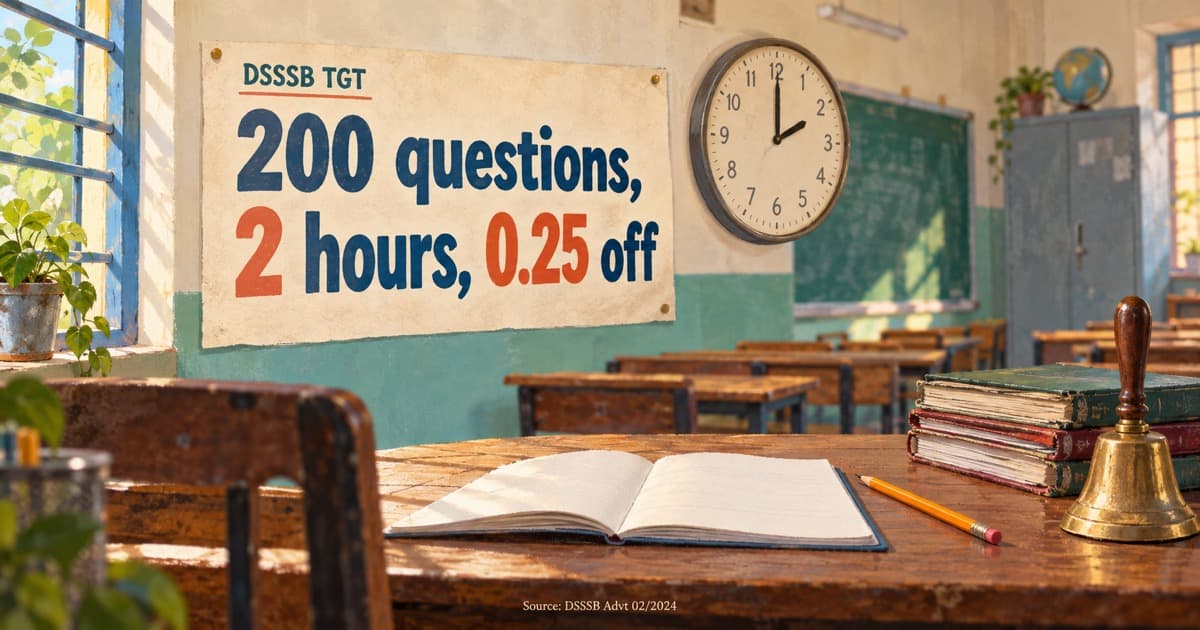
DSSSB TGT is one online paper: 200 multiple-choice questions, 200 marks, 2 hours, with a deduction of 0.25 for every wrong answer. That is the "One Tier (Technical / Teaching)" scheme, exam code I-T-T, printed in Advertisement No. 02/2024 for post codes 803/24 to 811/24. It has two sections of 100 marks each. Section A is the same general paper every DSSSB combined exam uses: five areas of 20 marks each. Section B is the subject paper, with questions on the subject concerned and on teaching methodology. The part that surprises most candidates is the qualifying rule: the minimum qualifying marks apply only to Section B, while the merit list is made on the combined 200.
All four are printed in the advertisement (paras 4 and 6); only the 36 seconds is our arithmetic.
ProSyllabus is an independent study site. We are not affiliated with, or endorsed by, the Delhi Subordinate Services Selection Board, the Directorate of Education or the New Delhi Municipal Council. Every rule below is quoted or summarised from their published documents, and every sum or ratio is labelled as our own arithmetic. We print no candidate names or roll numbers.
The scheme at a glance
The advertisement prints the scheme in a single table and nine numbered notes, (i) to (ix), beneath it. Every figure below is quoted from there unless marked as ours.
| Item | What the advertisement says |
|---|---|
| Exam code and name | IT-T, One Tier (Technical / Teaching); applies to post codes 803/24 to 811/24 |
| Mode | Computer Based Examination; draft answer keys displayed afterwards, online objections allowed within a time limit |
| Duration | 2 hours |
| Questions and marks | 200 MCQs of one mark each, 200 marks in all |
| Section A | General Awareness, General Intelligence and Reasoning, Arithmetical and Numerical Ability, Test of Hindi Language and Comprehension, Test of English Language and Comprehension: 100 marks (20 each) |
| Section B | MCQs from the subject concerned including questions on teaching methodology / B.Ed.: 100 marks |
| Language | Bilingual (Hindi and English), except the language papers, which are in the language concerned only |
| Negative marking | 0.25 mark for each wrong MCQ |
| Evaluation | On the cumulative marks of Section A and Section B |
| Re-evaluation | None; no re-checking of answer scripts |
| Invalid questions | Not evaluated; marks prorated out of the maximum |
| Centres | Delhi and NCR only |
Two details connect to results you can check. The post preference paragraph says candidates choose departments only at the e-dossier stage, which is why the exam itself carries no department choice. And "Skill Test / Endurance Test will be taken as per requirement of job" is listed in the scheme but, for the TGT posts, no result notice we read calls a skill or physical test; the notices go straight from the Tier-I marks to the e-dossier and preference form, covered in the result guide.
Section A: the general paper, area by area
DSSSB's I-T-T syllabus page describes each Section A area in a sentence or two. The table copies the substance of that official page; it is a list of areas the Board names, not a list of everything that can appear.
| Area | Marks | What DSSSB lists |
|---|---|---|
| General Awareness | 20 | Awareness of the environment and its application to society; current events and everyday observation; History, Polity, Constitution, Sports, Art and Culture, Geography, Economics, Everyday Science, Scientific Research, national and international organisations and institutions |
| General Intelligence and Reasoning Ability | 20 | Analogy, Classification, Series, Coding-Decoding, Blood Relations, Direction Sense, Logical Venn Diagrams, Alphabet Test, Sitting Arrangements, Mathematical Operations, Arithmetical Reasoning, missing character, Ranking and Time Sequence, Eligibility Test, Syllogism, Statement and Arguments, Assumptions, Courses of Action, Conclusions, Assertion and Reason, Cause and Effect, Analytical Reasoning |
| Arithmetical and Numerical Ability | 20 | Number Systems, Simplification, Decimals, Fractions, Data Interpretation, LCM, HCF, Ratio and Proportion, Percentage, Average, Profit and Loss, Discount, Simple and Compound Interest, Mensuration, Time and Work, Time and Distance, Tables and Graphs, Pie, Line and Bar charts, Venn Diagrams |
| English Language and Comprehension | 20 | Understanding and comprehension of English; Vocabulary, Grammar, Sentence Structure, Synonyms, Antonyms and correct usage |
| Hindi Language and Comprehension | 20 | Understanding and comprehension of Hindi; Vocabulary, Grammar, Sentence Structure, Synonyms, Antonyms and correct usage |
Section A is the same across DSSSB's one-tier teaching and technical papers, so previous Section A papers of DSSSB's one-tier teaching and technical posts are legitimate practice for it (other DSSSB schemes, such as the general one-tier paper, are laid out differently). It is also where a subject specialist loses marks he or she should not: 100 marks of reasoning, arithmetic, awareness and two languages for a candidate who has spent three years on a degree subject. The marks are not qualifying (see below), but they count in the total of 200, and the cut-off tables in the result guide show that the last selected general-category candidate in the Directorate of Education scored between 80.47 and 158.82 of 200, depending on the post code.
Section B: what is actually written down
The official line is short: "MCQs of one mark each from the subject concerned including questions on teaching methodology." The I-T-T syllabus page describes the section as "MCQs pertaining to Graduation qualification and Teaching Methodology required for the post". DSSSB publishes no unit-wise topic list for Section B for these post codes, and we have not invented one. What you can say from the documents is the following.
The subject is the graduation subject. The eligibility column of each post says what the subject is: Mathematics, English, Social Science (history, political science, economics, business studies, sociology, geography or psychology as the main subject), Natural Science (physics, chemistry, biology, botany or zoology), or a language (Hindi, Sanskrit, Urdu, Punjabi). DSSSB's syllabus page ties the section to the graduation qualification, which is a degree-level anchor even though the posts teach school classes. Teaching methodology and B.Ed. is named in the scheme, so some of the 100 marks are on pedagogy; how many is not stated. The language papers are in their own language. The scheme says the questions are bilingual "except for the Language papers which will be in the language concerned only", which governs Section B for Hindi, Sanskrit, Urdu and Punjabi.
Because the weight of pedagogy is unstated, the sensible preparation is to treat Section B as a degree-level subject paper with a pedagogy component, to work the pedagogy from your B.Ed. syllabus, and to use the official question papers that DSSSB publishes to see the proportion for yourself (next section). A coaching page that gives a unit-by-unit Section B syllabus for TGT is giving you its own list, not DSSSB's.
Qualifying marks: the rule that changed
Where other pages get this wrong
For post codes 803/24 to 811/24 the minimum qualifying marks apply only to Section B, not to Section A and Section B separately.
Commonly published instead: That a TGT candidate must qualify in both Section A and Section B separately, as an older DSSSB notice said.
DSSSB's notice of 28 July 2017 on the TGT scheme said a candidate "must have to qualify in Section A and B separately" and that merit would be on the aggregate. Advertisement 02/2024 replaces that for these posts: "There will not be any minimum qualifying marks in Section-A. However, combined aggregate marks of both Section-A and Section-B will be reckoned for preparing the final merit list." The 2017 notice is still on the Board's scheme page, which is why the two versions both circulate.
| Point | 28 July 2017 notice | Advertisement 02/2024 |
|---|---|---|
| Sections | A: 100 questions, 100 marks. B: 100 questions, 100 marks | A: 100 marks (five areas x 20). B: 100 marks. 200 MCQs |
| Duration | 2 hours | 2 hours |
| Qualifying marks | Separately in A and B, by category | Section B only; no minimum in Section A |
| Merit | Aggregate of A and B | Cumulative marks of A and B (combined 200) |
| Negative marking | Not stated in the notice | 0.25 per wrong MCQ |
The qualifying percentages are in the advertisement: General and EWS 40 per cent, OBC (Delhi) 35 per cent, SC, ST and PwBD 30 per cent, with ex-servicemen given a 5 per cent relaxation in their category subject to a minimum of 30 per cent. DSSSB also reserves the right to prescribe a higher minimum cut-off for any post "as per availability of candidates", and adds that selection cut-offs "may go higher". Applying the percentage to Section B's 100 marks gives 40, 35 or 30 marks (our reading; the advertisement does not spell out the base). Remember this is a floor on Section B alone, not on the total: a total can look comfortable and still fail if Section B is below 40, 35 or 30. (For scale, the lowest last-selected general-category total in any result, 80.47 of 200, sat above 40 per cent of 200, but that figure does not replace the Section B floor.)
| Category | Qualifying % | Section B marks (our reading, of 100) |
|---|---|---|
| General and EWS | 40 | 40 |
| OBC (Delhi) | 35 | 35 |
| SC, ST, PwBD | 30 | 30 |
| Ex-servicemen | 5 points below own category, minimum 30 | General 35, OBC 30, SC/ST/PwBD 30 |
Marking, normalisation, objections and tie-breaks
Negative marking is 0.25. A wrong answer costs a quarter of what a right one earns, so a blind guess among four options has an expected value of +0.0625 mark (our arithmetic: 0.25 x 1 minus 0.75 x 0.25). That is positive but tiny; the real gain comes only when you can rule out one or two options. Normalisation. The advertisement says computer-based scores "will be normalized (if required)" by the formula in DSSSB's notice of 11 July 2018 (its Annexure-III, which is image-only in the PDF), and normalised scores determine merit. The Mathematics and Drawing Teacher notices use the word "normalized" in their cut-offs; the Urdu notices say "prorated". Objections. Draft answer keys are displayed after the exam and online objections are accepted within a time limit; the Board's decision is final and there is no re-evaluation. Invalid questions are not evaluated and marks are prorated. Tie-breaks. Equal marks in the same category are broken by the higher Section B marks, then by seniority in age, then alphabetically by first name.
Previous papers: what DSSSB itself publishes
DSSSB runs a "Question Bank Online Exam" section with one page per year, 2018 to 2025, where it posts downloadable question papers of past online exams. We swept those pages on 7 October 2026. By our count of file titles the 2018 page carries 26 TGT papers (Hindi, Bengali, Mathematics, Natural Science, Punjabi and Social Science, in several shifts), the 2021 page carries TGT Computer Science (five files) and a TGT Special Education Teacher paper of 8 August 2021, the 2023 page carries a TGT Computer Science paper of 24 June 2023, and the 2024 and 2025 pages listed no files. We found no TGT English, Sanskrit or Urdu paper and no paper from the 2024 advertisement's own sittings.
| Question Bank page | TGT papers (our count of titles) | Subjects seen |
|---|---|---|
| 2018 | 26 | Hindi, Bengali, Mathematics, Natural Science, Punjabi, Social Science |
| 2019 | 0 found | Many posts listed; no title with TGT |
| 2021 | 6 | Computer Science (5 files), Special Education Teacher (8 August 2021, Shift 2) |
| 2022 | 0 found | None |
| 2023 | 1 | Computer Science, post code 39/22, 24 June 2023, Shift 2 |
| 2024 and 2025 | 0 (no files listed) | None |
Use these papers for style, difficulty and the proportion of pedagogy in Section B, and treat the 2018 papers as older: they pre-date Advertisement 02/2024 and probably follow the earlier TGT scheme of the 2017 notice, which required separate qualification in both sections (check each paper's own structure). Coaching sites sell "DSSSB TGT previous year papers" for the 2024-advertisement exams; DSSSB has not posted those, so what they sell is recalled questions, not the official paper. Candidates can raise objections on the draft key during the Board's window, and that is the only official look at a live paper.
How to split your time (our suggestion, not DSSSB's)
Section B is half the marks and the only section with a floor, so it deserves the larger share. The table is an illustration for a 20-hour week, built from the marks, not from any official guidance; shift it toward whichever area your mock scores show is weak. Arithmetic and reasoning are the quickest to improve; the two language areas are the slowest.
| Block | Marks | Share of hours (our suggestion) | Hours in a 20-hour week |
|---|---|---|---|
| Section B: subject and pedagogy | 100 | 55% | 11 |
| Arithmetical and Numerical Ability | 20 | 12% | 2.4 |
| Reasoning | 20 | 10% | 2 |
| General Awareness (incl. current events) | 20 | 10% | 2 |
| English | 20 | 6.5% | 1.3 |
| Hindi | 20 | 6.5% | 1.3 |
If you are weighing which subject to take given what the combined examination scheme allows (one subject per application, as the eligibility rules in the eligibility guide show), compare the competition ratios in the vacancy guide with your degree. And if you are working out how many marks a seat took, the cut-offs are in the result guide.
Frequently asked questions
What is the DSSSB TGT exam pattern?
One online computer-based paper of 200 multiple-choice questions, 200 marks, 2 hours. Section A is 100 marks across five general areas of 20 marks each; Section B is 100 marks from the subject concerned including teaching methodology. Negative marking is 0.25 per wrong answer.
Is there negative marking in DSSSB TGT?
Yes. Advertisement 02/2024 says deduction of 0.25 marks will be made for each wrong multiple-choice answer. Unanswered questions score nothing.
Do I need to qualify in both sections?
No, not for post codes 803/24 to 811/24. The minimum qualifying marks apply only to Section B, there is no minimum in Section A, and the merit list uses the combined marks of both. An older 2017 DSSSB notice required qualifying in both, and it no longer governs these posts.
What are the qualifying marks?
General and EWS 40 per cent, OBC (Delhi) 35 per cent, SC, ST and PwBD 30 per cent, with ex-servicemen getting 5 per cent relaxation subject to a 30 per cent floor. DSSSB can set a higher cut-off, and every result notice we read selected candidates far above these floors.
What is the DSSSB TGT syllabus?
Section A: General Awareness, Reasoning, Arithmetical and Numerical Ability, English and Hindi, 20 marks each. Section B: the subject concerned plus teaching methodology. DSSSB does not publish a unit-wise Section B list for these post codes.
Are the questions in Hindi or English?
Bilingual in Hindi and English, except the language papers (Hindi, Sanskrit, Urdu, Punjabi), which are in the language concerned only.
Where can I get DSSSB previous year papers for TGT?
On the Question Bank Online Exam pages of the DSSSB website. By our count they hold 26 TGT papers from 2018, TGT Computer Science and Special Education papers from 2021 and 2023, and nothing listed for 2024 or 2025. There is no official paper from the 2024 advertisement sittings.
Sources
- official — DSSSB: Detailed Advertisement No. 02/2024, Combined Examination 2024 for Trained Graduate Teacher and Drawing Teacher (55 pages; vacancy notice F.1(247)/P&P-I/DSSSB/2024/4386 dated 12.01.2024)
- official — DSSSB: Notice cum corrigendum No. F.4(406)/P&P/DSSSB/2021/Advt/5070-81 dated 19.02.2024 (post preference and merit-cum-preference allocation; no waiting list)
- official — DSSSB: Syllabus I-T-T One Tier (Technical / Teaching) 200 marks, Section-A indicative syllabus page
- official — DSSSB: Section A Indicative Syllabus page
- official — DSSSB: Notice dated 28.07.2017 on the examination scheme for TGT (Section A and B, 100 + 100, qualify separately), on the New Examination and Interview Scheme page
- official — DSSSB: New Examination and Interview Scheme page
- official — DSSSB: Question Bank Online Exam pages (2018 to 2025) with downloadable question papers
- official — DSSSB: Notice No. 1630 dated 01.06.2026, TGT-Maths 803/24 (Tier-I marks, shortlisting, cut-offs)
- official — DSSSB: Notice No. 1548 dated 20.06.2025, TGT Urdu 809/24
- official — DSSSB: Notice No. 1608 dated 02.04.2026, Drawing Teacher 811/24
official = a document published by the conducting body. reported = a news or coaching site we could not check against an original. Where sources disagree this page says so rather than picking one.
More in this series
- DSSSB TGT vacancies by subject, post code and category
- DSSSB TGT eligibility, age limit, B.Ed and CTET
- DSSSB TGT result and cut-off marks by post code
- DSSSB TGT salary, pay level 7 and in-hand
- DSSSB TGT updates and alerts
- DSSSB PRT updates (a different post and advertisement)
- DSSSB PGT updates (a different post and advertisement)
- DSSSB 801/25 Court Attendant (Delhi High Court): pattern and result


