
Checked 30 October 2026. Format and materials as in the American Welding Society's Part B information guide (Rev. 03.01.2024) and Examination User Guide (09.04.2026); clause, table and annex numbers from the Part B Book of Specifications 2017, U.S. customary edition, read on 30 October 2026. Check AWS's CWI page for the edition linked for your exam.
Part B is the practical part of the AWS Certified Welding Inspector (CWI) exam set by the American Welding Society (AWS), and you take it first. It has 46 questions, a 120-minute limit and a pass mark of 72%. It is open book: the book is the Part B Book of Specifications (BOS), a sample code AWS wrote for the exam and publishes as a free PDF. AWS describes it as assessing whether you can evaluate a physical characteristic and make the correct decision against given acceptance criteria or code requirements: you measure or read something (a weld replica, a WPS, a PQR, a welder test record, a photograph) and decide what the BOS says about it. This guide shows how the BOS is laid out, what each tool is for, how to work a decision step by step and where candidates lose marks. ProSyllabus is an independent study site, not part of the American Welding Society.
AWS CWI Part B Practical Examination Information (Rev. 03.01.2024) and Examination User Guide for CWI (09.04.2026), read 23 Oct 2026.
What you are given on the day
AWS's Part B information guide and Examination User Guide list four sets of material, all supplied at the test site. You answer from one or more of them:
| Material | What it is | Can you see it before? |
|---|---|---|
| Part B Book of Specifications (BOS) | A sample code written for the exam, with workmanship and visual acceptance criteria for structural steel, pipeline and pressure piping, plus procedure and welder qualification rules and annexes | Yes: a free PDF from AWS (U.S. customary for exams in the US and Canada, metric elsewhere) |
| Exam Exhibits Booklet | Sample welding documents (WPSs, PQRs, WQTRs) and photographs, including photographs of NDE methods | No: confidential |
| Four-piece plastic weld replica set | A T-joint, a groove weld, bend specimens and a pipe specimen | No: confidential |
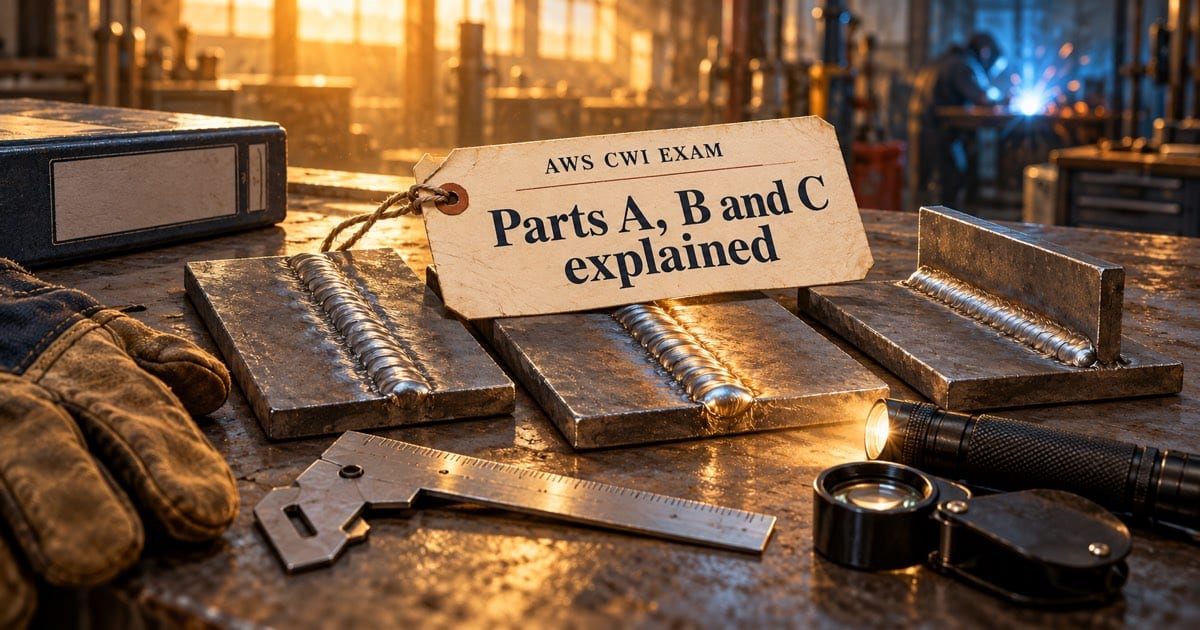
| Inspection tool kit | Fillet weld gauges, V-WAC gauge, dial caliper, ruler, C4.1 gauge, protractor, hi-lo gauge, magnifying glass, mirror, flashlight | AWS sells a sample tool kit |
Part B is a paper-based test at AWS test sites. The Examination User Guide says it runs in three sessions a day at each site, each with a 25-minute check-in window that closes five minutes before the listed approximate start time, and that doors close at the end of check-in: a late candidate is not admitted to another session. You sign a Candidate Attestation Agreement to keep the exam confidential before you start.
- 92 original Part B questions
- Two 46-question mocks, 120 minutes each
- All 5 Part B domains
- Book of Specifications references in the answers
- Every answer explained
- A score by domain
The tool kit
The kit holds fillet weld gauges, a V-WAC gauge, a dial caliper, a ruler, a C4.1 gauge, a protractor, a hi-lo gauge, a magnifying glass, a mirror and a flashlight. The BOS ties some of them to its own clauses: 1.2.1 allows a flashlight, magnifier and mirror as aids when inspecting for cracks and other discontinuities, and 2.2.1 judges cut edges against the AWS C4.1-77 roughness guide, which Annex V describes as both a written standard and a physical gauge for comparing oxyfuel-cut surfaces (Sample 1 the roughest, Sample 4 the smoothest).
The BOS says you are expected to know how to use and apply each instrument in the kit, including how to zero it where relevant. Measuring the plastic replicas is a hands-on skill: practise with a real kit if you can. The BOS also tells you to ignore pinholes, seams, glue and colour variations caused by the plastic moulding.
How the Book of Specifications is laid out
| Part | Covers | Applies to |
|---|---|---|
| Clause 1 | General requirements: scope, shall / should / may, visual inspection aids, dimensional tolerances (1.3) | All three applications, unless otherwise noted (1.1.3) |
| Clause 2 | Structural steel: base metal preparation, workmanship, Table 1 visual acceptance criteria (by statically loaded, cyclically loaded and tubular connections), Tables 2 and 3 weld profiles, fillet weld length and size | Structural steel |
| Clause 3 | Pipeline: workmanship, repairs, and visual acceptance criteria for IP, IPD, IF, burn-through, porosity, cracks, undercut (Table 4) and accumulation of imperfections | Pipeline |
| Clause 4 | Pressure piping: workmanship, repairs and their examination, visual acceptance criteria, reinforcement by design temperature (Table 5) | Pressure piping |
| Clause 5 | Procedure qualification: WPS data (Table 6), thickness limits (Table 7), PQR variables (Table 8), test specimens, bend and tension acceptance | All three applications, unless otherwise noted (1.1.3) |
| Clause 6 | Welder performance qualification: variables, diameter and thickness limits (Tables 9, 10), tests (Tables 11, 12), base metals and filler metals (Tables 13, 14), positions (Table 15), test acceptance | All three applications, unless otherwise noted (1.1.3) |
| Annexes I-III | A-Numbers (weld metal analysis), F-Numbers (electrodes and rods), base metal specifications with M-Numbers, group numbers and minimum strengths | Look-ups for Clauses 5 and 6 |
| Annex IV | Bend specimen preparation | Bend tests |
| Annexes V-VI | Formulas (tensile strength, cross-sectional area), conversions, abbreviations, fraction-decimal table, pipe schedules | Calculations |
| Annexes VII-X | Blank WPS, PQR and WQTR forms, and industry terms (such as high-low, crown, double repair, primary member) | Reading documents |
Two lines in the BOS shape the whole exam. Its foreword warns that it is formatted to look like a real codebook but is not one: read it carefully and do not rely on your memory of codebooks you know. And clause 1.1.4 says both its normative and informative annexes are part of the specification, so a value in an informative annex such as Annex V can be the basis of an answer.
The five Part B domains
AWS CWI Part B Practical Examination Information (Rev. 03.01.2024). Each figure is a minimum.
| Part B domain | Minimum share | Typical decision |
|---|---|---|
| Welding Inspection and Flaws | 34% | Accept or reject a discontinuity on a replica or in a narrative under Clause 2, 3 or 4 |
| Procedure and Welder Qualifications | 28% | Is this WPS supported by this PQR? What does this welder's test qualify? |
| Mechanical Test and Properties | 8% | Does a tension or bend specimen pass? Was a bend specimen prepared correctly? |
| NDE | 8% | Which method is shown, which step, which method the BOS requires for a repair |
| Utilization of Specification and Drawings | 8% | Read a tolerance, an annex or a drawing dimension |
Shares are minimums from AWS's Part B information guide. Together they add up to 86% (our arithmetic). At least 28% of the questions concern procedure and welder qualification, on documents and on specimens, so Tables 7, 8, 9, 10 and 15 repay steady practice.
Worked decisions, step by step
Each example below uses our own numbers, the way a Part B question gives you a measurement or a document and asks for the decision. Clause and table numbers are from the BOS 2017 U.S. customary edition.
1. Undercut on a structural weld
- You measure undercut 1/32 in deep on a fillet weld in 1-1/2 in thick plate, in a statically loaded nontubular connection.
- Step 1: find the application and the connection type. Structural steel, so Clause 2 and Table 1; statically loaded nontubular, so the first column.
- Step 2: find the row. Table 1, item (7)(A): for material 1 in thick or more, undercut may not exceed 1/16 in.
- Decision: accept. 1/32 in is less than 1/16 in. The same undercut on a primary member of a cyclically loaded connection, with the weld transverse to tensile stress, would be judged under item (7)(B) against 0.01 in, and rejected.
2. Undercut on a pipeline weld: "whichever is smaller"
- A pipeline weld joins pipe with a 0.200 in wall. You measure external undercut 1/32 in deep and 1-1/2 in long; the weld is 40 in around.
- Step 1: Table 4 compares depth with a fixed value and with a percentage of the wall, and uses whichever is smaller. 12.5% of 0.200 in = 0.025 in, which is smaller than 1/32 in (about 0.031 in); 6% of 0.200 in = 0.012 in, smaller than 1/64 in (about 0.0156 in).
- Step 2: 1/32 in (0.031 in) is over 0.025 in, so it falls in the top row of Table 4.
- Decision: reject, at any length. On a thicker wall the same undercut could have fallen in the middle row, where length decides.
3. A PQR's thickness range
- A SMAW groove PQR was welded in 5/8 in plate, with no single pass over 1/2 in, no PWHT and no fracture toughness requirement; the contractor wants to weld 1-1/8 in plate on a WPS it supports.
- Step 1: Table 7, the row for test weldments over 3/8 in but less than 3/4 in: the base metal range is 3/16 in to 2T.
- Step 2: 2 x 5/8 in = 1-1/4 in. Notes (d) and (e) would cut the maximum to 1.1T, and note (c) would raise the minimum for fracture toughness work, but none applies here.
- Decision: the thickness is supported, since 1-1/8 in is inside 3/16 in to 1-1/4 in, provided the WPS meets every other Table 8 variable.
4. What a welder's test position covers
- A welder passed a 2G plate groove test. Production needs a vertical fillet weld and a horizontal groove weld in 30 in OD pipe.
- Step 1: Table 15, plate groove 2G: groove F and H for plate and pipe over 24 in OD; fillet F and H.
- Step 2: the horizontal groove in 30 in pipe is covered (pipe over 24 in OD, position H). The vertical fillet is not: 2G gives fillets F and H only.
- Decision: the groove weld position is covered (provided the welder meets the other 6.2 limits); the vertical fillet is not.
- 92 original Part B questions
- Two 46-question mocks, 120 minutes each
- All 5 Part B domains
- Book of Specifications references in the answers
- Every answer explained
- A score by domain
Traps that cost marks
- The wrong application. Undercut, porosity and reinforcement limits differ between Clause 2 (structural), Clause 3 (pipeline) and Clause 4 (pressure piping). Read the question for the application before you open a table.
- The wrong column of Table 1. Several structural limits apply only to statically loaded, or only to cyclically loaded and tubular, connections. Check the column before the value.
- "Whichever is smaller" or "whichever is less". Table 4 (pipeline undercut), 3.2.4 (burn-through), 4.1.5 (interrupting a preheated joint), 4.1.9.3 (repair depth), 5.4.1 and 6.4.1 (undercut on test welds) all compare two limits. Work out both.
- The thinner material. Pressure piping reinforcement (Table 5, note 3) is based on the thinner of the materials joined; a pipeline pore limit (3.2.5) is 25% of the thinner wall.
- Tolerances that do not apply. The fractional tolerances of 1.3.2 apply to weld length and pitch (2.4.1) but not to fillet weld size (2.4.2); clause 1.3 also excludes test specimens and discontinuity limits. Undersize allowances for fillets are in Table 1, item (6).
- Procedure rules versus welder rules. A change that needs a new PQR (Table 8) is not the same list as a change that needs the welder to retest (6.2). A change in shielding gas composition is a Table 8 variable but not a 6.2 welder variable (6.2 lists only the deletion of root shielding gas, for GMAW and GTAW).
- "Q" and "T" in Table 8. Variables marked T apply only when fracture toughness testing is required. A heat input increase, for example, is a T variable (and Table 8 excepts it when a grain-refining austenitizing heat treatment follows welding).
- Fractions and decimals. Many limits are fractions and many readings decimals. Annex V Table 18 gives the equivalents, cut to three places: 1/64 in (0.015625 in) is listed as .015 there.
Pacing 46 questions in 120 minutes
120 minutes for 46 questions is about 2 minutes 37 seconds each (our arithmetic). Our suggestion: measuring a replica usually takes longer than looking up a table, so answer the look-ups quickly, mark any measurement you are unsure of, and come back to it. Read every option before you choose: the BOS instructions say there is only one correct answer, so check that your choice uses the right table, row and column. Transfer each answer to the correct place on the answer sheet, as the BOS reminds you, and keep calculations to the margins of your exam booklet: the BOS itself must not be written on.
How to prepare for Part B
- Download the Book of Specifications for your exam (U.S. customary for the US and Canada) and learn where every table is. You cannot write in the exam copy, so the layout has to be in your head.
- Work through Tables 7, 8, 9, 10 and 15 with your own examples until a range or a position takes you under a minute.
- Practise the decision on documents: read a WPS, a PQR and a welder test record together and say what each supports.
- If you can, handle a real tool kit: zero the dial caliper, read the V-WAC gauge, use the fillet gauge on convex and concave welds.
- Time yourself: 46 questions in 120 minutes, then review every answer against the BOS clause.
- AWS also runs a three-day Part B seminar (Book of Specifications review, WPS and PQR analysis, tools and replicas, a timed practice exam); its exam-plus-training price is on the CWI page.
Try a Part B-style question
Practice question · Part B style · Welding inspection and flaws
A drawing specifies a continuous 1/4 in fillet weld. Over part of its length you measure 3/16 in. Under BOS Table 1, may it stay without correction?
- A. Yes: 1/4 in may be up to 3/32 in under size (5/32 in minimum).
- B. Yes, but only if the undersized stretch is at one end.
- C. No: a 1/4 in weld may be only 1/32 in under size, so 7/32 in is the minimum.
- D. No: fillet weld size is a minimum, so no part of it may be under 1/4 in.
Show the answer and why
Answer: A.
BOS Table 1, item (6): for a specified nominal size L of 1/4 in, the allowable decrease U is up to 3/32 in, so 1/4 - 3/32 = 5/32 in is the smallest acceptable size. 3/16 in (6/32 in) is larger than 5/32 in, so no correction is needed.
An original ProSyllabus practice question, answered from the free Part B Book of Specifications 2017. It is not an AWS exam question.
Frequently asked questions
How many questions are on CWI Part B?
AWS's Part B information guide says 46, with a maximum of 120 minutes and 72% needed to pass. The questions are mostly multiple choice.
Is CWI Part B open book?
Yes. The reference is the Part B Book of Specifications, supplied at the test site and available as a free PDF from AWS. You also get an exhibits booklet, a plastic weld replica set and an inspection tool kit.
Can I see the Part B exhibits and replicas before the exam?
No. AWS says the exhibits booklet and the replica set are confidential. The Book of Specifications is free to download, and AWS sells a sample tool kit.
Which Book of Specifications should I use?
The one AWS links for your exam: the U.S. customary edition for English exams in the United States and Canada, and the metric edition for exams elsewhere. The U.S. customary BOS PDF we read on 30 October 2026 is dated 2017.
Do I take Part B before Part A and Part C?
Yes. AWS's Examination User Guide requires Part B first; Parts A and C can be scheduled at Prometric only after you receive the Part B confirmation letter.
Is the Book of Specifications the same as AWS D1.1?
No. It is a sample code written for the exam, covering structural steel, pipeline and pressure piping. Some clauses look like real codes, but the BOS itself warns you not to rely on memory of them.
How many questions must I get right to pass Part B?
72% of 46 is 33.12, and AWS reports scores to the nearest lower whole percent, so you need 34 correct: 33 is 71.7%, reported as 71% (our arithmetic).
More in this series
Sources
- official — AWS: CWI Part B Practical Examination Information: materials, domains, 46 questions, 120 minutes
- official — AWS: CWI Examination User Guide: order of the parts, Part C codebook policy, passing score, retests, renewal
- official — AWS: CWI Part B Practical Book of Specifications (BOS) 2017, U.S. customary edition (free PDF, read 30 Oct 2026): every clause, table and annex number cited in the Part B guide
- official — AWS: CWI Part B Book of Specifications, metric edition (free PDF) for exams outside the US and Canada
- official — AWS: "Certified Welding Inspector (CWI) Program" page (read 23 Oct 2026): eligibility, exam parts, Part C code books, fees, renewal and recertification
official = a document published by the conducting body. reported = a news or coaching site we could not check against an original. Where sources disagree this page says so rather than picking one.


