Checked 12 October 2026. The marks scheme is the June 2026 NTA bulletin. The December 2026 bulletin has not been verified. CSIR-HRDG labels the older Life Sciences file "up to the June 2026 cycle" and posts a revised merged file; its 13 January 2026 notice says the joint exam is intended from December 2026. Confirm final pattern and applicability in that cycle's bulletin.
The CSIR NET syllabus is not in NTA's bulletin and NTA does not send it to you: CSIR-HRDG keeps one PDF per subject and the bulletin points there. The June 2026 bulletin says, in section 3.6 and in Annexure I, that the syllabus and scheme "may be seen at CSIR HRDG website" and that NTA "will not provide the copy of syllabus to individual candidates". This page is a map to those official PDFs: what each one contains, how it is organised, the marks scheme for every part and the Life Sciences change. It does not paste the syllabus; the PDFs are three to sixteen pages each and you should read them in full.
Sources: CSIR-HRDG syllabus pages (checked 6 October 2026) and the NTA bulletin of June 2026, chapter 3.
The official syllabus PDFs, one by one
Open the syllabus page on CSIR-HRDG and each subject has its own page and file. The table lists them with the number of pages and the structure we found by reading each PDF.
| Subject | Official PDF | Pages | How it is organised | Parts B and C |
|---|---|---|---|---|
| Chemical Sciences | chemical_science_syllabus.pdf | 3 | Inorganic (12 numbered topics), Physical (14), Organic (13) and Interdisciplinary topics (5) | One list; no separate Part B and Part C syllabus |
| Earth, Atmospheric, Ocean and Planetary Sciences | earth_science_syllabus.pdf | 9 | Part B: five numbered sections. Part C: Geology (10 sub-headings), Physical Geography (5), Geophysics (10), Meteorology (10) and Ocean Sciences (4) | Separate: the PDF has "PAPER I (PART B)" and "PAPER I (PART C)" |
| Life Sciences (to the June 2026 cycle) | LS_Sylbs_29Jan2026.pdf | 11 | 13 units, each with lettered points | One list |
| Life Sciences and Biotechnology (revised) | Merged_Syllabus_CSIR-DBT_21Jan2026.pdf | 16 | 14 units, titled "UGC-CSIR-DBT NET", each with lettered points | One list |
| Mathematical Sciences | mathmeticascience_syllbus.pdf | 4 | Four units | Titled "common syllabus for Part B and C" |
| Physical Sciences | physicalscience_syllbus.pdf | 3 | The PDF's own "Part A (Core)": six sections (I to VI). Its "Part B (Advanced)": nine sections (I to IX) | Exam Part B is drawn from the PDF's Core part; exam Part C from Advanced and Core (HRDG scheme page) |
Direct links: Chemical Sciences · Earth, Atmospheric, Ocean and Planetary Sciences · Life Sciences, up to the June 2026 cycle · Life Sciences and Biotechnology, revised · Mathematical Sciences · Physical Sciences. The subject pages with the exam scheme are Chemical, Earth, Life, Mathematical and Physical.
Marks, questions and negative marking for every part
The June 2026 bulletin (chapter 3.2) gives each subject a scheme of three parts. The table reads: questions printed, the maximum you may attempt (only the first that many are evaluated), marks for a correct answer and the penalty. The last column is our sum of attempts times marks for the three parts, which equals 200 in every subject.
| Subject | Part A (common) | Part B | Part C | Maximum marks (our sum) |
|---|---|---|---|---|
| Chemical Sciences (701) | 20 questions, attempt 15; +2 / -0.5 (30 marks) | 40 questions, attempt 35; +2 / -0.5 (70 marks) | 60 questions, attempt 25; +4 / -1 (100 marks) | 200 |
| Earth, Atmospheric, Ocean and Planetary Sciences (702) | 20 questions, attempt 15; +2 / -0.5 (30 marks) | 50 questions, attempt 35; +2 / -0.5 (70 marks) | 80 questions, attempt 25; +4 / -1.32 (100 marks) | 200 |
| Life Sciences (703) | 20 questions, attempt 15; +2 / -0.5 (30 marks) | 50 questions, attempt 35; +2 / -0.5 (70 marks) | 75 questions, attempt 25; +4 / -1 (100 marks) | 200 |
| Mathematical Sciences (704) | 20 questions, attempt 15; +2 / -0.5 (30 marks) | 40 questions, attempt 25; +3 / -0.75 (75 marks) | 60 questions, attempt 20; +4.75 / no negative (95 marks) | 200 |
| Physical Sciences (705) | 20 questions, attempt 15; +2 / -0.5 (30 marks) | 25 questions, attempt 20; +3.5 / -0.875 (70 marks) | 30 questions, attempt 20; +5 / -1.25 (100 marks) | 200 |
Part A is common to all subjects and "shall contain questions pertaining to General Aptitude with emphasis on logical reasoning, graphical analysis, analytical and numerical ability, quantitative comparison, series formation, puzzles etc.", in the bulletin's words. Part B holds "subject-related conventional multiple-choice questions, generally covering the topics given in the syllabus". Part C holds "higher order questions" of an analytical nature. Our analysis of what Part A actually asked is in the Part A guide of this series.
Part A is 30 marks in all five subjects. Source: NTA bulletin, June 2026, chapter 3.2; sums are ours.
What the PDFs do with Part B and Part C
- Chemical Sciences and Life Sciences: one list each. The PDFs do not separate Part B from Part C.
- Mathematical Sciences: the PDF is titled "common syllabus for Part B and C".
- Earth Sciences: separate "Paper I (Part B)" and "Paper I (Part C)" sections.
- Physical Sciences: a Core part and an Advanced part; the scheme page says exam Part B comes from Core and exam Part C from Advanced and Core.
- What separates Part B from Part C in the bulletin is the kind of question: conventional MCQs against higher-order, analytical ones.
Read from the six syllabus PDFs and the bulletin of June 2026, chapter 3.2, on 6 October 2026.
Chemical Sciences
The Chemical Sciences PDF has three pages and four blocks: Inorganic Chemistry with 12 numbered topics (from chemical periodicity to nuclear chemistry), Physical Chemistry with 14 (from basic quantum mechanics to data analysis), Organic Chemistry with 13 (from IUPAC nomenclature to structure determination by spectroscopy) and five interdisciplinary topics (nanoscience, catalysis and green chemistry, medicinal chemistry, supramolecular chemistry, environmental chemistry). The scheme page says the pattern is the revised one from June 2017: 60 questions in Part C, of which 25 are attempted at 4 marks each.
Earth, Atmospheric, Ocean and Planetary Sciences
This is the longest of the older PDFs (nine pages) and the only one with an explicit split. "Paper I (Part B)" has five sections: the Earth and the solar system; Earth materials, surface features and processes; the interior of the Earth, deformation and tectonics; oceans and atmosphere; and environmental Earth sciences. "Paper I (Part C)" runs through five areas: Geology, Physical Geography, Geophysics, Meteorology and Ocean Sciences. Part C of this subject carries a heavier penalty: the bulletin gives 1.32 marks off for a wrong answer, "negative marking for part C is @ 33%". It had the highest UR JRF cut-off of the five subjects in June 2025, December 2025 and June 2026. It was not the highest in June 2024 or December 2024 (Life Sciences printed a percentile in those cycles and in several before, so older comparisons are not like for like); the cut-off guide in this series has every cycle.
Life Sciences, and the merger with Biotechnology
The CSIR-HRDG Life Sciences page lists two files: "Syllabus up to Exam cycle June 2026" (13 units) and "Syllabus (Revised)", titled "UGC-CSIR-DBT National Eligibility Test (NET)" with 14 units. We opened both complete PDFs and CSIR-HRDG's 13 January 2026 merger notice on 12 October 2026. The notice says the joint examination is intended to start with the December 2026 cycle, says fellowships are not reduced on account of the merged syllabus, and promises enough optional questions for both traditional Life Sciences and Biotechnology backgrounds. That is an official intention, not a December information bulletin or a guaranteed new question pattern. The June 2026 bulletin still lists Life Sciences (703) with its own then-current pattern.
| Unit number | Syllabus up to the June 2026 cycle (13 units) | Revised merged syllabus (14 units) |
|---|---|---|
| 1 | Molecules and their Interaction Relevant to Biology | Structure and Function of Biomolecules |
| 2 | Cellular Organization | Cellular Organization |
| 3 | Fundamental Processes | Fundamental Processes |
| 4 | Cell Communication and Cell Signaling | Cell Communication and Cell Signaling |
| 5 | Developmental Biology | Developmental Biology |
| 6 | System Physiology - Plant | System Physiology - Plant |
| 7 | System Physiology - Animal | System Physiology - Animal |
| 8 | Inheritance Biology | Inheritance Biology |
| 9 | Diversity of Life Forms | Evolution and Diversity of Life Forms |
| 10 | Ecological Principles | Ecology and Behavioural Biology |
| 11 | Evolution and Behavior | Bioinformatics and Computational Biology |
| 12 | Applied Biology | Biochemical Engineering and Industrial Biotechnology |
| 13 | Methods in Biology | Advances in Biotechnology |
| 14 | (no unit 14) | Methods in Biology |
Read the table immediately above as two lists placed side by side by number, not as a mapping of equal topics. In particular, old unit 11 Evolution and Behavior does not turn into new unit 11 Bioinformatics. Units 1 to 8 broadly carry over, but unit 1 is renamed and subtopics can change. The later units are reorganised; three additional stand-alone headings cover bioinformatics, biochemical engineering and advances in biotechnology. Some of their concepts existed under older Applied Biology or Methods headings, while others need fresh study. The June 2026 marks table above is historical. CSIR has not supplied a verified December 2026 pattern in the sources used here.
Life Sciences 2026: a real 13-to-14-unit crosswalk
A number-for-number comparison is a common revision trap. For example, moving a notebook labelled “Evolution and Behavior” into a folder called “Bioinformatics” because both carry the number 11 would hide both the evolution work you still need and the computational work you have not done. The crosswalk below instead follows concepts across the two official PDFs. It is our reading of the headings and subheadings, so use the PDFs for the complete examinable scope.
| Earlier preparation area | Where to look in the revised PDF | Revision decision |
|---|---|---|
| Old 1–8 | New 1–8, in broadly the same order | Keep your foundation notes, then compare each subheading. New unit 1 is titled Structure and Function of Biomolecules; new unit 2 explicitly includes microbial physiology. |
| Old 9 Diversity of Life Forms + old 11 Evolution and Behavior | New 9 Evolution and Diversity of Life Forms; new 10 Ecology and Behavioural Biology | Move evolution with diversity, and behaviour with ecology. Do not infer a missing topic from a changed heading. |
| Old 10 Ecological Principles | New 10 Ecology and Behavioural Biology | Refile population, community and ecosystem notes; inspect the revised act/policy and behavioural ecology subheads separately. |
| Old 12 Applied Biology | New 12 Biochemical Engineering and Industrial Biotechnology; new 13 Advances in Biotechnology, with related topics also elsewhere | Check each application against the full PDF. Biotechnology is reorganised and expanded; an old Applied Biology notebook is not a complete substitute. |
| Old 13 Methods in Biology | New 14 Methods in Biology, plus specialist methods in new 11–13 | Retain core methods, then add the revised omics, statistics, IPR, biosafety and bioethics subheads that your notes omit. |
| No stand-alone earlier unit headed Bioinformatics | New 11 Bioinformatics and Computational Biology | Audit database search, sequence analysis, gene annotation, structure modelling, drug design and systems biology as their own study block. |
The revised title “Evolution and Diversity of Life Forms” combines material that was split between the old Diversity and Evolution units. Behaviour is now named in “Ecology and Behavioural Biology.” Methods still has a familiar core, but the revised unit also names single-cell omics, newer structural methods, statistical ideas and IPR, biosafety and bioethics. The word “same” at unit level never means every subtopic is identical. Audit your actual notes subheading by subheading before discarding or reusing them.
Fourteen units: what to study and one way to practise each
The PDF supplies a syllabus, not a rank order or chapter-wise marks. This table gives its exact revised unit numbering, a short sample of its subtopics and one original practice task per unit. The tasks are ours; they are not copied previous questions, and no row claims a future question count. Keep the official PDF open for the full list, especially when a short phrase in this table covers a large area.
| Unit | Revised unit | Representative scope | One useful practice task |
|---|---|---|---|
| 1 | Biomolecules | Buffers, kinetics, bioenergetics, macromolecular structure and metabolism | Draw one cause-and-effect chain from structure to function; solve an enzyme-kinetics interpretation. |
| 2 | Cellular organisation | Membranes, organelles, chromosomes, cycle and microbial physiology | Explain a transport or organelle experiment and identify the control. |
| 3 | Fundamental processes | Replication, RNA, translation, regulation and repair | Map a mutation or inhibitor to the step it changes. |
| 4 | Cell signalling | Receptors, pathways, immunity and cancer-related signalling | Trace a perturbation from receptor to measurable output. |
| 5 | Developmental biology | Developmental principles and organismal examples | Separate fate, specification and experimental evidence in a diagram. |
| 6 | Plant physiology | Water, photosynthesis, nutrients, growth and stress | Interpret a plant response curve rather than memorising a list. |
| 7 | Animal physiology | Organ systems and regulation | Track feedback after a change in an input variable. |
| 8 | Inheritance biology | Mendelian and non-Mendelian inheritance, mapping and population genetics | Work a cross or linkage example, then state assumptions. |
| 9 | Evolution and diversity | Classification, phylogeny, evolution and diversity | Build a small cladogram and explain the character evidence. |
| 10 | Ecology and behaviour | Populations, communities, conservation and behavioural ecology | Distinguish proximate from ultimate causes in a behaviour example. |
| 11 | Bioinformatics | BLAST/FASTA, alignments, annotation, modelling, drug design and systems biology | Compare an alignment score with biological interpretation; note database limits. |
| 12 | Biochemical engineering | Balances, bioreactors, fermentation, downstream processing and scale-up | Set up a material balance before inserting numbers. |
| 13 | Advances in biotechnology | Recombinant DNA, medical, animal, agriculture, marine and environmental biotechnology | Link a technique to the decision it supports and its control. |
| 14 | Methods in biology | Molecular/biophysical methods, omics, imaging, statistics, IPR and ethics | Choose a method for a research question and describe the evidence it cannot provide. |
The three biotechnology blocks need different kinds of revision
Unit 11 is computational. It names sequence databases, BLAST and FASTA, pairwise and multiple alignments, gene annotation, phylogenetics, protein structure prediction including AI-based methods, drug design and systems biology. A useful diagnostic is to explain what an alignment establishes, what it merely suggests and what experimental result would strengthen a functional claim. Memorising the expansion of BLAST alone does not answer that reasoning problem. In a practice notebook, separate sequence identity, homology, function and structure so you do not treat them as synonyms.
Unit 12 is process and engineering. It explicitly includes introductory calculus and linear algebra, material and energy balances, transport, thermodynamics in biological systems, batch and continuous growth, bioreactors, mass transfer, fermentation, enzyme immobilisation, downstream purification, plant design and metabolic engineering. A life-science student who has never solved a balance equation should start with a small defined system, mark what enters and leaves, and check units before trying a long bioreactor problem. Conversely, a biotechnology graduate with process coursework may need more of the traditional organismal units. The syllabus does not state a fixed distribution between those backgrounds.
Unit 13 is application and technology: recombinant DNA, medical, animal, agriculture, marine and environmental biotechnology. It includes genome editing, vaccines and diagnostics, organoids, marker-assisted breeding, wastewater treatment and bioremediation. Here a strong answer often connects a tool to a purpose and a limitation. For example, a marker helps track an inherited region under stated assumptions; it is not itself proof that a plant has the desired phenotype. Make a two-column sheet of “method” and “claim it can support,” and add the missing control for each claim.
How to revise across the transition without guessing a weightage
First mark each revised subheading as already studied, partly studied or unfamiliar. A unit title alone is too coarse: you may know classical ecology but not the act and policy subsection of the revised unit 10, or know molecular cloning but not the marine biotechnology subsection of unit 13. Next choose one official older Life Sciences paper to diagnose general Part B/C reasoning, recording every miss by revised unit and by cause: concept, interpretation, method or time. Older papers are useful for these skills, but their distribution reflects the old syllabus and cannot establish December 2026 weightage.
Reserve a separate first pass for the revised-only or expanded subheadings in units 11–13 and 14. Work one explanation and one data or experimental question for each block before increasing speed. Then mix new and familiar topics in timed sets. If your mock shows repeated errors in biomolecules or genetics, do not skip those foundations simply because biotechnology is new. The merger notice promises optional choice to accommodate different backgrounds; it does not publish a reliable topic quota, so an hours planner based on imaginary quotas would mislead you.
A four-week example illustrates the process, not a universal schedule. In week 1, compare your notes with the two PDFs and tag gaps. In week 2, repair two high-impact foundation gaps and learn the basic vocabulary of unit 11. In week 3, practise balances and process flow for unit 12 alongside one older paper. In week 4, study one application in each unit 13 subsection, then run a mixed timed set and review errors. Change that sequence if your diagnostic shows a different weakness. Keep the checklist below as a record of coverage, not a score prediction.
Three questions to ask before buying another course or question bank
- Does it identify whether it follows the 13-unit file or the revised 14-unit CSIR-HRDG PDF?
- Does a “new syllabus” label include actual practice for computational, engineering and applied biotechnology areas, with worked reasoning?
- Does it separate the confirmed June 2026 marks scheme from any unconfirmed December 2026 claims?
The official PDFs are free; a paid resource should add usable explanations, not just rename an old index.
Mathematical Sciences
Four units on four pages, titled as a common syllabus for Part B and Part C. Unit 1 holds analysis and linear algebra; Unit 2 complex analysis, algebra and topology; Unit 3 ordinary and partial differential equations, numerical analysis, calculus of variations, linear integral equations and classical mechanics; Unit 4 probability and statistics. This subject also differs in marking: Part B and Part C carry 3 and 4.75 marks, Part C questions may have one or more correct options with credit only for identifying all of them, and Part C has no negative marking.
Physical Sciences
The PDF has two blocks and uses its own letters. "Part A (Core)" has six sections: mathematical methods of physics, classical mechanics, electromagnetic theory, quantum mechanics, thermodynamic and statistical physics, and electronics and experimental methods. "Part B (Advanced)" has nine: the same six at an advanced level, then atomic and molecular physics, condensed matter physics and nuclear and particle physics. Do not confuse these with the exam's Part A, B and C. The CSIR-HRDG scheme page says exam Part B is drawn from the Core part of the syllabus, and exam Part C from the Advanced part and the Core part.
Where the official pages differ
| Topic | General HRDG scheme wording | Subject page and bulletin | Our reading |
|---|---|---|---|
| Part B and C marks of Mathematical Sciences | Part B 70 marks and Part C 100 marks (the wording of most subject pages) | Mathematical Sciences: Part B 75 marks (25 x 3) and Part C 95 marks (20 x 4.75) | Both of the Mathematical Sciences sources agree on 75 and 95; the generic 70 and 100 do not apply to it |
| Subject name | Syllabus page titled "Life Science and Biotechnology" | Bulletin and result sheets: "Life Sciences" (703) | Same subject; the title reflects the merger the revised syllabus is for |
| Chemical Sciences scheme | Page headed "Revised exam scheme from June 2017" | Bulletin chapter 3.2 repeats the same 20 / 40 / 60 questions | No conflict; the page has simply not been retitled |
Turn the map into a checklist
The list below uses only the official unit titles, so each tick means "I have read this block of the PDF and attempted questions on it". Choose your subject and keep the PDF open beside it.
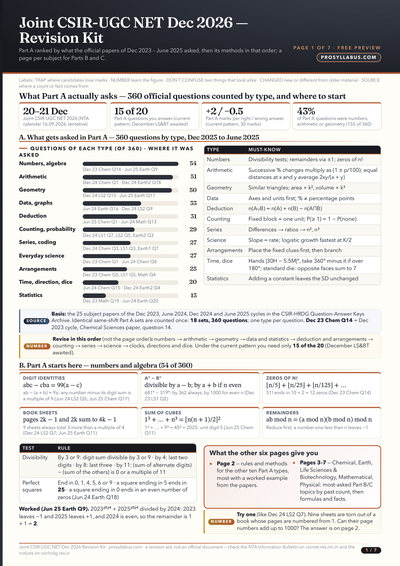
The CSIR revision kit gives each subject one page ranking its units by Part B and C question counts in the official papers; the free first page covers Part A. For practice, three CSIR quizzes are live on ProSyllabus (cell structure and organelles, NMR spectral interpretation and quantum mechanics perturbation theory); there is none yet for Earth or Mathematical Sciences.
Questions
Frequently asked questions
Where is the official CSIR NET syllabus?
On CSIR-HRDG (csirhrdg.res.in), under CSIR-UGC JRF NET Exam, Syllabus. Each of the five subjects has its own PDF. NTA's bulletin points there and does not provide a copy.
Is the syllabus the same for Part B and Part C?
For Chemical Sciences, Life Sciences and Mathematical Sciences the PDF is one list. Earth Sciences has separate Part B and Part C sections. Physical Sciences splits its PDF into Core and Advanced, with Part B from Core and Part C from Advanced and Core.
How many marks is each part?
Part A is 30 marks in every subject. Parts B and C total 170: 70 and 100 in Chemical, Earth, Life and Physical Sciences (Physical gets there with 20 x 3.5 and 20 x 5), and 75 and 95 in Mathematical Sciences.
Is there negative marking?
Yes, 25% of the marks of a question in Parts A, B and C for Chemical, Life and Physical Sciences, 25% in Parts A and B and 33% in Part C (1.32 marks) for Earth Sciences, and none in Part C of Mathematical Sciences.
What changes in the Life Sciences syllabus?
CSIR-HRDG posts a revised 14-unit syllabus and labels the older 13-unit file “up to exam cycle June 2026.” Its 13 January 2026 official notice says a merged CSIR–UGC–DBT examination is intended from December 2026. New stand-alone units cover bioinformatics, biochemical engineering and advances in biotechnology; older topics also move. Confirm final applicability and pattern in the December bulletin.
Does NTA give the syllabus to candidates?
No. The bulletin says NTA will not provide a copy of the syllabus to individual candidates and points to CSIR-HRDG.
Is there a model paper?
Yes. CSIR-HRDG hosts a Part A model paper and Part B and C model papers for each subject on its Model Question Paper page.
ProSyllabus is an independent study site. It is not part of the National Testing Agency (NTA), the Council of Scientific and Industrial Research (CSIR) or the University Grants Commission (UGC). Always confirm on csirnet.nta.nic.in and csirhrdg.res.in.
Sources
- official — CSIR-HRDG: Syllabus page (CSIR-UGC JRF NET Exam), with links to each subject
- official — CSIR-HRDG: Chemical Sciences syllabus (3 pages)
- official — CSIR-HRDG: Earth, Atmospheric, Ocean and Planetary Sciences syllabus (9 pages)
- official — CSIR-HRDG: Life Sciences syllabus "up to Exam cycle June 2026" (11 pages, file dated 29 Jan 2026)
- official — CSIR-HRDG: Life Sciences and Biotechnology "Syllabus (Revised)", UGC-CSIR-DBT NET (16 pages, file dated 21 Jan 2026)
- official — CSIR-HRDG: Mathematical Sciences syllabus (4 pages)
- official — CSIR-HRDG: Physical Sciences syllabus (3 pages)
- official — CSIR-HRDG: Life Sciences and Biotechnology page with exam scheme and both syllabus files
- official — CSIR-HRDG: Model Question Paper page
- official — NTA: Information Bulletin, Joint CSIR-UGC NET June 2026 (pattern s.3.2, syllabus pointer s.3.6, score card s.3.7, result procedure ch.8, Annexure I)
- official — CSIR-HRDG: 13 January 2026 notice on proposed joint CSIR–UGC–DBT JRF-NET from the December 2026 cycle (opened and read 12 October 2026)
official = a document published by the conducting body. reported = a news or coaching site we could not check against an original. Where sources disagree this page says so rather than picking one.


